When it doesn’t rain, plant thistles…

Everyone has been talking recently about how dry it is down here in SE England. A hosepipe ban is due to start soon, London’s first for six years. Dry is and isn’t good for bees. Rain stops them flying (honey bees, anyway – I’ve seen furry bumbles busy foraging in heavy drizzle), but rain also helps plants produce nectar.


(A very happy man juggling bees in the rain, from the Bee Bright website)

So we need the rain, and I kept trying to feel grateful for it as it finally pounded down at the apiary today. But it did stop us shook-swarming – we’re going to try next weekend instead. That might be just as well, because that has given Emma and me time to make up frames in the privacy of our own homes, without an audience of bearded beekeepers snorting with laughter at our hammering skills.


Boots for beekeepers to wear in the rain. I found loads of bee boots at thefind.com/apparel/info-bee-rain-boots!

I asked Pat for advice on whether frames of foundation we’ve had since last summer would be ok for the shook-swarm. The National Bee Unit’s shook-swarm fact sheet says “Make sure that your foundation is ‘fresh’. Old foundation becomes hard and brittle so bees tend to chew it into holes. It can be restored by carefully warming it, which releases oils making it usable again.” I’ve heard before that heating these old foundation sheets with a hairdryer can restore them, but Pat advised doing this had caused them to buckle and bend for him. Instead he advises dipping them in warm water, after which they take about a day to dry out. Beeswax melts at 64C (147F) so the water must be colder than that – think Pat suggested 40C was best which is just slightly above normal hive temperature.

For this “dry” weather, Thames Water has given advice that Mediterranean drought-resistant shrubs and thistles should be planted. Plants that love arid conditions include sea holly, globe thistle and lavender. The great news is that these type of flowers happen to be favourites with bees!

Sea holly

The BBC’s gardening section says: “This attractive sea holly forms clumps of evergreen, soft, deep green heart-shaped leaves. In early summer, the thin wirey stems emerge, set with spiny leaves. The branched stems carry a profusion of small, sea holly flowers in bright, steely blue. This plant prefers full sun and well-drained soil.”


Pic from the Paghat’s Garden blog

Pic from Wikipedia, author Lee Kindness

Globe thistle

From the BBC website: “The prickly, grey-green leaves and powder-blue pompon flowers of this variety of globe thistle make it a striking architectural plant for the back of a summer border. It also works well planted in drifts in a wild garden. The flowers attract large numbers of bees, butterflies and other insects, and can be dried for winter decoration if cut while immature. Lift and divide overcrowded groups in autumn or spring.”


Bees visiting a globe thistle, photo credit Dennis Hinkamp

When it comes to bee flowers, it’s all about the blues.

EDIT: The RSPB blog has done a great post on conserving water with photos of a drought-resistant garden: ‘Water: it’s liquid gold.‘ They suggest catmints and sages (the bees will also love those mints).

Posted in Uncategorized | 8 Comments

8th Honeybee Management revision post: honeybee feeding

8th revision post for the British Beekeeping Association’s Module 1 exam, Honeybee Management, which I’m taking very soon, on 24th March. I’m at 1.14 on the syllabus:

“The Candidate shall be able to give a detailed account of:-

the principles involved in feeding honeybees, including types of feeder, amounts of food, types of food and timing of feeding;

Uh oh. I know that whatever I say here, someone will disagree with me. Feeding is one of those sensitive topics that beekeepers tend to argue over. I will just go through the tips I’ve picked up from the my bees, my books and the Ealing beekeepers and hope I get it right for the BBKA exam judges.

Why feed bees?

    • To try and build the colony up in time to take full advantage of a particular crop, such as oil seed rape or heather.
    • Emergency feeding if the colony is short of stores.
    • To help the bees out if they need to draw comb, for instance if you have hived a swarm or just carried out a shook-swarm.
    • To give certain treatments such as Fumadil B for nosema.
    • To help replace their winter stores if you have harvested their honey supers.

Some beekeepers do not feed their bees and prefer to operate on a ‘survival of the fittest’ approach, leaving an appropriate amount of honey for the bees overwinter but not providing extra food such as sugar syrup or fondant. I think this is probably psychologically easier to do if you have plenty of local forage and plenty of colonies. Our two hives are very precious to me and I would hate to lose them, particularly as they are very gentle bees and seem to overwinter well.

Methods of feeding differ during the year, so I’ll go through them by season, starting with spring.

Spring feeding

Up till carrying out an annual shook-swarm/Bailey comb exchange procedure in late March, I usually have fondant on my hives. Between about November – March in the UK it is generally too cold to give the bees sugar syrup, as they have difficulty processing it whilst the temperature is still cold, and the liquid feed causes them to need to defecate, a bad thing when they are confined in the hive during cold weather.

A shook-swarm involves shaking the entire colony into a new brood box full of fresh foundation. Their old brood combs and the honey stores within the combs are then burned, to ensure that any AFB/EFB/nosema spores are destroyed, along with a load of varroa mites busy reproducing in the brood cells. The process is quite an extreme one, so some beekeepers prefer to use a Bailey comb exchange instead to provide new combs, especially if the colony is a small one. Ensuring that brood comb is replaced annually in these ways is good for the colony’s health. However, immediately after the shook-swarm, the bees need to be provided with 2: 1 ratio sugar syrup, otherwise they will starve on the foundation. The syrup enables them to draw out replacement comb fast. You can usually stop feeding the syrup after 2-3 weeks or so, once they’ve drawn out & filled a good number of brood frames.

Photo of wax building below from the ‘Bee Photographer‘ website, an amazing collection of photos. The caption for this photo says “Bees use 8 to 9 kilos of honey and pollen to produce one kilogram of wax. Wax is produced by eight abdominal glands turning out tiny 0.2 mm specks. The building of 80,000 cells requires 80,000 hours of work and 991,000 specks of wax.”

For general stimulative spring feeding for a colony that hasn’t been shook-swarmed, 1 pound of sugar can be dissolved in 1 pint of hot water to make up a 1:1 ratio syrup mix, which is usually used in spring (rather than the 2:1 sugar-water ratio used in autumn). The weaker solution replicates early nectar coming into flow and encourages the queen to increase her laying. The sugar must be white granulated sugar, never brown which upsets the bees’ digestive systems. I have also been taught to use cane sugar rather than beet, although some beekeepers say beet is fine.

If using a rapid or other type of feeder that sits above the crown board, trickle a small amount of syrup down through the feeder tunnel so the bees know it’s there. As Clive de Bruyn bluntly says in Practical Beekeeping (1997), “Why on earth the honey bee, with 30 million years of collecting its food from flowers, is expected to know that suddenly there is a lake of food on top of the hive is hard to credit.” Flowers have the benefit of scent and colour to attract foragers to them, sugar syrup in the darkness of the hive does not.

Below is a photo of feeding sugar syrup in a Rapid feeder to my bees after shook-swarming them last year. Unfortunately I didn’t cover the other crown board hole up and some of the bees managed to get in the feeder and drowned. I’ve learnt from this to cover up crown board holes and to weigh the feeder lid down with a brick just in case!
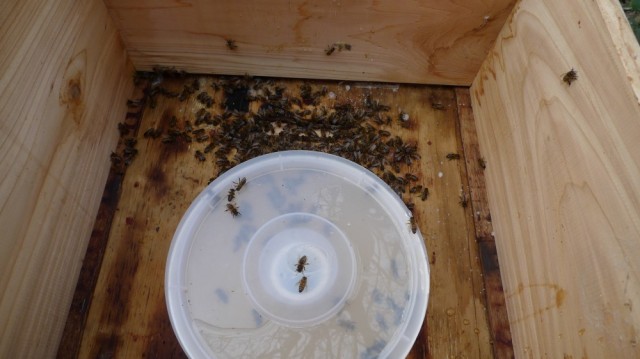
Dead bees in feeder

Summer feeding

Most healthy colonies will not need feeding during the summer. If you have honey supers on which you plan to harvest, feeding is a big no-no as you will end up with sugar syrup stores rather than honey, which you could get into trouble for if you attempted to sell it.

At the end of the summer, once you take supers off to harvest, keep an eye on your colony’s remaining stores. If there is a period of bad weather colonies could starve if they don’t have sufficient stores in their brood area. Make sure small colonies and nuclei have their entrances reduced to the minimum whilst you feed them, in case robbing begins. Only ever provide food inside individual hives, not by leaving honey frames or other food out in the middle of an apiary, which can provoke a robbing frenzy and spread disease.

A captured swarm will benefit from a weak sugar solution, but wait 48 hours, until wax-building and foraging are under way, before feeding. This ensures that any disease contaminated honey brought in the bees’ honey stomachs is used as energy for wax secretion and not stored in the frames.

Autumn feeding

September is the month to begin preparing bees for the winter ahead. At this time of year the colony begins producing bees that will overwinter until the following spring. These winter bees are physiologically different to summer bees. They develop fat bodies which are reservoirs of protein in their abdomen. These fat bodies allow the bees to produce brood food in their hypopharyngeal glands in the late winter and early spring at times when it is too cold to forage or even for the bees to move away from the cluster to reach pollen stores in other parts in the hive.

To ensure that these winter bees have well developed fat bodies, make sure the colony is well provisioned with food to last well into the following spring. The bees will need at least 20kg/40lb of stored honey in the hive (just over one British National hive super’s worth) to survive the winter, especially if there is a wet spring. Protein from pollen is important as well as carbohydrates from nectar; if bees suffer from poor pollen supplies, they age more quickly and will die sooner. My colonies usually seem to have plenty of pollen stores in autumn, but it is something to be aware of and keep an eye on. If you have a garden, putting in suitable (plus pretty!) early and late pollen sources, such as crocuses, hazel and willow for spring and Michaelmas daisies and ivy for autumn, is a good idea.

Photo below from the ‘Bee Photographer‘ website. The caption for this photo says “Pear trees bloom from mid-March to May. The pear flower is not really attractive to bees but its early blooming makes up for its poverty for bees in need of pollen to feed the brood.”

In the last sugar syrup feed of the year, in late September/early October, many Ealing association beekeepers treat against nosema using Fumadil B. Nosema is a parasite that multiples in the gut of adult bees; it has no obvious symptoms but its main effect is to shorten an infected bee’s life by about 50%, so dwindling colonies which are slow to build up may be suffering from it. Fumadil B is a naturally occurring antibiotic which is dissolved into sugar syrup and fed to the colony. You can use a microscope to test a sample of your bees for nosema first to see whether you need to treat or not.

Feed the sugar syrup in the evening, using a stronger 2:1 (e.g. 2lb-1pt) sugar-to-water ratio to help them build up their winter stores, rather than the weaker 1:1 mix recommended in spring. This lower water to sugar ratio takes less effort for the bees to lower the moisture content down to under 20%, ready for storage. Large feeders can be used in the autumn; for instance the Miller or Ashforth type feeders, which hold between two and three gallons. They are efficient in warm conditions and are used to get a large amount of syrup onto the hives in one go.

The Miller feeder sits over the brood box and enables the bees to come up and feed from a central slot.

Winter feeding

Ideally colonies will now have their required minimum 20kg/40lb honey stores, which they will have built up with the help of the sugar syrup and ivy nectar. Sugar syrup feeding should have been finished by early October in Britain, as if syrup is fed too late in the year the bees will have insufficient time to evaporate the excess water, and the syrup will be stored and could ferment, causing digestive problems for the bees when they come to feed on it later.

As a just-in-case precaution, I like to give them a slab of fondant over the crownboard in early December, although it usually won’t be finished until February/March. If the colony was desperately short of food the fondant could be placed directly on the top of the frames with an eke to provide space. Ambrosia fondant is shown below; this is a sucrose, fructose & glucose fondant paste which can be bought in for around £6-£12 for a 2.5kg bag, depending on where you buy it from.
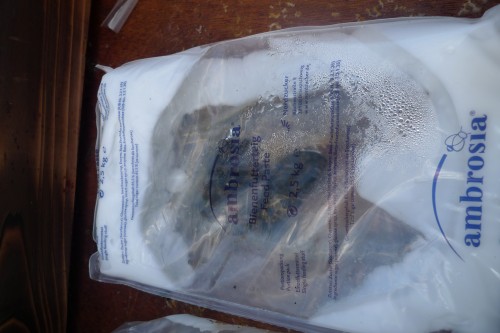
Fondant feast

References:

  • Guide to Bees & Honey, Ted Hooper (2010)
  • Keeping Healthy Honey Bees, David Aston & Sally Bucknall (2010)
  • Module 1 Study Notes, Mid Bucks Beekeeping Association (2012)
  • Practical Beekeeping, Clive de Bruyn (1997)
  • The Honey Bee Around & About, Celia Davis (2007)
  • Bees at the Bottom of the Garden, Alan Campion (2001)

Further reading:

  • Flower power‘ by Dr Sally Bucknall, p11, BBKA News November 2013 – an article on the benefits of ivy for bees. It explains that because of its high glucose content, pure ivy honey crystallises easily in the comb and is not useful to the colony when stored. However, if the honey contains a mixture of nectar from other late flowers such as Himalayan Balsam, it may not crystallize.
Posted in Uncategorized | Tagged , | 8 Comments

A Bath Bumblebee

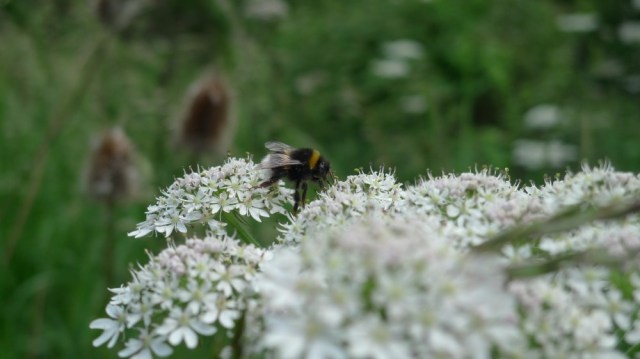
I’ve missed beekeeping this weekend as we were away celebrating Drew’s 30th birthday in Bath. It was a beautiful day for the “Bath Half”, an annual half-marathon through the city centre, and whilst waiting for Drew’s mum to finish the race I spotted this little madam on the flowers in the park.

I’ve had a go at identifying her using the Bumblebee Conservation Trust’s guide to the “Big Six”, the six bumble species most found in British gardens. It’s hard without seeing the tail end but I think she may be a garden bumblebee, Bombus hotorum. They have long tongues, which I get the impression she has from the pic above and the fact that she’s on these tubular bell flowers (anyone know what they’re called?). I may be wrong – please do correct me if you think otherwise. I thought at the time that she looked different to a buff-tail, which is the species I see most in London.
While she was hard at work collecting nectar in the sunshine, Kenyan runner Edwin Kiptoo was building up a sweat of his own nearby, beating the Bath Half previous record  in a time of 62 minutes and one second.

Edwin Kiptoo storming towards the finish line

Posted in Uncategorized | Tagged | 4 Comments

The bees in March

After a chilly start, yesterday grew into a surprisingly warm and sunny day. The bees were going crazy. Today has been a definite umbrella day, wet and windy. That’s British weather for you.

The pic below shows Rosemary’s bees zooming back home. Rows of bright crocuses were out in the nearby parks, so I expect they were finding pollen from them. The bees below don’t have much pollen to show, but others were bringing it in.

Bees flying in March

I found this bee hanging in the mouse guard. She looked recently dead.


Emma and I checked up on the fondant levels of both our hives. Surprisingly they hardly seem to have touched it, although both hives feel reasonably heavy still. Perhaps they are content with their honey stores. We also talked with some beginner beekeepers, who wanted to know the origin of the term ‘super’ and how the shook-swarm we’re going to be doing soon works, so we were nattering quite a while and missed the explanation for this magnificent hive below.

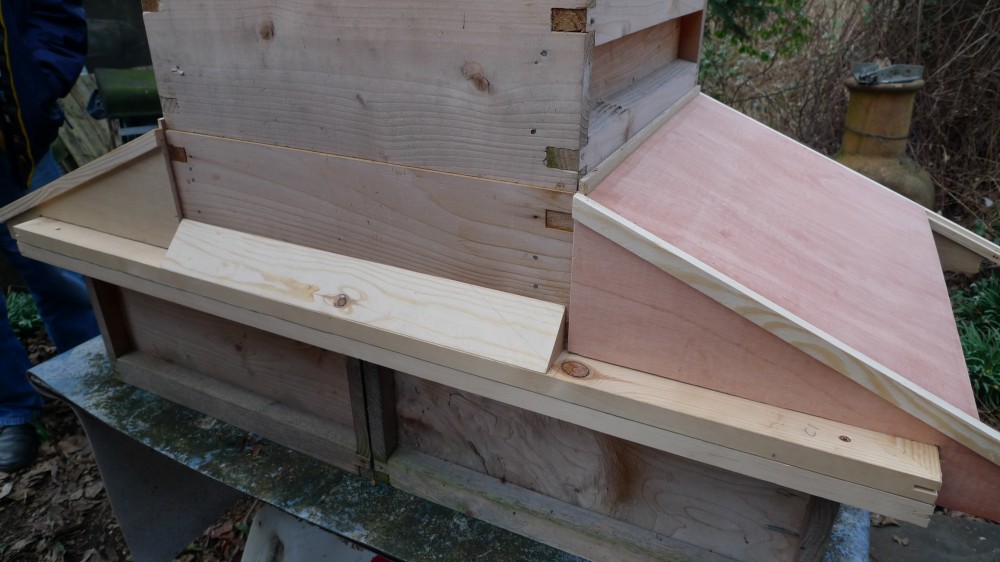
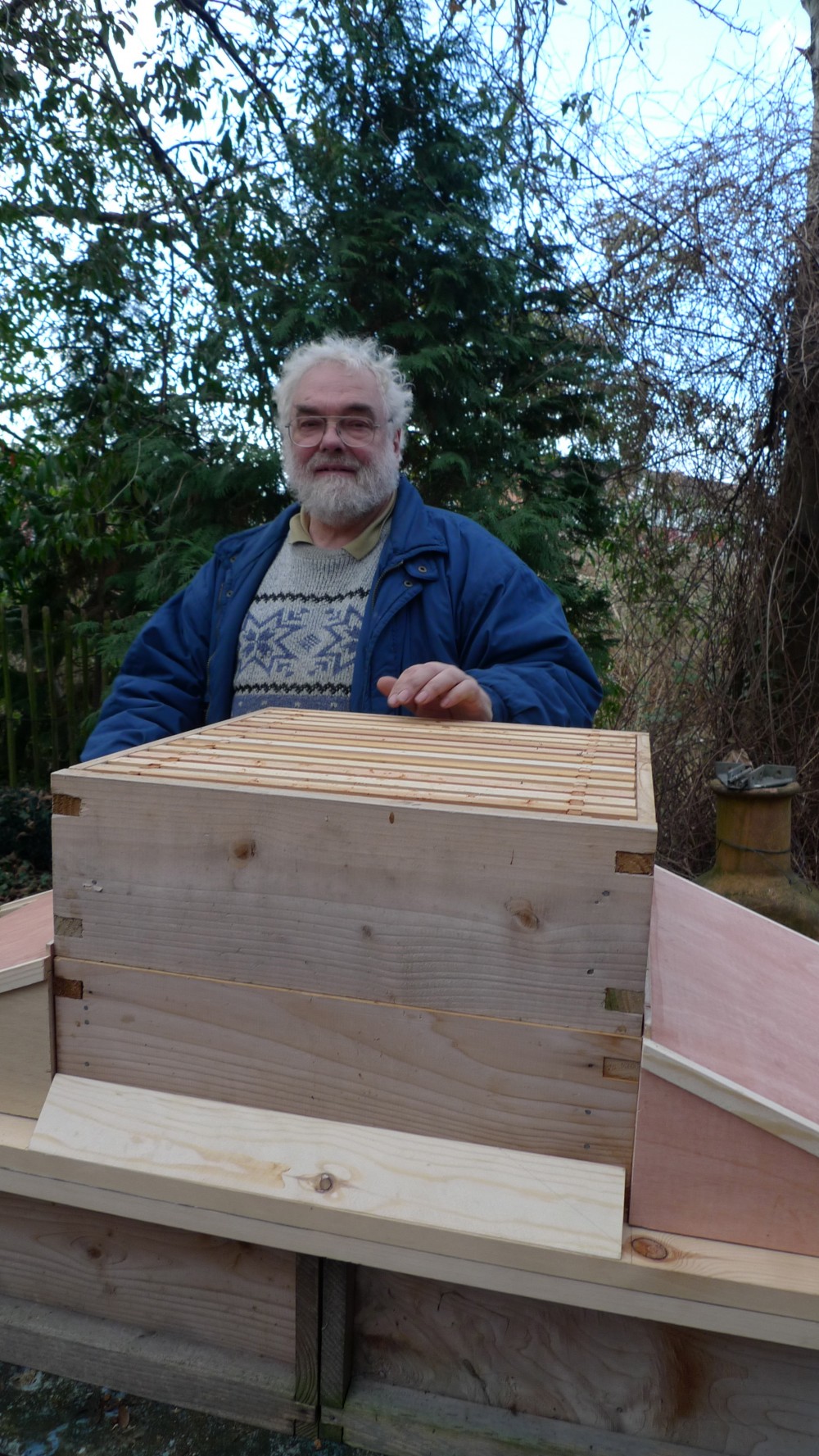
This is Cliff’s latest attempt at innovative top bar hive design. Cliff is the Ealing Association’s R&D department. He has exceptional carpentry skills and isn’t afraid to experiment with them.

John Chapple presiding over the hive. Cliff was too shy to pose with his creation.

John Chapple with Cliff's hive

John Chapple with Cliff's hive

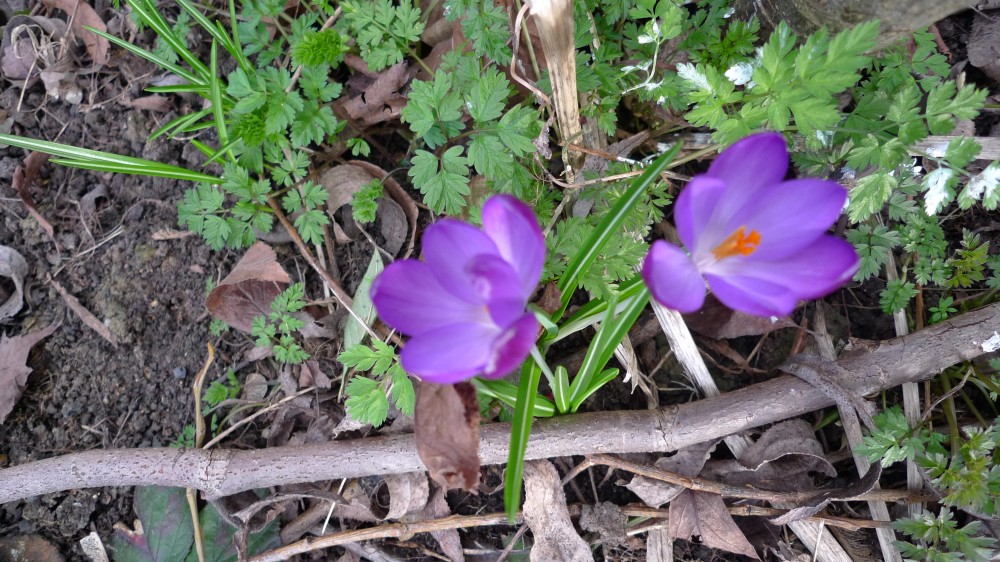
A few flowers I found around the apiary…crocuses

…and hyacinths. Are hycainths any good for bees, does anyone know?

March hyacinths

We’re probably going to shook-swarm both hives in a couple of weeks time, fingers crossed that it goes well.

Posted in Uncategorized | Tagged | 14 Comments

Bee Keepers’ Day part 3 – how the National Bee Unit protects our bees

A third post carrying on from my previous on last weekend’s Federation of Middlesex Beekeepers’ Associations annual ‘Bee Keepers’ Day‘.

Our final speaker was Mike Brown from the government’s National Bee Unit. He had very kindly travelled all the way down from York to see us. The Unit’s role is to protect the honey bee through carrying out research, inspecting hives across the country for disease and providing training for beekeepers. Below are my notes from Mike’s talk.

Mike Brown, Head of National Bee Unit technical Staff
The NBU function in protecting our bees and current research’

The National Bee Unit keeps around 200 colonies up in York and has 60 inspectors who work out in the field inspecting apiaries (many of these inspectors are part time, so getting round to all the apiaries is quite a challenge). Mike believes the NBU run probably the most comprehensive inspection and training programme anywhere in the world. He showed us a picture of some NBU hives with two brood boxes and seven supers, so they are obviously doing something right with their bees.

The NBU estimates that only 50-60% of British beekeepers are registered on Beebase – https://secure.fera.defra.gov.uk/beebase – their free website for beekeepers which provides a massive amount of free, and most importantly, authoritative and trustable information on bee pests and diseases. Registering tells the inspectors where you are and enables them to arrange an annual visit to see you. I wrote a post last year about our visit by Caroline Washington, our local bee inspector – A bee inspector calls. The inspectors are very helpful and just do a quick check that your bees are doing okay.

Caroline taking a sample last year from a hive – she was scooping up bees using a small plastic container. The bees are tested back at the NBU lab.

What issues do the inspectors find?

From the NBU’s point of view, varroa still seems to be causing most of the problems for colonies and is the most common reason for a colony dying off. Over the last few years there have been “tremendous problems” with wasps and woodpeckers. In the London area there is a high frequency of European Foul Brood (EFB) infection. Nosema apis, nosema ceranae and deformed wing virus (which is associated with varroa) are very common across the UK. Despite Nosema ceranae (an asian species of nosema, which is a fungal parasite) having arrived here more recently, surprisingly the NBU is finding more ceranae than apis!  The prevalence of both nosema species increases in larger apiaries, and they tend to be found together – if apis is present ceranae is likely to be too. Thankfully Kashmir bee virus (KBV) and Israel acute paralysis virus (IAPV) are very rarely found.

As well as looking out for pests currently here, the inspectors are constantly on the alert for new pests and diseases which might enter the country. Last year a swarm of bees attached themselves to a plane on a runway on Nigeria. Incredibly, the plane took off, stopped in Germany and finally landed in Britain, where the swarm of yellow African type bees were found still attached to it and still alive. After surviving that chilly trip, they were destroyed because they represented a disease risk to our bees here. The fear is that exotic pests such as the Small hive beetle and Tropilalaelaps mites will arrive in one of the many containers constantly entering the country.

The NBU have assessed that there is a high risk that one of the Asian hornet species, specifically Vespa velutina nigrithorax, will arrive here from France, become established and spread. It was confirmed present for the first time in Lot-et-Garonne in the South West of France in 2005, thought to have been imported in a consignment of pottery from China, and has since spread rapidly up to northern France.

Vespa velutina nigrithorax is anticipated as likely to have a moderate impact on bee colonies here. The reason it strikes such fear into the heart of beekeepers is that the hornet workers prey on bees, decapitating honey bee workers in seconds and feeding their larvae on their pulped bodies. Each hornet can kill up to forty bees a minute; 30 hornets can kill 30,000 honey bees in three hours. This very upsetting You Tube video shows it happening – the poor honey bees are tiny in comparison with their huge orange-faced attackers. In France beekeepers have had some success with hornet traps put out early in the season. The traps are specially designed to trap hornets only and release smaller insects. Preventing hornet colonies getting going early in the year seems to be the way forward.

A most unwelcome visitor.

A much cheerier picture below from a post called ‘The bees fight back‘ on the ‘Bees in France‘ blog. That appears to be a dead hornet lying in the hive entrance. Yay!

Previous posts:

Bee Keepers’ Day 1 – The decline of insect pollinators
Bee Keepers’ Day 2 – Improve your bees and beekeeping – simply

Posted in Disease prevention | Tagged | 7 Comments

Bee Keepers’ Day part 2 – Improve your bees and beekeeping-simply

A second post carrying on from my previous on this weekend’s Federation of Middlesex Beekeepers’ Associations annual ‘Bee Keepers’ Day‘.

Our second speaker was Roger Patterson, advertised simply as a “Sussex beekeeper of great practical ability”. He will be well known to those of you who visit the BBKA forums. The theme of his talk was Improve your bees and beekeeping- simply’. Roger arrived with his two dogs who sat at the back and were very well behaved. They were rewarded with some ham from Emma’s lunch. Below are my notes from his talk – settle nicely on the comb while you read them please.

Roger gave us a bit of advertising info first – he now owns and runs Dave Cushman’s beekeeping and breeding website since Dave passed away – www.dave-cushman.net. He also has his own honey recipes website – www.honeyrecipes.org.uk. He also recently published a book, ‘Beekeeping – A Practical Guide‘.

“Treat bees as a wild animal”, Roger told us. But one which you should expect to be good tempered. He has only walked away from about ten colonies which he couldn’t handle in a veil and no other protection. He has found that crosses between a pure sub-species of honey bee and mongrels are often very bad tempered. But he believes it’s a myth that the temper of bees is determined by the drones the queen mated with – more likely to be the drone the queen’s mother mated with.

What should you look for in your bees? (If you live in the UK)

  • Good temper
  • Quietness on the comb
  • Non-runners – “runners” being bees which appear to boil over the combs and hive – there is a risk the Queen might come out of the hive during an inspection too.
  • Storing honey in the brood frames – something Roger sees as a positive trait – this ensures survival if the supers are harvested by the beekeeper.
  • Dark colouring – important to Roger. In general, he feels the yellower honey bees, for example yellow Italians such as those bred in New Zealand, tend to be more prolific and need more than a single brood chamber. He prefers a native/near native type of bee closer in origin to the original British Black subspecies of Apis Mellifera.  Such bees tend to be darker, non-prolific, less susceptible to nosema apis & acarine, nice and frugal with their stores and good over-winterers. Of Roger’s 42 colonies all were still alive when he last checked a week ago, and he hasn’t started thinking about feeding yet.

As a side note – as Roger himself admits, beekeeping books disagree that colour alone is a reliable indicator of sub-species type. To identify a sub-species properly, technically overall size, tongue length, and other external features must be measured. In his book ‘Practical Beekeeping‘ (1997) Clive de Bruyn suggests that the dark bees now present here are not necessarily descended from the British Black bee, as large numbers of continental dark bees were imported in the early 20th century from France and Holland to compensate for the heavy losses of bees due to the ‘Isle of Wight’ disease. However Roger insists that the British bee is alive and kicking up in the Orkneys and doing very well in the harsh weather up there. He believes most beekeepers here have mongrels of mixed colours and genes, whereas he is trying to breed for the traits above.

In their book ‘Keeping Healthy Honey Bees‘ (2010), David Aston and Sally Bucknall say “The honey bees of the British Isles are a mixture of genetic types produced through the introduction of strains of bees from abroad, the Dark European Honey bee and its variants, and those produced through crossing with imported strains and races of honey bees.” We are mongrels and our bees are too 🙂

A frame from Rose’s hive last year – showing Roger’s preferred trait of storing honey in the brood combs.

Photo of our bees last April – most are dark but you can see some are darker than others, the striping of the abdomen differs from bee to bee as they are local mongrels.

Now compare our darker bees above with the workers and drones below produced by a queen imported from New Zealand, where light-coloured Italian bees tend to be bred.


How can you help yourself?

  • A nice thin hive tool to fit between the frames easily – Bee Basic hive tools recommended
  • A good smoker – with easy to puff bellows
  • Use firm but gentle movements. Bees are a pack of sensors – antennae, legs, exoskeleton – so extremely sensitive to vibrations. Roger believes some people are naturals and others are not but luckily improvement is possible!
  • Read the colony – comes through experience but even a beginner can check the amount of pollen and liquid stores available to a colony. Combs empty of pollen will cause nutrition problems.
  • Smoke – but only when needed.
Get yourself a nice thin hive tool…

Other posts:

Bee Keepers’ Day 1 – The decline of insect pollinators
Bee Keepers’ Day 3 – How the National Bee Unit protects our bees

Posted in Uncategorized | 3 Comments

Bee Keepers’ Day – The decline of insect pollinators

Yesterday I went to the Federation of Middlesex Beekeepers’ Associations annual ‘Bee Keepers’ Day‘. Each year the Middlesex associations (Ealing, Enfield, Harrow, North London, Pinner & Ruislip) take it in turn to host a day of beekeeping talks; this year the day was held in Ruislip. Below are my notes from the first speaker.

Dr Stuart Roberts of Reading University, Centre for Agri-Environmental Research. The decline of insect pollinators’

Dr Roberts began by asking the question: is there a bee decline or not?

Before trying to answer this, he gave an overview of just how many bee species there are. There is only one species of honey bee native to the UK (the European honey bee, Apis mellifera). There are rather more species of bumbles: 25ish. The reason for the ‘ish’ is that a few species have only been spotted near the Channel and may have been blown across. The honey bees and the bumbles are the bees you are most likely to have seen. Going unnoticed and unappreciated by most people here are a whopping 240 other bee species, such as little solitary and parasitic bees.

Worldwide we have 9 species of honey bee, 25o bumble species and a staggering 19,300 other species of bee in total, many of which in the tropics come in shimmering tones of metallic blue, green or violet. The polinizador.wordpress.com blog is a good place to see galleries of these jewel like bees, I found the photo below there.

In size, the world’s bees vary from a tiny 2mm long, such as the least carpenter bee, found in southern Europe, to the huge 39mm Wallace’s Giant mason-bee, a species believed to be extinct until 1970s and still threatened as it requires primary forest. This research paper by its 1970s re-discoverer, Adam Messor, has a photo showing just how collossal these bees are compared to Apis mellifera: www.pollinators.info/wp-content/uploads/2012/01/giant-bee.pdf.

Now, back to Dr Roberts’ original question – are bees really threatened? There is, he told us, a clear difference between a well known fact and a widely held belief, even though these two things are often confused. To try and distinguish between the two, Dr Roberts’ and his colleagues at Reading University have spent the last four years gathering data on honey bee numbers. At first he thought it should be relatively easy to put such datasets together, but in reality he found reliable data was scattered and published in obscure, hard to track down journals. There is a need for consistently gathered data across countries. Not all countries require beekeepers to register their hives, and there is a considerable black economy of honeybee products in Europe. Migratory beekeeping in the USA makes it hard to collect data – where and when do you count the bees?

When it comes to honeybees, saying whether we’ve had a decline depends when you start counting! In Europe hive numbers are generally higher than in the 1800’s but lower than since the 1980’s. There has been roughly a 23% decline in colony numbers and a 36% decline in beekeepers in central Europe since 1985. The introduction of varroa may have something to do with this. The Mediterranean basin bucks the trend, with a genuine increase in beekeeping and Mediterranean hillside honey particularly in demand.

Next Dr Roberts turned to bumbles and solitary bees. In one historical source, the shrill carder bee (bombus sylvarum) is described as the ‘commonest bumblebee’. It has sadly greatly declined here, so much so that it is now restricted to only four grassy sites in southern England and Wales. Many species of solitary bees show a great decline too. Specialist species which forage on a particular crop or nest in a particular type of place, such as the ‘snail shell bees’ bee artist Val Littlewood has drawn so beautifully for us, tend to be more in decline. Species which produce more brood cycles during the year (double brooders such as Bombus hypnorum) and generalist feeders are doing better.

The shrill carder bee, so called because the queens fly very quickly, producing a high-pitched buzz

Dr Roberts concluded that the decline of bee species is occurring everywhere, although the larger the scale of the area you look at the harder it is to measure decline. Many reasons for the decline have been put forward – some fanciful..

  • Car exhaust – compared with wholesale destruction of habitat, probably a small impact, Dr Roberts said
  • Mobiles – “cited in some appalling papers”
  • Electromagnetic fields from power lines – “no evidence”
  • Osama bin Laden – “bonkers suggestion but at least is now testable”!
  • Whisked off to heaven in the rapture – no need to comment.

More serious suggestions include:

  • Monocrops
  • Agrichemicals
  • Large-scale migratory beekeeping
  • Plus parasites and pathogenic viruses affecting bees already stressed by the above, e.g. varroa, small hive beetles, tracheal mites

For bees in the UK in particular, Dr Roberts sees the following factors as the biggest problems:

  • Habitat loss – 50% of the problem, so much prime bee habitat has been lost to housing, golf courses, gravel mining, conifer plantations, kebab shops…
  • Intrinsic factors such as low population densities & restricted range – some bees have always been rare
  • Native species dynamics – some favourite species of plants are declining and, in the case of parasitic bees, some host species are in decline
  • Climate change

People tend to think honey bees do the most pollination but in fact for agriculture the contribution of honey bees is only about 8.7%. The combined value of all pollinators to UK agriculture is £402m per annum, of which honey bees only contribute £38m pa. Why bother about saving the other pollinators? Why don’t we just put in more honey bee hives?, Dr Roberts was asked when he went over to Washington DC to speak. In reply to that, he pointed out that you don’t make up a football team using only quarterbacks. It’s not a good idea to try and rely on just one species.

Some plants can’t even be pollinated by honey bees, such as tomatoes and bell peppers, which require buzz pollination. 50,000 bumbles are imported here each year for pollinating these types of crops in poly tunnels. The preferred species are the European type of Bombus terrestris, the buff-railed bumble. The buff-tail is one of the top five bumbles you are most likely to see in a UK garden, but the ones found in poly tunnels look different. The breeders rear for large specimens which have a rapid turnover of colony and produce a small number of workers in relation to sexuals (males & queens), so that farmers have to restock more frequently and spend more money doing so. Allowing these bees to escape from a poly tunnel breaks the law – but how do you control this? There is already suspicion that American species of bumbles reared in Europe and transported over to the US for commercial purposes have escaped and spread European pathogens amongst wild populations.

A  buff-tail I photographed last summer. Those found in poly tunnels have a bigger body but less of a ‘buff’ to their tail.

Is there any good news amongst all these indicators of decline? We should not despair, said Dr Roberts. He believes this is not a catastrophe – yet. We have noticed the problem in time to do something about it and much research is currently going on.

On a personal scale, we can all do something to help bees. How great would it be if everyone who read this post planted a bee-friendly flower somewhere this spring? I have a strip of garden which is something like 3 x 6 feet and mostly in constant shade from fences and walls. Yet last summer, by putting a few bee friendly pot plants in, including lavender, rosemary and mints, I was able to attract bumbles and other pollinating insects to this unpromising spot.

Dr Roberts recommends a book called ‘Befriending bumble bees‘ by Elaine Evans for information on attracting and even rearing bumbles. And don’t forget the little solitary bees – Dr Roberts has put on his garden wall the most extravagant solitary bee nesting house he could put in “without needing planning permission”! It has 1,000 tubes and last summer every single tube was occupied. Not just by bees but by tiny solitary wasps too – which handily hunt garden aphids.

The type of nesting sites which solitary bees enjoy. There is a photo of Dr Robert’s actual super deluxe bee hotel here – it is a thing of beauty: http://www.flickr.com/photos/87532379@N00/2423347448

Also, check out this post by Morgan Bowers on the Invertebrate Challenge Project in Preston: ‘A Luxury Bee & Bee‘  – her group has built the biggest solitary bee hotel I’ve ever seen:

huge solitary bee hotel
Photo by Morgan Bowers, from her ‘A luxury Bee & Bee‘ post.

And a final example, from the ‘Food from the Sky‘ project above Budgens supermarket, north London:

Follow-up posts:

Bee Keepers’ Day 2 – Improve your bees and beekeeping – simply
Bee Keepers’ Day 3 – How the National Bee Unit protects our bees

Posted in Bees | Tagged , , | 19 Comments

7th Honey bee Management revision post: honeybee drifting

A 7th revision post for the British Beekeeping Association’s Module 1 exam, Honey bee Management, which I’m taking in March. Moving to 1.13 on the syllabus:

“The Candidate shall be able to give a detailed account of:-

the drifting of honeybees, the dangers caused and techniques used to minimise the problem;”

Drifting occurs when worker bees, usually returning foragers, or perhaps young bees on their first orientation flights, accidentally drift into a hive close to their own. They will have an unfamiliar smell to that colony’s guard bees, but if they are carrying nectar or pollen and display submissive body behaviour they are likely to be let in. Ted Hooper, in ‘Guide to Bees and Honey‘ (2010), p39, gives us this description of guard bee behaviour towards drifters:

“a drifting bee entering the colony by mistake, perhaps because it has been blown down to the hive by a cross wind, or misled by a similarity of the approach picture, will be challenged. In this case the guard will press the challenge because the smell of this bee is not the right one. The drifter, because its instinct says it is in the right place, will not try to fight the guard but will submit. If the drifter is facing the guard it will offer food, which the guard will usually ignore. If the guard is attacking from the side […] the drifter will tuck its tail in and stand quiet, with its head tucked down, or it may rear on to its two back pairs of legs, extending its tongue and strop this with its front legs. These patterns of behaviour denote submission and the guard […] will do no real harm and certainly not attempt to sting. As with all bees, the guard’s concentration period is short, and in a few seconds it gets tired of the whole affair and lets the drifter proceed”

If you’re not very impressed by the rather lackadaisical bouncer skills of the guard bees Ted describes above, take a look at this landing board view video for a sense of the amount of bee traffic guard bees might be dealing with during a nectar flow: http://www.youtube.com/watch?v=5tZ607q-OHA. The Italian honeybee Apis mellifera ligustica, the most popularly kept bee worldwide, is thought to have a greater tendency to drift than other bees (as well as being renowned robbers of other colonies).

The problem with the innocent behaviour of drifters is that they can spread disease and parasites, whether American Foul Brood (AFB) spores or varroa. A newly mated virgin queen who mysteriously goes missing could have drifted into the wrong hive. A less serious issue is that it can result in uneven numbers of bees in an apiary’s hives, as a result of bees returning to some colonies more often than others.  This can weaken some hives whilst making others stronger, resulting in the colonies requiring different management for swarm control, super adding, harvesting etc (more troublesome if you have twenty hives than if you have two).

In his book ‘Practical Beekeeping‘ (1997), Clive de Bruyn remembers

 “a time when local beekeepers from Manchester and Sheffield used to place their hives on the north Derbyshire moors in long lines. It was the boast of one old time beekeeper that he always got the best honey crops by being the last one to place his hives. By placing them at the ends of the stocks already there his colonies benefited from the extra foragers he collected.”

I can just imagine that old Northern beekeeper chuckling cannily to himself. Do the hives still get lined up across the moors, does anyone know?

To reduce drifting, beekeepers can paint hive entrances different colours and provide distinctive landmarks in front/nearby to hives (perhaps a big branch or shrub). Hives should be positioned with their entrances facing in slightly different directions – in a circle, with hives facing outwards is recommended – and as far apart as possible, preferably 1.2 – 1.5 metres apart. Ted Hooper suggests facing the hives towards cover between 4-6 feet away, such as a hedge, to provide calm air in front of the hives so bees are not blown off course as they try to land.

Barnsley Beekeepers Association use the below photo on their website as an example of a set up which could cause drifting (http://barnsleybeekeepers.org.uk/apiary.html), as the hives are lined up close together in a row all facing the same direction, towards a fairly flat nondescript looking field.

An example of different coloured hives – Michael Bush’s hives, photo from www.bushfarms.com. The best colours to use are black, white, blue and yellow (bees are red colour-blind so do not use red).

The hives of a church in Gradišče Pijavo Gorizia, Slovenia, also making use of blues and yellows to differentiate the hives for the bees.

EDIT: As Chris reminded me in his comment below, drones deliberately pay visits to other hives, where the workers welcome them in and feed them. I like to think they are hunting out virgin queens about to go on their first mating flights, so they can get a head start in the chase. Nothing much can be done to prevent this deliberate drifting, as opposed to the accidental drift of a returning forager.

References:

  • Guide to Bees & Honey, Ted Hooper (2010)
  • Keeping Healthy Honey Bees, David Aston & Sally Bucknall (2010)
  • Module 1 Study Notes, Mid Bucks Beekeeping Association (2012)
  • Practical Beekeeping, Clive de Bruyn (1997)
  • The Honey Bee Around & About, Celia Davis (2007)

Useful blog posts:

  • Drifting in honeybees – The Apiarist, December 2015. Discusses research into drifting by American Foul Brood infected bees and also how frequently drones drift compared to workers.
Posted in Colony management, Exams | Tagged | 12 Comments

Snowy days, snowy bees

We have in Ealing what I’m sure Phillip and his bees over at the Mud Songs blog in Newfoundland, Canada would think of as a light dusting of snow, a mere icing sugar like sprinkling. Personally I am enjoying it. London in winter can be a grey place; the snow covers up all the dirt with sparkling light.

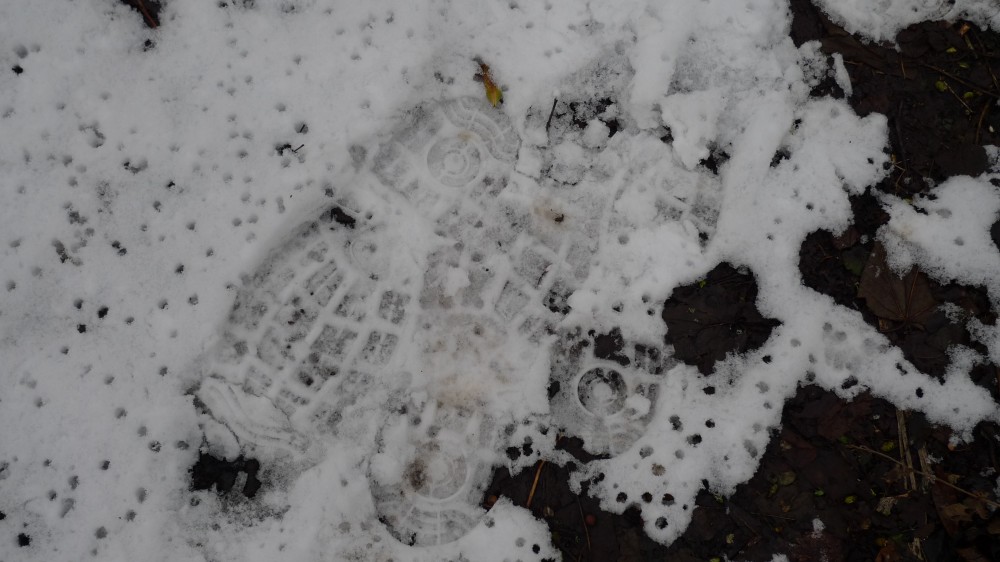
But how are the bees doing? I went down to the apiary today to find out. Someone had got there before me…a male beekeeper, by the looks of it, possibly in wellies. I left slightly more delicate tracks behind.

Tell-tale signs of a beekeeper

The apiary lay still. Of all the hives in this picture, only two (which are mine and Emma’s) still contain bees.

The snowdrops are snowed in.

The crocuses are wilting. They came too early.

With a dusting of snow on the ground, I assumed our ladies would not be flying. How wrong I was. Rosemary’s underlings poked their heads out of the entrance and seemed to be feeling out the temperature. A minute later a worker landed on a patch of snow on our hive roof and started buzzing frantically. I picked her up using a leaf but she either fell or flew off, I’m not sure which, before I could blow hot air on her.

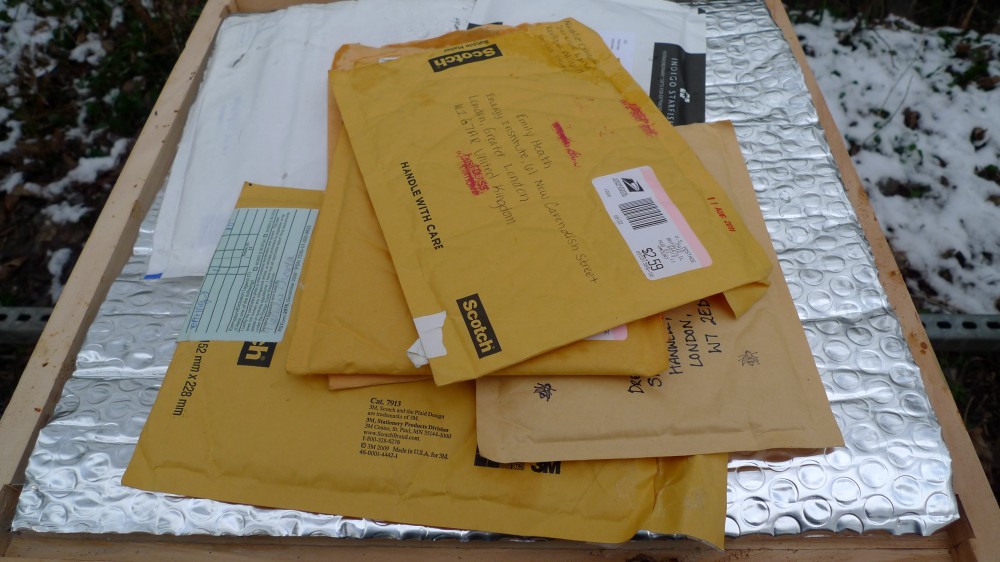
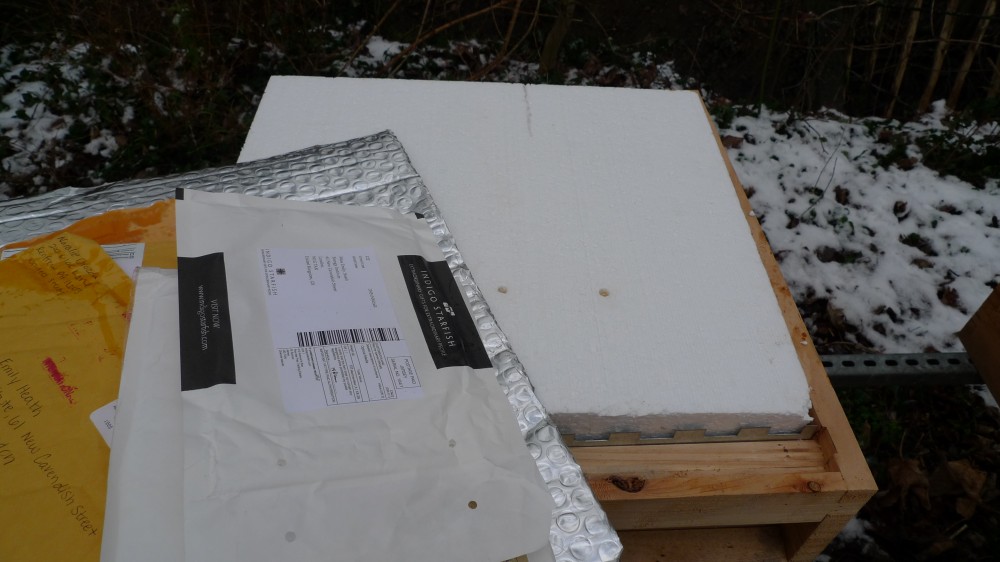
The bees have been well insulated with the generous help of the elder beekeepers, particularly Pat, who provided some industrial style bubblewrap and polystyrene, and Thomas, who helped Emma tuck the bees in. They have also been supplied with pre-addressed envelopes in case they want to send us letters.


The last thing I did before leaving was feed the robins on behalf of Don. Don is a kind-hearted Australian beekeeper who always feeds the apiary’s robins every Saturday. But he is in Australia for six weeks now, so the robins will be missing him. I hope they enjoy their seeds.

. 098574 – this is a comment left for you by my cat Bob, who is into typing numbers.

Posted in Uncategorized | Tagged | 18 Comments

National Bee Unit annual report 2011

Found via the Ealing Association’s Secretary Andy Pedley, who does a very good e-newsletter for us all. The report is available online from the Beebase News page. The National Bee Unit inspectors are funded by the UK government to provide a programme of apiary inspections, laboratory diagnosis, research and training for beekeepers in England and Wales.

Summary of the 2011 National Bee Unit Apiary Inspections Programme

This season has been an average year for beekeeping, with mixed reports of honey yields, however, many beekeepers reported making an increase in colony numbers. It has also been a good year for the National Bee Unit inspectors who visited more beekeepers (5781), more apiaries (8920) and more colonies (37,785) than last year. Despite having fewer inspectors on the ground in 2011 due to retirements and unfilled posts, these inspection figures represent 12% increase on the total number of colonies inspected last season. Hand-in-hand with increases in the number of inspections was an increase in the amount of disease discovered, and increase in diagnostic support required from the NBU diagnostic laboratory at York. There were three times more cases of American foulbrood in 2011 (104 cases) and one third more European foulbrood in 2011 (695 cases) compared to 2010.  Therefore as a beekeeping community we need to remain vigilant to these damaging brood diseases, and remind everyone to report suspicions of disease to their local Bee Inspector (see below for contact details).

The NBU visit apiaries based on the risk of finding disease, or finding exotic pests, and conduct so called priority inspections. The risk of an apiary having disease is derived from the proximity of each apiary to known disease outbreaks, so the closer an apiary is to known disease, the higher the priority of inspecting that apiary. The Random Apiary Survey was commissioned by Defra and the Welsh Assembly Government to help the NBU obtain an accurate estimate of disease prevalence by visiting apiaries in all areas, rather than concentrating on high risk areas. Over the last 2 seasons the NBU have checked for disease at over 4700 apiaries selected at random from across England and Wales.  We know from this massive surveillance exercise that the priority inspection programme, routinely used by the NBU, detected significantly more American and European foulbrood than the inspection of apiaries selected at random. Also, the apiary risk classifications used by the NBU to prioritise inspections, were confirmed as being very useful for targeting disease. The final part of this exercise was to look at 13 pathogens in adult bee samples collected from each visit, including viruses, fungi and bacteria. We can confirm that every one of these pathogens was detected across England and Wales, but the prevalence of each ranged from being very common, to a single finding in the survey! Some good news is that the viruses linked to Colony Collapse Disorder in the United States were of very low prevalence, and none of the 19,615 colonies assessed in the survey, were suffering from this condition. The final report for this surveillance exercise will be shared with beekeepers in spring next year, so look out for updates in magazines, on BeeBase (see http://www.nationalbeeunit.com) and presentations at the WBKA and BBKA Spring conventions. NBU staff will also throughout the year be giving presentations across the country as well which will include these details.

This season was also another successful year for providing training and advice building on what has gone before. To date, NBU staff have given 833 training events with 25,200 attendees. Also seasonal husbandry advice was sent to 4500 beekeepers who had registered on BeeBase and provided their email addresses, and 105 disease alerts were sent to 2076 registered beekeepers who own bees within 5 km of foulbrood disease. If you wish to receive seasonal advice and updates or be informed when foulbrood has been found in your area, please provide us with your email address (see contact details below).

The NBU can only provide training and advice, and effectively control disease when we are in a position to contact you! This might seem like an obvious statement, but if we do not know you are a beekeeper, we cannot warn of disease threats near you or provide timely husbandry advice. A large number beekeepers that remain unknown to the NBU seriously compromises our ability to control notifiable disease and to contain any future incursion of an exotic pests like the Small Hive Beetle. Many beekeepers presume that by registering with a local association, NBU inspectors will know automatically where beekeepers are. However, this is not always the case. For example a survey in 2011 revealed that 45 of 64 county level associations do not share such information with the NBU, leaving large gaps in our ability to control disease and future exotic pest incursions. Recent efforts by the NBU inspectors has resulted in an estimated additional 2291 beekeepers becoming registered, and therefore becoming part of a responsible community of beekeepers who are serious about improving honey bee health. If you want to register with the NBU as a beekeeper, and help us to help you, then please contact us.

National Bee Unit

Contact us on 01904 462510, by emailing nbu@fera.gsi.gov.uk, or find more information by visiting our website (www.nationalbeeunit.com).

Posted in Uncategorized | Leave a comment