National Bee Unit Varroa Workshop – Part 2 – practical apiary session with Caroline Washington

A follow-up post from my one yesterday, ‘Varroa – Know your Enemy‘, about the series of workshops on varroa given by National Bee Unit inspectors this Sunday.

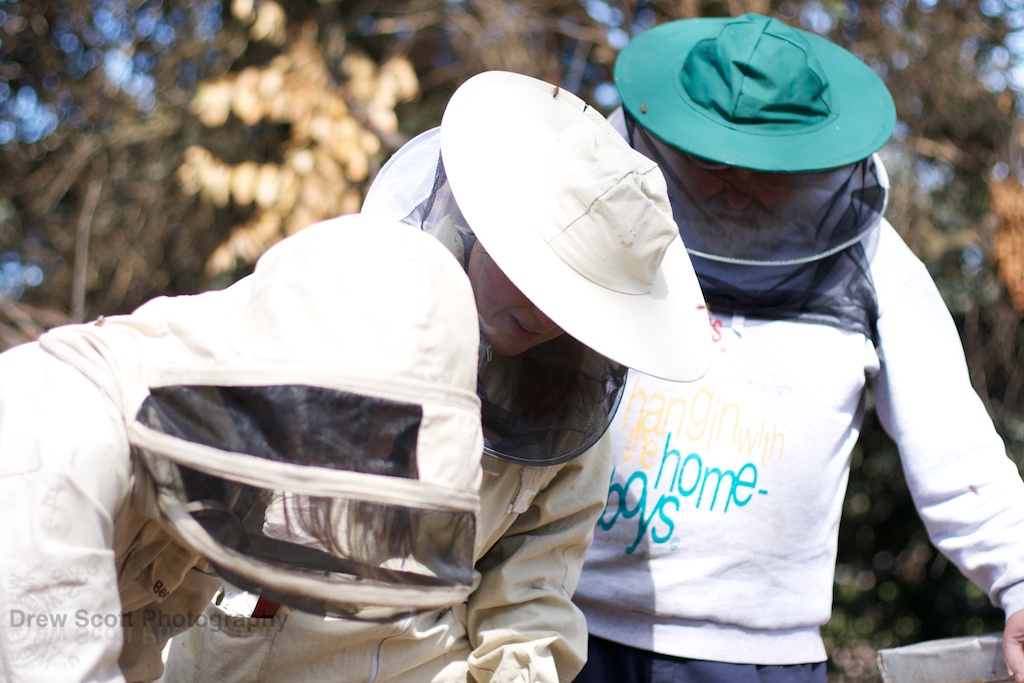
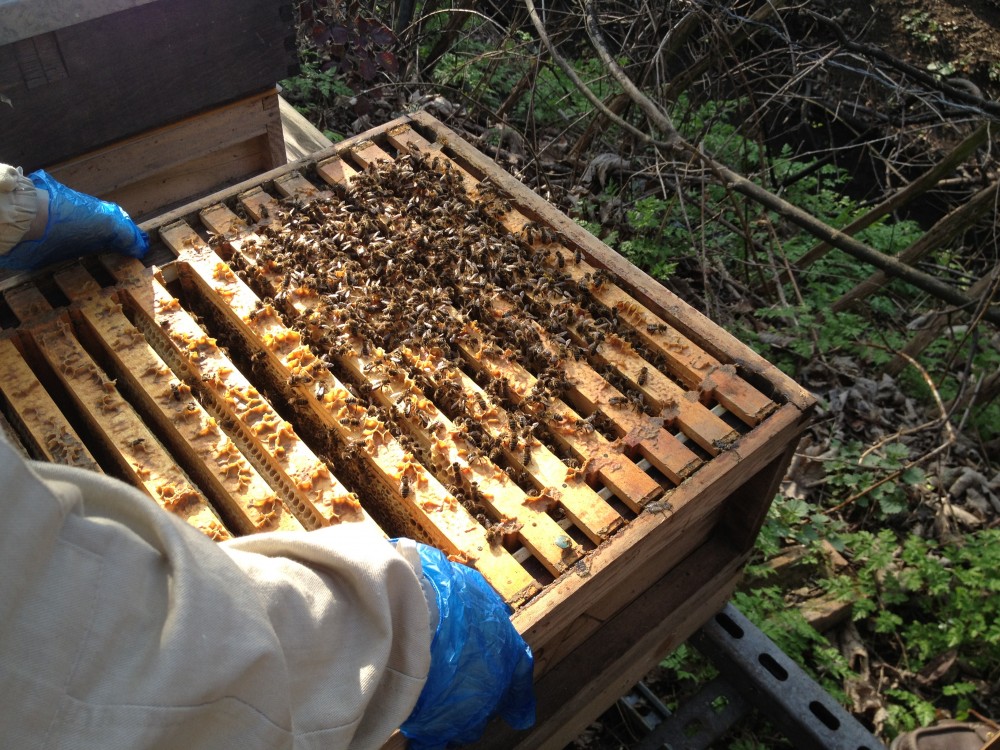
After Alan’s talk to all of us on the life-cycle of the varroa mite, we split up into three groups for some practical workshop sessions. Emma and I were in Caroline Washington’s group, Caroline being the NBU inspector north of the Thames.

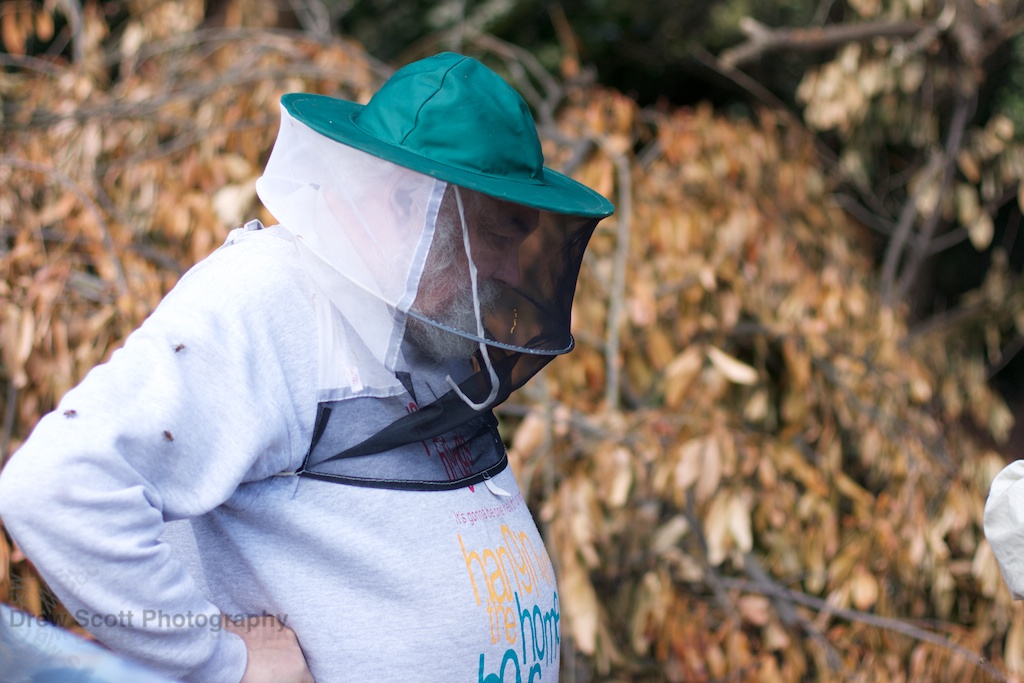
Caroline speaks in a Joanna Lumley-like plummy accent and takes no nonsense, peering at any troublemakers over the top of her glasses. Beekeepers can just occasionally be somewhat awkward and stubborn, especially when it comes to being told what to do with their bees. Luckily Caroline is not adverse to a little shepherding and will happily quiet anyone trying to talk over her with a firm “Let me finish” or a simple “Shush!”. Here she is below, getting her smoker going with pine cones.

Caroline Washington

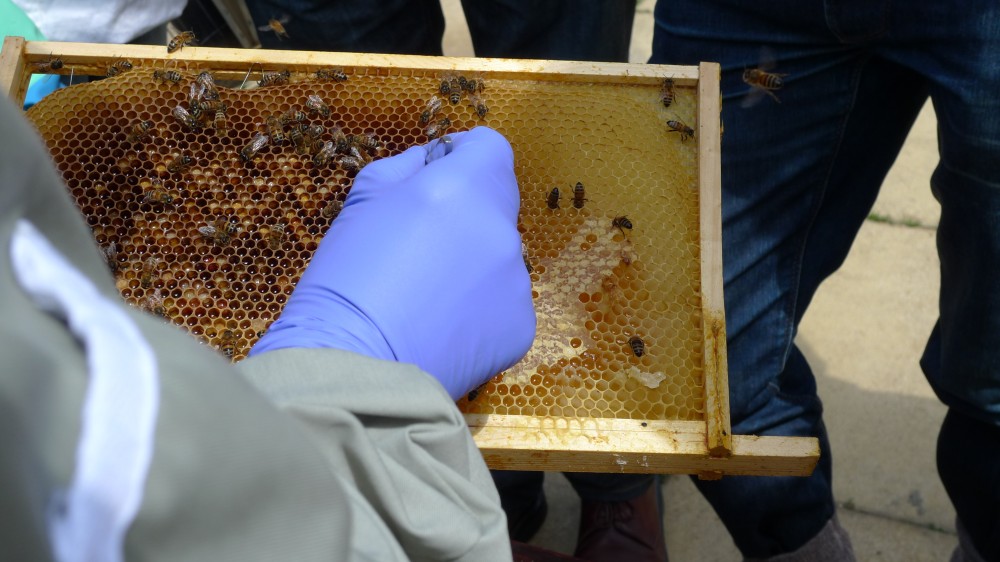
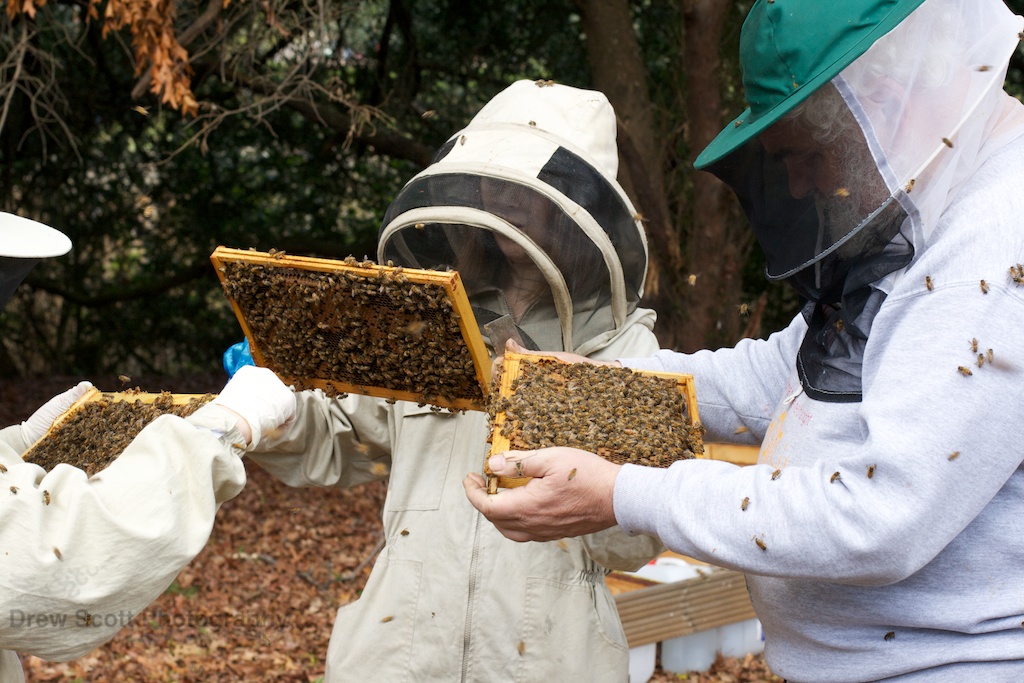
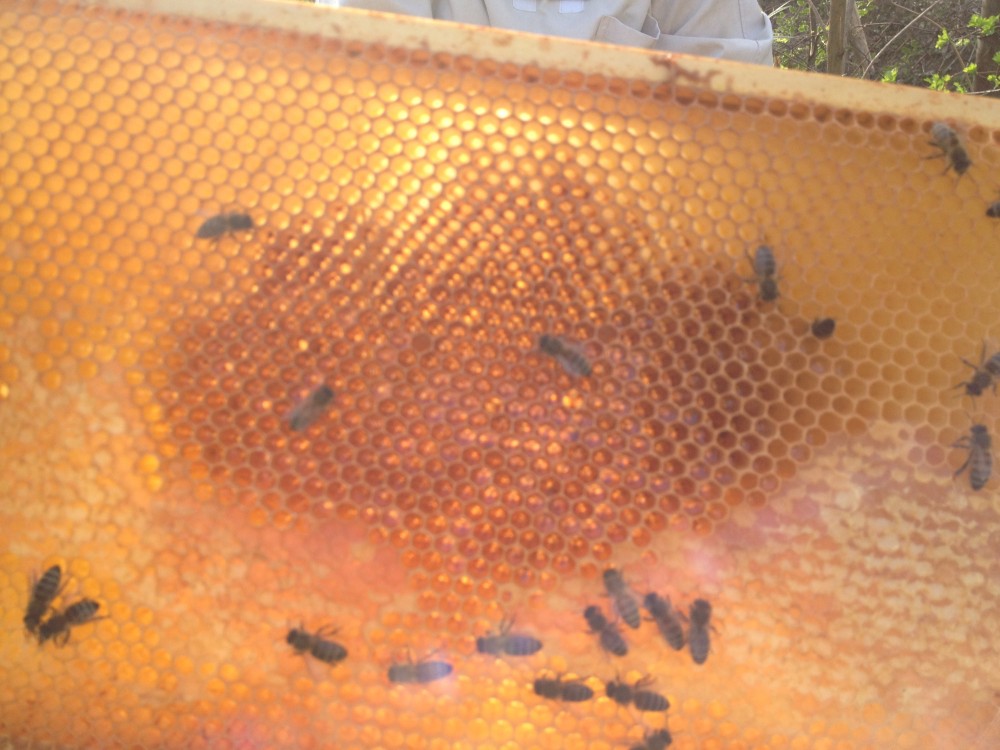
A hive had been put out for each of the groups, and Caroline told us to cluster round her as she started inspecting. This did not particularly please the bees, who were soon swirling all around our heads as they tried to get home. “Why are these cells shiny?”, Caroline asked, holding up a frame of pollen. I tried guessing that the pollen might have a thin film of nectar over it, but Caroline revealed that the cells’ shine came from being varnished with propolis. I had read about the bees doing this to take advantage of the anti-bacterial properties of propolis, but hadn’t realised just how much shine propolis could add.

“Why are these cells shiny?”

“This is a very boring colony!” Caroline said. The hive which had been brought for us to look at wasn’t particularly full of bees, and had very little brood, probably as a result of the terrible weather lately. She told us that if the hive was hers she would have used a dummy board midway through the frames to help keep them warm, as the colony was too small for all the space in the hive.

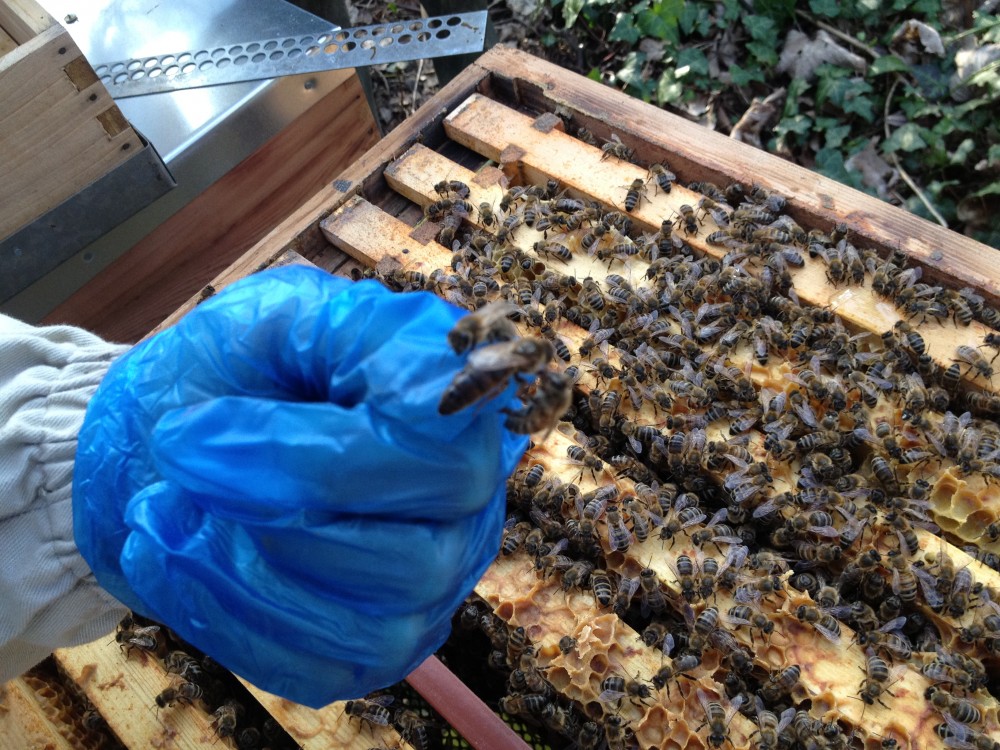
As we went through the frames Caroline was looking out for the queen when Emma pointed her out on a frame that was still sitting in the hive – uncannily impressive queen spotting skills!

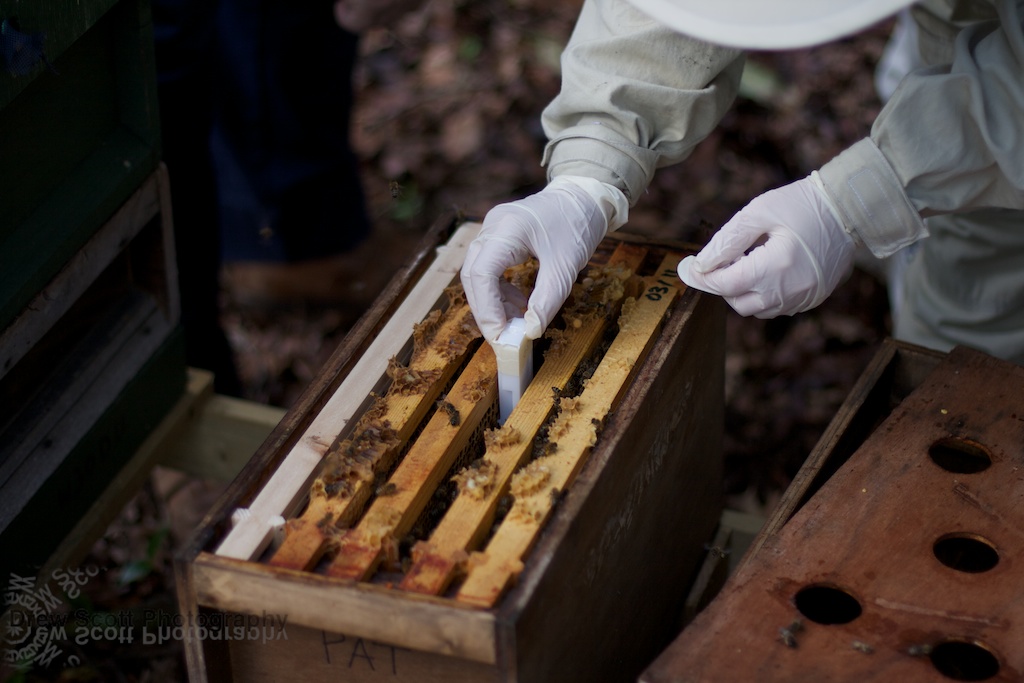
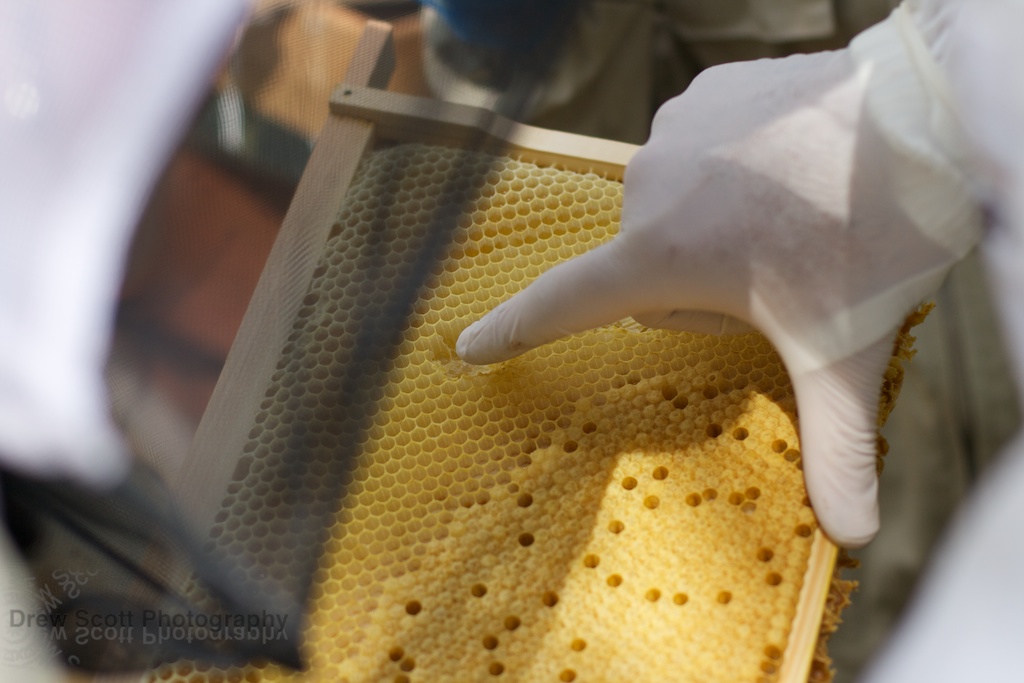
We took out the varroa monitoring board to take a look, but it had obviously been cleaned recently as there was very little debris on it. Caroline pointed out some pure white wax flakes, which she thought had fallen from the bellies of young wax-building workers.

Caroline pointing out wax flakes

One of our group mentioned the brood nest as having a “rugby ball shape pattern”. Caroline looked at him over the top of her glasses. “What shape”, she asked, “is a rugby ball?”. Taken aback, he tried his best to demonstrate, making the shape of a rugby ball with his hands. Caroline looked doubtful and replied “I shall leave that analogy to you, I will never remember that”.

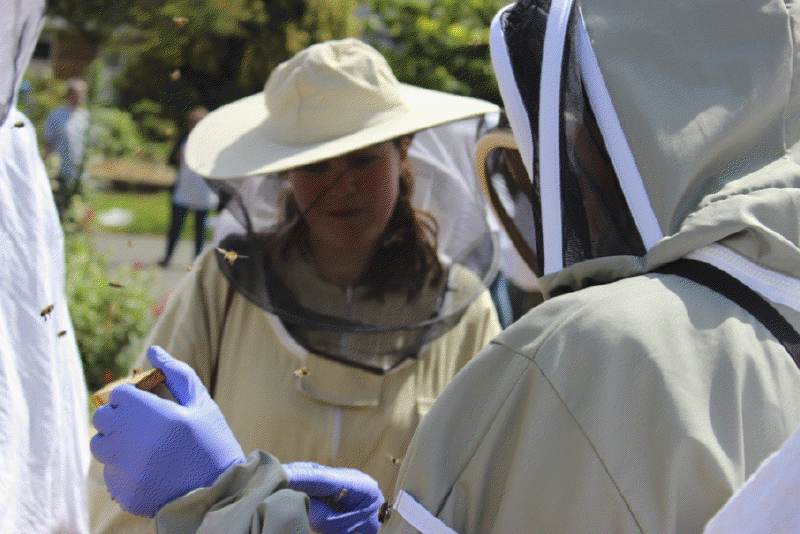
Below is a photo Emma took of me watching Caroline in action.

Copyright Emma Tennant

The next post will feature information Caroline gave us on honeybee viruses.

Posted in Uncategorized | Tagged | 9 Comments

National Bee Unit Varroa Workshop – Part 1 – “Know your enemy”

On Sunday Emma and I went to a ‘Varroa Workshop’ themed day held by the London Beekeepers Association, in conjunction with inspectors from the National Bee Unit. The Unit’s inspectors spend their working lives giving beekeeping training, checking for disease in the public’s hives and carrying out beekeeping research. If anyone in this world knows anything about bees, it’s them.

I learnt so much during the day that I’m going to have to split my notes up into a series of posts. This first post contains my notes from the talk by Alan Byham, SE Regional Inspector, on varroa – “Know your enemy”.

A female varroa mite – © Crown copyright 2010 “Courtesy The Food and Environment Research Agency (Fera), Crown Copyright”

“There are far more colonies lost to varroa than anything else”, Alan told us. The number of colonies lost to the statutory diseases which must legally be reported if suspected by a beekeeper (the European & American foul broods) is about 800 annually in the UK. In contrast many thousands of colonies will be lost to varroa. The main risk is not the mites themselves but the viruses they help transmit.

Alan gave us an extensive presentation on the in-bred lifecycle of the mite. A female mite will enter an uncapped cell with a larvae inside and bury herself under the larval food, where the bees – and beekeepers – can’t see her whilst inspecting. She uses specialised tubes to breathe during this time. A pheromone is given off by larvae ready to be capped –  female mites sense this earlier than adult bees and receive a cue to enter cells just before they are ready for capping (mites enter day 8 after the egg is laid, while worker & drone cells are capped on day 9).

Once the cell is capped, the female mite will emerge from under the larval food and lay a series of eggs – first a male egg, then females. The young mites hatch and mate with each other within the cell, obtaining energy to do so by feeding on the developing honey bee larvae. Mites mate on their own faeces, which give off a pheromone smell enabling them to find each other in the dark of the cell. 60-70% of the mite population will be breeding in the brood during the active seasons of spring, summer and autumn. Western honeybees, Apis mellifera, currently have no  defence against varroa multiplication.

Once the honeybee larvae emerges, the young female mites crawl out too and spend some time feeding phoretically on the backs of adult honeybees, before they can carry out the cycle again by hiding within an uncapped cell. They can live between 1-5 months.

Immature mites feeding on a bee larvae- © Crown copyright 2010 “Courtesy The Food and Environment Research Agency (Fera), Crown Copyright”

“I get so many beekeepers telling me they haven’t got varroa in their hives”, Alan remarked…”In the early part of the season you won’t see varroa – doesn’t mean they’re not there!”

The big problem comes in July, when brood numbers start to drop off but mite numbers are increasing. At this stage the colony can collapse if varroa levels become too high. Tragically, often beekeepers find that their strongest and best colonies succumb. This is because lots of brood will also carry lots of varroa. Colonies that are prevented from swarming will also have more mites, because they won’t have a broodless period.
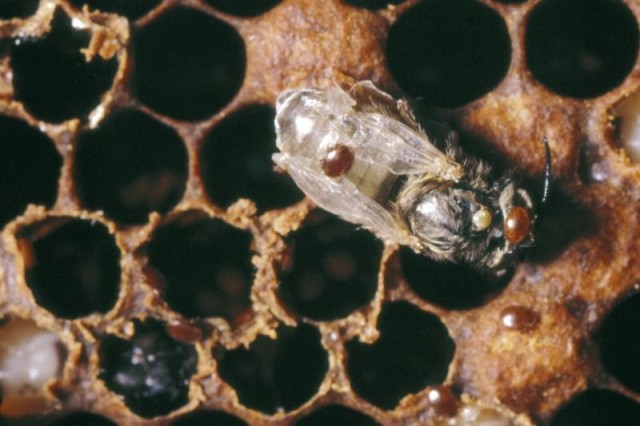
Varroa infestation – © Crown copyright 2010 “Courtesy The Food and Environment Research Agency (Fera), Crown Copyright”

The audience was obviously fascinated as plenty of questions were soon flying. “What about varroa resistant bees?”, Alan was asked. An “interesting idea”, he told us, but in his opinion no-one has successfully done it yet. He believes good husbandry methods, combined with requeening each year with a resistant-bred queen from specialist breeders, produces this effect. It’s not sustainable when queens are mating with local drones from all over the place, and therefore resistant bees are going to take a long time to do significant good for beekeeping.

“How effective is icing sugar dusting?”. The advantages of this method, Alan told us, is that it’s cheap and easy to do. It can also be done with supers on, unlike thymol based treatments like Apiguard which might taint the honey with their smell. The icing sugar works by interfering in the mite’s grip on adult bees moving around the hive. A flour dredger or a honey jar with holes punched in a lid work well. Work in pairs to do the treatment, with one person holding out each frame horizontally and another person dusting the sugar over each side.

As the treatment doesn’t kill mites, but only knocks them off, it is only any good in a hive with an open-mesh rather than a solid floor. Since it only affects phoretic mites clinging onto adult bees, which only make up about 30-40% of the mite population, it is a low efficiency treatment and generally only reduces mites by about 20-30%. This may sound good, and is better than nothing, but really an 80% effective treatment (such as Apiguard or oxalic at the appropriate times of the year) is needed to have any real effect on mite numbers.

“All sorts of things might do something – a pair of my smelly socks might kill off a few mites – but you want to kill them in quantity!”, Alan concluded.

You cannot rely on sugar dusting alone to keep varroa levels down; if you do your colonies will die (Alan repeated this twice). This is true generally of varroa control: you cannot rely on one treatment alone, but should use several different methods throughout the year.

Some beekeepers prefer to grind up their own sugar, as they are wary of the anti-caking agents in icing sugar. In Alan’s view the anti-caking agents do the bees no harm and grinding up the sugar is likely to reduce the efficiency of the treatment, because it’s the super fine powder that you want to reduce the mite’s grip.

“How do feral colonies last without treatment?”, someone asked. Many people were surprised when Alan told us that in his opinion feral colonies could last longer without treatment than a managed colony. This is because feral Apis mellifera colonies are more similar in composition and behaviour to the mite’s native host, the Asian honeybee Apis cerana. Feral colonies are smaller and swarm more often, meaning there is less brood for the mites to reproduce in and regular breaks in the brood cycle after each swarm. Maintaining large colonies to try and produce a honey crop brings its own risks.

My next posts will contain advice from the bee inspectors on chemical controls and husbandry methods to keep mite levels down, as well as photos of bees in the beautiful garden where the day was held, at Roots & Shoots in Lambeth.
Posted in Disease prevention, Uncategorized | Tagged , | 12 Comments

Battle of woman vs beekeeping exam: and the winner is…

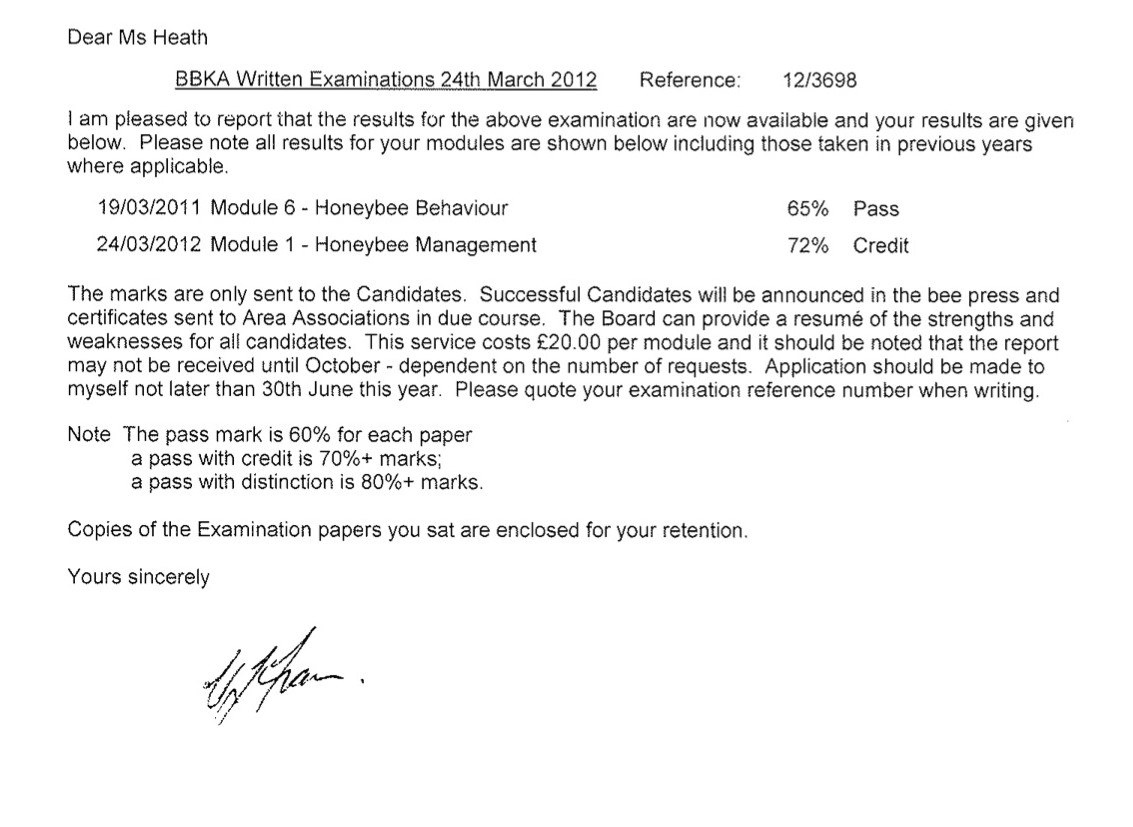
Yesterday I came home to a long-awaited letter. As soon as I saw the British Beekeeping Association’s address on the back, I realised it must be my Module 1 Honeybee Management exam results.

Opening exam results is hard, isn’t it? I remember a girl at 6th Form College who walked around for hours shakily clutching her A-level results envelope, too terrified to open it. I never did found out what she got. As I stared at the envelope I was hit by a feeling of doom. Even though I had felt positive afterwards on the day in March, in the weeks since I’d thought up plenty of mistakes I’d made and visualised tight-lipped examiners tutting and sighing at my messy writing.

Luckily, the feeling of doom was unfounded and in the battle of woman vs beekeeping exam…woman won!

Yay! Very relieved that I won’t have to revise frame sizes or how to wire a frame ever again. Next I hope to do Module 3 on diseases in November, so that I can inflict lots of gruesome photos of yucky gooey larvae on my rapidly decreasing blog visitors.

Here’s the BBKA Module 1 exam paper. The questions weren’t too bad, they could have been a lot nastier to us. I’ve marked the ones I answered in Sections B & C. Many thanks as always to the Mid Bucks Beekeeping Association, who produce excellent free Module study notes, and to the elder beekeepers in Ealing who take the time to patiently pass on all their years of bee knowledge.

Posted in Exams | Tagged | 38 Comments

Book review – ‘Beekeeping: A Novice’s Guide’, by David Wootton (2011)

I bought this after reading a very positive review in the BBKA News and starting to follow David’s blog: (www.beekeeping-book.com/blog). I am pleased with it!

Do not buy this if you are an experienced beekeeper wanting to learn extra tips and tricks or scientific background to your beekeeping. Do buy it if you are a beginner wanting simply written, beautifully illustrated advice to get you started on the basics. As David says, “It is written by a novice, for novices, to demonstrate that taking up beekeeping doesn’t need to be complicated”.

Things I liked about it:

  • David is a professional photographer and used his own photos throughout the book. It is sumptuously illustrated, with a glossy colour photo on almost every page. I’m a very visual person so this really attracted me to it.
  • His is the first book I’ve found to have a step-by-step photo guide (p28-33) to making up a frame, down to where every nail should be placed. This really helps when you’re a beginner and, like me, not a natural carpenter!
  • He has similar thoughts to me on bee suits, smokers and feeders, preferring an all-in-one suit and round rapid feeders. About smoking, he says “I don’t smoke the entrance of my hives, as I’ve found it aggravates my bees unnecessarily. As a beginner, you can only judge this by observing how your bees react as you get to know their temperament.” Emma and I have also stopped smoking the entrances, as our bees are so gentle it’s not needed.
  • The book guides a beginner through the basics of their first year, from the first inspection to winter feeding. Making up sugar syrup is explained well.
  • It has a pollen colour guide! This is really quite unusual in a general beginner’s book and very fun to have.
  • Practical advice on storing combs and equipment over winter, a topic often not covered.

Little niggles:

  • There are a couple of minor typos and spelling mistakes, even though this is the 2nd edition. I’ve noticed this in a lot of beekeeping books – don’t the publishers use copyreaders?
  • He recommends that the third year beekeeper should replace some old frames with new frames of foundation gradually. In their ‘Replacing Comb’ factsheet, available for free on the Beebase website, the National Bee Unit team describe this as the comb replacement method that causes the most problems (they prefer either replacing old comb with prepared drawn comb or carrying out a Bailey Comb Change). 
  • It has a glossary but no index!
  • He describes a mouse-guard as non-essential if using a reduced entrance. Having seen mice damage in a nucleus with a round entrance about the size of a 1p piece, I don’t think it’s worth risking going without one.

These are just minor niggles and overall it’s one of the best beginners’ books I’ve read. If you are interested in buying it, cheap e-book editions are available at www.beekeeping-book.com/ebook.html or it can be bought directly from David at www.beekeeping-book.com/order-book.html.

Posted in Uncategorized | Tagged | 24 Comments

National Bee Unit warning

This email was sent out by the National Bee Unit yesterday:

With the on-going poor weather, there is a real risk of bee colonies starving. Please check for stores in the colony and if in any doubt feed your bees. You should feed with either a fondant or a thin syrup.

Further information on feeding bees can be found in Best Practice Guideline No. 7, on the Advisory Leaflets page of BeeBase (click here)

Kind regards,
National Bee Unit.

Today was yet another rainy day. Emma and I went round the apiary topping up the sugar syrup in all the hives. Meanwhile the others huddled around cups of tea and three different kinds of cake. We still don’t know if Myrrh has managed to find a passing sunny moment to mate.

Who will feed the bumbles?

A few pics from Drew’s photos last week which I didn’t post yet:
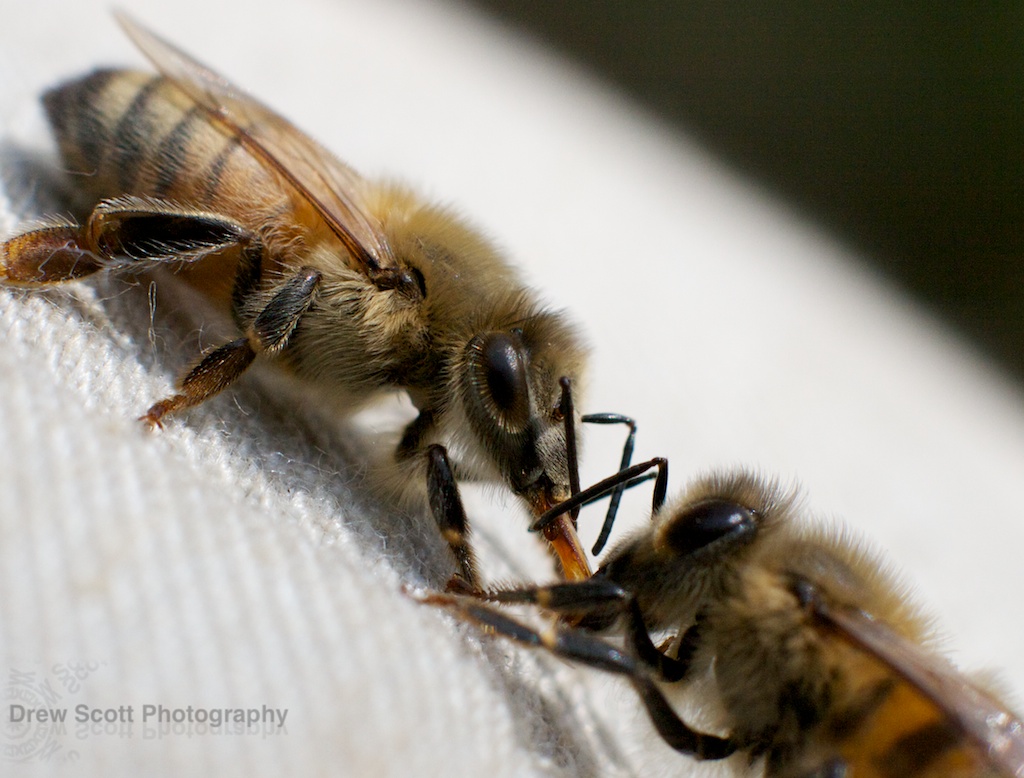
Trophallaxis
Wave your bum in the air like you just don’t care
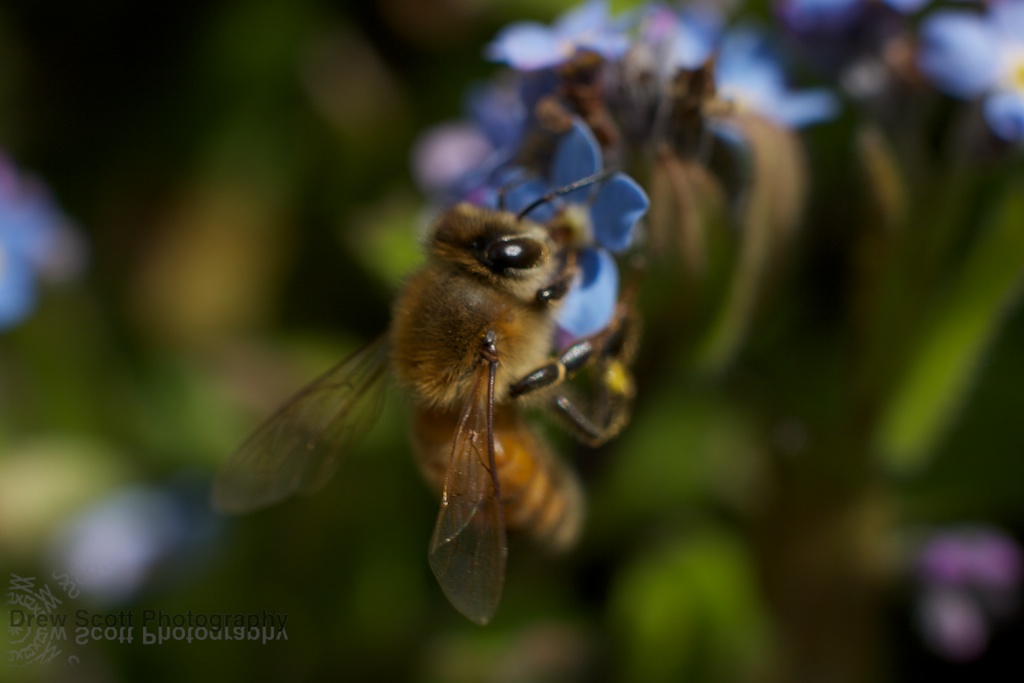
Bee on blue flower 2
Bee on blue flower
 Hello bees!

Can we have some sunshine please?

Posted in Uncategorized | 22 Comments

A day out with John

“What are you doing tomorrow?” John Chapple had asked Emma and me, “Would you like to help me at Osterley?”. Well, when a beekeeping legend invites you down to some hives it would be madness to say no!

Osterley is a National Trust property near where I live, with beautiful gardens which Drew and I like to picnic in. It has ponds, woodland and meadows so is perfect for bees as well as the horses, cows, rabbits, ducks, geese and swans that live there. The hives there don’t belong to John but to a few members of the Ealing association, who had kindly offered to let us make some nucs up from their bees. The nucs will be used to build up the stock in the association apiary, which only had five hives left after winter.

A long distance shot of John with the hives. They are in a lovely sunny spot. As a master beekeeper, John has a fine beard. Emma and I are mere novices so have no beard yet.

John and Osterley hives

Of course we didn’t have a clue what we were doing (or at least I didn’t anyway) but John patiently directed us.

John directing

Three beekeepers in a row

There were six nucs to be made up (nucs = mini nucleus hives, for building small colonies up). We went through each parent hive finding the queen first, then separating her off and putting some brood and stores from her hive into a nuc. John had ordered in some yellow Italian type queens from New Zealand, which recently arrived. One of the little queen cages was put into each nuc, fondant upwards so that any dead attendant bees in there wouldn’t fall on the fondant and block the queen’s exit. The workers will nibble through the fondant gradually to let the queen out, getting used to her smell whilst they do so.

Putting a queen into a nucleus

As well as the bees already on the frames, more nurse bees were shaken into each nuc to make up numbers.

Shaking into nucs

Looking at bees together

At first we were doing well at spotting queens (all un-marked btw). John even spotted a tiny virgin queen in one hive, and triumphantly pulled another adult virgin out from her cell – calling it “a cesarean birth”! But about four hives in we got stuck. The bees were on a one-and-a-half brood box system. We kept going through the boxes again and again, inspecting the bees at the bottom and sides of the hive too. We passed the frames between each other, triple-checking every single frame. Nothing.

Eventually John came to the conclusion that the hive was queenless, as there were no eggs either. To test his theory, he put one of his caged New Zealand queens in there, to see if the bees would be attracted to her. “If there is a queen in there, she’ll come running over”, John said. No queen came rushing over, but I was surprised at just how quickly workers carpeted the cage, eagerly sensing her pheromones. John decided they liked her, and left her in there.

We each got stung once, in the finger. Below is a pic of John just after he got stung. I’m not sure he notices it much by now!

John and Emma

With all the disturbance to the hives there were plenty of workers like the one below with abdomens up in the air to reveal their Nasonov glands, fanning their wings to spread the scent. It’s an aroma used to mark scentless locations such as water or a new colony location. When a virgin queen leaves the hive to mate, workers will mark the entrance with Nasonov pheromone to guide her back.

Nasonov gland scenting

On the first sunny day for ages, the workers were also going mad bringing all sorts of pollen back in. Some was brick-red, so the horse chestnuts must be coming out.

Bee with orange pollen

Hello Miss pollen face.

Pollen face

And all the hives had plenty of big butch drones. Swarm season is here!

Drone face

It was a fun morning. Many thanks to Drew for taking the pictures and for waiting whilst we played hunt-the-queen!

Posted in Uncategorized | Tagged | 31 Comments

Bee macro shots by Drew Scott…and queen news!

You are in for a treat. In my last blog post I shared with you some of my boyfriend Drew’s awesome photos from Saturday, but I didn’t show many of the macro shots.

Now you get the macro shots. Plus, if you can keep going to the end of the post, some exciting (for me anyway) queen news…

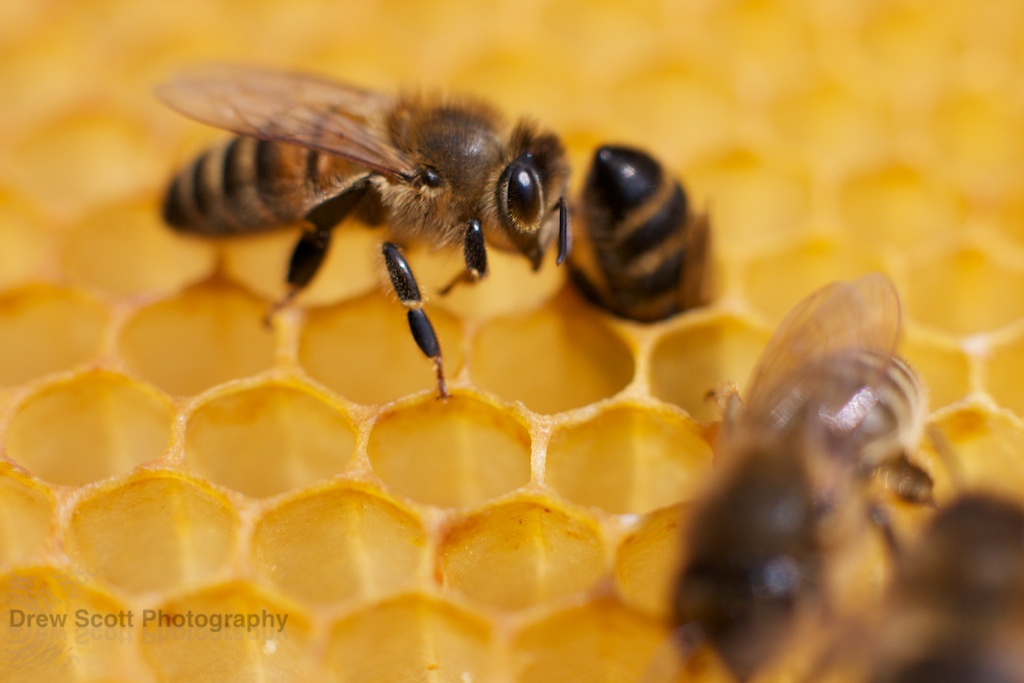
If you look closely at this worker’s mandibles I think she has some propolis in them. We’re often looking down on bees – seeing their eyes and upper bodies – so I like this shot because it reminds me how practical their mandibles are, just like little pliers. Very handy for manipulating propolis and wax.

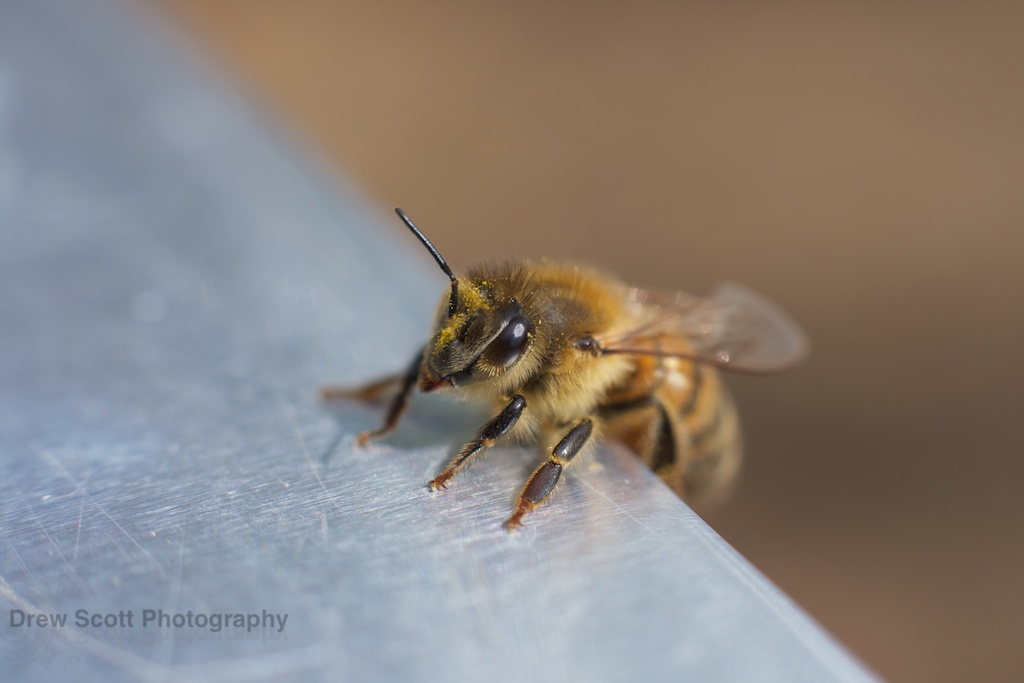
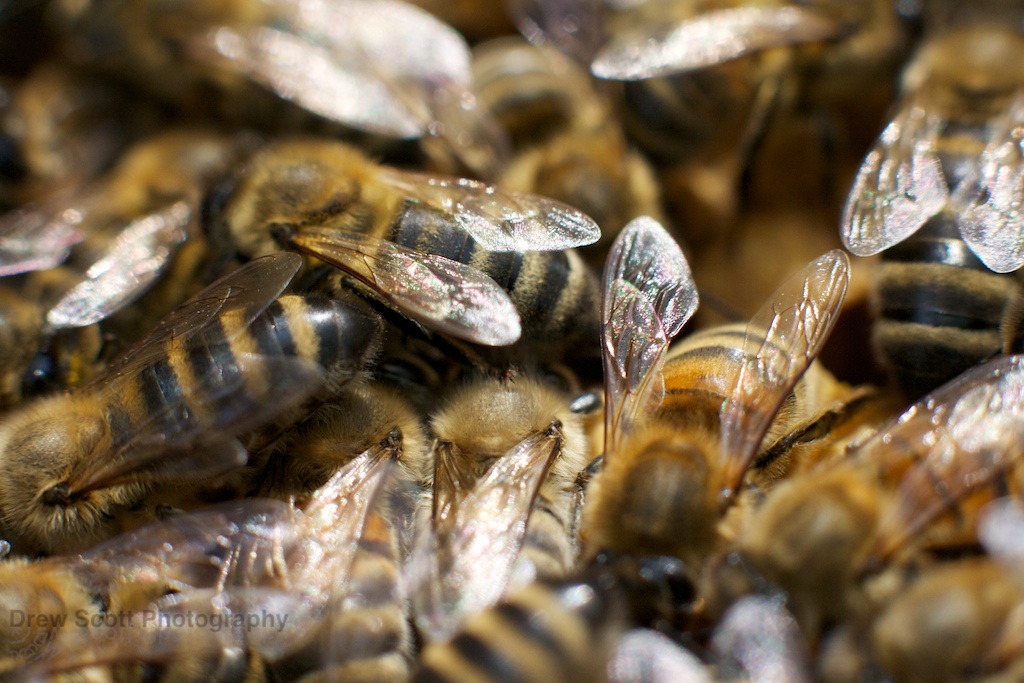
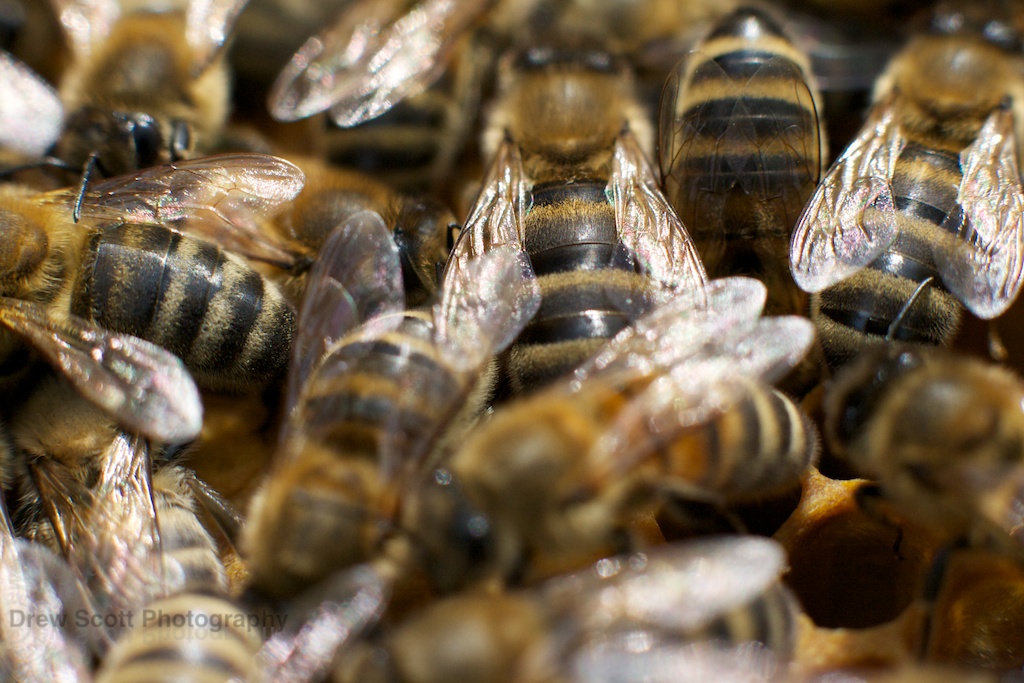
Please show the above photos to anyone who tries to tell you honeybees have yellow and black stripes. Up close they are a gorgeous mix of shimmering, subtle, browns, oranges and blacks. And very hairy.

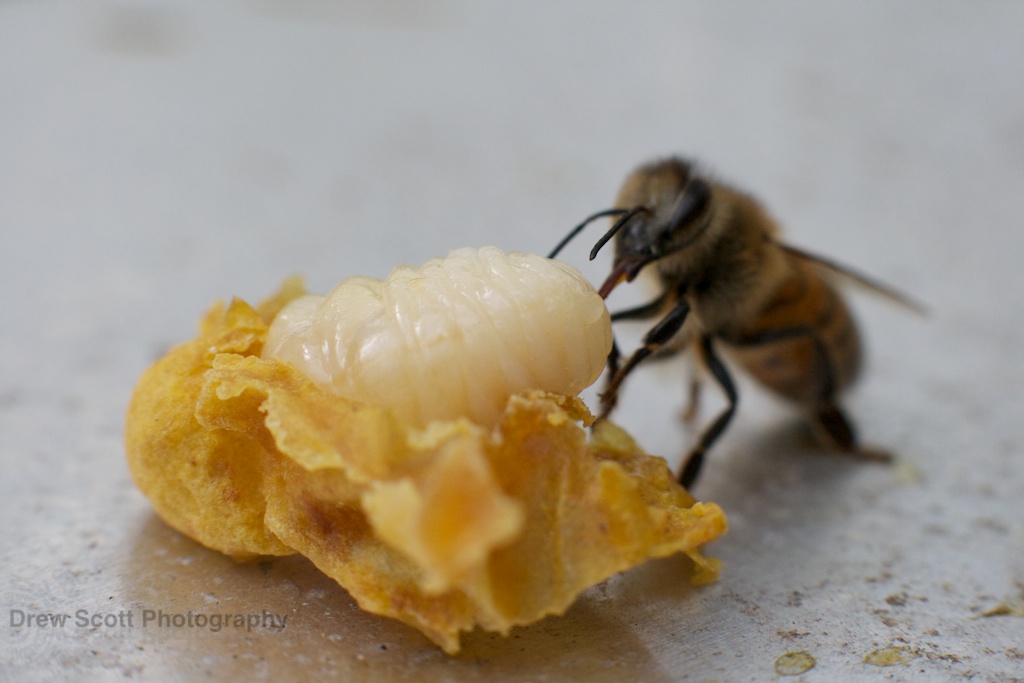
This larvae’s sealed cell was accidentally damaged whilst removing brace comb. You can see its legs have the same form as an adult bee, but are a translucent white colour, whilst its eyes are pink. Kinda creepy looking!

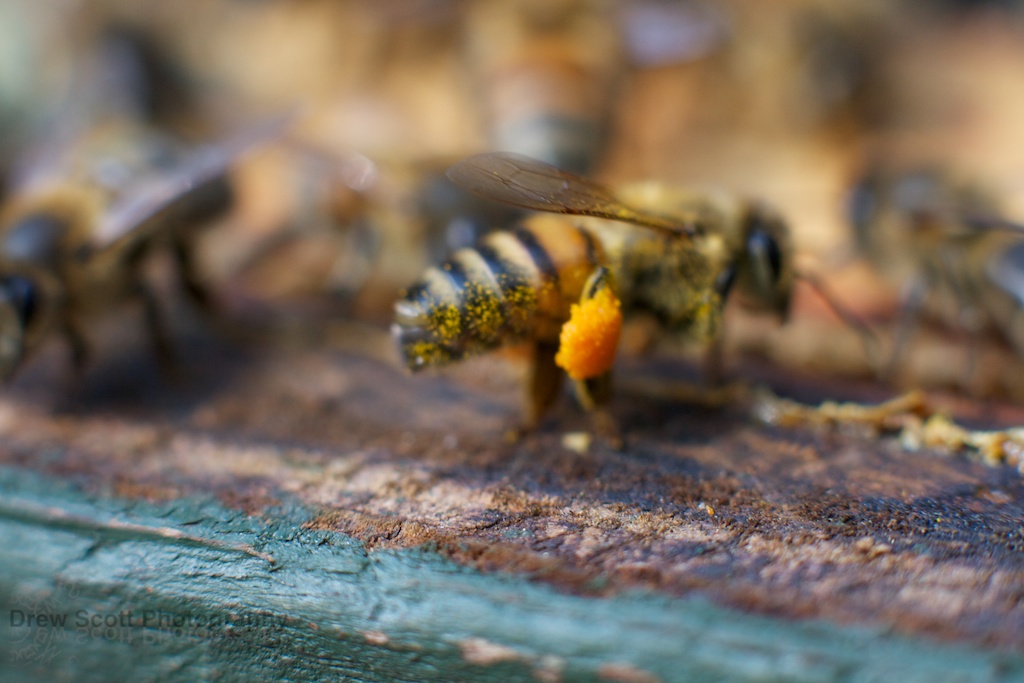
Ah the many colours of pollen. Beautiful. Some of these bees will be young workers eating it so that their glands can produce brood food, whilst others will be returning foragers head-butting it in for storage.

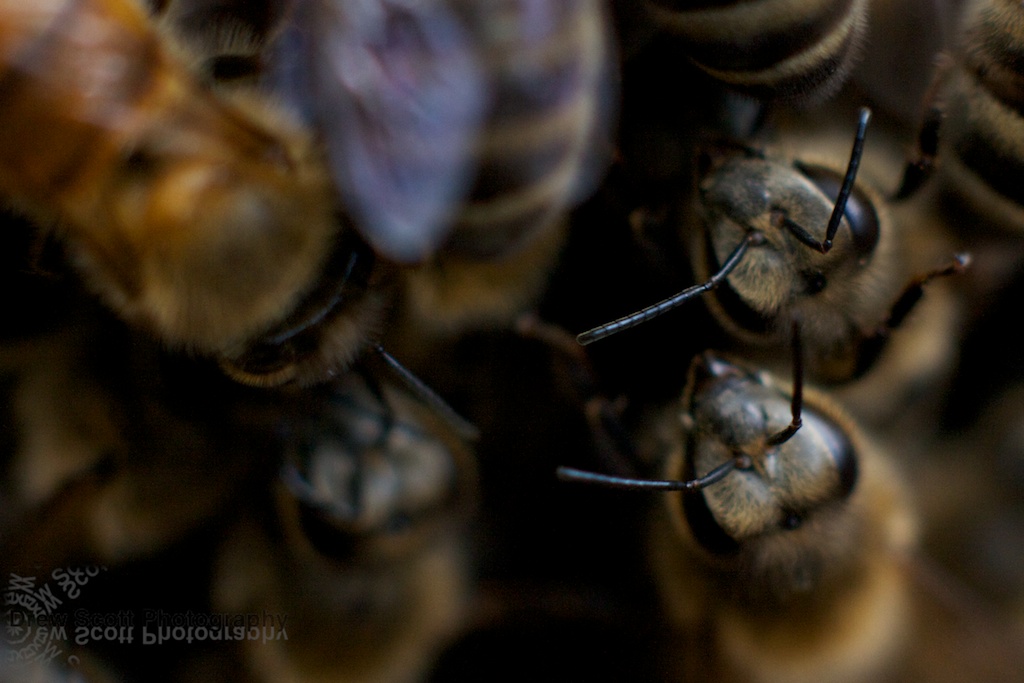
Trophallaxis

I got very excited when I saw this one. It’s trophallaxis! (A fancy word for bee food sharing). You can see their tongues meeting.

Workers will constantly pass nectar around, so the aroma of their shared food ends up giving bees in a colony a shared scent. One of the ways a guard bee patrolling the hive entrance recognises fellow colony members is this common smell. If several colonies are close by and sharing large areas of a single crop such as oil-seed rape, they will often become irritable because lots of drifting occurs and they cannot tell each other apart.

Trophallaxis more often takes place by an older worker giving to a younger worker rather than vice versa. One bee will beg from another by pushing its tongue towards their mouth parts. The giver bee will respond by opening her mandibles, regurgitating a drop of nectar and pushing it forward on her tongue. During trophallaxis the antennae of the two bees will touch (as you can see happening here), allowing them to pass on scent messages such as queen substance. It’s all about communication as well as getting a snack.

This plump larvae had been accidentally damaged as we inspected. I removed it from the hive but this worker continued to tend to it, licking it with her proboscis. I imagine it would have been giving off distress pheromones as it became exposed to colder air, in the same way as I squeal if the duvet gets pulled off me on a cold winter’s morning. You can see its segments – one of the signs of a healthy larvae.

Thanks Drew!

Queen news

On Monday our local bee inspector, Caroline Washington, visited our apiary for her routine annual inspection. On Monday evening Emma and I received this e-mail from Andy:

“when Caroline checked the hive, we found an emerged queen cell in the bottom corner of one frame. Caroline then spotted a queen. very dark coloured. the frame that we put in had not got q cells pulled out on it, indeed the section that was prepared for q cells were being repaired!

no sign of new eggs (the eggs we transferred had not developed, probably too cold and they’ve perished, but it will be very interesting to see what happens next!! maybe the new q. will fly, mate and be OK or you may prefer to buy one in so as to be sure and get them going again asap.”

So we have a new queen in there already! Sadly, she couldn’t have emerged into worse weather. After a winter so dry a hosepipe ban got put into place, it now won’t stop raining. Wet, windy, miserable…classic British April weather. And utterly useless for queen mating. And the forecast is…more rain. It seems relentless. Poor new queen.

Posted in Bee behaviour | Tagged , | 22 Comments

EFB or not EFB? And the answer is…

We were really lucky today that Andy Pedley was able to come down and help us. As well as being incredibly experienced he has such a kind and patient manner. I felt better as soon as he started going through our hive. I was also lucky because Drew has just got a new lens and came down to take photos. Stand by for an exponentially better standard of photography than you normally see here.

Andy used tweezers to pull out suspicious looking larvae. The larvae he found were mostly drones. After pulling them out he exposed their guts with the tweezers – they were yellow, which he told us is a good sign. The yellow comes from the pollen in their food. For hygiene reasons each larvae inspected was discarded into the smoker.

Removing larvae with tweezers

There were a few larvae which were a bit slimey and gooey, which Andy didn’t like the look of so much, so he tested for EFB using a kit just in case.

One larvae at a time should be shaken in the testing fluid, then a pipette is used to extract some of the liquid and place a couple of drops on the yellow testing device.

EFB testing - shaking

It works like a pregnancy kit – you wait three minutes, and then either one or two blue lines appear. One line indicates a negative result, two lines a positive. Andy did a few tests on different larvae and they all came back with one line. Yay!

EFB testing

Andy’s conclusion – the dead brood had been chilled, probably because Rosemary had become a drone-layer. The colony had become over stretched and there were not enough nurse bees to look after them properly. They’re not in great shape, but there’s no bacterial disease.

Queen Rosemary – her last moments.Bye bye Rosemary

Andy took pity on Emma and me and dispatched Rosemary for us in water with a bit of washing up liquid in. She could no longer be any good to our colony without the ability to lay worker eggs. Here’s a last shot of her, proboscis out. It looks like she’s missing a segment of her right front leg in this photo, but I checked back through the other photos and it’s just the angle of the shot.

With Rosemary gone, we were able to take a frame of eggs & young larvae from our healthy hive and transfer it into the struggling hive. The idea is to provide the bees with young worker larvae which they can draw out into a replacement queen cell.

Andy selecting a suitable brood frame from Lavender’s hive. I love the light shining through. This is fresh new wax the bees have drawn out in the last three weeks.
Andy holding a frame

Andy holding a frame

Even some of the bees flying around the frame are in focus! Trust me, that is not easy. Go Drew.
Andy inspecting

Andy inspecting

Me brushing bees off the frame Andy had selected. It had a gorgeously even brood pattern. Apart from some nectar nearly every cell had an egg or larvae in. After I had brushed most of them off Andy shook the rest back into Lavender’s hive.

Brushing a frame

Before putting the frame into Rosemary’s old hive, Andy did something I would never have thought of. He selected a couple of tiny 1-2 day old larvae and made a space beneath their cells by pressing down on the wax with his finger. He said this would encourage the workers to draw the larvae out into queen cells. Top tip!

Andy making space for a queen cell with his finger. Next weekend we will need to check if they’ve made queen cells. If not, we will either need to find a replacement queen from somewhere or combine the bees with Lavender’s hive.

Andy making space on the frame

Lavender’s hive

Back in Lavender’s hive, we needed to carry out the next step of the Bailey comb exchange, which we started three weeks ago. They have drawn out about five frames in the top brood box and Lavender has been laying well up there.

First we started trying to locate her – not easy, as her marking had worn off. But Emma managed to spot her pretty quickly, and we marked her again. A queen excluder was put between the two brood boxes, and Lavender released in the top box. The brood below will hatch out in the next 21 days, leaving the colony with brood in the top box only. We can then remove and destroy the old brood frames below, leaving the colony with a fresh set of brood frames.

Emma and Pat

Emma and Pat

While this was going on, Pat, who you can see in the photo above, was busy shook-swarming someone else’s bees the day before he leaves on holiday to Australia and New Zealand for the next six weeks. Now that’s dedication! You can see Emma in the background, somehow managing to make a bee suit look stylish. I think the pink accessories help.

Thanks to Andy, a very successful day’s beekeeping! What a relief.

Posted in Disease prevention | Tagged | 28 Comments

Trouble in bee-land

I had the day off today so went down to the apiary to take a look in the hives, as several days of rain plus work have meant there haven’t been many chances for Emma and me to inspect. Today was the first chance since starting the Bailey exchange two weeks ago.

As I opened Rosemary’s hive, I was expecting her drone laying to have got progressively worse, and to possibly find a supersedure cell as a result. Sadly I found something worse –   brood disease. I’m not sure what type of disease yet. Hopefully maybe John or Andy or someone else more experienced can have a look at the weekend, and see if we need to call in Caroline, our local bee inspector.

I didn’t see Rosemary or eggs, but I did see uncapped larvae – but it didn’t look healthy. Some of the larvae looked dried and crusty. Some of them looked bloated, twisted and lacking in the segmented definition of a healthy larvae. There were some perforations in the wax cappings – a bad sign as it means the workers have recognised a diseased larvae and are trying to remove it. Some people online have suggested chalk brood, but it doesn’t all look like the photos of chalkbrood to me. What do you guys think?

These bees are usually so calm that we hardly bother smoking them, but today I smoked them a few times. They were irritable. They have no healthy brood, and possibly no queen – certainly not a worker-laying queen. There was a thin film of honey over some of the stored pollen, something Ted Hooper mentions in his Guide to Bees and Honey as a possible sign of queenlessness, as the honey preserves the un-needed pollen from going mouldy. The workers returning to the hive were not bringing pollen in.

Seeing the diseased brood reminded me of how inexperienced I am. It seemed to have a whole mix of different problems, not like the photos I’ve seen illustrating one particular issue. Books help give a background to what you do, but they’re not a substitute for having seen this sort of thing before with your own eyes and hives.

Hopefully John or Andy or someone else who knows what they’re doing can take a look this weekend and see if we need to call Caroline, our local bee inspector, in. We will need to call her if European or American Foul Brood is suspected. I am worried that it may be EFB as the brood looks a bit similar to the EFB photos in the FERA ‘Foul Brood Disease of Honey Bees‘ leaflet. It is an E-arly brood infection, killing larvae before they’re sealed in their cells. The culprit is a mass of bacteria inside the gut of an infected larvae, which can cause death from starvation. The brood pattern will often appear patchy and erratic as dead brood is removed by the bees. When an uncapped larvae dies it lies in an unnatural attitude suggesting pain – twisted spirally around the walls, across the mouth of the cell or stretched out lengthways. The remains may dry to form scales, which are variable in colour, loose and somewhat ‘rubbery’, unlike the hard black scales of AFB. I hope I’m wrong and it is just chalk brood as EFB is nasty stuff.

After inspecting Rosemary’s hive I changed my gloves and hive tool before looking in Lavender’s in case I transmitted infection. It was so nice to see that they at least are doing well, Lavender is laying superbly and they are getting on well with drawing out comb following the Bailey comb exchange. Tons of bright yellow, orange and even greeny pollen was being taken in.

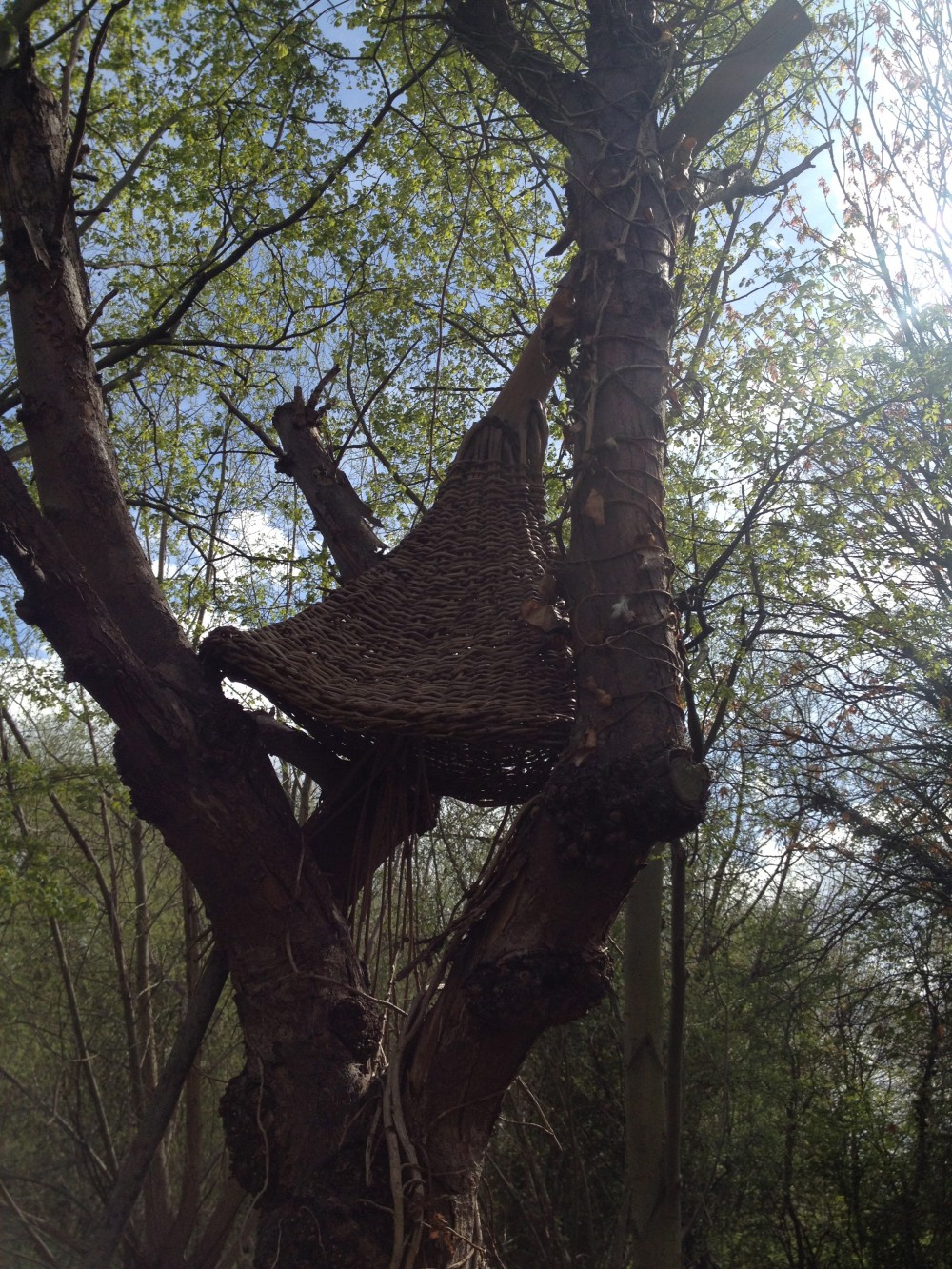
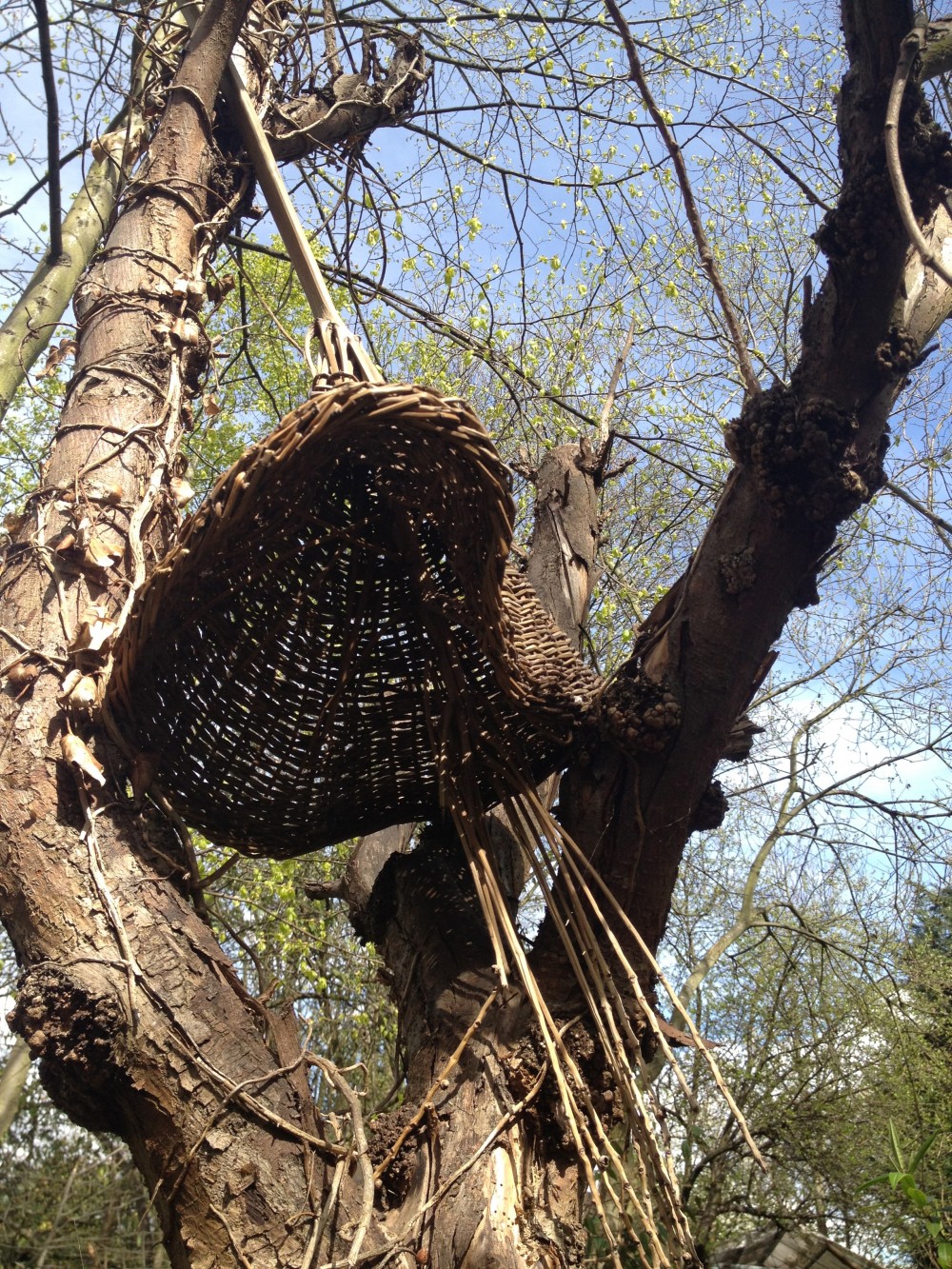
I noticed this gorgeous object up in one of the apiary trees. I think it must be a swarm trap.

I love this view as I leave the apiary on a sunny day – blossom and rushes. Even next to a busy dual-carridge way some beautiful things can exist.

Posted in Disease prevention, Uncategorized | Tagged | 41 Comments

Lavender on the loose

Our first inspection of Lavender’s hive since last autumn…
Hive inspecting (Lavender's hive)

Doing well! So much better than Rosemary’s hive, with plenty of eggs and full frames of evenly laid, biscuit colour, worker brood. Below is an empty drawn out frame with some honey stores towards the bottom. The comb is darker in the centre so probably had brood in last summer.

We had gone all the way through the hive and started the Bailey comb exchange, but seen no Lavender. We assumed she was hiding at the bottom of the hive. Then one of the beginner beekeepers with us, Rosemary, pointed her out on the crownboard we’d taken off to inspect. We had given the underside of the crownboard a quick check for her when we took it off – as John and Andy have drummed into us to do – but obviously missed her as her white dot had nearly worn off. We got such a shock! It just shows why placing the crownboard over the upturned roof while you inspect, rather than propping it up against the hive where the queen could drop off, is such a good idea. Thank you Rosemary for spotting our queen!

Below you can see Lavender perched happily on Emma’s hand. I know I’m biased but isn’t she a beauty? A lovely long dark queen. It looks like one of her attendants is feeding her.

Queen Lavender perched on Emma's finger

The next drama was that one of the other ladies with us, Sarah, got a bee up her trousers. She got it out but I think sadly got stung in the process, ouch. Hope she’s doing okay and the sting’s gone down by now.

Emma has done a great blog post with more photos from the day: http://missapismellifera.com/2012/03/30/bailey-comb-change-for-spring-bees.

Posted in Uncategorized | 25 Comments