2nd Honeybee Management revision post: how to begin beekeeping

This is a 2nd revision post for the British Beekeeping Association’s Module 1 exam, Honey bee Management, which I’m taking in March.

I’m skipping forward a bit on the syllabus, onto:

“The Candidate shall be able to give a detailed account of:-

1.6: how to begin beekeeping, including the acquisition of bees, sources and type of personal and other equipment, the approximate costs of equipment and bees and any precautions necessary

This seems easy now, but wasn’t to start with. How to begin? Let’s break 1.6 down a bit.

How to begin

It’s a good idea to find out if beekeeping is really for you before going ahead and spending several hundred pounds on equipment and a few thousand little faces peering expectantly up at you. Some ways to gather information first:

  • Join or at least start visiting a local beekeeping association (in my case the Ealing and District Beekeepers Association, where I keep my bees). Depending on the weather, they should be able to show you inside a few hives.
  • Take a basic beekeeping course, which many associations run annually
  • Read some beekeeping books for beginners, for example Bees at the bottom of the garden (2001) by Alan Campion, which was the first beekeeping book I purchased as part of the Ealing basic course. I now have around 20 books…Keeping bees and making honey (2008) by Alison Benjamin and Brian McCallum is another good one for beginners, lots of photos. Both of these are UK oriented. Beekeeping techniques vary greatly depending on your climate, so buy a book focused towards your local area.
  • Read the British Beekeeping Association (BBKA) About Beekeeping leaflet by Roger Patterson

The acquisition of bees

Once you’ve got to know the local beekeepers, taken an introductory course, opened up a few hives and drunk a lot of tea, you should feel ready to take the first step of getting your own bees. I cheated here – a nice lady called Ann Fox very kindly gave me mine. Most people will need to either buy their bees, as a nucleus or full colony, or wait for a swarm.

– Buying a nucleus or full colony

Most books recommend starting in spring with a nucleus, which is a manageable size for a beginner and you can then watch them expand as the year goes on. A nucleus is a mini hive, containing 4-5 frames of bees and a laying Queen, with healthy, disease-free brood and stores. Keeping the bees in a nuc helps keep them warm during nippy British springs, as it is a smaller space to heat. Once your colony grows and fills all the available space you’ll want to move them into a full size hive. So starting with a nucleus does mean quickly needing to buy more equipment, but then spare equipment is always handy. Below is a pic of our nucleus in May 2011, following an artificial swarm to split one hive into two.

Below are our bees travelling up from the nuc into their new full sized home (we’d already shaken most of them in).
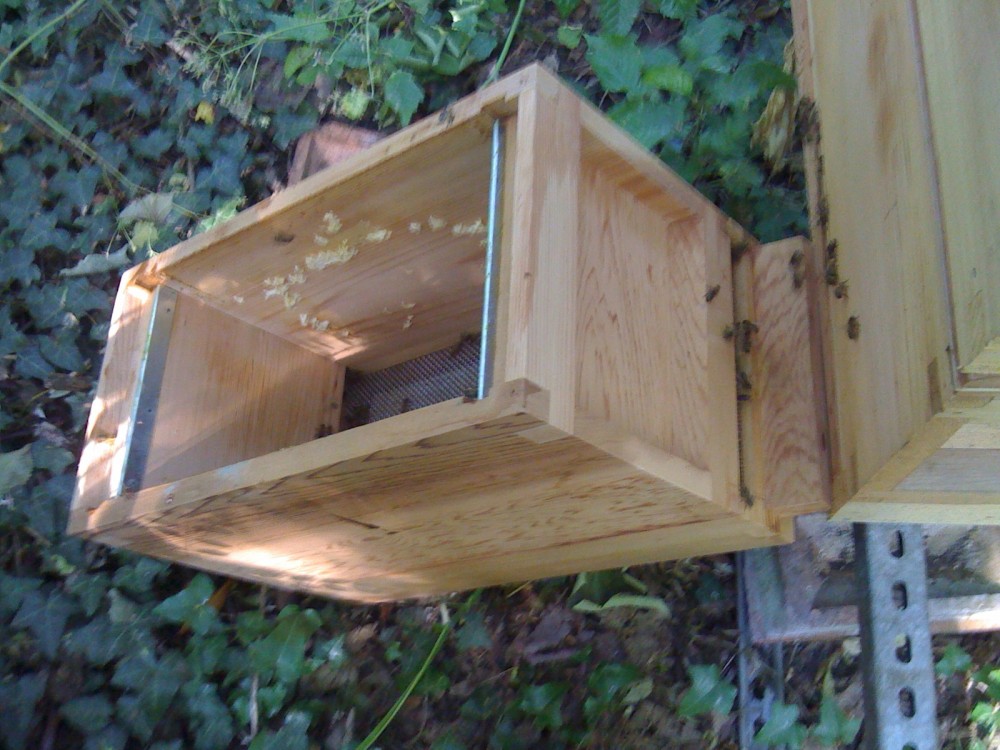
The last of the nuc bees slowly proceeding into their new home

Be careful where you buy your bees from. It is easiest to buy your bees from a local beekeeper who you know and trust and can easily talk to if you have any problems. This way the bees will also be suited to your local climate.

Of course this is not always possible, in which case you need to go to a commercial supplier. The British Beekeeping Association forums have had posts by beginner beekeepers who have been unlucky enough to buy bees from dodgy suppliers – for example, ‘New hive no queen‘. Sometimes suppliers will throw together an imported queen with unrelated bees, which can lead to the queen being rejected and killed by the workers during the stress of transportation. The BBKA has produced Nucleus guidelines which beginners should read before buying. Any substandard nucs should be photographed on arrival and the supplier informed immediately.

– Waiting for a swarm

The patient beginner beekeeper can get a hive ready and wait for a swarm. Beekeeping associations often keep a list of people looking out for one. In the UK they’re likely to turn up between May to August. The main advantage is obviously that they’re free! A potential disadvantage is that they may be bad tempered or carry disease – you take what you’re given. A swarm should be housed away from other colonies at first and monitored for any signs of disease. It helps the colony if you feed them a weak sugar solution, but wait 48 hours until wax-building and foraging are under way before feeding. This ensures that any disease contaminated honey brought in the bees’ honey stomachs is used as energy for wax secretion and not stored in the frames.

Sources and type of personal and other equipment

My previous post on the hive types and frame sizes used in the UK covered some of the hives available. It is often easiest to pick the hive most commonly used in your local area. This means you can take frames from a neighbour’s hive and put them in your own if needed, for example if your hive has become queenless and you need eggs for your bees to raise a new queen. Most beginners in the UK use a National.

A list of equipment needed:

For the hive 

  • A stand to place the hive on, to lift it 15-18 inches off the ground
  • Hive floor (preferably open mesh, so that varroa mites fall through)
  • Brood box(es)
  • Brood frames and foundation – 11 frames in a National box; awkwardly frames come in packs of 10
  • A dummy board – these make inspection easy
  • Queen excluder
  • Super box(es)
  • Super frames and foundation
  • Crown board
  • Clearing board/bee escape for harvesting
  • Roof
  • Entrance reducer for the autumn
  • Mouse guard for winter
  • Feeder

For inspecting the hive

  • Smoker – a large one stays alight longer
  • Bee suit – light-coloured
  • Gloves – these can just be rubber washing up gloves, which are easier to clean than more expensive leather ones
  • Hive tool
  • Wellies – good protection against moody bees
  • Bucket and washing soda to keep hive tool etc clean (if inspecting multiple hives)

The approximate costs of equipment and bees

Often expensive, but I’m told not as expensive as golf.

A nucleus from a commercial supplier containing the nucleus and bees can cost £130-175; less if you buy one from someone nice locally.

A flat pack National hive on its own costs around £125. A kit of an empty hive plus suit, gloves, smoker, feeder and hive tool from a big national supplier like Thornes will cost around £275-350. A fancy Omlet Beehaus costs £495, so be really sure you like bees before buying one of these. A boxed package of 10,000 workers and a laying queen can then be bought separately and placed in the hive. The disadvantage of packaged bees is that they only contain feed, not brood, so you need to wait three weeks before the colony has new young bees.

Second-hand hives sold locally or online will be cheaper, but beware of old wood containing disease or lots of holes, which wasps or other bees could get through to rob. One tiny hole in a super could lose you your entire honey harvest during the 24 hours you put your bee escape on before taking the super off, as I know from personal experience (arrrgh). Especially avoid second-hand brood frames. They may look fine, but nosema spores are invisible to the human eye.

Clever people can save money by constructing their own hives. Drawing plans for many types of hives are available online. Check that you are using plans compatible with the frame sizes or any other equipment you plan to buy.

Another way to save money is buying equipment through your local association. Because they are buying in bulk, they can get discounts from suppliers, which they can then pass on to you. Similarly a new honey extractor costs a lot of money, but associations often loan them out to members on a rota basis.

Taking all this into consideration, you can see that initial costs can vary greatly depending on how you go about things – whether you buy bees or wait for a swarm, what type of hive you choose, whether you buy it new or make it yourself. For a beginner buying everything new, in 2012 the costs could easily come to £400-£500 for your bees and equipment, and more if you buy a fancy Beehaus hive.

…and any precautions necessary

Take into account your neighbours. If your next door neighbour is highly allergic to bees, maybe you don’t want to keep bees in the bottom of your garden (even if they are really annoying). Also bear in mind local restrictions, for example not all allotment managers allow bees on allotments so check first.

Make sure you have enough spare time to look after your bees properly, especially in the summer. Your neighbours won’t appreciate your bees constantly swarming, and other beekeepers won’t be pleased if your bees are spreading disease.

Joining either the BBKA or a local association that is a member of the BBKA will provide you with public liability and bee disease insurance as well as other membership benefits like the regular magazines. As a beekeeper, you need to ensure that you are protected should you or your bees be accused of causing damage to other people or their property, whether the event relates to your apiary, collecting a swarm of honey bees or participating in a show. Bee disease insurance covers against losses of beekeeping equipment as a result of notifiable honey bee diseases.  The joining fee is small – £33 annually for the BBKA at the moment.

Beekeepers in England, Scotland and Wales can sign up to Beebase, run by the government’s National Bee Unit. You will then receive a free annual visit from a qualified bee inspector who will check your hive for any signs of disease or pests. We’re very lucky to have such a scheme and it’s well worth taking advantage of.

Posted in Colony management, Exams | Tagged , | 7 Comments

1st Honeybee Management revision post: hive types and frame sizes used in the UK

This is a 1st revision post for the British Beekeeping Association’s Module 1 exam, Honey bee Management, which I plan to take in March.

Over the next few months I’m going to aim to do a post on each item on the syllabus, starting with:

“The Candidate shall be able to give a detailed account of:-

1.1 the types of hives and frames used by beekeepers in the United Kingdom, including comparative knowledge of frame sizes of the following hives, National, WBC, Smith, National Deep, Commercial, Langstroth and Dadant.”

I find it quite annoying that we’re being asked to memorise frame sizes – in real life I cannot imagine how this would be useful. If I really need to know the different frame sizes, I can look them up on the internet. But it’s point 1 on the syllabus, so here we go…

Langstroth

Named after the famous Rev. Lorenzo Langstroth, who is credited with having being the first person to use the concept of ‘bee space‘ to have removable frames in a top-opening hive (a few European side-opening hives had previously used bee space).

Langstroth realised that bees will leave a gap of about 6mm (0.25 inches) – 9mm (1/3 inch) between frames unfilled with either propolis or comb, instead leaving it as a space for themselves to walk around in. Spacing out the frames appropriately therefore allows beekeepers to inspect with ease (in theory!), rather than finding all the frames stuck together with burr comb or propolis. His patent is available to read online via Google Patents.

His idea revolutionised beekeeping and made it possible as a commercial industry; since he patented his design in 1860 a top-opening, removable framed hive has become the standard choice for around 75% of the world’s beekeepers. The National, Smith, Commercial etc are all variations on Langstroth’s original design, with a few differences here and there – mainly in the size and number of frames used. Langstroth’s original dimensions are popular with commercial beekeepers and used extensively overseas but not so much here in the UK.

Brood frames – 10
Brood body dimensions – 508 x 414mm
Max no. of bees per brood box – 61,000
Comb area (inches sq) – 127

National (also known as the Modified National)

This is what me and Emma, and the vast majority of beekeepers in our apiary and across the UK use, as shown in my photo below.

So why is the National so popular in the UK? Well, it’s a practical, simple, single-walled design. It has handy grooves in the side acting as hand grips to lift the boxes with. Some beekeepers find one National brood box too small – one is designed for a colony no larger than 55,000 bees – and add an extra brood box (for a double brood system) or an extra super as a brood box (brood and a half). As you can see in the photo above, Albert had his New Zealand bees on two brood boxes and two supers this summer as they were a large colony. Giving bees more space can help prevent swarming.

Brood frames – 11
Brood body dimensions – 460 x 460mm
Max no. of bees per brood box – 55,000
Comb area (inches sq) – 93

National Deep

To prevent having to use a double brood or brood and a half system for bigger colonies as mentioned above, National Deep brood boxes were created in a 14 x 12 inch size, giving a brood space slightly larger than the Commercial or Langstroth. This does make it heavier to lift.

Brood frames – 11
Max no. of bees per brood box – 72,000
Comb area (inches sq) – 143

WBC

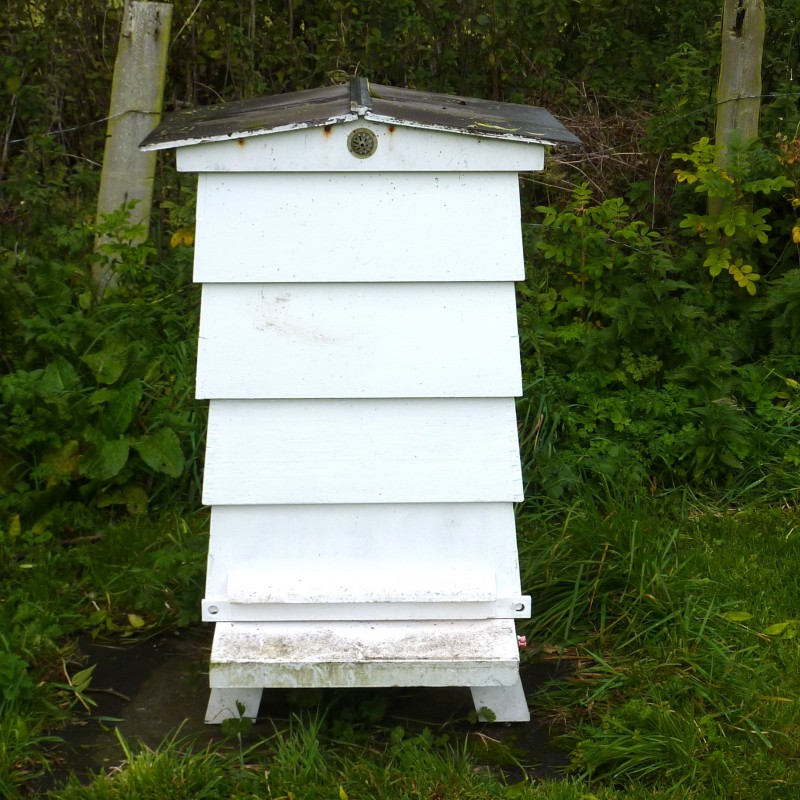
Named after its inventor, William Broughton Carr, this is the classic English country garden style beehive.

WBC hive

(Photo from English bee suppliers www.stamfordham.biz)

Is it not a thing of beauty? But rarely used nowadays as its double-walled design makes it cumbersome to move and inspect. Inside is a standard box shape hive which provides a small brood chamber suitable for a colony no larger than 45,000 bees.

The extra wall insulation makes it good in cold winters; however this can also mean it takes longer for the hive to warm up in the early spring sunshine. The extra wood also means extra cost – Thornes are currently selling a assembled WBC for £351.27 compared to £266.42 for a National or £298.02 for a Deep 14″x12″ National.

Brood frames – 10
Brood body dimensions – 460 x 419mm
Max no. of bees per brood box – 45,000
Comb area (inches sq) – 93

Smith

Mainly used up in the cold wilds of Scotland, and named after their Scottish inventor, W. Smith of Peebles, who originally designed it for heather working. The frames have the same surface area as National frames, but smaller handles or ‘lugs’, creating a slightly smaller box. The brood chamber is suitable for up to 50,000 bees.

Brood frames – 11
Brood body dimensions – 464 x 416mm
Max no. of bees per brood box – 50,000
Comb area (inches sq) – 93

Commercial (also known as Modified Commercial)

These hives have the same dimension as a National, but with no grooves on the side so that the hive is a simple cuboid shape. This allows the frames to be larger, with shorter handles, making the brood box suitable for up to 70,000 bees. The brood box and supers are picked up using small hand holds cut into the outer wall of the hive. These small hand holds can be hard to grip a super full of honey with, so some beekeepers use National supers on top of a Commercial brood box.

Ted Hooper recommends the Modified Commercial in southern Britain and the National in a “colder, more austere area”.

(Photo from Fortune Favors the Bold blog)

Brood frames – 11
Brood body dimensions – 464 x 464mm
Max no. of bees per brood box – 70,000
Comb area (inches sq) – 130

Dadant

Named after a Frenchman, Charles Dadant (1817-1902), who emigrated to America, where he designed this hive, believing Langstroth’s brood box to be too small. Not used very often in the UK, but the favourite hive in France, and popular with commercial beekeepers due to its large capacity. Introduced around 1863, it was used by Brother Adam at Buckfast Abbey to breed his gentle and productive Buckfast bees. It’s the largest Langstroth style beehive available, able to house 85,000 bees in a single brood box. Single walled.

Brood frames – 11
Brood body dimensions – 508 x 470mm
Max no. of bees per brood box – 85,000
Comb area (inches sq) – 159

In summary

A smaller hive is more suited to colder areas and less prolifically laying queens; a larger hive better for warmer areas and strong laying queens. I must confess I find it hard to get very excited over all this talk of dimensions. I also wonder why we are not asked to discuss top-bar varieties of hives, which are perhaps more common in the UK than, say, the Smith. The BBKA is perhaps still a very traditional institution! Think I won’t bother memorising all the frame sizes – all the numbers do my head in – instead will focus on doing well in other areas of the syllabus.

Posted in Exams, Hive types | Tagged | 17 Comments

Happy November bees

Feeling quite satisfied with yesterday’s beekeeping. The following tasks were accomplished:

  • Drinking tea
  • Eating sponge cake with strawberry jam my friend Annie sent from California
  • Purchasing a mouseguard (75p) and putting it on
  • Sawing down our entrance reducer, which was slightly too long to fit in the entrance properly

At first not many of us were down at the hut and I thought we’d have a second slice of cake each. But then lots more turned up and some people didn’t even get one slice!

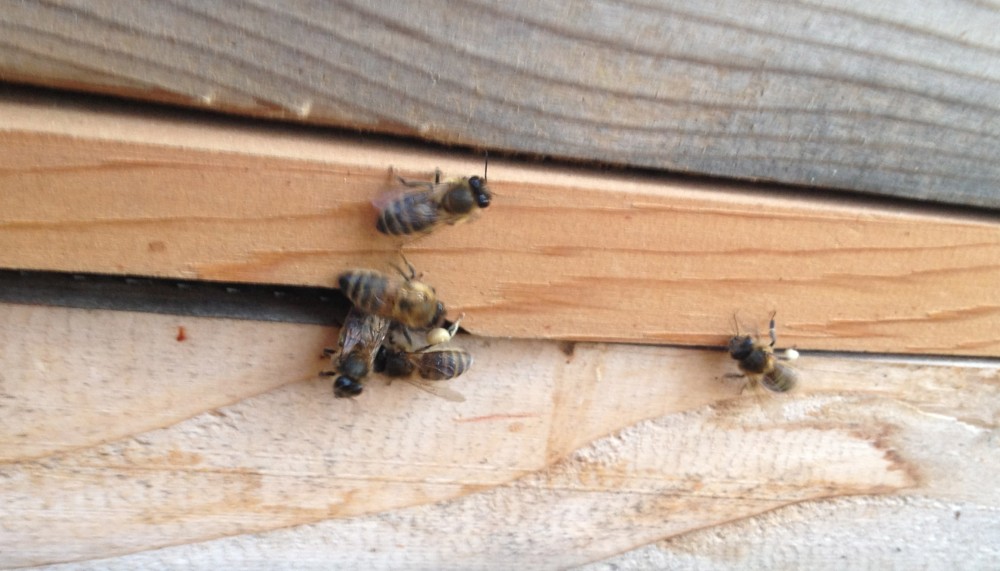
I shot another bee video which only a bee obsessive like me will enjoy watching, it shows our bees coming back with some pollen about 20 seconds in. It only lasts about 40 seconds in total. I’m pleased that they are finding pollen even in November, but hope they don’t tire themselves out too much before the winter ahead. Workers have glycogen reserves in their flight muscles which last for approximately 800km of flight, after these are exhausted the bee is unable to create more and will collapse and die.

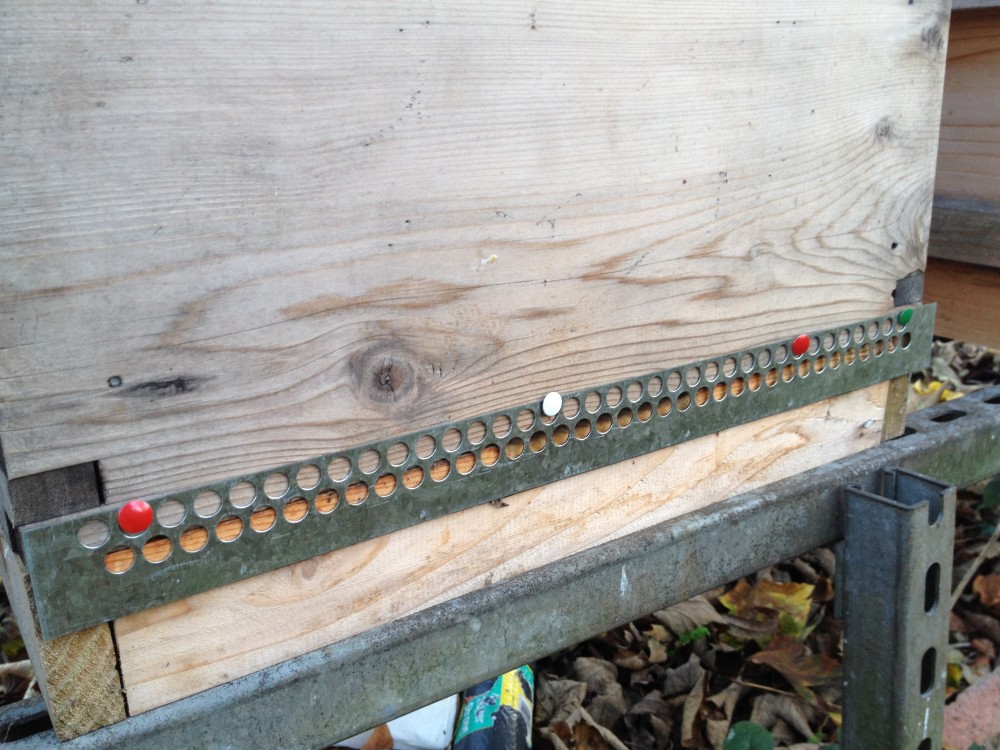
Andy advised me on the right way up to put on the entrance reducer and mouseguard. The thicker edge of both should be closest to the ground. This is so the bees can get out if a layer of dead bees builds up at the bottom of the hive. Something as simple as this can mean the difference between life and death for the colony during the winter. The entrance reducer in the photo and video above is the wrong way up, below is a picture taken after I’d corrected this and put the mouseguard on.

Albert and I had a quick compare of each others’ varroa boards. Think Albert had about 50-60 on his board. There were about 30 mites on Rosemary’s hive board after it had been in for a week. I had a look on the Beebase Varroa calculator to see if this was an ok drop count. It said that the Average Daily Mite Fall = 4.3 varroa mites and the estimated number of adult varroa mites in the colony = between 860 and 1700.

The Beebase ‘Managing Varroa’ leaflet says “in the UK researchers agree that it is wise to aim to keep the Varroa population below about 1000 mites; above this level the risk of damage from the mites, associated pathogens and the effect of feeding on the bees can quickly become very significant. In Europe and parts of the United States, higher threshold levels of around 4000-5000 mites are generally used.” And that a daily winter/spring drop of over 0.5 mites can lead to colony collapse before the end of the season. So our mite levels are probably slightly above recommended levels right now. Andy took a look at the board and said he thought it would be fine to wait to treat until oxalic acid time in December, when we’ll knock the evil buggers hard.

As Andy said, at times of the year when you can’t get in the hive to take a look, the monitoring board can provide a fascinating insight into what’s happening within. At the top of the board, nearest the entrance, is a lot of dropped litter where Rosemary’s brood nest must be. The amount of brood at the moment will be much smaller than in the summer months. But the dropped pollen and wax at the back shows they are busy there too – perhaps storing pollen or uncapping the wax cappings of their honey to eat from their stores. Those of you with really good eyesight may be able to spot the shiny brown dots of the varroa mites, mainly falling down from around the brood nest where they reproduce. The board should only be left in for a week at most as the bees need the ventilation provided by the open mesh floor.

Posted in Colony management | Tagged | 8 Comments

Carol Ann Duffy’s The Bees

On Monday night I went to see our current Poet Laureate, the Scottish poet Carol Ann Duffy, read from her latest collection, ‘The Bees‘.

While I was taking my English Literature GCSE, A-level and degree, I read quite a few of her poems, but she had slipped from my mind since. Until I heard about ‘The Bees’, a collection of poems loosely inspired by bees, some more obviously than others. The recurring motif of the bee is interspersed amongst themes of love, loss, war and politics.

The Southbank Centre was packed out on Monday night. I had booked fairly late so had a seat far up at the back, next to a man who kept muttering to himself. Like me, many of the audience seemed to be lone poetry fans, and it was quite amusing to look down on us all busily reading our pale blue honeycombed editions.

Dressed all in black, jewels glittering at her neck, Carol Ann Duffy came out on stage accompanied by a gentleman whose name I didn’t catch but who played a brilliant trumpet solo to announce her arrival. Throughout the evening he accompanied her on various instruments, many of which I had never seen or heard before. She didn’t talk much, apart from reading from The Bees, but she did say that the bee was an image she found had crept into some of the poems. And that there are wonderful long connections between bees and poets, from Virgil to Sylvia Plath.

The Human Bee – this poem she described as inspired by the problems being suffered in the southern Sichuan province of China, following pesticide poisoning killing all the local bees and forcing local farmers to have to hire people to pollinate their orchards by hand.

The Human Bee
I became a human bee at twelve.
when they gave me my small wand,
my flask of pollen,
and I walked with the other bees
out to the orchards.
I worked first in apples,
climbed the ladder
into the childless arms of a tree
and busied myself, dipping and
tickling,
duping and tackling, tracing
the petal’s guidelines
down to the stigma.
Human, humming,
I knew my lessons by heart:
The ovary would become the fruit,
the ovule the seed,
fertilised by my golden touch,
my Midas dust.
I moved to pears,
head and shoulders
lost in blossom; dawn till dusk,
my delicate blessing.
All must be docile, kind. unfraught
for one fruit –
pomegranate, peach
nectarine, plum, the rhyme1ess
orange
And if an opening bud
was out of range,
I’d jump from my ladder onto a
branch
and reach.
So that was my working life as a bee,
till my eyesight blurred,
my hand was a trembling bird
in the leaves,
the bones of my fingers thinner than
wands.
And when they retired me,
I had my wine from the silent vines,
and I’d known love,
and I’d saved some money  –
but I could not fly and I made no
honey.

Here’s a review of the collection by fellow poet Liz Lochhead: www.guardian.co.uk/books/2011/nov/04/bees-carol-ann-duffy-review and a less positive one at www.guardian.co.uk/books/2011/nov/06/carol-ann-duffy-bees-review.

Posted in Uncategorized | Tagged | 5 Comments

Autumn at the apiary

After a couple of months of yo-yoing odd weather, when summer seemed to be here once again, it’s nearly November and Autumn seems to be properly here now. Crisp, cold days and falling leaves are upon us.

Everyone was at the National Honey Show today, so I had the apiary’s autumn gloom all to myself. Yellow leaves dropped softly down as I walked amongst the hives. The bees were subdued too, just a few coming back home now and again with some pale yellow pollen.

Drew has very kindly given me one of the new iphones, which do videos! Here’s one of our little bees with some of that yellow pollen. Expect to see many, many more badly shot videos on this blog.

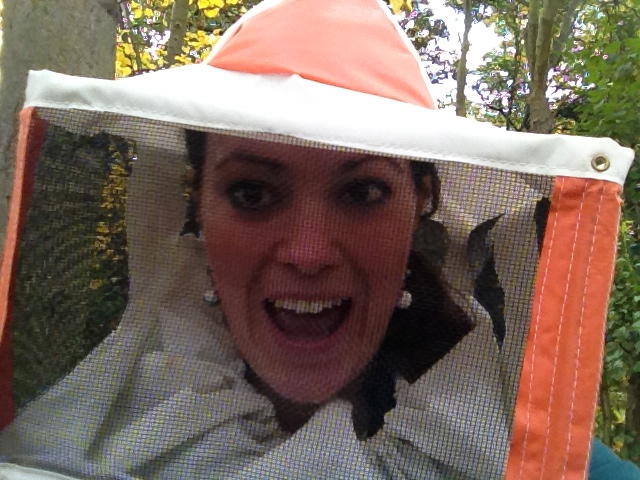
Another great thing about the new iphones is you can take pictures of yourself. Here is one of me looking ridiculous in my bee veil. I like this one in winter when I’m not doing much interfering with the hives, as it is not attached to a suit but just pops over my head. I find this enough protection for simple tasks such as topping up syrup. It just protects me from any bees who might innocently land on my head and get stuck in my hair.

Me grinning like a nutter

Not much to do now in the coming months except hope and check on the hives every so often to make sure they haven’t been vandalised or attacked by woodpeckers. Fondant for extra feed and oxalic acid for varroa treatment in December. Bye bye bees, I will miss you.

Posted in Uncategorized | 8 Comments

Buzz…Paintings and Drawings by Valerie Littlewood

I just wanted to say a few words recommending the work of Valerie Littlewood, a native bees artist who I discovered at the recent London Honey Show.

Her blog can be found at www.pencilandleaf.blogspot.com. It has plenty of information about bumbles and solitary bees as well as photos and her gorgeous illustrations.

I’ve just had her Buzz book delivered, it has an illustration of a different native bee on every other page (15 bees in total) along with accompanying info about the bees’ life. See http://buzzbooknprints.blogspot.com to see inside. The book has a lovely glossy finish. Val sells signed copies for £12.50 plus £1.90.

Did you know the Snailshell Bee existed? The female uses discarded snail shells as nests to lay her eggs in.

Or the Hairy Footed Flower Bee? The males’ extravagantly hairy feet are said to be part of their courtship ritual.

Posted in Bees | Tagged , | 4 Comments

Winter bees advice from Andy Pedley

This month’s Ealing Beekeepers newsletter from Andy Pedley contained some helpful wintering advice which I hope he won’t mind me putting up here, mostly so I can find it again next year:

It’s the end of the season … hopefully colonies are all prepared for the winter; well fed, treated against varroa, in wind and weathertight hives … mouseguards essential, woodpecker mesh desirable. Insulation on top … well, I like to do that! ventilation … no need for matches under the crownboard since open mesh floors came along. Well, thats what I think.

Weather’s on the change … cold & wind predicted (could we have some rain too please?); time now to leave the hives alone, except for an Oxalic Acid Drizzle in December, a belt and braces approach to varroa treatment – has to be when the colony is broodless (the Oxalic will only work if it contacts the mites) and must not be retreated (as the oxalic is toxic to the bees too, they will sustain a single treatment each year but no more.

One colony at the apiary has been found to have high varroa drop, despite apiguard treatment having been applied. Possibly an untreated colony somewhere has absconded, invaded and brought with them their mite burden.

John C. reported a bad tempered swarm a few weeks ago; the temper suggests that they were hungry, so it may well have been a starvation swarm from a colony that had not been able to rebuild its stores after being harvested.

Andy Pedley, October 2011

Posted in Colony management | Tagged , , | Leave a comment

London Honey Show 2011: part 2

A continuation of my previous post on the first ever London Honey Show. I’m going to kick this one off with a few photos:

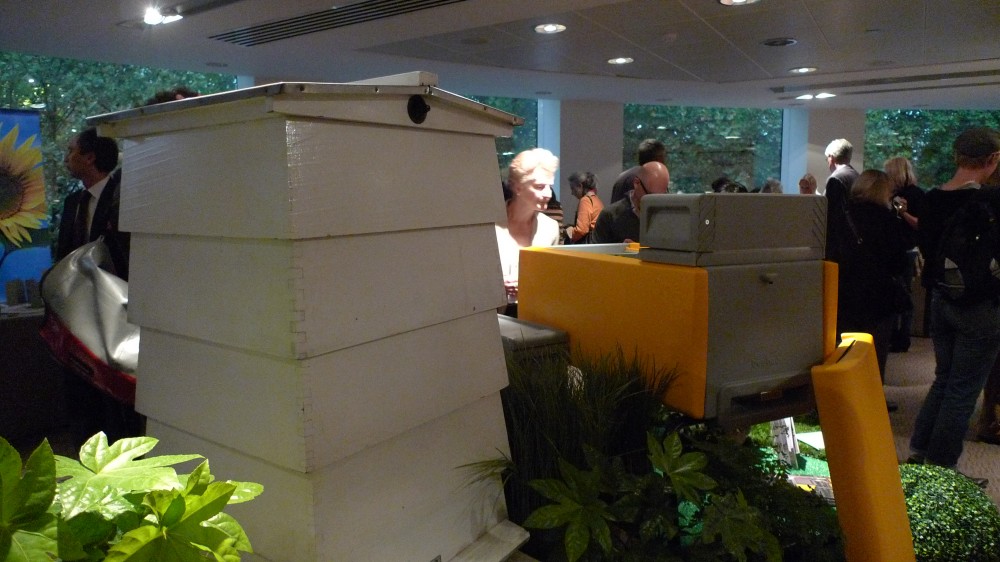
That pretty white hive is a WBC, named after its British inventor, William Broughton Carr. Not the most practical of beehives, but very recognisably a beehive and much nicer to look at than the plain wooden boxes my bees live in. Next to the WBC is a yellow & grey Omlet Beehaus, the plastic hives loved by fashion conscious urban beekeepers.

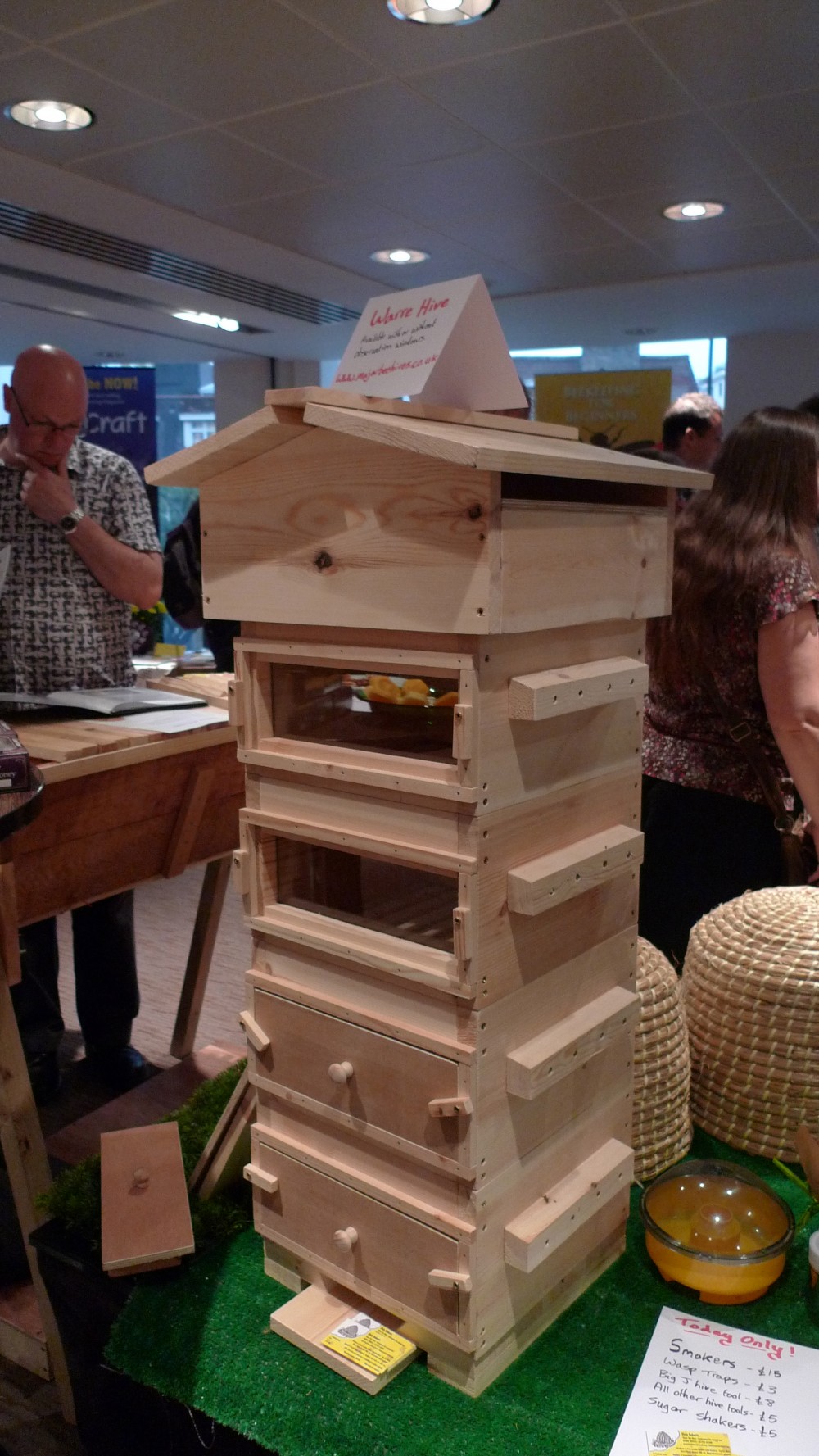
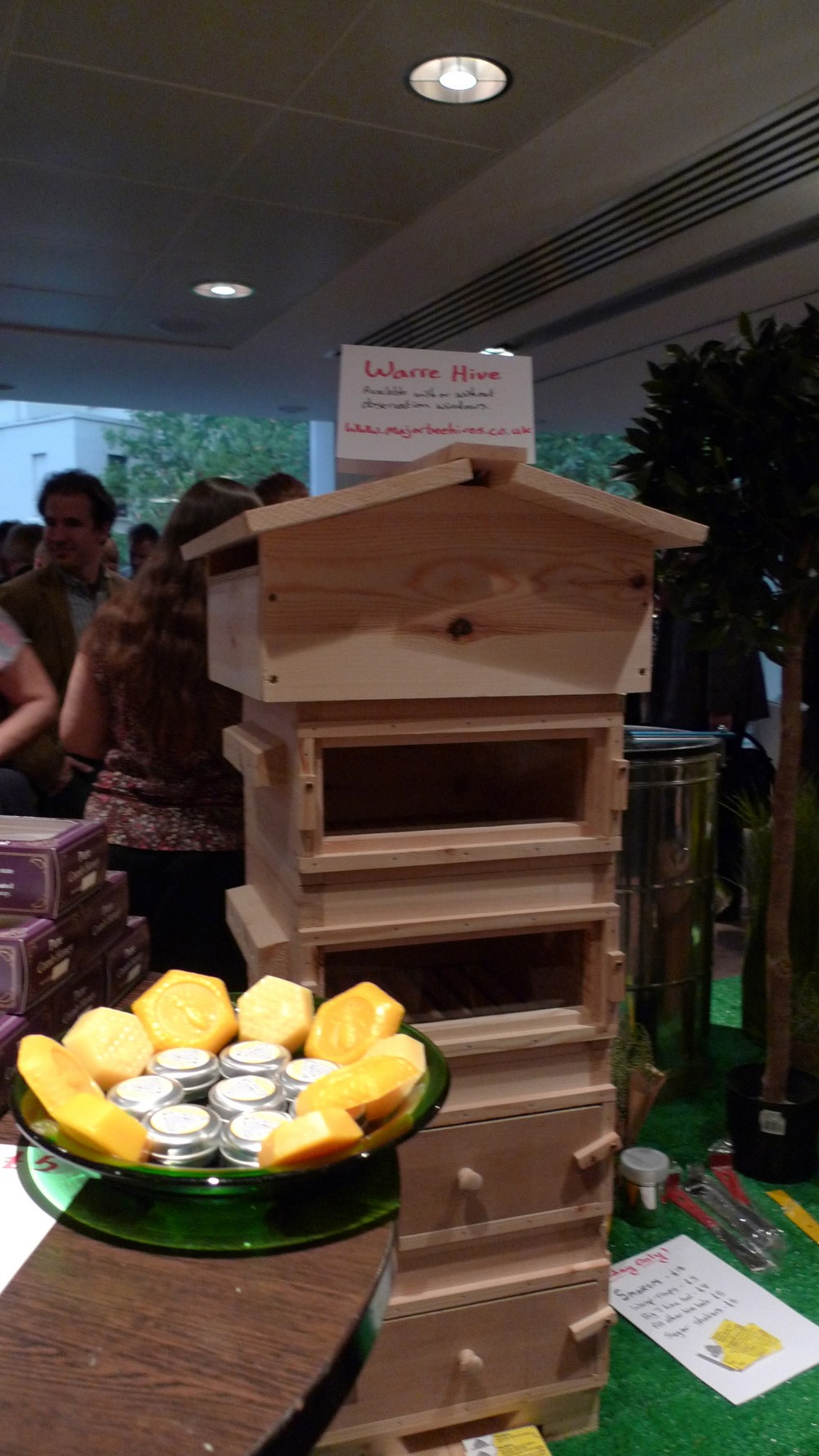
Warre hive

And a couple of the tall Warre hive, a vertical version of a top-bar hive. From the little I’ve heard about them, Warre hives are favoured by beekeepers who like to take a hands-off, minimal inspections approach.

Chris Beale – Chairman of the Pinner & Ruislip Beekeepers
“Marketing Honey & Wax Products (the byproducts of the hive)”

Going back to my talk notes, the third and last talk I attended was by Chris, Chairman of the nearby Pinner & Ruislip association. In Chris’s view, honey, wax, propolis etc are mere byproducts of the main hive product, which is pollination of London’s flowers. His talk gave us some ideas on how to use these gorgeous byproducts produced by the bees. Right now, Chris has 800 pounds of honey sitting in his kitchen, so using it up is on his mind!

Propolis
Quite valuable. Can be distilled in alcohol for a sore throat cure – but watch out, this liquid will burn! It’s a sticky, red-brown substance which bees collect from trees like conifers which secrete resin. It has antibacterial and antifungal properties, which is why the bees use it to cover any large objects in the hive too large for them to carry out, such as mice which have intruded into the hive and died.

Pollen
Can be jarred up and sold for a good price – £4-5 a jar – to people who put it on their breakfast cereal as a cure for hayfever. See the Pinner & Ruislip Association’s page ‘Honey and Hay-fever’ for an explanation of why local honey and pollen might help your hayfever – their website is beautifully designed and well worth looking at for their innovative use of grass imagery!

Mead
Honey and water with added yeast, yeast nutrient, tannin and citric acid. 900g/2lb/5 cups of honey produces about 3 litres (5 1/2 pints) of mead. Retails at £8 a bottle but you need a licence to sell it in the UK – don’t be tempted to sell without one!

Lipbalm
Wax from your honey cappings makes great lipbalm,  but be careful to label all the ingredients in case anyone’s allergic to one of them.

Here’s a lip balm recipe from Collins Beekeeper’s Bible:

Makes 5-6 x 15ml pots
20g beeswax
10g lanolin
10g cocoa butter
10g olive oil
40g sweet almond oil
2 tsp honey (any variety chosen for taste, but try borage or honey blossom)

1. Melt the wax in a bain-marie over a gentle heat.
2. In a separate pan, gently heat the lanolin and cocoa butter, stirring until the mixture is fully liquid.
3. Add the olive and sweet almond oils, stirring over a low heat until fully combined, then stir in the melted beeswax.
4. Remove from the heat and allow the mixture to cool until just beginning to set, then add the honey, stirring thoroughly until fully incorporated.
5. Scoop into pots and leave to set at room temperature.

Beeswax polish
Wax plus turpentine and essence of lavender (to make it smell nice) makes a lovely polish.  But watch out – the turpentine makes the mixture extremely flammable and Chris told us about a local beekeeper who went to answer the phone and came back to find his kitchen on fire. It melts at 62F. The National Trust polish furniture once a year using beeswax polish.

Here’s a recipe from Keeping Bees and Making Honey by Alison Benjamin and Brian McCallum (2008):

Beeswax wood finish (for bare wood)
You will need: 55g (2oz) beeswax, 300ml (1/2pt) turpentine, bain marie.
1. Melt the wax in the bain marie.
2. Remove from the heat source and pour in the turpentine.
3. Return to the heat and give a gentle stir.
4. Cool, and spoon into sealable containers.
5. Warm slightly before applying to bare wood. Apply with a soft cloth, allow to dry, then buff with a wool cloth. Can also be used on leather.

Candles
Thornes make silicone candle moulds, including a Christmas tree candle which can be coloured green to disguise any dirty wax. Beeswax should be melted in a double boiler bain-marie, without coming into direct contact with the water or the heat. The temperature of the wax can be checked with a sugar thermometer. The melting point range for beeswax is 62-64 °C (144-147 °F).

Honey
You can sell this either in crystallised or liquid form, but don’t sell jars with a mix of the two.  If you’re going to sell your honey, it’s worth buying a refractometer to check the water content is low enough to meet legal specifications for honey. If the honey contains too much water, it can ferment and cause the jar to explode. Honey jars must also be clean and full to the top with honey – otherwise people can complain to Trading Standards!

Don’t be tempted to cut in shop-bought honey with your own to make a bit more of a profit. You can easily be caught! Chris told us the story of a British beekeeper who mixed up different types of honey. He was found out because pollen grains from different plants can be identified under a microscope – and British honey does not contain eucalyptus pollen.

Chris’s tip was that nostalgia sells honey. He once had shiny black and gold labels made up which he considered very smart and stylish. Yet when the public saw those labels next to some others he had with a colourful picture of a country cottage, the cottage won every time. And buy tamper proof labels that stick down over the lid. Sell your honey for about £4.50-5.00 minimum a jar – more than supermarket honey, but you have a premium product with real taste and flavour on your hands.

An example of a ‘country cottage’ style honey label, sold for £5.30 for a 100 on the Paynes Bee Farm website.

Country Cottage honey label

I recommend Keeping Bees and Making Honey by Alison Benjamin and Brian McCallum (2008) for lots of info on using your bee products, including extracting/showing honey, making candles and cosmetics/cooking recipes. Or, if you have a bigger budget, the Collins Beekeeper’s Bible, a much heftier tome which you won’t be taking to read on the bus. It contains a whole chapter on ‘Honey and other Bee Products’, including beeswax, candles, propolis, pollen, bee venom and royal jelly, with plenty of recipes.

Posted in Urban beekeeping | 7 Comments

London Honey Show 2011

Yesterday I went to the first ever London Honey Show at the Lancaster London hotel (see www.londonbees.com for the hotel’s bee blog), a celebration of London honey which included a tasting competition, free talks and plenty of honey/bee related stalls to visit. It was a lot of fun! Lovely to see so many beautiful London honeys on display, from pale yellow to deep reds.

My notes from the talks:

Ian Douglas – Telegraph journalist
“Why London is the perfect place to keep bees”

I enjoy reading Ian’s articles on his beekeeping in the Daily Telegraph: www.telegraph.co.uk/gardening/beekeeping. So I was pleased to be able to hear him speak in person about why London is such a great place to keep bees.

Ian reminded us of the literary image of beekeeping as a solitary pursuit, conducted in an idyllic rural retreat. This is typified by the W.B.Yates poem ‘The Lake Isle of Innisfree‘:

I will arise and go now, and go to Innisfree,
And a small cabin build there, of clay and wattles made;
Nine bean rows will I have there, a hive for the honeybee,
And live alone in the bee-loud glade.

And Sherlock Holmes himself, too, retired to Sussex to divide his time “between philosophy and agriculture”, watching the gangs of workers as once he watched the criminals of London. There he produced his magnum opus of his latter years, a ‘Practical Handbook of Bee Culture, with some Observations upon the Segregation of the Queen.’

But despite such literary ideas of peaceful countryside buzzing, Ian told us that in reality urban environments are now the best place for bees. Around 14% of London is green – gardens, parks, trees, with 85 square miles given over to gardens. In contrast, the countryside is now often the home of monocrops, relieved only by strips of hedgerow of varying flower foraging quality. Sussex Downs, for instance, is mainly teasel (a kind of thistle) and grass – great for sheep, ok for bees – but not brilliant. London has a longer season for flowers and provides a more varied diet. One of Ian’s friends recently patiently identified 250 different kinds of pollen on his varroa board.

[The day after Ian’s talk, the BBC ran an article on how the believed to be extinct solitary bee, Halictus eurygnathus, has been re-discovered on the Sussex South Downs. The bees enjoy the greater knapweed there, which is one of the special flowers of chalk grassland. So we need grasslands too – but preferably ungrazed ones – grazing sheep present a risk to the bees’ favourite plants].

Other cities in the world are good for bees too, Ian told us, but none quite rival London. In Paris you have to register with a vet and are put on a national beekeepers register which you can be struck off from for bad behaviour! In New York, beekeeping has only recently become a legal activity. Before, there was a $2,000 fine. So the beekeeping community cannot yet have the same camaraderie we do here. Sydney has the advantage of being varroa free, plus enormous parks, but is just too hot! Ian enjoys a beekeeping blog by a beekeeper in Tokyo who talks at length about the advantages of there being no bears in Tokyo… but Tokyo surely does not have the green space we do. And Milan – well, it would be impossible to find the right outfit to wear.

Ian did not get much honey from his two beehives this year (a Dartington and a plastic Omlet Beehaus) – only 80ml. Nonetheless, he loves his bees and finished by asking us to raise a glass to them, and to London beekeeping.

Tim Baker – Head Teacher at Charlton Manor Primary
“Bees in school; overcoming the challenges”

Tim told us the story of how bees came to his school. Usually a beekeeper chooses to keep bees; in Tim’s case, the bees chose him! He had already created a wildlife garden at the school. Then, in July 2008, a swarm settled on the school’s entrance. Tim was fascinated to see the reactions of the children and staff – the children wanted to watch the bees, the staff were worried about getting stung.

Tim decided the school should keep their new arrivals and contacted the local Ruxley Beekeepers club. Creating an observation hive with openable windows in the brood box and supers was a project he thought would cost £200 and ended up costing nearer £2,000! But it has been well worth it for the enjoyment and learning opportunities it has brought the children.

A pupil competition was launched for a design to paint the hive with. A cute ‘Home Sweet Home’ design won, which can be partially seen in the photo below. The pupils also build the frames themselves and take part in weekly inspections. When honey extraction time comes they borrow equipment from Ruxley Beekeepers and get involved in jarring the honey, which enthusiastic parents buy up almost instantly from the school’s ‘Sweet Pickings’ stall.

Tim recently held a workshop day for other schools to see how the beekeeping is done – many schools from around the country attended, so hopefully many more pupils will get the chance to learn from the bees.

See the Capital Growth website for a pdf version of Tim’s presentation and a case study of the project. The Guardian has a Charlton Manor picture gallery at www.guardian.co.uk/education/gallery/2011/aug/30/beekeeping-in-schools.

Chris Beale – Chairman of the Pinner & Ruislip Beekeepers
“Marketing Honey & Wax Products”

To be continued – I’m getting a bit tired out now, so will type up my notes from Chris’s talk some other time soon! [Edit: see London Honey Show: part 2 for the follow-up post]

Posted in Urban beekeeping | 10 Comments

Heatwave

England is basking in record breaking temperatures for October – Gravesend in Kent set the record at 29.9C. Usually October is winter coat time. You might be getting the gloves and scarf back out of your drawers. Instead everyone is walking around in shorts and flip-flops.

Lovely for us humans, but any good for the bees? Betty, one of the Ealing beekeepers who gets incredible amounts of honey and just won five awards for it at a local show, told me she thinks it will confuse them. They’ll be out tiring themselves out trying to find forage and ivy will be what they find. Ivy granulates very hard so isn’t great for winter stores. Ted Hooper’s Guide to Bees and Honey says: “When the weather is favourable the honeybee works ivy with considerable avidity…Problems have been caused by this as the white honey very rapidly granulates and has been known to dry out so that the bee was unable to use it during the winter. There have also been cases of bees being found with the honey granulated in their honey stomachs, but whether this is cause or effect of death is not known for certain. Pollen loads are yellow-orange.”

The bees were certainly busy when we looked in on them. You can see some stores in the photo below of Rosemary’s hive along with Emma’s stylish pink gloves.

And some more beautiful stores in Lavender’s hive below. You can just see above Emma’s hand a discussion is going on in the background between Andy and Peter.

The discussion got a bit heated, because Peter had decided to start cutting some trees down. He is the apiary’s unofficial gardener, and does a great job growing gorgeous tulips in the spring. However, he is somewhat stubborn and strong willed when it comes to doing things his way. The trouble was, the tree he was sawing through was on course to land on David’s hive, which is the mardiest, moodiest hive in the apiary. I got stung under the eyes by one of his bees a few month ago – they do not mess about.

As you can see from the photo below, one of the branches did land on the hive. Followed a shortly by another which actually knocked half the hive’s boxes off. All the people in the photo below not wearing beesuits very sensibly ran away! Emma and I were suited up so grabbed our smoker and went to the rescue of the bees.

Timber!

Under the circumstances they could have been a lot nastier with us. I was sockless under my bee suit but did not get stung. Luckily only the supers were knocked off, not the brood boxes, so it was not complete chaos. But lots of squashed bees and upside down frames. We carefully put everything back together. The roof was old and had been damaged so we borrowed one from an empty hive and peace was restored.

Despite the tree incident, another enjoyable afternoon’s beekeeping. Bees, cake, tea, sunshine and bagpipes serenading us in the background – what more could you ask for?

Posted in Uncategorized | 7 Comments