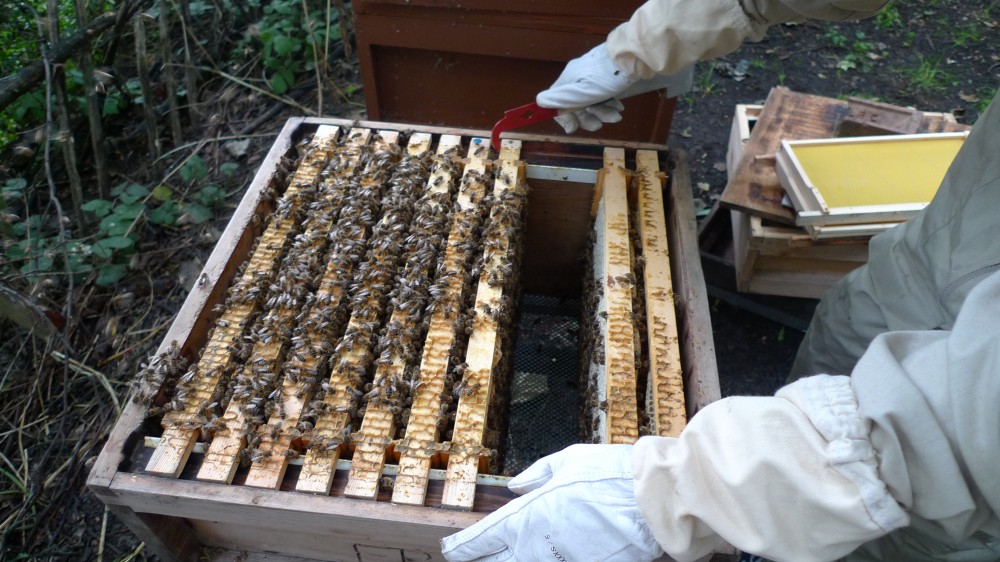
Both hives were doing great today. An audience of learner beekeepers were watching and luckily both lots of bees were on their very best behaviour. They didn’t need smoking and a brave beginner inspecting bare handed received no stings.
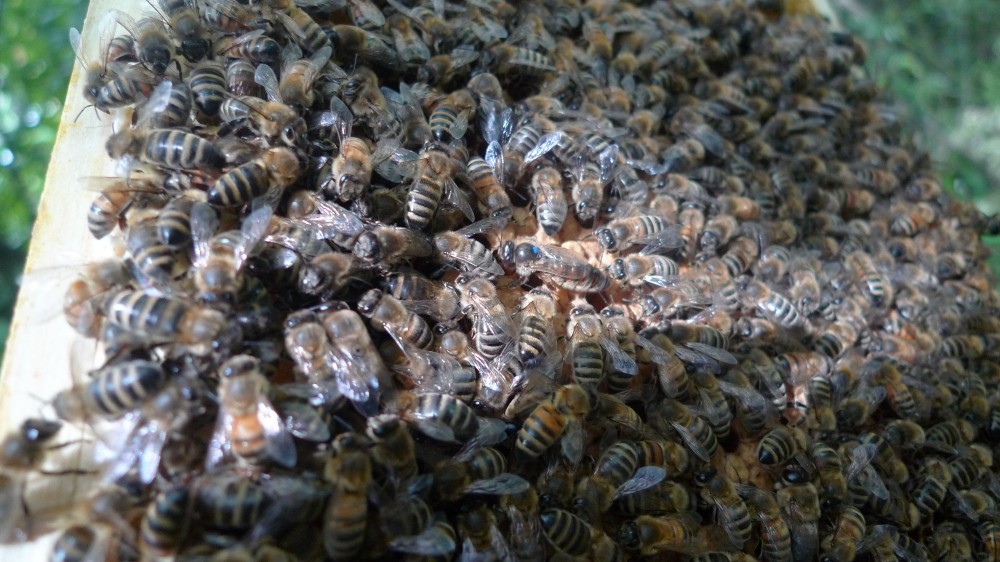
In the bigger hive, with our new queen Rosemary, they are doing really well at filling out the super and it’s very heavy now. We might need to put another super on at some point this month. Rosemary and plenty of brood were spotted. Some of the beginners hadn’t seen drones or a queen before so it was nice to be able to show them the difference.
Inspecting Rosemary's hive
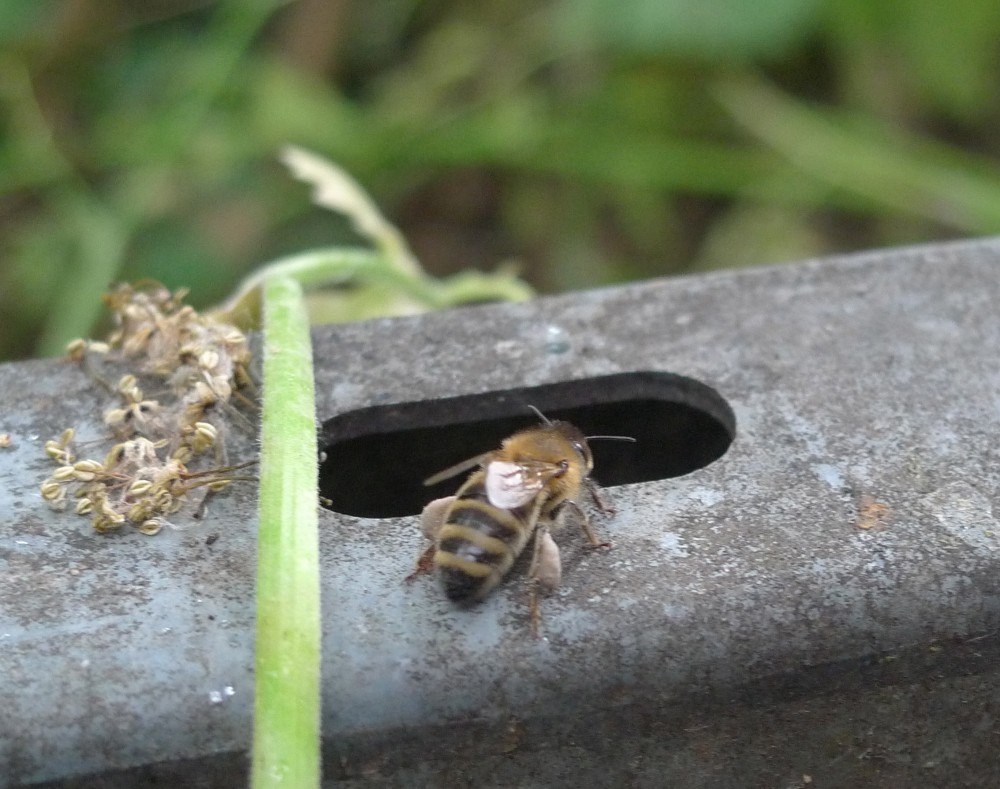
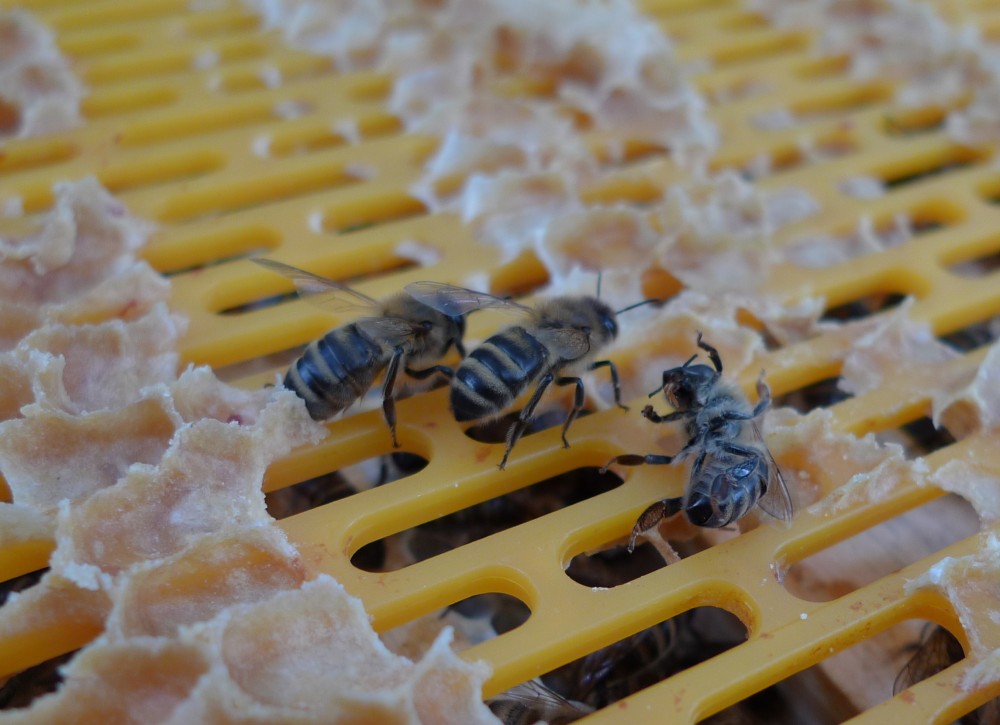
I noticed that the little bee on her back below was very weak. Her fuzziness gave her away as a young bee and she was noticeably smaller than her sisters. I wondered whether, with so many frames of mouths to feed, the nurse bees were struggling to feed all the brood sufficiently? Or could it be the effect of varroa feeding on her whilst she was a larvae? The two bees next to her nudged her a little and touched their antennae against hers.
To close up the hive we smoked the top of the brood box to get them to go down without squashing the ladies, and also used a wedge (door stop shaped) to lever the super down gently. Once the super is in place, the wedge can be slowly pulled out. This week we used sawdust and lavender buds in the smoker, and the smoke seemed to be easier on our eyes as a result, and hopefully easier on the bees’ eyes too. Aromatherapy for bees!
These flying bees belong to Albert. Their queen came from New Zealand last year. Their distinctive golden yellow colour and energetic flying makes them stand out in the apiary.
On to Rose’s hive. Rose is Rosemary’s mum. We did an artificial swarm to split Rose’s hive into two a couple of months ago, when the queen cell containing Rosemary was spotted. Rose is now in the smaller of the two hives. Her hive is doing well – once they’ve filled out a couple more frames we could probably put a super on.
Rose's hive
Here you can see the brave beginner inspecting bare handed, trying his best to find eggs. Eventually he spotted them by holding the frame up to the light. It’s darker under the apiary trees than it looks in the photos.
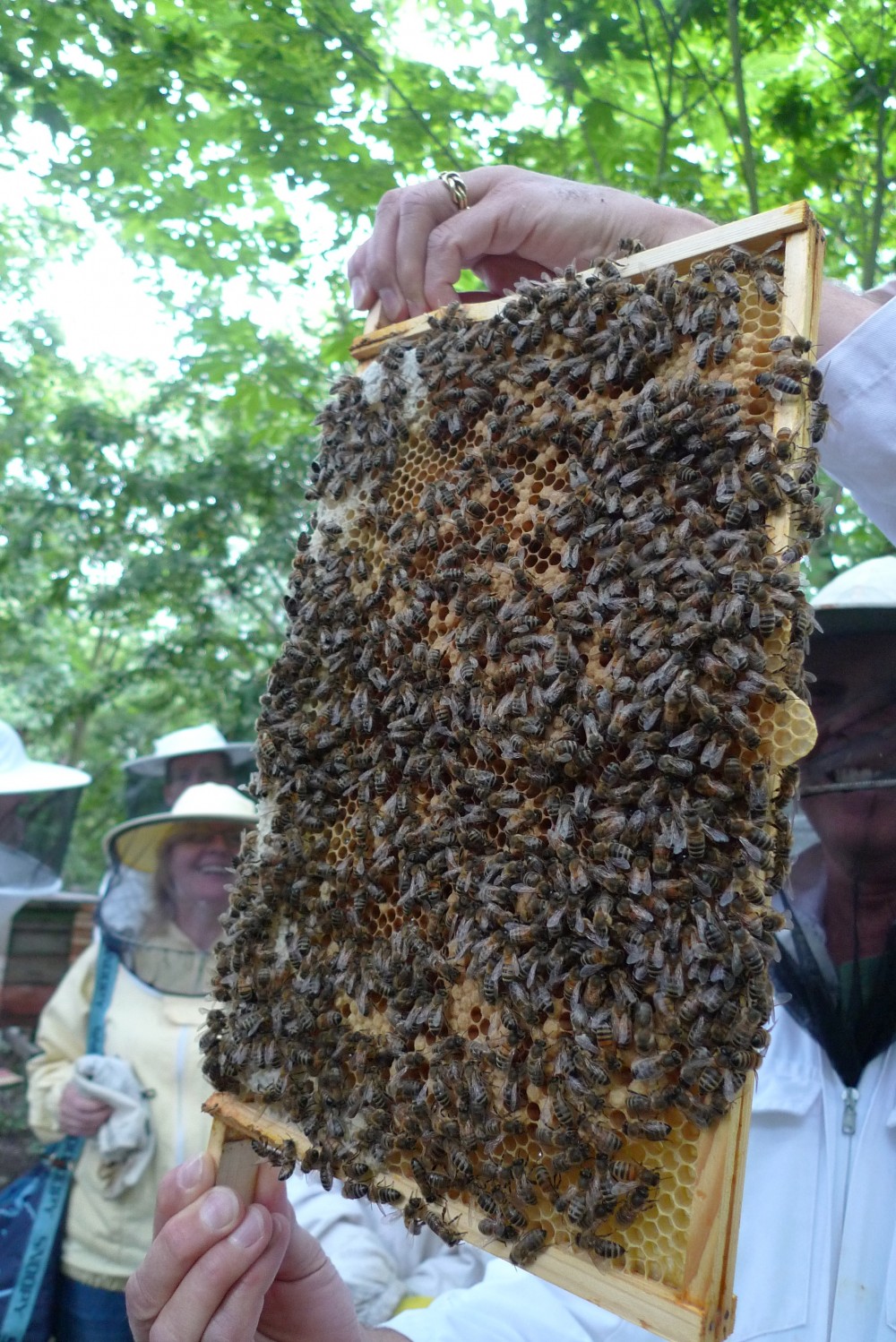
Looking for eggs
Some Ealing association beekeepers are taking their Basic Beekeeping exam on Wednesday, good luck everyone!
My worst beekeeping nightmare came true within ten minutes of me stepping foot in the apiary today. Two prospective beekeepers had arrived and Andy asked me if I could show them round the apiary quickly before they put their beesuits on later. Big mistake. Big, big mistake. I took them round and all was fine until someone asked one of the other beekeepers what the entrance reducer in one of the hives was. He, also un-beesuited, took it out and showed them. He then slid it back in. The bees didn’t like this, and one flew straight out and landed on my face, even though I was standing some way away. I instinctively tried to grab it because it was crawling towards my eye, and then she stung me. I now look like this:
My beekeeping nightmare come true
…only worse, because that was taken when I’d just got home. Now it has swelled up a lot more, and is very swollen and painful. Liam, another beekeeper, told me that he got stung just above the eyebrow one day, and didn’t feel too bad before he went to bed. Then he woke up…and he couldn’t see. His eyes had swollen up that much. So I’m scared now, and annoyed that tomorrow is meant to be a beautiful sunny day and I’ll be stumbling around in agony looking like a grotesque swollen monster. Never again am I going near the hives without a bee suit on!
At least it was good news inside our hives, and none of our bees tried to sting me, because they’re nice like that. This is Queen Rosemary’s hive. They have nearly filled up a whole super and are taking up most of their brood box.
Queen Rosemary
Queen Rosemary, the blue dotted dark beauty above, is a new queen born this year. She is the daughter of Rose, our previous queen, who we split into another colony while Rosemary was still growing in her queen cell. Emma had marked Rosemary on May 21st, after which she gave us a bit of a shock by promptly flying right off.
Rosemary is rather feisty and enjoys giving us the run-around on the frames. However, this must be the ultimate symbol of her rebellious nature:
An unravelled queen marking cage
It was once a queen marking cage! We used it to pin Rosemary down whilst Emma marked her, but during the shock of her flying off it fell to the bottom of the brood box where we forgot to rescue it until today. That string would normally be crisscrossed in a grid pattern across the top, allowing us to mark the queen between the gaps but not allowing her to escape. There have clearly been orders given direct from the top: the queen marking cage could not be tolerated! Who knows what they would have done with the unravelled string if we’d left it in there longer.
All was well in Queen Rose’s hive too, her colony is gradually expanding since been transferred into a full size hive from the nuc a couple of weeks ago, and is now across about seven frames.
After a week of rain and cloud the weather seems to be on a turn for the better, just as the weekend arrives. The bees will be pleased; the rain will have helped flowers produce nectar and the sunny weather will give them a chance to collect it.
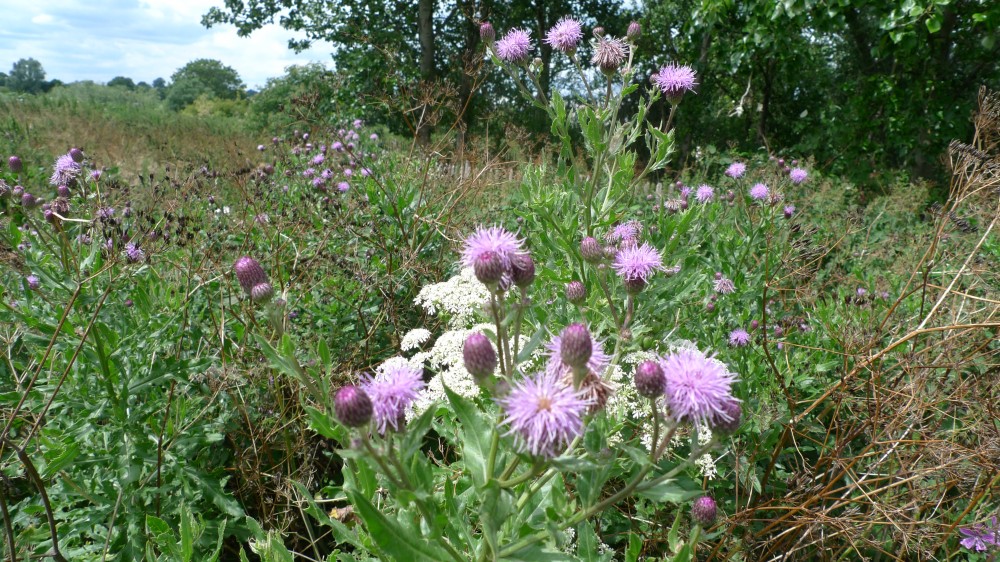
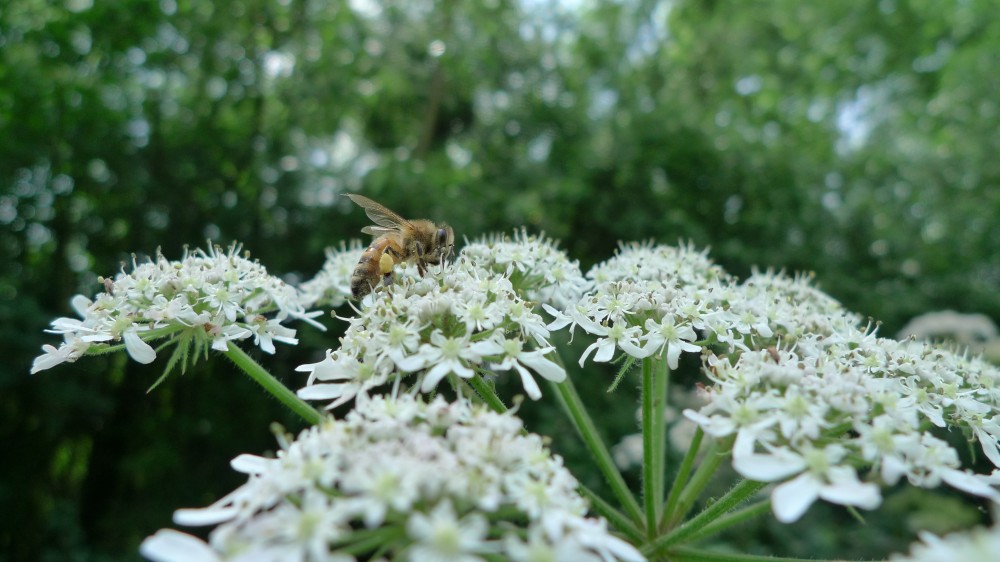
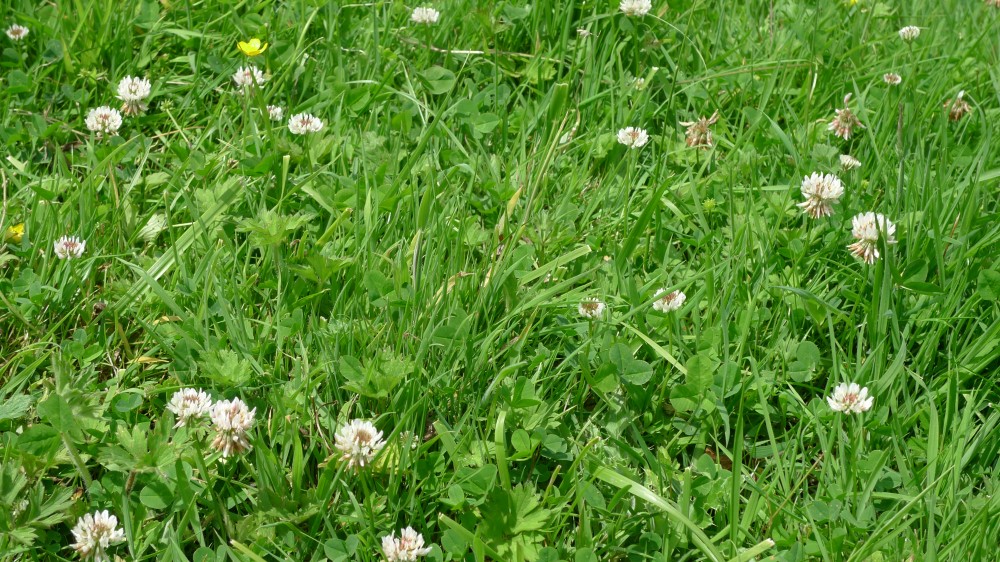
In Elthorne Park, which borders on the canal near my house, I found plenty of bees today. The dog roses which the bees loved so much back in May have come to an end, but the blackberry brambles are flowering everywhere. And some new flowers are also out – hopefully the June gap is coming to a close.
A honey bee enjoying a thistle, which produce quite large amounts of nectar and pollen.
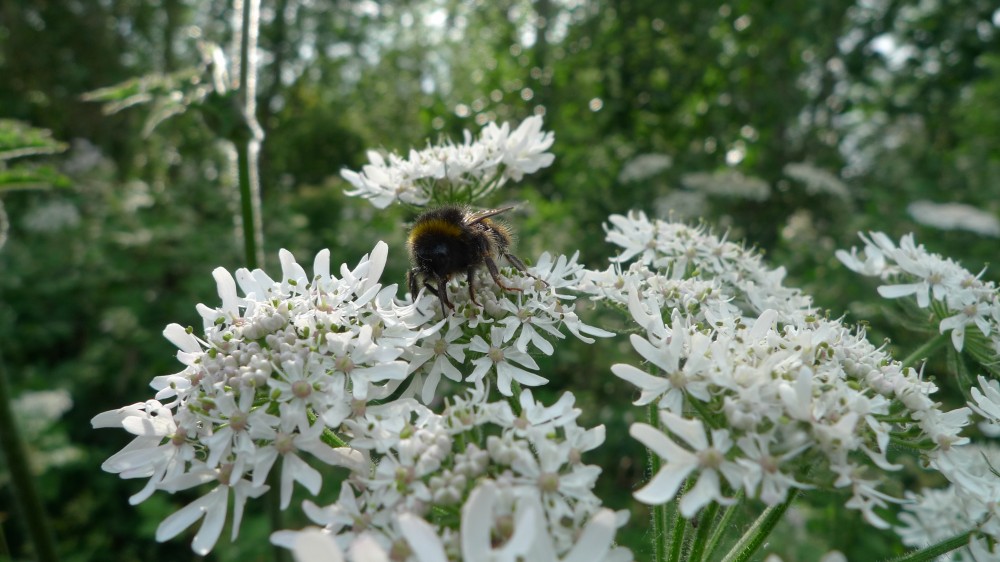
Honey bee on these pretty white flowers – a previous commenter has told me they are likely to be ground elder or the less glamorous sounding hogweed. Whatever they are, bees, flies and ladybirds adore them.
Honey bees on blackberry bramble flowers.
Hello Miss Buff tail
A buff-tailed bumble bee. These bees prefer old abandoned mouse holes in shady places that don’t get too hot in midsummer. A full grown buff-tailed bumble nest is about the size of a football.
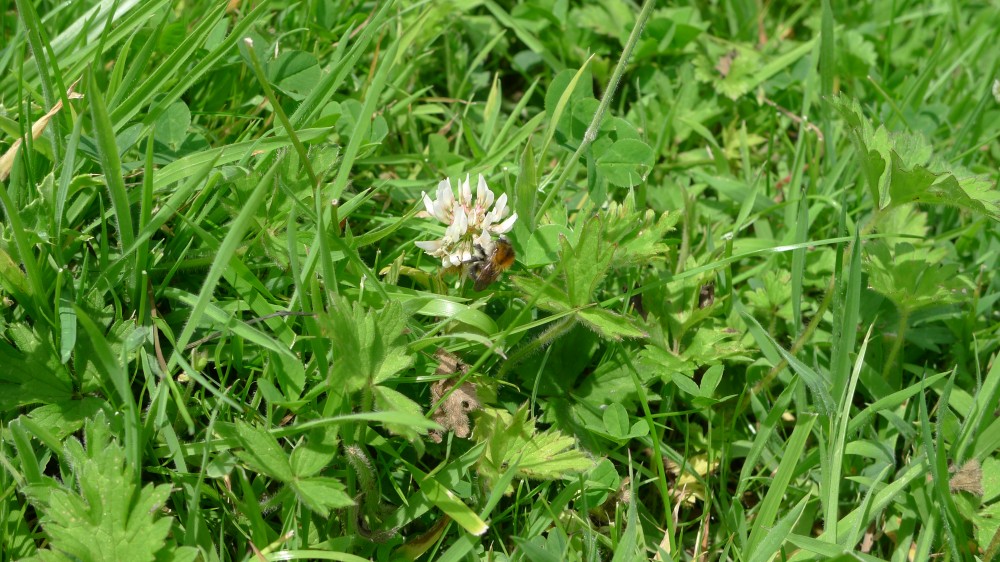
White and red clover is out. Red clover is very popular with bumble bees but not honey bees, as their tongues are too short. Both bumbles and honey bees love white clover. I thought this might be a common carder bee on the white clover above. This species usually nests on the soil surface under leaf-litter or moss and is common in gardens throughout the UK which don’t have their lawns mowed too often.
The legume family, including clovers, vetches and trefoils, have bacteria in their root nodules which are able to turn nitrogen from the air into nitrates that the plant needs to manufacture protein for growth – in other words, they make their own fertilizer. This means they can afford to put more protein into their pollen, making their brown pollen especially nutritious to bees.
You can barely see it, but that black dot against the grey cloud is a bird of prey hovering up above, finding food in a London park squeezed between major roads. Its body flashed red as it hung above me, making me wonder if it could be a red kite.
Lavender is always popular. The air was humming with bees flying between its purple flowers. It usually flowers from July to August in the UK, but has been flowering in London a few weeks now. The honey is medium to dark amber in colour and strongly (deliciously!) flavoured.
Walking through the park and seeing the bees on the flowers makes me convinced that worrying about things like mobile phones is a red herring. Bees need food and a home: give them the right flowers and a place to live and they will come. Unfortunately we have destroyed huge amounts of their natural habitat. Over 95% of the UK’s natural unimproved grasslands (hay meadows and chalk downlands) have been lost (Bumblebee Conservation Trust). Less than 2% remains of what we had just 60 years ago, the rest having been ploughed up and replaced by cereal fields, or ‘improved’ with fertilizers which cause grass to grow very quickly and squeeze out flowers like clovers.
A quiet night in watching films with my other half has been cut short by his getting a call from work about temperature alerts in their data centre (he’s an IT bod). He’s cycled off at top speed, saying something about potential meltdowns, so I might as well type this now, before any computer apocalypse occurs.
Today was a beautiful British summer day, hot yet mischievously breezy, blowing summer skirts up unexpectedly. I arrived at the apiary at the usual 2pm time, and was almost immediately overwhelmed by hordes of newbie beekeepers keen to have a look round. Some had turned up on their own while others were there as part of the Ealing Transition Community Gardens group. This group has gained funding for a community bees project and will spend 2011 training before their first bees arrive around March 2012. So it looks like the apiary will continue to see plenty of enthusiastic new faces this summer!
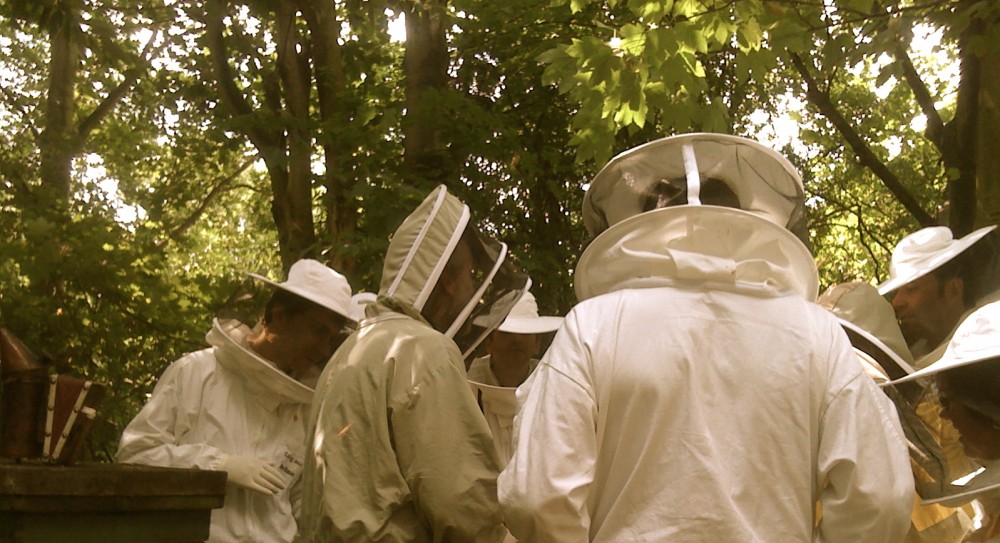
Andy Pedley showed them a few hives today. Andy has been keeping bees for over 20 years and is a born teacher. He has an incredibly loud, infectious laugh which would make him the perfect Father Christmas, as well as the required Santa/beekeeper beard. You can see him surrounded by a attentive crowd below – he’s the tall man second left in the olive suit.
Andy talking to the newbies
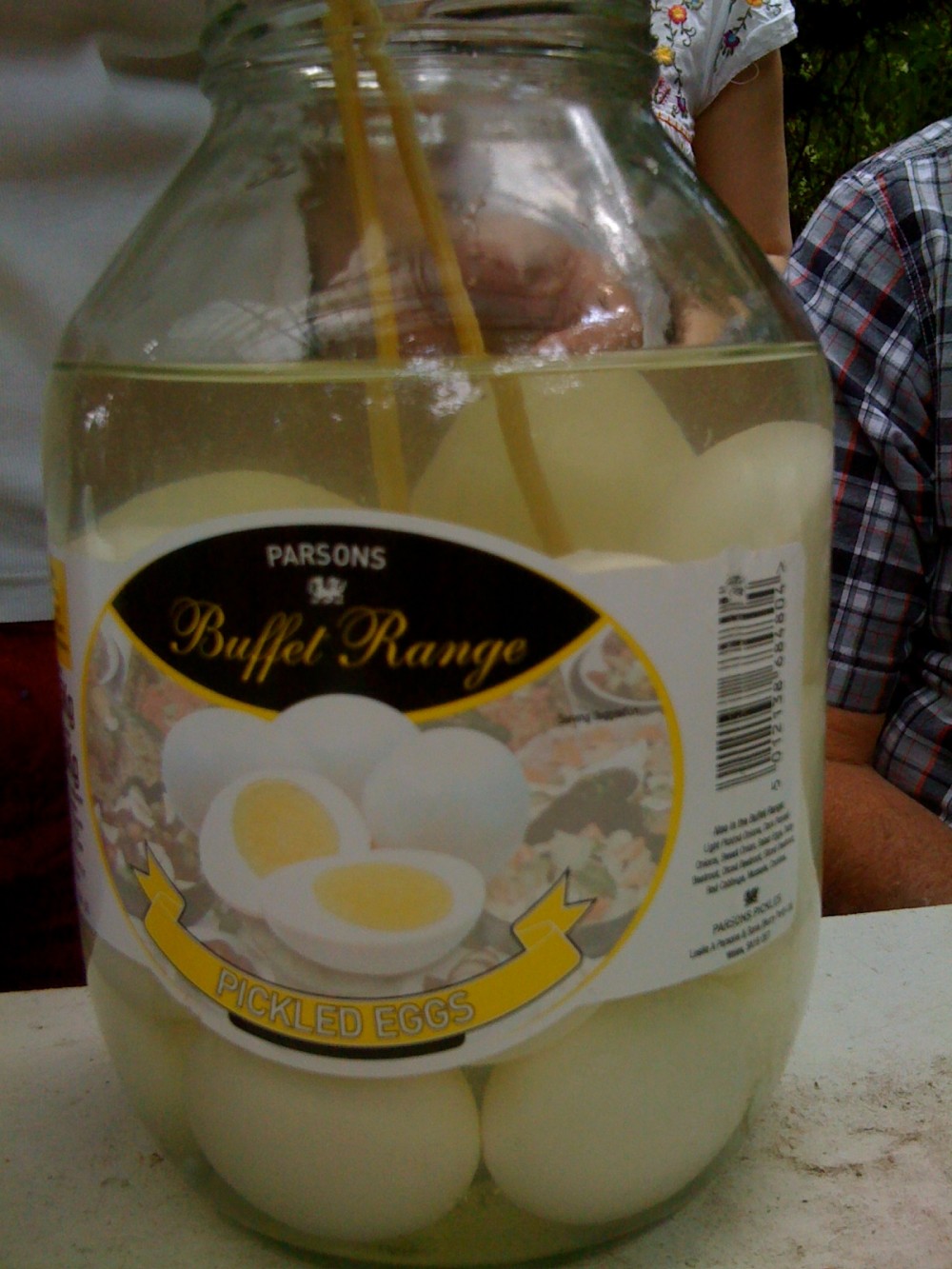
Shy of opening our bees up before such a big audience, Emma and I had a cup of tea first. One of the other beekeepers, Cliff, had brought us along an unusual Northern delicacy – see photo below. I can’t honestly say I’m converted to eating these, but they were certainly an experience. They’re harder than you might expect. Albert actually managed to bounce one on the table like a ping pong ball.
Cliff's pickled eggs
Tea and eggs over, we crept round the crowd to open up the nuc. Last week we had worried that Queen Rose was missing, because we hadn’t seen her or eggs for a couple of weeks. Well, turns out that as usual Pat was right to reassure us, because I turned a frame over today and there she was! Just like that. But now she is unmarked. I do think it’s still Queen Rose though, because it would be hard to miss a queen cell in the little nuc, she looks identical, and when we last saw Queen Rose her blue dot looked to be wearing off a bit. I even saw a few eggs.
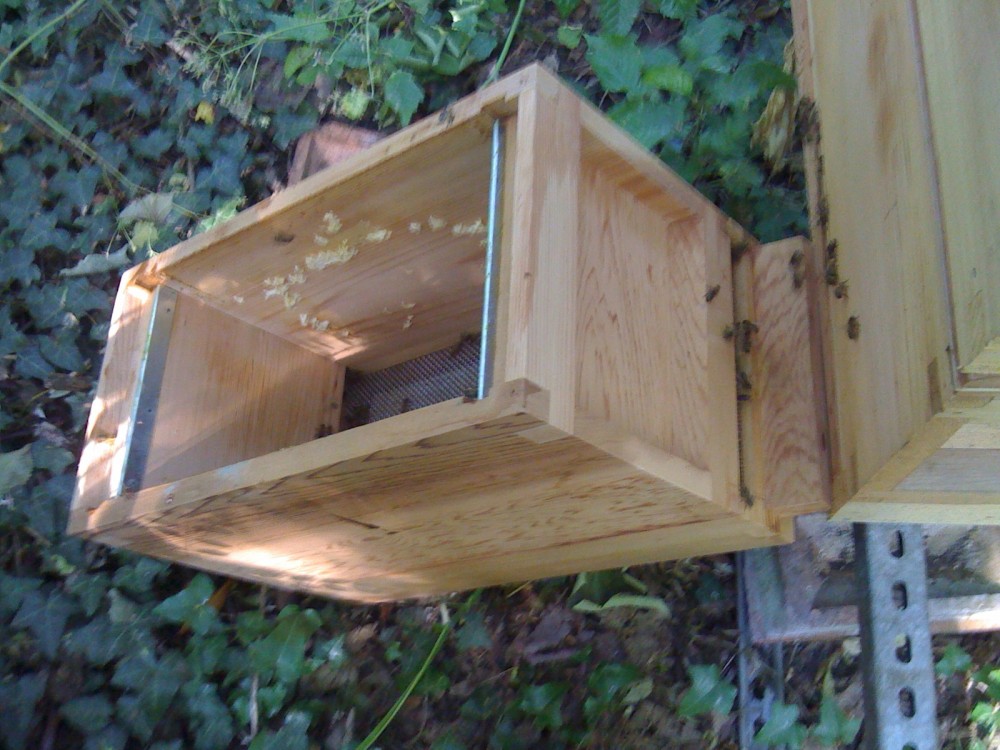
Emma pointed out that maybe she didn’t have enough space to lay eggs. I agree with this idea as they’d filled out all five frames, mostly with stores. Lots of nectar and honey, plus grey pollen. So we moved them into Emma’s National hive, which she had put some made up frames into already in anticipation of this day. I’m glad that Emma is much more organised than me! First we moved all the frames over into the middle of the new hive, to keep the brood warm, then put the new foundation frames around them. A few bees had clustered in the nuc’s corners and were surprisingly reluctant to leave their cosy old home. Even several shakes and a go with a leaf brush didn’t dislodge them. We ended up leaving them to walk back in like this:
The last of the nuc bees slowly proceeding into their new home
Back in the old big hive, they have really done well at starting to fill up their first super. We also saw our new queen for the second time. Emma has named her Rosemary, as she is fiesty (having flown off after being marked two weeks ago), and rosemary is an energising essential oil. We’re going to name all our queens after essential oils as Emma is a trained aromatherapist – see her blog post ‘Rosemary – an established personality‘ for an invigorating rosemary tea recipe. It’s also a neat name because she’s Rose’s daughter, and looks just like her mother, long and dark.
I’m hoping we might even get some honey, if the UK June forage gap doesn’t cause them to eat all their super stores. Now that Rosemary has started laying they should expand rapidly, so soon the dilemma will again be whether to double brood box or not double brood box. It would be amazing to have my first jars of honey after three years of trying!
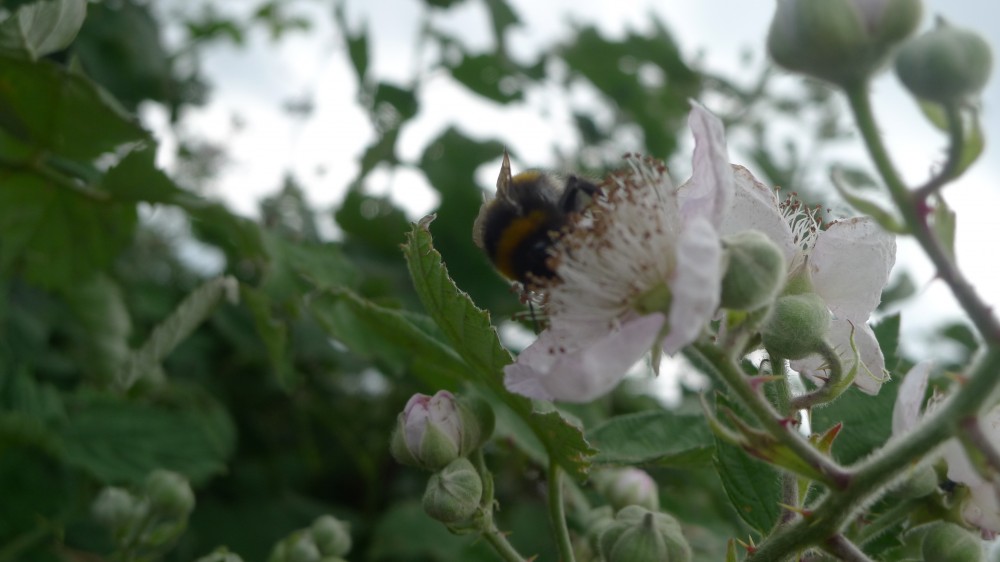
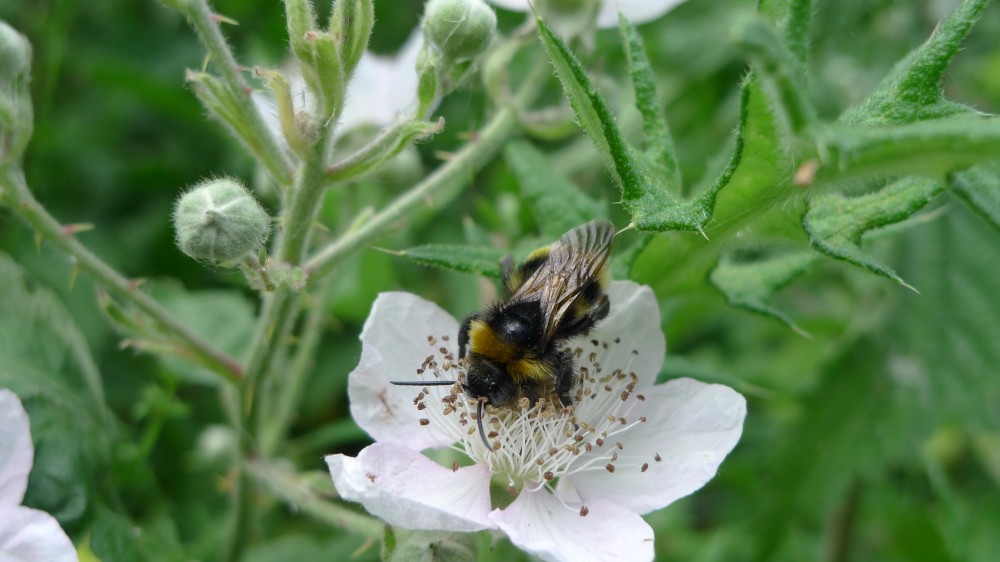
I think these two were Buff Tailed bumbles. The similar looking White Tailed bumble bee is said to have more lemony coloured stripes, whereas the Buff Tailed has more golden lines. If anyone thinks differently please say!
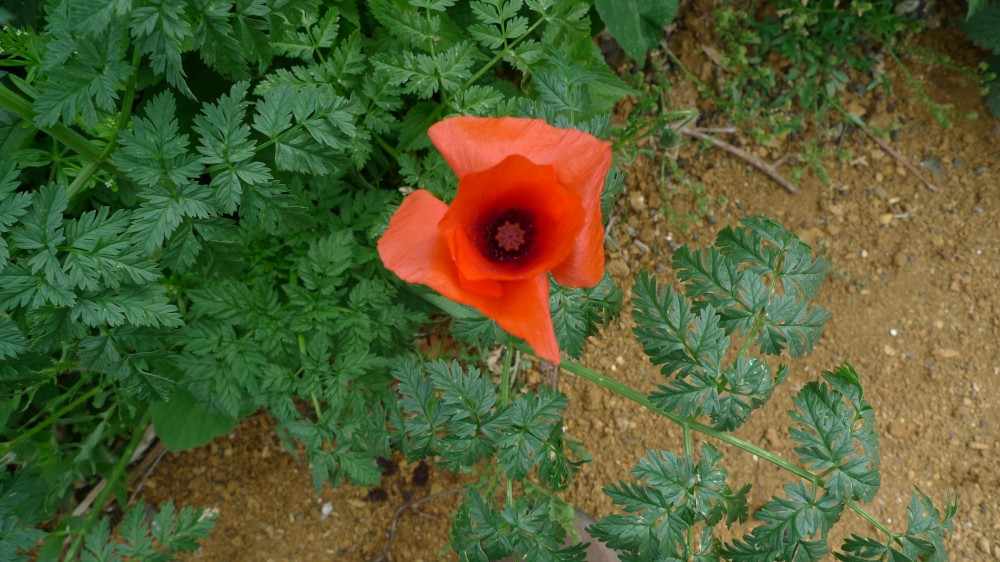
The wild roses are coming to an end now. The blackberries above have come out to replace them. Also popping their heads up are the glamorous poppies:
This one looked almost more like a garden poppy, but we also saw the smaller red field poppies. Field poppies only produce pollen, with no nectar. Bees are said to seek the pollen out as it is for some reason extremely attractive to them, perhaps because the poppies produce it in enormous quantities. Bees returning home with it cannot be missed as it appears quite black, but is actually a very dark purply blue on examination.
Poppies are quite an interesting flower because usually bee pollinated flowers are not red, as bees are red colour blind and see red as black. However, some red flowers such as poppies contain pigments that reflect UV light, attracting bees and appearing to them as bee ultra-violet. I didn’t see any bees on the poppies; possibly because I was walking at 4pm, whereas poppy flowers open between 5-6am and have often completed their lives by midday.
This pink flower was being visited by the bees, but too fast for me to get a photo. Any ideas on a name for this? The nectar lines guiding the bees in can clearly be seen.
What is this one, anyone know?
EDIT: The pink flower has been identified by Chelsea in her comment below as a Lavatera or alternatively by Nigel as a Wild Mallow.
Elderflowers are blooming in spectacular numbers. Here are a couple of bumbles enjoying them.
Bumble on elderflower
Buff tailed bumblebee on elderflower
Buff tails again I think. With the drifts of elderflowers came our first sightings of honey bees. Whereas bumbles are happy to feed from small groups of flowers, honey bees don’t get out of bed for anything less than a big clump.
Honeybee on elderflower
Elderflower isn’t listed as an important flower in my bee books, and from what I can find online it’s not very popular with the bees, so maybe this honey bee was struggling to find better forage available? With a hot spring the June gap may have come early.
Yesterday was a overcast, cool day here in London. The bees were still flying regardless, bringing back large amounts of a grey coloured pollen.
It looks like velvety mole skin. Any ideas about what it might be? I’m wondering about blackberry, because someone said the brambles were about to come into flower, and blackberry pollen is said to be a pale brownish grey. Ted Hooper’s Guide to Bees and Honey says blackberry is “Well worked by bees even at fairly low temperatures, supplying both nectar and pollen in quantity. Honey of good flavour, medium amber, tending to granulate with a coarse-grained texture.”
Last week an unfortunate turn of events had occurred when our temperamental new queen had taken off immediately after we marked her, zooming off into the distance. We had not known whether or not she would return to us.
The cold, overcast weather yesterday was not ideal conditions to be opening a hive up in. But we wanted to know. And the news was good…first I saw rows of regularly laid new eggs, then Emma spotted our queen. So she came back! Having seen her, we hastily closed the hive up before she changed her mind.
We topped up the sugar syrup in the nuc next. A quick look through that revealed no queen or eggs for the second week running, only capped brood. This worried us, and we were considering whether to combine the nuc bees back in with the main hive which we split them from a few weeks ago. However, Pat advised us against this, on the basis that the nuc bees were very calm, whereas queenless bees are typically aggressive and running all over the place. There may be no eggs because Queen Rose has temporarily stopped laying in response to the colder weather or other factors, and we could have missed her both weeks, even in a five frame nuc.
Here’s what Ted Hooper (author of Guide to Bees & Honey, 2010) says about queenlessness:
“Recognition of queenlessness is far from easy if one is just relying on conclusions drawn during examination of the colony. The main signs are that the colony is more irritable than usual, the bees seem to be less well organized on the combs, very few brood cells will be polished up ready for the queen to lay in – certainly not a large circular area of such cells. Pollen in the broodnest will be shiny from being covered with honey to prevent it going mouldy. Often there will be some cells with little hoods drawn out from the top walls and often these are covering pollen, and in some cases, an egg from a laying worker. All these signs are straws in the wind pointing towards queenlessness but none is conclusive.”
We will have to see how they’re doing next week and hope Queen Rose is in there and starts laying again soon. I didn’t take notice of whether the brood cells were polished up or not, so that’s something to look out for.
The most successful hive in the apiary at the moment in terms of bee numbers & honey stores is Albert’s – he has a New Zealand queen in there and everyone is always amazed to see the beautiful yellow bees she produces. They seem to be slightly more irritable than our dark bees but not majorly so. Here’s a pic of Albert holding his yellow bees up:
Albert's New Zealand bees
Slightly off-topic…
I don’t want to turn this into a cooking blog, but yesterday Australian Don gave me a nice recipe for savoury cardamom rice. I had made a cardamom cake, which got all the guys talking about how they cook with cardamom. Here’s Don’s recipe:
2 cups brown basmati rice
3 medium onions chopped (or less if preferred)
1-2 cups mixed frozen vegetables
10-12 cardamom pods cracked open
2 cinnamon sticks
1/2 tsp chilli flakes
1/2 tumeric
1 cup or thereabouts raisins
salt
black pepper (generous)
I love how laidback the quantities are. Don is a very relaxed guy. He’s in charge of the equipment for sale at the apiary and is often faced with long queues of people & endless receipts to write out when it’s frame making time but nothing seems to faze him.
This is a follow up post to this one on the Bee Health Day I went to held at Roots & Shoots (a wildlife garden and base for the London Beekeepers’ Association), which is an annual event run by our government bee inspectors. Below are my notes from the Varroa control workshop given by Caroline Washington later in the afternoon.
Varroa control
Drone trapping
It’s well known that varroa mites prefer to breed in drone brood. Drones take 24 days to develop whereas workers take 21, so drones give the mites time to fit in more breeding cycles. The mites identify the drone brood by its different smell, which is a result of the more protein rich diet fed to drones.
In South East England drone trapping can be used as a method of varroa control during April, May and possibly June. To do this put a drawn super frame into the brood box, to encourage them to build drone comb in the gap underneath. Put the super frame at the side of the brood nest, not the middle.
Once the drone comb is sealed, cut it off the super frame and feed to your chickens or burn it. You can do this 2-3 times during the summer. Do not leave the drones to hatch out! Before you destroy the drone brood you can uncap some to see how many mites are inside. Put your uncapping fork in deep, right into the neck of the drones. Fork out a hundred drones and count how many larvae have mites to get an idea of mite numbers in the hive.
Icing sugar
By July the bees will not be producing drones anymore but your supers will still be on, so it’s too early for Apiguard treatment. What you can do instead is an icing sugar shake.
Icing sugar treatment is easiest done in pairs. Get someone to hold each frame out horizontally for you and then sprinkle over icing sugar using a shaker. This encourages the workers to groom each other, removing mites in the process. Check your varroa monitoring board afterwards to see how many have fallen down. Just sprinkling over the tops of frames without pulling each one out is not effective enough, that way the sugar just falls down the gaps between the frames.
Apiguard
Apiguard is a natural thymol based treatment done in August once your supers have been removed (otherwise your honey will stink of thyme). Starting in August allows the hive to produce several generations of healthy bees before going into the winter.
Tape up your varroa monitoring board whilst treating so the fumes stay in the hive. Do not be tempted to treat using your own home made thyme concoctions. These do not regulate the release of thymol in the way Apiguard gel does, and Caroline has known bees to abscond as a result of home made treatments being too overpowering.
You only need half a dose of Apiguard for a smaller colony, or a quarter for a nucleus. If you give too big a dose the bees will be hanging outside the hive.
Oxalic acid
This can be done during winter whilst you have no brood – around Christmas/early January in SE England. You need the bees to be in a cluster. You literally whip the hive lid off, trickle the acid over the top of the cluster and put the lid right back on before they get too cold. I have a post on our 2011 acid trickling here: https://adventuresinbeeland.wordpress.com/2012/01/01/drizzling-oxalic-acid-on-bees.
Why varroa is such a problem
Historically bees have always had viruses. But in the past they were not such a problem. However, certain conditions can trigger viruses to become a problem. Viruses are now getting into bee larvae via varroa. If you have nosema in your colony, viruses are transmitted by nosema too.
The deformed wing virus associated with varroa mites causes bees’ wings and bodies to become deformed and stunted. Affected bees are often unable to fly and have a severely reduced life span. The virus can affect queens too. Drones have not been as good as they were for some time.
Caroline advised us not to keep weak colonies out of sentimentality but to bump them off, because weak colonies are more likely to be carrying viruses. You can destroy a small number of bees by having a big bowl of hot water with washing up liquid in and shaking the bees into it. The washing up liquid gets through the bees’ waxy exoskeleton.
On the saucer are bees Caroline found suffering from deformed wing virus earlier in the day.
Today has been rapturously lovely and sunny. When I arrived at the apiary there were already lots of eager beginner beekeepers being shown a few hives by Andy and Pat. Soon the apiary got busier and busier until it felt like maybe thirty or forty people were chattering away over tea. A lot of people I hadn’t met before and seemed to be mostly new beekeepers or people interested in getting bees.
So today Emma and I opened our hives up before a big audience of peering faces. Three weeks ago we split our hives, putting the old queen into a nuc and leaving two queen cells in the old hive. Today first we looked inside the old hive, which looked like this:
The blue pin at the top of the picture was marking a new sealed queen cell we found last week. There was no sign of it today, so perhaps the bees tore it down.
Then we spotted her, our new queen. She looked like her mother, long and dark, a black beauty. I had a queen marking cage in my pocket and Emma had a marking pen. A good start, but then I tried to catch her with the cage…here my inexperience clearly showed. This new queen was not conveniently methodically moving from cell to cell laying eggs, she was running like crazy across the frame. My hand could barely keep up with her and the frame was covered with hundreds of bees moving towards her. I chased her round and around that frame and a few times thought I’d got her in the cage before she slipped out again. I eventually managed to pin her in the cage along with what seemed like dozens of frantic workers but was probably only four or five.
< the type of queen marking cage I was using
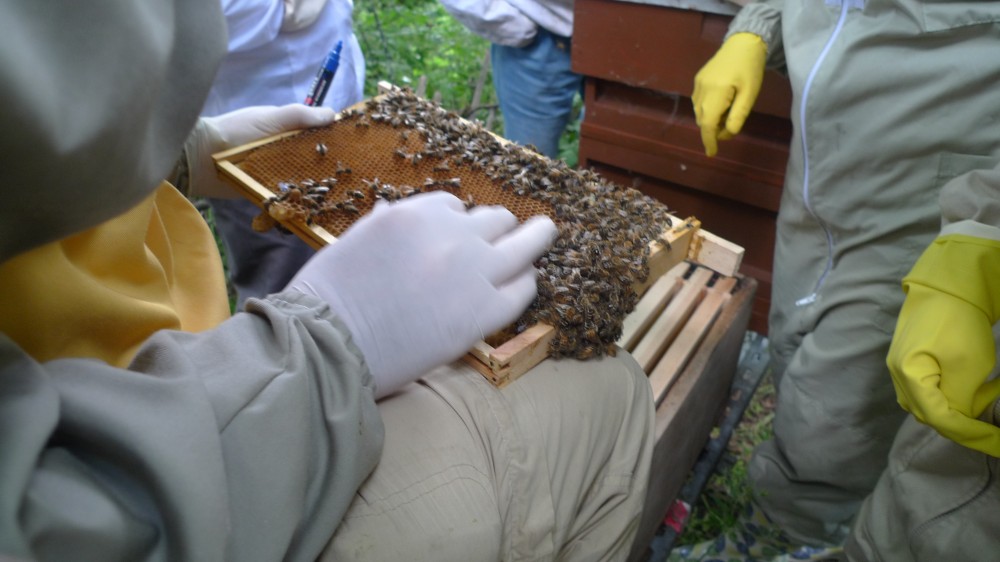
Emma asked Andy if he could come and help us, as neither of us have done much queen marking. Andy got us to practice on a few drones first, he picked them up and we planted a blue dot on their thoraxes, which felt surprisingly firm. Then Emma marked the queen through the cage mesh.
Andy balancing the frame on his knee so Emma can mark the queen
So far so good. Of course next it all went horribly wrong.
Because once Andy lifted the cage up the queen took off. She flew onto another beekeepers’ suit, Andy grabbed her and put her back in the hive and she took off again, so fast. Off to who knows where. I think Andy was quite upset about this, but I don’t blame him at all, by the way she had been giving me the run about earlier it was obvious this one was too feisty to appreciate being imprisoned for long.
Andy said she might get lost, and he doesn’t hold out much hope, but as she is a new queen and her flight muscles will still be strong, there’s a chance she’ll come back. Alan (who helped me shook-swarm them back in March) came over later and reassured us “Don’t worry, she’ll be back” – apparently it’s happened to him twice and both times Queenie came back. But in case she gets lost or gobbled up by something bigger than her we’ve taken a frame with young larvae in over from the nuc and put it in the old hive. So if HM is gone for good they can make a queen cell or two.
It’s so frustrating how everything can be going really well until suddenly it really isn’t. It’s not looking too hopeful for my first ever jar of honey in three years. Oh well.
When I got home Drew had just made up some tapioca pearls. We first had these recently at a new Asian tea shop in Soho called Bubbleology. They serve fruit or milky teas either ice cold or hot with these chewy tapioca ‘bubble’ balls in, which you suck up through a ball size straw. Drew managed to get hold of these balls on eBay and served them to me in some mango juice. After such an eventful day it felt good to sit back on the sofa chewing and sipping.
Anyone else have a queen marking disaster story to tell?
Emma and I checked up on the nuc and the old hive yesterday. The nuc’s doing fine, it’s got a couple of frames of brood, some stores and about a frame and a half still to draw out. I popped back today to give them some sugar syrup to help them along. This week the temperatures have been a bit lower, more like a British summer, 16-18°C type of thing, and it may rain. As we haven’t had much rain at all this month it could be there isn’t much nectar out there either.
Can you see Queen Rose in the middle there? A little court is turning to face her. It was only March she was marked and already her blue dot is starting to fade.
Back at the main hive, which we split Queen Rose from two weeks ago, things were perplexing. The two queen cells had hatched out, with a round hole at the bottom. We also found one in the middle of a frame which the bees had destroyed and eaten the larvae from. And…a sealed queen cell. It looked like an emergency one, as it was quite small and made in the middle rather than hanging down from the bottom. No eggs or sign of the two hatched queens, but an unmarked queen is easy to miss and they would only have emerged about 12 days ago.
We erred on the side of caution and left the sealed queen cell alone, just in case we don’t have a queen in there, the two queens could have killed each other or be missing in action. Hopefully the bees will know what’s best to do. I spoke to Pat afterwards and he thought the new QC might have been an emergency one created after we split them two weeks ago, due to the sudden drop in queen substance when Queen Rose was transferred to the nuc. He thought we had done the right thing by not destroying the QC and advised leaving them alone for a week or two – nice and easy!
Emma inspecting the old hive, with a rare ray of sunshine penetrating through the trees…
Am very jealous of Jane, an Ealing beekeeper I spoke to yesterday who has two supers on now and no queen cells in either of her two hives yet! She deserves it though, she’s had only a tiny bit more honey than my none over the last couple of years and has made all of us several extremely good cakes.
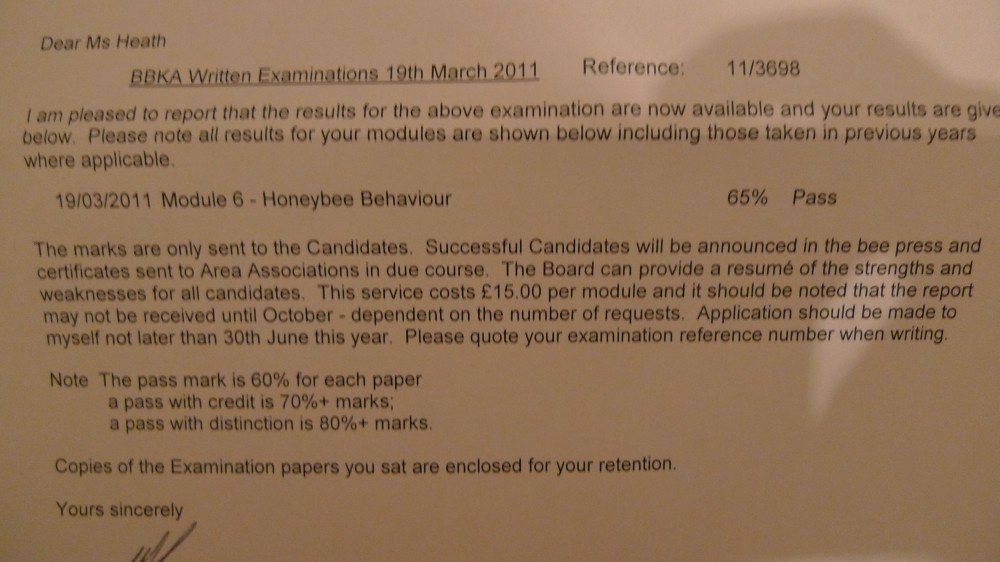
This week I got a nice letter through the door. This is what it said:
I was pleased and surprised. I knew before I opened the envelope what it was and got a sudden feeling that I had failed. Not so 🙂
They also sent the exam paper through, here is a pdf copy I made of it. I’ve starred the second page questions I answered. The depressing thing is that looking at the questions I bet I wouldn’t pass if I took the exam right now! I’m ok at cramming things in temporarily but then it all drops out of my head again. My brain just isn’t big enough to hold all the info in.
Should say a special thank you to the Mid Bucks Beekeepers Association. The study notes they’ve put together for each BBKA module are completely free and amazing. Without them to have a quick look at while sitting on the bus I doubt I’d have passed. They’ve also produced notes for the Basic Assessment. All their study notes can be found under the Categories section on the right hand side of their website. It is amazing how generous beekeepers like them are with their knowledge.
[Edit: later in the year I received feedback on my answers, see my later BBKA exam feedback post for a copy of the comments].