Preparing honey bee colonies for winter & anti-varroa bees

I found out about these two links from Andy Pedley’s Ealing and District Beekeepers email newsletter, which I always enjoy reading…

Fera’s National Bee Unit have put together a leaflet on preparing your colony for winter. Essential reading. I always fear for my bees during the winter, even though the colony has survived two winters now (obviously different sets of bees each time!). Must remember to put my mouse guard on, and also find it first. Now, where would I have put it?!

Also… a beekeeper claims to have bred a ‘superbee’ which has increased grooming behaviours, making it unusually resistant to the varroa mite. Ron Hoskins is obviously not your average beekeeper. Not only did he study his bees under a microscope to find tiny marks where varroa mites had been previously before being removed by grooming bees, he then bred this ‘superbee’ strain by extracting the sperm from mite-beating drones and inseminating virgin queens. Now that must require a seriously steady hand! Extremely impressive stuff.

The Asian honeybee, Apis cerana, is the natural host of the varroa mite. What appears to have been a long period of co-existence with varroa has enabled the Asian bee to evolve defence strategies, including grooming behaviour, to cope with varroa and keep their numbers to a minimum. It would be wonderful if the European honeybee, Apis mellifera, could evolve similar strategies and Mr Hoskin’s findings offer encouraging news.

Posted in Colony management, Disease prevention | Tagged , | 4 Comments

A September day – 25/09

Went down to the bees today, but first I mixed up an autumn sugar syrup feed for them. This has a ratio of 2 pounds of sugar to 1 pint of water. It is important that the sugar is white granulated cane sugar, as brown or beet sugar can give the bees digestive problems. I stirred the sugar in the water over a low heat for a while until the crystals had dissolved, then poured it into an empty coke bottle.

It was cold at the apiary. I poured the syrup into a circular plastic rapid feeder, which is designed in a way that allows the bees to drink the syrup without risk of drowning. I was surprised to see the ladies bringing back large amounts of a bright yellow pollen. Looking at this pollen colour chart it may have been sunflower, which surprisingly I have seen blooming this week – but I suspect it must be something more common than sunflower for the bees to be finding so much pollen from it. Does anyone have any ideas?

Other beekeepers were feeding their bees a product called Ambrosia, which the beekeeping suppliers Thornes sell. It is a clear sugar solution which has substances added to it which are supposed to help keep the bees healthy (if that sounds vague, it’s because I don’t have a clue what these substances are!). You really need a car to get some though – heavy to lug about on the bus, especially as a Thornes shop is not really nearby to me.

We all admired a nucleus hive made by one of the Ealing Association members who is a very skilled carpenter (many local beekeepers seem to be retired engineers, carpenters, mechanics or people with other practical skills which I’m very jealous of). He is selling them for £30-£40, a generous price which doesn’t make much of a profit for him.

Two of our most prolific honey producers, a married couple called Alan and Betty, brought along some of their brace comb honey (from comb which the bees have built up on the walls or ceiling outside the foundation frames) for us to try. It had a beautiful flavour to it which was worth getting my hands all sticky for! I brought some home in a cup for Drew, who was initially very suspicious of this honey in a comb, but seemed to enjoy it once he tried it. The comb is edible but very chewy, so most people just suck the honey out.

The day ended with a look at a jar of honey which a beekeeper wanted to enter in the National Honey Show in October, the UK’s biggest honey show. Everyone agreed that it was a nice clear, dark colour. The judges mark for viscosity, aroma and flavour. There are all sorts of classes to enter your honey in – light, medium, dark, chunk, ling heather, soft set, cut comb to name but a few. The beekeeper was advised to enter her jar in the London class, which is less strict on the jar presentation rules and only requires a single jar with any type of lid. There is even an essay prizewinning challenge, which this year is on the subject “Bees and Darwin”. The 2011 essay subject is  “Disastrous Beekeeping Purchases”! There is a honey fruit cake section, which I may enter one year if I ever get any of my own honey.

Mmm honey…

Posted in Honey | Tagged , | 2 Comments

Allotment adventure

I was down at the apiary on Saturday when one of the other beekeepers, John Chapple, mentioned that he had been left an answering phone message telling him that the roof of a hive on an allotment in Perivale had been knocked off, and its owner was on holiday. The message said the road name but it was a very long road and John was unsure where the entrance to the allotments would be. My iphone came in handy as I was able to look on the council website and find out exactly where the allotment was.

So three of us then went down to this allotment to put the roof back on (one to put the roof back on, the others to watch just in case). One of the houses nearby was having a barbecue so a delicious smell was in the air. All the locals must have been at this barbecue as the allotments were empty. We wandered around looking for someone to ask where the hive was, as it was a big site and there were plenty of places to hide a hive. After a week of rain the allotment was overflowing with life and the scarecrows had plenty to watch over. Huge tomatoes bulged inside greenhouses and plump blackberries hung glistening in the sun.

Eventually we found a lone man who was able to point us in the direction of the hives, which were under a big tree. Two big cats, one ginger, one tabby, scampered off as we approached. A sheltering fence had fallen down so we picked it back up and John placed the roof back on the hive. To my surprise the bees seemed fine and even good tempered despite all the heavy rain recently, and were busily flying in and out. They are tough little critters. I was impressed by a wasp trap attached to the hive which had what looked like at least 50 wasps inside.

Looking at my own hive this week, everything seemed fine. For some reason ladybirds seem to love the hive roof and there were about four or five of them plus ladybird larvae (which look really cool) on top – though only one a British ladybird and not an invader. I put a second tray of Apiguard anti-varroa treatment on and left them alone other than that. I took a pic of the apiary, my hive is the big one second from the right:

Posted in Uncategorized | Tagged | 1 Comment

21/09/10 – not much going on here

Yesterday was a easy beekeeping day. We all checked our varroa boards following our Apiguard treatment last week. The Apiguard kills off a large percentage (but not all) of your hive’s varroa mites, causing them to fall through the wire mesh floor of the beehive onto your varroa board, which slots in underneath the mesh. The boards can be made of plastic or thick cardboard, with cut-up estate agent boards being a favourite among thrifty local beekeepers here. Counting the number of mites on your varroa board gives you an idea of how badly your colony is infested.

I noticed a worker bee and a big drone struggling in front of a hive entrance, despite her smaller size the worker bee was managing to pull the drone away from the hive. Eventually the pair fell to the ground, the drone got free and flew off up into the air, presumably to die somewhere with his destiny as sperm provider unfulfilled.

After this strenuous exercise we all went for a nice cup of tea and a sit down. Luckily you can learn a great deal about beekeeping just by sitting around drinking tea, eating biscuits and listening to other, much more experienced, beekeepers talking.

Yesterday a lady with a top-bar hive in her garden told us her hive was packed with bees from end to end and she had been offered £10 for a jar of cut-comb honey – double the usual price local Ealing beekeepers sell their honey for. Another beekeeper with top-bar hives has not done so well, his bees have struggled to get started and not produced enough honey to take a honey-crop this year.

For those unfamiliar with these hives, basically top-bar hives are removable bars of wood in a horizontal box with an entrance. The bees build their comb hanging from the bars -see http://www.biobees.com/how_to_start_beekeeping.php or http://topbarbees.wordpress.com for more info.

From observing how other people get on with top-bar hives, there seem to me to be a number of advantages but also disadvantages, as with any other hive type. The more commonly used hive in the UK is the square-box type National hive, into which beekeepers place frames containing flat wax foundation sheets which the bees then draw out into comb cells.

In a top-bar hive the bees build their own comb entirely, allowing the beekeeper to make cut-comb honey and see comb developed in its natural form. However, worker bees must consume a great deal of honey to produce wax. Their wax making glands develop from about the 10th day of their life, allowing them to convert the sugar in the honey into wax, which seeps through small pores in the bee’s body leaving tiny white flakes on its abdomen. So it seems to me that by not giving your bees starter sheets of foundation wax you are going to lose more of your honey crop to wax-building than a National hive-type beekeeper would.

There are also issues like how to inspect your top-bar hive on a hot summer day without the comb disintegrating and falling off the bars, how to feed your bees in winter and administer anti-varroa and other disease treatments. There are certainly ways to solve these difficulties, but a little problem-solving ability may be required. For all these reasons I feel a top-bar hive is not for me, but I certainly enjoy seeing other people’s.

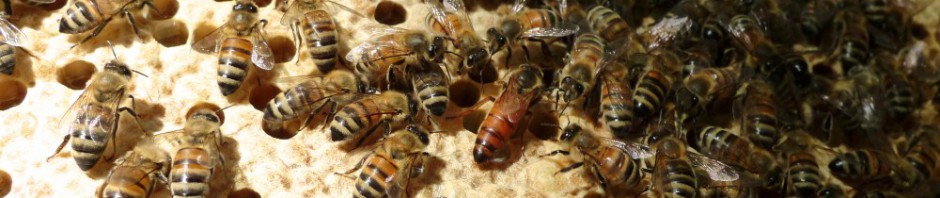
Bees on comb from a top-bar hive:

Posted in Hive types | Tagged | Leave a comment

Even more FAQs

Continuing my answering of beekeeping questions on the Innocent Smoothie website (see previous FAQs post)…

Q: What kind of relationship do bees in a hive have with each other? and how do they have rules?

An interesting question this. Each worker bee works together to fulfil the colony’s aim of raising brood, producing sufficient honey stores for the winter and, if the colony is strong enough, reproducing by swarming. After spring/summer worker bees are born they progress through various ‘work experience’ roles – cleaning out cells, nursing larvae, producing wax, taking nectar and pollen from foragers, guarding the hive, removing dead bees etc, until they are old enough (around day 20) to reach the final top job of foraging. Drones have their place in the colony too, as sperm donors for virgin queens, and are fed by the worker bees until their usefulness runs out in the Autumn. Last but not least, the Queen is the colony’s egg laying machine. She can lay around 2,000 eggs a day – more than her own body weight!

How do they have rules? The answer is quite complicated as bees communicate in multiple ways. Probably the most important is smell. For instance, the queen produces a pheromone smell beekeepers call ‘queen substance’. As bees take it in turn to clean and feed the queen, queen substance is distributed through the hive. Its smell reassures the bees and also prevents worker bees from laying eggs. The colony will notice a missing queen within half an hour of her disappearing, and the beekeeper will notice that a queenless colony is particularly irritable. Different pheromones are also released by brood to let the nurse bees know when their cells need sealing, and by worker bees when they sting, alerting guard bees that the colony is under threat.

Q. How closely related are honey bees to the little wild bees I have in my garden?

There are wild honey bee colonies in the UK, but these are the same species of honey bees as beekeepers here keep, the European honey bee, Apis Mellifera. By ‘little wild bees’ the commenter may be thinking of a solitary bee species native to the UK. This webpage has plenty of photos of solitary bees spotted in the UK: http://www.glaucus.org.uk/SolitaryBee.html

A red mason bee glistening spectacularly in the sun:

Posted in Uncategorized | Tagged | 4 Comments

FAQs

I subscribe to the Innocent Smoothie newsletter, and noticed that they had a blog competition recently to win an afternoon cream tea and look in a hive with a beekeeper, Tim. To enter the contest, members of the public were asked to leave a blog comment answering three questions, one of which was “What is the one thing you’d like to ask Tim the beekeeper?” A winner was then chosen based on the answers.

I was pleased to see how many members of the public were interested in meeting Tim (and having tea of course!) and found it fascinating to find out what people want to find out about bees. Now that I have learnt a little about bees it is easy to forget what it’s like to know even less about them!

I decided to try and answer a few of these queries here, as they are probably a good representation of what the general tea drinking public are curious about. So here goes.

Q: How do prolonged periods of rain affect bees?

A: Long periods of rain in the summer may prevent bees being able to forage and virgin queens being able to make mating flights. On the up-side, flowers rely on rain to be able to produce nectar.

Q: What are the best things we can do to support the bee population?

A: Plant bee-friendly flowers in your garden. Bees are colour-blind to red, so red flowers are unlikely to be appreciated (unless they appear ultra-violet, which bees do see, e.g. poppies). Blue and purple flowers tend to be popular – lavender, borage, heather. Herbs are also well-visited and have the bonus of being sweet smelling and good for your cooking, e.g. rosemary, marjoram, mints, chives, thyme. If you have a tiny garden or even just a windowsill, herbs are ideal for growing in pots.

The flowers chosen should be planted in clumps by type, not singly or in twos, and in a sunny spot of the garden as much as possible. Bees often overlook flowers growing in shade, even though they produce nectar and pollen. Something else to bear in mind is planting flowers which bloom during varying times of the year. Planting early flowers – snowdrops, crocuses, daffodils – which help get the hive going in the spring or late flowers – buddleia, heathers, ivy, Michelmas daisies – which provide a final boost to honey stores is of great help.

If you are really lucky and have enough space to plant trees in your garden, lime trees are a major source of forage for bees here in London and make fabulous honey.

Bees also need a place to drink from and collect water to cool the hive on a hot day. A pond, bird bath or shallow source of water with pebbles in to prevent the bees drowning would help.

Finally, why not support your local beekeeper and buy honey straight from the producer? Amateur honeys can be superior to those in supermarkets which tend to be blended together using honey from multiple hives or even countries, obscuring the delicate individual taste of each original honey. In Ealing local beekeepers sell their honey at the apiary on the junction of Stockdove Way and Argyle Road, in Perivale between 2-5pm most Saturdays of the year (depending on how terrible the weather is and what’s on that day). Visiting directions here.

Q. What happens to all the bees in Winter?

Honey bees live longer during the winter; worker bees flying all over the place in the summer live around six weeks compared to several months in the winter. The queen and a reduced colony of around 10,000 workers will over-winter together, the workers huddling in a tight ball around the queen and vibrating their muscles to stay warm. They feed on their honey stores and leave the hive only for cleansing (pooing) flights. The beekeeper opens the hive only to administer anti-varroa treatments or feed candy.

Bumblebee colonies do not over-winter; only the queen hibernates and starts a new colony in the spring. Worker bumblebees die out in the autumn.

Q: Why do I now see many huge bees in the garden and few ‘normal’ size ones?

A: By ‘huge’ bees, this commenter probably means the big furry bumblebees, and by ‘normal’ they mean honeybees or even solitary bees. Many wild colonies of honeybees are believed to have died out in the UK due to the pressure of living with the recently introduced varroa mite. It is also possible that the larger, slower flying bumblebees with their black banded down are more noticeable than the nippy honeybees.

Q: Is every bee different in appearance and is it possible to determine certain characters when working with them like you do?

A:All honey-bees in a colony are at least half-sisters (unless a new queen has just superseded an old queen). However, a queen bee mates with multiple drones, so they may have several different fathers. Although worker bees tend to look very similar there can therefore be colour variations from ginger to light brown within a hive. Is it possible to determine certain characters? Among 50,000 pretty identical worker bees? No way! Colonies as a whole do have a ‘hive personality’ or mood though, and particular colonies soon get a reputation on the apiary if they are especially mardy.

Q: Could we pollinate flowers without bees/wasps?

A: Yes, and some poor farmers in China’s Sichuan province are having to do just that for their pear trees since over-use of pesticides caused the local bees there to die out. Surprisingly enough, a person climbing up on a ladder with a feather brush does not rival a bee for efficiency of pollination.

Edit: 20/08/10 – I see Tim has since answered all the blog questions, his replies can be found here: Meet the beekeeper.

Posted in FAQs | Tagged , , , | 2 Comments

Another year without honey – 7th August

Felt quite depressed at the apiary today. Quite a few people were talking about how big the honey crop was this year, and how many jars they had, and me and Emily (my hive partner) have…nothing. Zero jars. A super filled with pristine flat foundation that the bees haven’t even touched to draw out and make comb on, never mind putting any honey in the comb. If the point of beekeeping is to produce honey, we are absolute failures.

= 0!

Pat, one of the very nice experienced beekeepers at the apiary, told me he is against having a double brood box as we do. Most of the other beekeepers have one broodbox, so that any excess honey is put into the super(s) by the bees. He thinks ours didn’t bother as they had so much space down below to put the honey around the brood. Losing our queen and waiting ages before we had a new queen laying eggs didn’t help either. A properly mated queen lays 2,000 eggs a day, so in the month we had no brood being laid we missed out on around 60,000 new bees to replace the older ones dying out – fewer bees, fewer foragers, less honey.

However, we can feel satisfied about one thing while we cry ourselves to sleep over the honey loss. A commercial beekeeper from New Zealand visited us last week, and he commented that many of the hives in the apiary are lacking in stores. Not so ours, we have two brood boxes full of honey (and eggs and larvae, which is why beekeepers don’t extract this honey). We can be reasonably confident that our bees have enough stores and are strong enough to survive the winter. Of course they may well all come down with some disease and die, but we’ve done the best we can for them.

Next week everyone is putting Apiguard on, which is a anti-varroa thymol based treatment made from thyme. It comes in foil trays which are placed on top of the queen excluder. It works by giving off a strong smell, a strong thyme smell I guess. The bees don’t like having this smelly stuff in their nice honey smelling hive, so they remove the Apiguard gel and in doing so distribute it through the hive, killing a large proportion – about 93% – of varroa mites.

Autumn is on its way now, and the bees know it. The queen is winding down her egg laying and there is a lack of flowers outside. With less brood to look after and less nectar and honey to collect, the bees are twiddling their thumbs a bit, so to speak. One thing they can do is guard the hive against wasps and robber bees from other colonies, and throw out drones, whose greedy appetites are now surplus to colony requirements as the swarming season is over. I saw one big beady eyed drone ejected today. He rolled pitifully about on his back by the hive entrance for a while, his legs wiggling in the air, unable to get his well-fed body the right way up. In other hives vicious one-on-one bee/wasp battles were going on, the pairs rolling over and over as the wasps fought to sting the bees to death and steal their honey. It is a good time to reduce entrances and tape over any holes.

A plump drone and his wrap-around shades

Posted in Colony management, Honey | Tagged | 2 Comments

Basic Beekeeping Assessment exam – learning under the trees

Today, at 6pm in the slightly dim light under the Apiary’s many trees, I took my Basic Assessment in Beekeeping exam, a practical and oral exam which is sort of equivalent to taking your driving test. It is run by the British Beekeeping Association (BBKA), who send a ‘Master Beekeeper’ to test you.

My examiner was a very nice lady, and I looked enviously at the ‘Master Beekeeper’ badge sewn onto her suit. The first test was to make up a frame. I’m no master frame builder, but I managed to get all my nails in straight first time. I was told off a bit for my wax foundation sheet buckling slightly and asked to add a couple of other nails in on the top bar to hold it together better.

Next, I lit my smoker, got my eyes streaming up nicely, and we went in. She asked me to open up someone else’s hive (you never do the exam on your own hive) and tell her what I saw inside. I lifted off two supers (lucky beekeeper) and the queen excluder, carefully placing them down on the ground, and started looking through the brood box where the queen lays her eggs. I saw lots of worker bees, nectar and honey but no eggs. I felt like an idiot when she pointed to a dry biscuity coloured substance in one of the cells and asked what it was, and I didn’t know…turned out it was pollen. Should have known that. Think I would have got it had it been more brightly coloured, but with it being quite neutral I thought it was honey.

As I went through we discovered queen cups and a couple of opened queen cells, a sign that virgin queens had hatched out. Shortly afterwards I found a mated one with a swollen abdomen, though she didn’t seem to have laid any eggs yet. At that point the examiner asked me to close that hive up and open another, as she wanted me to identify eggs and larvae. So I opened another hive up, which I was relieved to find wasn’t violent either. In that I found lots of little larvae, and after lots of peering on my part, some eggs.

Then we closed the second hive up and went onto the oral exam part of the assessment, sitting down in chairs and unzipping our veils. The questions she asked weren’t too bad – what to look for when opening up a hive, the life cycle and purpose of the queen bee, what to do if you find two queen cells in your hive, how to spot worker bees laying eggs, how to harvest beeswax, how to bottle your honey, which plants my bees visit locally, which diseases are notifiable, how to identify and treat American foul brood, European foul brood & nosema, the life cycle of the varroa mite.

The question I got most stuck on was the legal requirements for labelling your honey jar for sale. Not that I’ve got to the stage of having honey yet in two years, but I should have revised that. What would be on the label? I got name, address and expiry date. She said “You’ll kick yourself if you don’t get it”. She was right. One of the things you have to put on the label is… “HONEY”. Doh.

After the questioning the exam was over. I think I did better on the oral than the practical bit, because I’m not the most practical person in the world and I get even clumsier and less practical when I’m nervous. But I think – I hope! – I passed and got over the 50% required correct, though we have to wait a few weeks to find out.

Edit: Found out a few weeks later I’d passed 🙂 Recommend the Mid Bucks Beekeepers Association Basic Assessment study notes for anyone yet to take their Basic. They’ve also put together notes for each BBKA written module. All their study notes are free and can be found under the Categories section on the right hand side of their website.

Edit: A 2013 presentation I gave to the Ealing Beginners group on the Basic Assessment and other BBKA exams:

Progressing with Beekeeping (interactive online version)
Progressing with Beekeeping (pdf version)

Some blog posts by other Basic Assessment survivors:

Posted in Bee behaviour, Exams, Uncategorized | Tagged | 10 Comments

Entrance pic

Our bees coming in and out, we have the wrong size entrance board in and it leaves a little gap at the end.

Posted in Uncategorized | Leave a comment

11 July 2010

Went down to the bees today. As it’s a Sunday, no-one was down the apiary (people usually meet on Saturdays, 2-5), which always makes me a little nervous. I lit the smoker, which promptly went out within five minutes. Luckily my bees are gentle, so I continued my inspection without bothering to re-light it.

First I lifted off the roof and crownboard, which I upturned on the ground next to me. Then I peered in the super (the super contains smaller frames which the beekeeper hopes to see full of honey. The queen should not be able to get up there to lay brood, as a queen excluder is placed in-between the brood boxes and super. A queen excluder can be made of metal or plastic, with small cylindrical holes punched in it which only the worker bees can fit through). The super was completely empty. As July is the main nectar flow month here, I have a feeling our bees won’t make much or any honey up there this year 😦

I took the super off and placed it on top of the roof, before removing the queen excluder and carefully turning it over to make sure the queen wasn’t on there. No sign of her, so I placed the queen excluder on top of the super. Onto the brood boxes…

Two weeks ago I united two hives using a piece of newspaper between their two brood boxes, which gives the bees time to chew through it and get used to each others’ smells. We united them because they were both quite small and one appeared to be queen-less. I was pleased to find lots of young uncapped larvae today. As I was on my own I decided not to bother looking for the queen too hard, as she’s unmarked and I didn’t fancy trying to mark her without anyone to hold the frame steady for me.

The top brood box was packed full of beautiful honey and brood. Beautiful, heavy honey and brood. I wanted to lift it off to inspect the bottom brood box underneath and remove the last bits of newspaper left. However, the two boxes had got stuck together, probably partly with propolis, an anti-bacterial sticky brown substance which bees collect from tree resin. I wasn’t sure if I would be able to lift that brood box up or not, and I only just managed to heave it off and put it on top of the super.

A quick look through (the bees had begun to buzz round my face in a accusatory manner by this point) showed that the bees haven’t done so much in the lower brood box, with only about half the frames from the entrance backwards filled up with honey and brood. I took off some brace comb on top of the frames (brace comb is comb built anywhere outside the frame area), which was probably contributing to the two boxes sticking together. Some of it was dripping with honey and looked very tasty, but as it was also covered with bees who objected to me removing it, I didn’t fancy unzipping my bee suit to try it. Instead I put the brace comb in my pockets, an idiotic move which made the pockets of my newly washed beesuit completely sticky. You can’t just throw bits of brace comb on the apiary floor as that could spread disease, but I should have had a plastic bag with me to put them in, or perhaps left them in the hive roof for the bees to clean out. Won’t be doing that again.

So they seem okay, but knowing me I’ve probably squashed the queen as well as having made my pockets a sticky mess. It’s probably best that I’m off on holiday next week.

Posted in Uncategorized | Leave a comment