2nd Honeybee behaviour revision post: honey bee mating

Revision post for this week: section 6.2 of the BBKA’s Module 6 syllabus –
the mating behaviour of the honey bee queen and drone including an account of the pheromones involved and the concept of drone congregational areas

Virgin queens are sexually mature and ready to mate within 5-6 days of emerging from their queen cell as an adult bee. They then have four weeks to find some suitors; after that period they are no longer able to mate. As long as the weather is warm enough (preferably between 21 to 27°C and little cloud cover) the queen will go on one or more mating flights. She is encouraged out by the workers, who may treat her roughly by vibrating her up to 1200 times an hour or pulling at her wings. She is no one-man romantic; quite the opposite, she likes to have liaisons with as many drones as possible, mating with an average of around 13 in total.

Flight timings

Drones from several hives, up to 6km away, will fly up on a sunny summer day to await their fate in drone congregation areas (DCAs) 10-40 metres above the ground, much higher than foraging worker bees fly. There can be as many as 10,000 drones in a single DCA and there are usually several DCAs for a Queen to choose from within flying distances of apiaries.

Drone flights take place in the afternoon, generally beginning about one hour before virgin queens take their nuptial flights (Ruttner 1966). When drones reach the congregation areas, they remain flying in wide loops until they are depleted of energy stores and need to return home to feed. Only queens within the areas attract their attention; outside of the areas, virgins are ignored (Ruttner and Ruttner 1965a, 1966). For a rare film of drones whirling in the air after the queen, see this Russian YouTube video: www.youtube.com/watch?v=hAzZHdX0k2E.

The drone: big, butch & beady eyed

Drone face

DCA locations

There are still many unanswered questions as to how the drones decide on the DCAs, but each generation of drones certainly seem to choose the same spot year after year. There is a DCA over Selborne Common in Hampshire (south England) that was first described by the well-known naturalist Reverend Gilbert White in the 1700s. It still reappears in the same place each year and can easily be heard on a fine summer’s day (A Practical Manual of Beekeeping, David Cramp, 2008).

How do the drones find the DCAs? Older boys cannot be showing them the way, as any drones still alive and unmated at the end of  the mating season in autumn are turfed out of the hive by the workers, to die of exposure and starvation. The DCAs tend to be over open ground and sheltered from the wind, but some are not. Following experiments with a queen pheromone lure on an extra-long fishing rod in 2015, beekeeper blogger Turlough concluded that “A local rise in the land, no vertical obstructions and the presence of a breeze” were common features of the DCAs he discovered (In search of drone congregation areas’, Turlough, Beecraft magazine, December 2015).

It’s even possible that the earth’s magnetic field is important, as drones develop large quantities of magnetite in their abdomens (magnetite is a naturally magnetic iron oxide which can respond to magnetic fields). It is an area of bee behaviour which could do with further research.

The great chase

The congregating suitors are attracted from several metres away by a virgin Queen’s pheromones (from her mandibular glands within 100m & tergite glands within 30cm), forming a black drone ‘comet tail’ behind her as they chase her though the congregation area. Drones also have huge bulging compound eyes which help them spot as well as smell the Queen.

Then comes the exciting bit – when within sight of the Queen’s behind, a drone will approach from below to catch the queen with his legs, impregnate her and then flip back, breaking his endophallus which explodes spectacularly, releasing his sperm into the Queen’s sting chamber. How a drone looks post mating….

It’s all over for the drone within seconds, and he falls to the ground dying. I can’t help wondering – does the drone anticipate his fate? Or does it come as a bit of a shock? Amazingly, the drone’s left behind endophallus in the queen’s sting chamber glows, emitting ultraviolet (UV) light which attracts other drones to come and get her. See Chris Slade’s Bee Blog for a spectacular sonnet on the life and unfortunate death of the drone (I’m nearest, what is there to lose?/Got her! I’ll mate with all my might/WOW!!!/OWWW!!!!).

The queen’s prize

Immediately after mating, the oviducts of a queen contain an average of 87 million sperm and a maximum of up to 200 million, although when full her spermatheca contains only 5.3 to 5.7 million sperm, which represents contributions from all the drones which have mated with her. Intriguingly, research has shown that worker bees back in the colony will pay more attention to a queen that has mated with a large number of drones than to one which has mated with fewer, and that they will more readily accept her – there are pheromonal differences which they can detect. The queen will lay between 175,000 and 200,000 eggs annually, so as long as she is well mated the sperm she receives as a young Queen lasts long enough to fertilise worker eggs for the rest of her average lifespan of less than four years.

Director Markus Imhoof has successfully managed to capture a remarkable 36 seconds of footage showing a queen bee mating high up in the air: Queen bee wedding flight video. The drone grasps the queen and strains to bend his abdomen forward to reach hers…

The queen bee grows fat on royal jelly
So she can grow eggs in her belly.
Her suitors she’ll goad
Till their testes explode.
What else could she do, without telly?

(Extract from a limerick by Elissa Malcohn, for Bug Girl’s Ribald Limerick Contest 2011: http://membracid.wordpress.com/2011/11/14/ribald-tales-of-entomology-limerick-contest-1st-runner-up.)

References:

  • A Practical Manual of Beekeeping, David Cramp (2008)
  • ‘In search of drone congregation areas’, Guest Beekeeper Blogger Turlough (Beecraft magazine, December 2015, p.7-9)
  • Mating Biology of Honey Bees, Gudrun Koeniger (2015)
  • Rediscovering the first drone congregation area‘, Turlough (vita-europe.com, August 2015 blog post) – includes a nice recording of the sound of the drones and links to other posts in the series.

More revision/Module 6 themed posts:

Posted in Bee biology, Exams, Queens | Tagged , , , | 4 Comments

1st Honeybee behaviour revision post: bee jobs

This is a revision post for the BBKA Module 6 Honeybee Behaviour exam. I’m trying to work my way through the syllabus, one section at a time. Starting at the beginning:

6.1 The candidate shall be able to give a detailed account of: the function and behaviour of the worker honeybee throughout its life including the types of work done, duration of work periods under normal circumstances and the variations in behaviour due to seasonal changes in the size of the colony.

First days

When a worker bee emerges, all soft and fuzzy, one of her main priorities will be eating pollen from nearby cells. The protein in pollen is important for developing her hypopharyngeal (they don’t make these names easy) & mandibular glands, which will produce brood food and royal jelly, as well as her wax glands. Between pollen eating she will help out the colony by beginning in days 1-3 with the simple tasks of cleaning the cell she emerged from and those around it (which takes hive-proud bees longer than you might imagine – about 41 minutes a cell, with about 15-30 worker bees helping out) and, if necessary, brood incubation by sitting on top of capped brood cells.

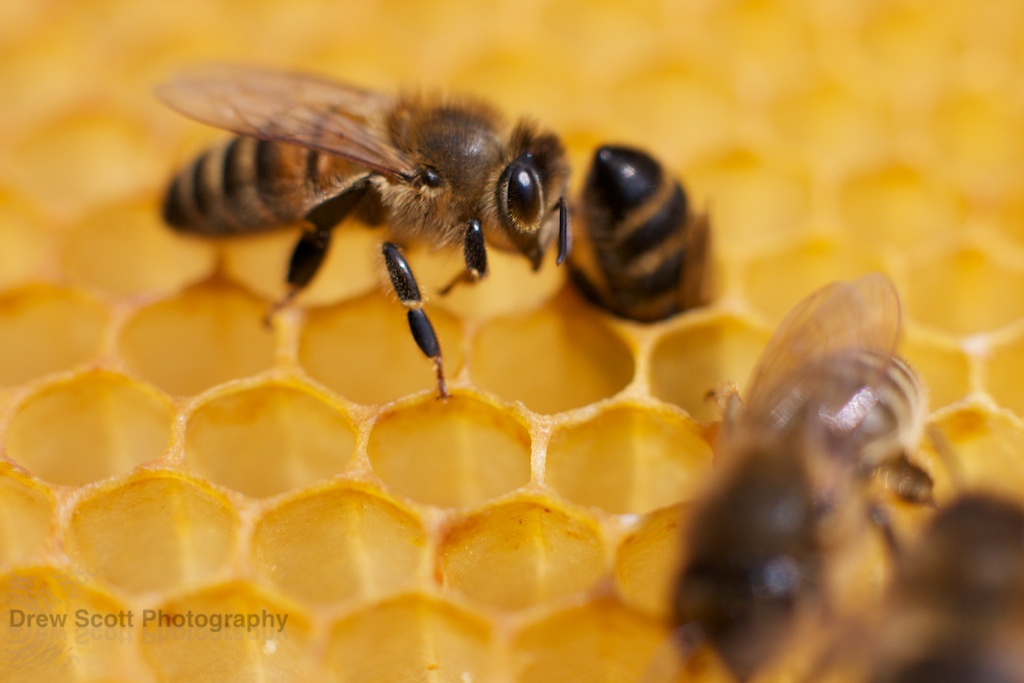
Bees hanging out on a comb.

Wave your bum in the air like you just don't care

Moving outwards

About days 4- 6 she will progress to becoming a Nurse bee, feeding young larvae with the brood food secreted from her glands and older larvae with additional honey & pollen. If it is swarm season, or the bees decide to supersede the existing queen, she may be helping raise queen larvae, which will receive large amounts of protein-rich royal jelly.

By around 10-12 days old her wax glands will have developed and she can begin wax making, along with processing honey into nectar, pollen packing and temperature control duties such as fanning in hot weather. She may also be an undertaker bee, removing dead bees and other debris from the hive. By days 16-20 her hypopharyngeal gland decreases in size and begins producing invertaze and glucose oxidase, enzymes required for honey production. Her body is getting ready to forage.

Bees on a frame of pollen.

Out and about

Our bee has progressed from spending most of her time in the centre of the brood nest to moving further out on the comb for wax building and food handling duties. She will spend days 19-21 on the edge of the nest, fanning or guarding the entrance and making longer orientation flights than previously – she has become an outside bee. Her body is now able to produce the alarm (2-heptanone) & sting (isopentyl acetate) pheromones, along with venom.

She will spend the rest of her life – about another 20 days – foraging for nectar, pollen, water and propolis. The flight distance she accumulates rather than her chronological age seems to do her in, since workers tend to die after flying a total of about 800 km, whether that distance was flown in 5 days or 30. This appears to be caused by exhaustion of the necessary glycogen reserves which accumulate in the flight muscles of young workers; older foragers are unable to produce more glycogen and die of exhaustion.

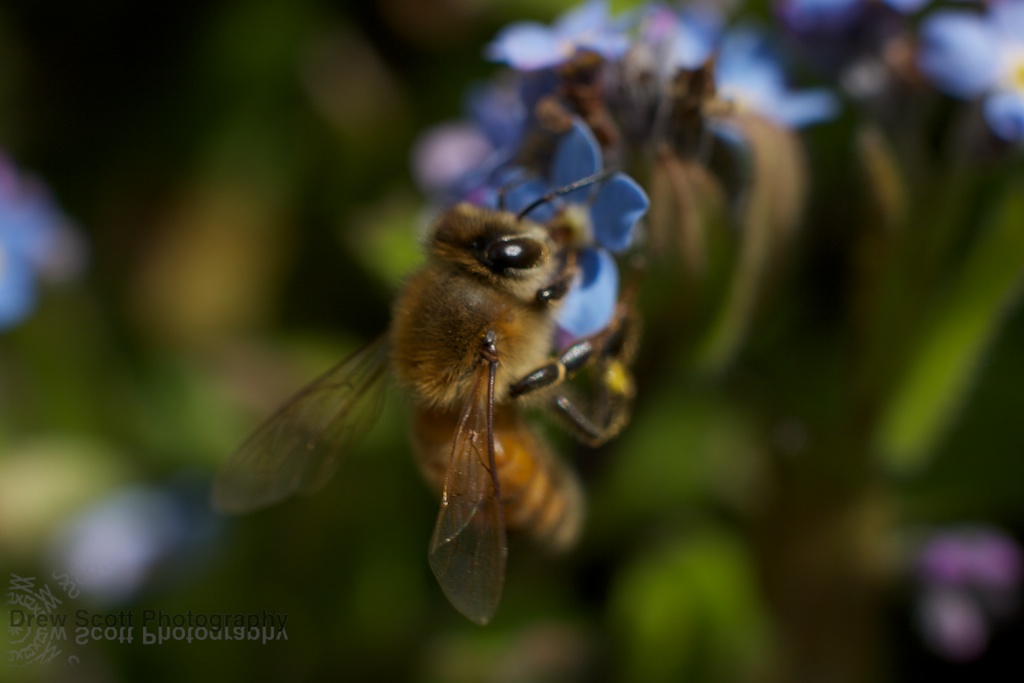
Bee on blue flower

But bees are very flexible…

Despite the rough time frames given above, the activities a bee carries out are extremely variable and flexible depending on factors such as colony population or the time of year, for example in spring as the colony expands foraged food is mainly eaten by the brood and little honey is stored. If a lot of nectar is being foraged by outside bees, house bees will be encouraged to become receivers and honey makers earlier. However, certain duties such as wax making and entrance guarding are dependent on gland development.

Despite their reputation for being ‘busy bees’ workers often spend a lot of the time resting or walking around the colony, allowing them to react quickly to emergencies or an increase in nectar/pollen flow. Resting or alternating tasks also allows their body time to recover, for example for the wax glands to produce more wax before a bee returns to comb building or for the hypopharyngeal glands and mandibular glands to produce more brood food.

Winter bees

The tasks described above are the life of a spring/summer worker bee. Autumn bees that do not raise young live longer, as the pollen they eat is not used for brood food production but instead increases their body’s fat content, which helps them to live longer as they over-winter. When the temperature falls to about 18C they begin to cluster around the Queen with their heads inwards, contracting the cluster as the temperature drops. They consume honey and shiver their flight muscles in the thorax to generate heat. Once the weather warms and the queen starts to lay eggs again they will begin nursing brood and foraging.

More revision/Module 6 themed posts:

Posted in Bee behaviour, Bee biology, Exams | Tagged , | 2 Comments

Spring seems far away

The apiary snowdrops had progressed a little further in their journey up and out of the earth this weekend, but it was a bleak damp day for us beekeepers to be huddling round our cups of tea. No bees were flying. I longed for the hum of a summer’s day.

Bought a jar of pollen collected by a local beekeeper for £4. I plan to feed it to my bees, to try and help them out as the queen starts laying more brood. First I must mix the pollen up into a patty, but finding a recipe is proving difficult. Most I can find on the internet feature pollen substitute rather than pollen itself. This recipe looks quite good, except that I would need a lot of brewer’s yeast. Anyone know a good recipe?

I have been revising for the BBKA Module 6 exam I’m taking in March (eek!) by reading hardcore bee biology textbooks. No pretty pictures of bees on flowers in these; instead about twenty scientific studies are referenced on each page and the only pictures are anatomical diagrams or graphs relating to developmental time scales. I must admit there are times I find it hard to concentrate; there are so many different numbers to remember and the chemical names of pheromones (e.g. 9-ODA – 9-oxodec-2-enoic) are not named for ease of remembrance.

But even if I fail the exam, which is quite possible, at least I will have learnt lots. The more I learn the more fascinating yet mysterious bees seem. For example, each year Drone Congregation Areas, where the drones eagerly await their queen, exist in the same place. Drones do not survive the winter, so this knowledge can’t be passed down from drone to drone. We still just don’t know how they pick the areas, with theories including topographical features and even magnetic effects, as drones develop large quantities of magnetite in their abdomens.

A nice thing to end on – someone (thanks Mo!) sent me this fab link today: http://www.wired.co.uk/news/archive/2011-01/24/bee-feeding-dress. “Artist and insect-lover Karen Ingham has created a range of clothing covered with a nectar-like food source that attracts and nourishes bees.”

Posted in Exams | Tagged | Leave a comment

January’s bees are flying

Visited my bees for the first time since mid-December to wish them Happy New Year. To my surprise, they popped their heads out of the hive to see me (or, more likely, to poo) and were flying all over the place. It’s got milder over the past week, but still wasn’t that warm today – maybe about 13°C?

Here’s a couple of them hobnobbing together:


Just after taking this photo one landed on my bare hand. Not wanting to get stung, I carefully lifted her up to the roof and luckily she walked off my hand. I took the roof off to peek inside and was happy to see loads of bees under the crownboard nibbling away at their fondant, which they ignored for ages when I first gave it to them. Such a relief to see they survived the snow last month, in what was the coldest December documented since nationwide records began 100 years ago, with an average temperature of -1C. Despite the cold, it may be that the weather actually suited those bees in colonies large enough to keep warm. Beekeepers always say wet is worse than cold – dampness can cause stored pollen to go mouldy – and December was also an unusually sunny and dry month.

My bees haven’t got through the winter yet. Brood rearing starts in early spring, initiated by increasing day length. More losses from starvation occur when rearing begins than during the depths of winter. One of my fellow beekeepers opened their hive today to find all the bees dead on the comb. Felt really bad for him and just hope it doesn’t happen to my little bees.


Posted in Uncategorized | Tagged | Leave a comment

Module 6 here I come

I’ve taken the probably over-ambitious decision to take the British Beekeeping Association’s Module 6: Honeybee Behaviour written exam in March. I have about 9 weeks left to revise, which I’ll need because when I downloaded a past exam paper this week I discovered I could only answer one question!

The BBKA offers seven exam modules: Honeybee management, Honeybee products & forage, Honeybee diseases, Honeybee biology, Honeybee behaviour, Selection & breeding of Honeybees & Honeybee management & history. I’m jumping straight to Module 6: Honeybee behaviour because it seemed the most interesting – sorry Module 1 but I don’t care much about memorising the different frame sizes of various hive types!

Beekeepers who pass all eight modules plus the practical ‘Advanced Certificate in Beekeeping Husbandry’ receive the official BBKA accolade of ‘Master Beekeeper’, which my Basic Assessment examiner last summer had sewn onto her beesuit.

Here’s a few questions from the Module 6 past paper I purchased:

Q1: Name in full the primary pheromone from a virgin queen that attracts drones on her mating flight

(A: 9-ODA – 9-oxodec-2 -enoic – really hope I don’t have to spell this out in full!)

Q4: Where in the hive is the ‘dance floor’ said to be located?

(A: the vertical face of the comb near the entrance, where worker bees do their dances to show other bees where they’ve found some cracking flowers)

Q10: The repellent pheromone that acts to deter foragers from an already visited flower is which of these options -Heptanone b: Geraniol c: 9-HDA d: Iso-pentyl acetate?

A: 2-Heptanone. The pheromone 9-HDA is emitted by queen bees for a calming influence that promotes stability of the swarm. Geraniol is a pheromone produced by the scent gland of honey bees and attracts other bees to the location. Isoamyl acetate and 2-Heptanone are both alarm pheromones used by bees. The former is used as a beacon to attract other bees and provoke them to sting, while the latter is a potent pheromone used by foragers to scent-mark recently visited and depleted foragers, which indeed are avoided by foraging bees. (Answer given to me by Andrew Brown on the Q&A website Quora, which is a bit like Yahoo Answers only good).

Q14: List three ways in which trophallaxis is used to advantage by honeybees

A: Trophallaxis is just a fancy word for food sharing. During the exchange of nectar bees pass on scent messages. Food is also exchanged as part of the wagtail dance from the dancing bee to onlookers, so they know what they’re heading for. Sharing a common food source gives bees a distinctly similar smell, helping bees in a colony to recognise each other (similar to us eating brussel sprouts at Christmas?).

Some of the questions require one word answers, others are mini-essay style questions. They aren’t exactly general-knowledge stuff – I could hardly find the answers to any within my enormous edition of Collin’s Beekeepers Bible. To revise I will be buying books on the recommended reading list and have also downloaded the excellent free study notes available from the Mid Bucks Beekeepers Association blog, which gave me the answers to the questions above.

Today the local Ealing beekeepers met up for the first time since Christmas and we watched a video of beekeepers in India. The Asiatic Apis Cerana honeybees which beekeepers there keep are very gentle, so much so that the beekeepers in the video wore no protective clothing and were reaching in with ungloved hands to break off comb from hives. They also were moving bees from one hive to another by scooping them up with bare hands! Made me feel like a right coward for always having my beesuit firmly on.

There was also some discussion about the need for secure places on allotments or similar locations where beekeepers can keep bees. The Ealing association knows of about 170 hives in the Ealing area – as not all beekeepers are members there are probably about 200-300 hives in total. So we’re beginning to feel a little squashed for space! Suitable places are hard to find because vandalism is such a problem. So if anyone in the local area wants to volunteer their garden or allotment as a space for a hive Ealing beekeepers would love to hear from you.

Posted in Bee behaviour, Exams | Tagged , | Leave a comment

New varroa treatment

The Guardian reported yesterday on some promising sounding new research into a way to make the varroa mite self-destruct.

The treatment involves introducing harmless genetic material which encourages the mites’ own immune response to prevent their genes from expressing natural functions, causing them to self-destruct. (I in no way understand how this works, but this is what the article says!) Tests by other scientists have shown the treatment can be added to hives in bee feed. The bees move it into food for their young, where the varroa hides.

The original research paper is here: http://www.biomedcentral.com/content/pdf/1756-3305-3-73.pdf

If we can get nurse bees to feed their brood a treatment that kills varroa, this would be ingenious indeed. It’s one thing carrying out tests under lab conditions and another getting it to work in real life though. Bees are stubborn creatures and I’ve found they’ll often ignore any food I give in favour of what they can collect outside, which is presumably tastier. Perhaps they’ll develop additional ways for beekeepers to give the treatment, such as by syringing over the brood.

I agreed with the comment left on the Guardian story by BeesinArt on the problems caused by monoculture:

“Certain crops though, such as borage, can gain up to an extra 1/4 yield per acre or so, if there there is one hive of bees placed alongside the field per acre. It’s lovely to see 100 beehives alongside a 100 acre field of borage. Imagine the clouds of honeybee workers over the borage field. But, although one can see many bumblebees taking advantage of the borage bonanza, it only lasts a few weeks at most. What then is there for the bumblebees when this mono crop is cut and harvested? Devastating then to see the same bumblebees desperately seeking nectar from horizontal borage plants cut the day before!”

This is the main reason I think organic farming is a good idea, because organic farms tend to plant a wider variety of crops and plant borders with wild flowers. Jordan’s (the oats & muesli people) are one of the companies doing great work in helping bees by supporting farmers to plant more nature friendly plants. Unfortunately the trend in farming certain fruit & veg recently seems to be towards developing enormous pest-free greenhouses which wild bees can’t even get into.

Posted in Disease prevention | Tagged , | Leave a comment

Giving acid to bees

Oxalic acid time at the apiary today. Oxalic acid is a naturally occurring acid that’s one of the beekeeper’s best weapons against the evil varroa mite – it burns their feet and they drop off the bees!

We do this treatment in December because there should be no brood now – if brood was present the acid could damage it. Also, no brood means all the mites are out on the adult bees, where we can get at them.

A group of us proceeded round the apiary one hive at the time, dribbling a pre-mixed and slightly warmed solution of 3.2% oxalic acid mixed with sugar syrup. 5ml at a time goes in-between each frame with bees on.

We had a smoker but only needed to use it on a couple of particularly feisty hives. One poor lady had her top half covered up in a jacket-style bee suit but still got stung on the legs through her trousers! I was relieved to find my bees alive and as well behaved as ever.

Dribbling the acid on a nuc:

Posted in Disease prevention | Tagged , , | Leave a comment

Christmas candy

Today I popped down quickly to see my bees, or at least their hive. With the drop in temperature the apiary was completely still, with no bees flying at all that I could see. The snow’s melted by now, so I wasn’t able to take a pretty picture of snow-topped hives (unlike The Surrey Beekeeper, who has taken some stunning ones), but here’s what their Christmas fondant looks like:

I lifted it up quickly to see if they’d been nibbling on it, but there were no signs that they had. They have two brood boxes of honey stores, so perhaps they’d rather have yummy flowery tasting honey than boring sugar fondant. They will not be eating very much in general, as during winter they huddle together in a rugby-ball shaped mass and slow their activities right down to a point where they are nearly comatose. If you’re interested, the Brockwell Park Community London beekeepers have written a great blog post (Candy is dandy) explaining why we feed bees fondant and not honey.

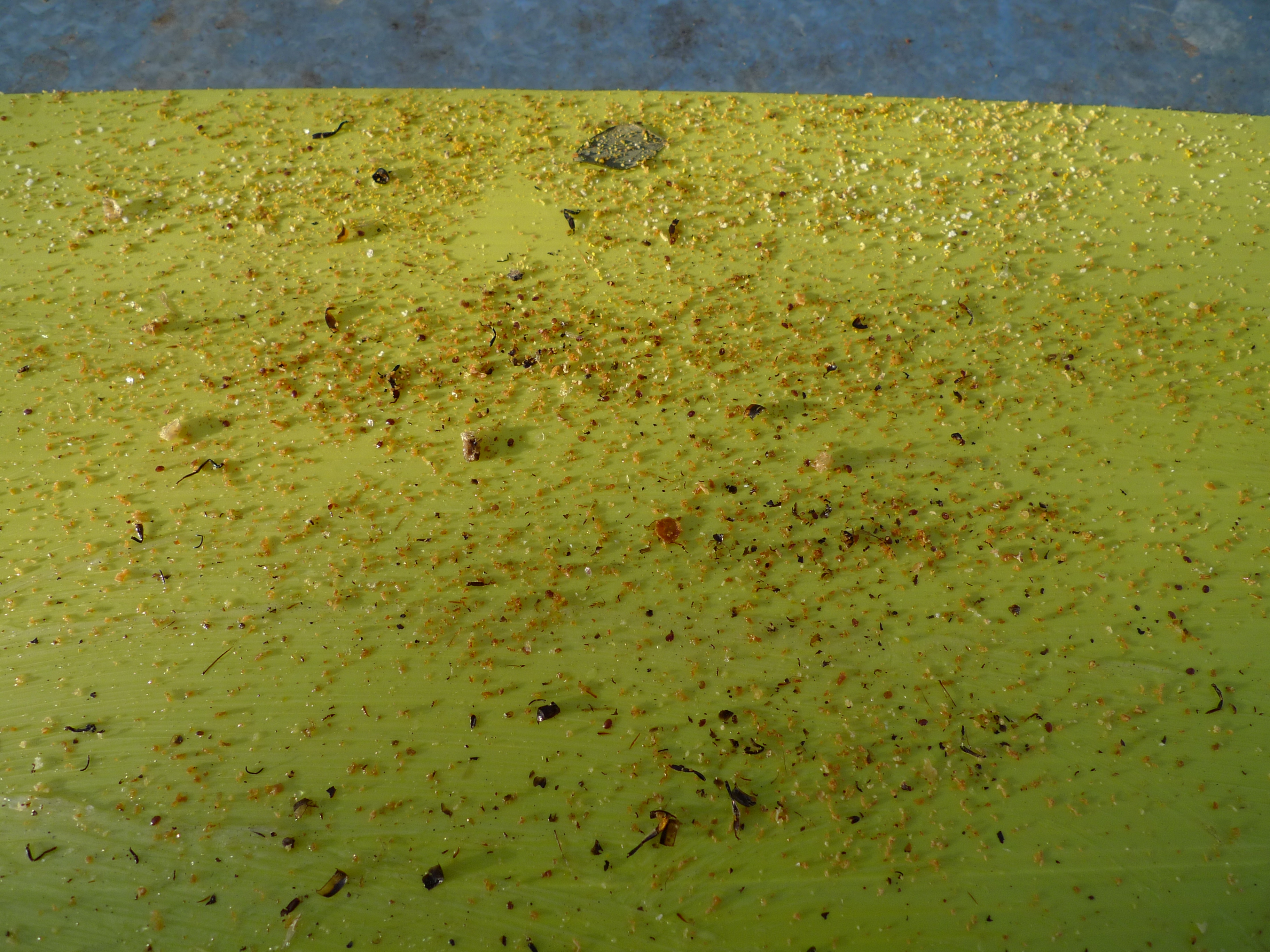
Here’s what the varroa board’s looking like:

The way the pollen has fallen tells me they’re clustering towards the middle front of the hive at the moment. The clusters position changes as the bees eat their stores in one part of the hive and slowly move on to another. Somewhere in the middle of the cluster, in the warmest position, will be the queen. Like penguins huddling together, the bees on the outside become colder than those on the inside so now and again they rotate positions. There seemed to be less varroa on the board than previously – about 50 in two weeks – which is encouraging.

Yesterday was the Ealing Beekeepers Association annual Christmas party, which was a lot of fun. One of the beekeepers told me about beekeeping in Iran, where he used to live. In certain parts of Iran the winter is too cold to keep the bees outside, so beekeepers bring the bees inside a dark room in their houses, until the weather is warm enough for them to be brought outside again. As the room is dark and the bees usually only fly during the day, during this time the bees do not leave the hive for their normal cleansing flights to defecate, so as soon as they’re brought out again they are in a furious mood and go mad at the beekeeper whilst pooing everywhere!

Posted in Uncategorized | Tagged | Leave a comment

14/11/10

Finally put my mouseguard on:

Now only bees or creatures the size of bees can get in. Hopefully a little mouse hasn’t crept in there already.

Had a look at my varroa board, which I last checked two weeks ago. The varroa board is a piece of cardboard which sits under the wire mesh hive floor. Once the mites fall through the wire mesh they are unable to crawl back up again. I gave up counting varroa mites after I reached 100, which seems a lot in two weeks. My FERA booklet on varroa classes a high infestation of mites as >8 dropping per day in October and says that “If the mite drop in a colony is >15 mites per day you must do something and treat immediately”. In November-December Lactic/Oxalic acid are options, I’ll talk to some of the experienced beekeepers next weekend and see what they recommend.

You can see the mites in the photo below, they are the little shiny brown oval buggers. They overwinter by feeding on the bees, sitting on the top of their abdomens, where the bees can’t reach when they groom themselves. A British study has found that they prefer the left side of the bees, probably because the left side allows the mites to place their mouthparts closest to the bee’s midgut, which is likely to contain higher concentrations of many nutrients. The varroa mites not only weaken the bees but are associated with the transmission of pathogenic diseases between bees. I hope my poor little bees can hang on in there over the winter.

Rosemary’s varroa board

A less close up shot from another hive, plenty of pollen and wax cappings here.

Lavender’s monitoring board

Posted in Disease prevention | Tagged , | Leave a comment

Bee news

There’s been quite a bit of bee related news in the papers this week, some good, some not so good…

The bad news

The good news

  • The UK’s five rarest bumblebees are making a comeback, with the help of wildlife-friendly farming. Putting in pollen and nectar-rich flower margins to fields, growing red clover hay meadows and rotating the grazing of animals on land has helped in farms in Kent and East Sussex.

>>The shrill carder bee, Britain’s rarest bumblebee. They have pale greenish yellow chests and the queen makes a shrill sound when she flies.

  • Bees are very clever (possibly could be classed as bad news for the beekeeper!). So clever that their tiny brains beat computers at finding the shortest route between flowers discovered in a random order.
Posted in Uncategorized | Tagged , | 2 Comments