Middlesex Federation Day Part 1: Professor Field, Why do we use insecticides?

Yesterday I went to the Federation of Middlesex Beekeepers’ Associations annual ‘Federation Day‘. Each year the Middlesex associations (Ealing, Enfield, Harrow, North London, Pinner & Ruislip) take it in turn to host a day of beekeeping talks; this year the day was organised by the Enfield association, in a remote area of north London which took me around 2 hrs 45 mins to reach from my part of west London!

The travelling was worth it as I learnt lots from three expert speakers.  Below are my notes from the excellently-named first speaker, Professor Field. She works at Rothamsted agricultural research station, focusing on understanding insecticide mode of action and resistance at the biochemical/molecular level and then using this to develop better pest control strategies. Recently she has played a role in developing Rothamsted’s policy on the effect of neonicotinoids (neonics) on bees and a lot of her talk was spent giving us an update on the neonics situation.

Why do we use insecticides and what are the threats for bees?
Professor Linda M. Field. Head of Department, Rothamsted Research

Professor Linda Field

Professor Linda Field

Advantages of neonics: 

  • Very selective to insects, not toxic to mammals
  • Systemic – travels through plant to leaves and flowers if used as a seed dressing (this has turned out to be less of an advantage than initially thought, as it means neonics end up in the nectar and pollen). Avoids the need for costly sprays which are potentially more damaging to local wildlife.
  • Pests take a long time to develop resistance to neonics
  • If used properly, little evidence that they directly kill bees

Problems with neonics

  • The question is not “Are they killing bees?” but “Are they having a sub-lethal effect which causes problems for bees?” – for instance, stopping foraging bees finding their way home. There is evidence that this is the case, but we don’t understand why this might be.
  • To gather research in the field, large-scale experiments are required to find out if neonics are a problem. These studies are not being funded by governments.

Lots of other factors beside pesticides are causing bees problems – varroa, viruses, weather, loss of forage – these are important but less easy to control and stop.

Where are we with neonics now?

In 2013, Regulation No 485/2013, the European Commission restricted the use of three neonicotinoid pesticides, clothianidin, thiamethoxam and imidacloprid, preventing the use of seeds treated with them in EU member states.

No-one has monitored the overall effect of the ban! The EU is not providing money for research into neonics. We have some scientific papers from independent organisations, but the research has been done in varying ways using different methods, making it hard to compare. A decision is unlikely to be made on what to do next until spring 2017.

The most recent EU report was in April 2015, by the European Academies Science Advisory Council (EASAC): Ecosystem services, agriculture and neonicotinoids. Professor Field recommended the conclusions at the end of the report (p.29) to us as the “easy bit to read”. She went through some of the report’s conclusions and gave us her comments on them:

“There is an increasing body of evidence that the widespread prophylactic use of neonicotinoids has severe negative effects on non-target organisms that provide ecosystem services including pollination and natural pest control.” (Conclusion 5)

Professor Field agreed with this but added that equally there are also papers which have found the opposite.

“Current practice of prophylactic usage of neonicotinoids is inconsistent with the basic principles of integrated pest management as expressed in the EU’s Sustainable Pesticides Directive.” (Conclusion 7)

Professor Field commented that people often take the word ‘prophylactic’ as implying unnecessary usage, whereas most farmers can reliably predict that certain pests will turn up each year. As mentioned above, one of the advantages of neonics is that pests take a long time to develop resistance to them. When the neonics ban was put in place here, weevils began destroying oil seed rape crops, resulting in some farmers spraying with pyrethroids 4-5 times in an attempt to kill them – but the weevils had developed resistance to pyrethroids. By the time farmers and agricultural advisers realised this, the sprays had also killed beneficial insects that might have helped control the weevils.

“Widespread use of neonicotinoids (as well as other pesticides) constrains the potential for restoring biodiversity in farmland under the EU’s Agri- environment Regulation.” (Conclusion 8)

Professor Field said there is a lot of debate going on about how to combine habitat diversity and farming. Should we try to share farming land with native species and make it biodiverse? A nice idea but not optimal for either farmers or wildlife. Or farm some areas of land intensively while leaving other areas aside for biodiversity? There is evidence that this approach may help rare species more.

Current UK situation

The UK government temporarily lifted the ban and allowed about 5% of farmers to sow neonic treated oil-seed rape in autumn 2015. This applied to farmers in areas where there is high resistance to pyrethroids in cabbage stem flea beetles, a pest of oil-seed rape. There are a lot of oil-seed rape crops out there which survived the initial onslaught but are full of beetle larvae waiting to attack. We may see farmers start to plant more field beans and pulses.

The COLOSS 2014-15 winter losses data showed low honey bee colony losses in the UK compared to many other European countries. The overall proportion of colonies lost (averaged out across all 31 countries surveyed) was 9%, the lowest since the COLOSS international working group started collecting data in 2007. But we really need the 2015-16 winter data to try and see if the ban has had an effect. There will be all sorts of factors affecting colony losses in any case, including the weather and varroa. We still have limited national data on numbers of solitary and bumble bees, which the EASAC report noted are more vulnerable to the risks from neonicotinoid use.
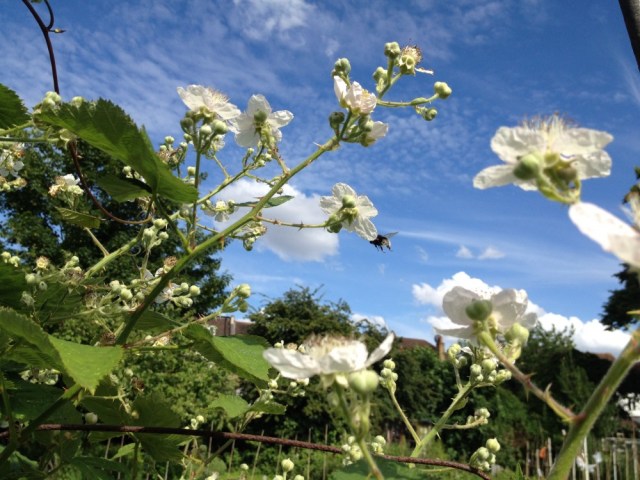
Bramble flowers against the sky


Insecticides and pollinators – are they incompatible?

Professor Field concluded that we can have both, through:

  • Biological controls – for example plants that naturally repel insects or plants that are naturally resistant to pests. GM has the potential to engineer plants to be naturally resistant.
  • Cultural controls – rotating crops more, mechanical sowing.
  • Using pesticides as a last resort when other methods don’t work!

I was left feeling ambivalent about neonics. In some ways they are better than the pesticides that came before – none of us want to go back to DDT. At the same time, I would rather have a countryside which is more welcoming to pollinators. I support the EU ban because at least it’s trying something – at least it’s an attempt to protect pollinators, see what the effects of neonics are and if banning them can help.

See also Emma’s write-up of the day on her Miss Apis Mellifera blog, I missed the beginning of Professor Field’s talk but she was there for it all: Federation of Middlesex Beekeepers Day 2016.

Posted in Events | Tagged | 13 Comments

What’s flowering now: early February

Everything is early this year. So we have snowdrops at the apiary:

Snowdrops

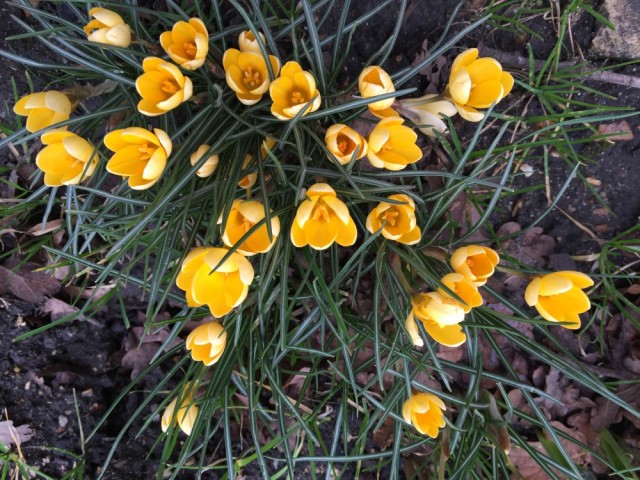
Crocuses at Northfields allotments:

Yellow crocuses

Purple crocuses

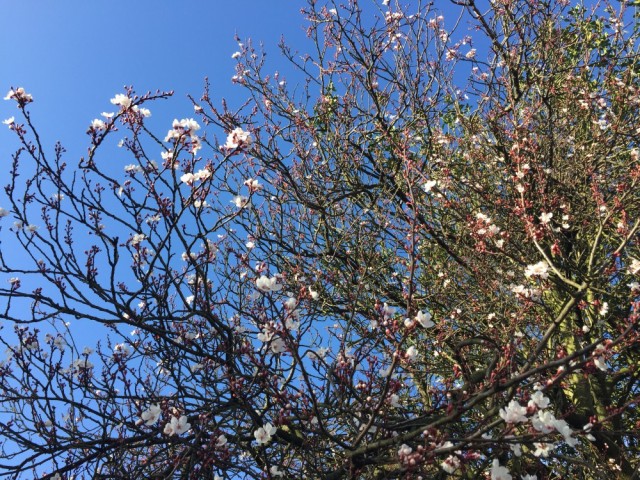
Blossom on the trees:

Blossom

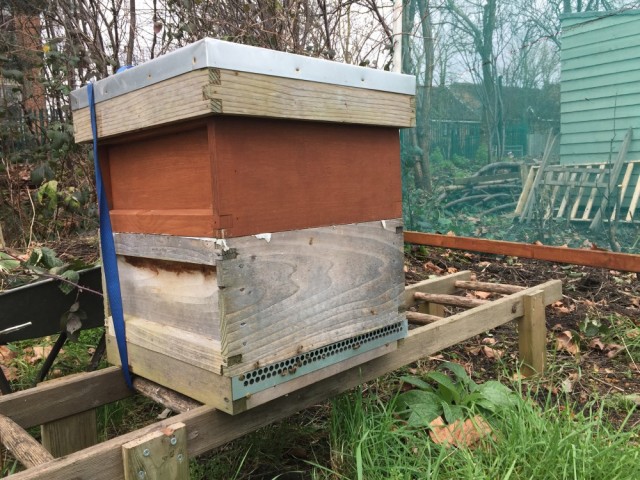
It were a mild day today, so the allotment bees were out and about.

Allotment hive

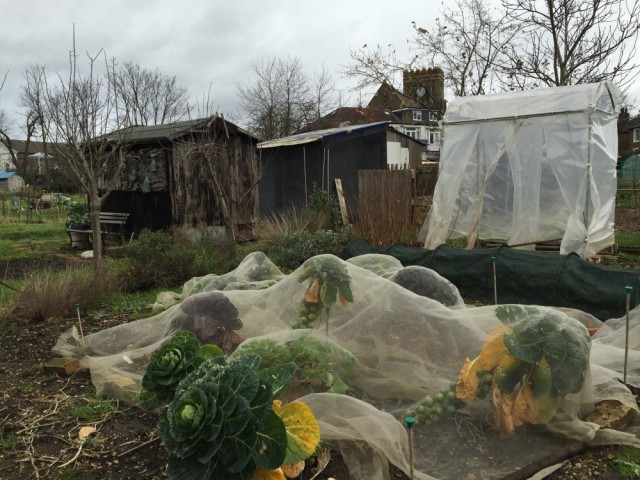
The plots were quiet except for birds hopping over the bare earth. The main crops in view were the strange shapes of brussel sprouts.

Brussel sprouts

All is quiet with the bees at the moment, but before we know it spring will be underway and the first swarms will be here.

Thanks to Margaret Anne Adams, who posted helpful December 2015 advice from the Regional Bee Inspectors on the BBKA Facebook page: INSPECTORS_ ADVICE.docx – apparently there have been outbreaks of European Foulbrood (EFB) in the Shropshire/Welsh borders. Part of the advice given to prevent these outbreaks is to change brood combs regularly and avoid re-using combs from colonies which have died out. Now is a good time to prepare new frames ready for spring Bailey or shook-swarm comb changes.

Posted in Uncategorized | 26 Comments

Winter at last?

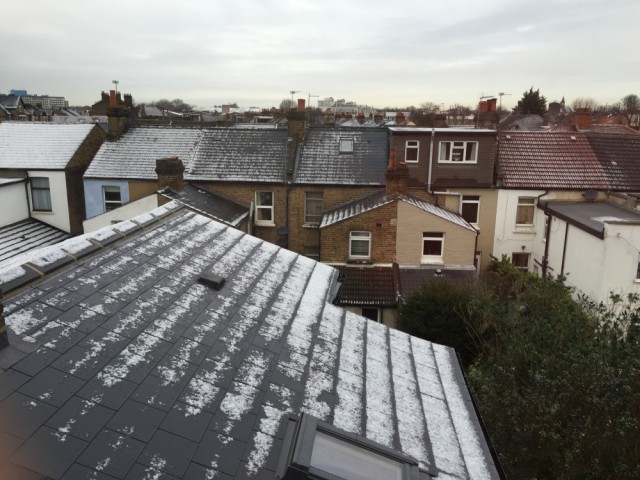
Last weekend brought a surprise – snowy rooftops. The white stuff melted fast, but the chilly air remained. Down at the apiary the ground was hard and all was quiet, with no bees flying.

Snowy roofs

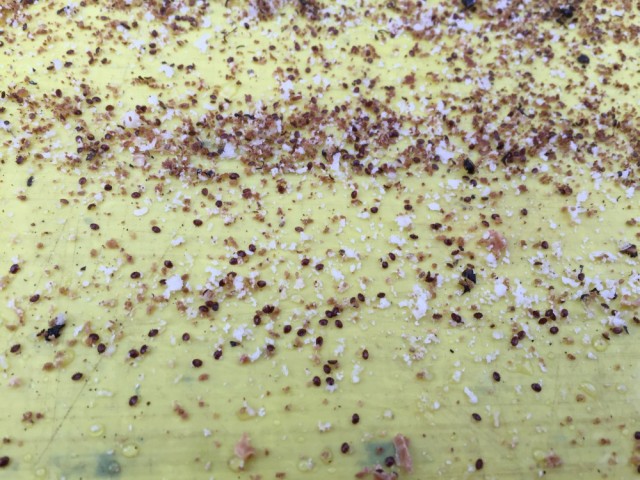
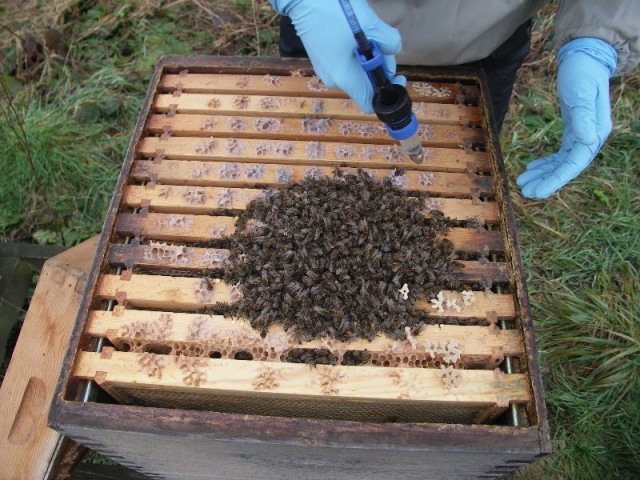
When the bees are tucked up, the varroa boards provide a clue to the size and position of the cluster. The white flakes are particles of wax dropped by the bees as they uncap honey stores to feed. The dark brown oval shapes are varroa mites killed by oxalic acid trickling.

Varroa monitoring board

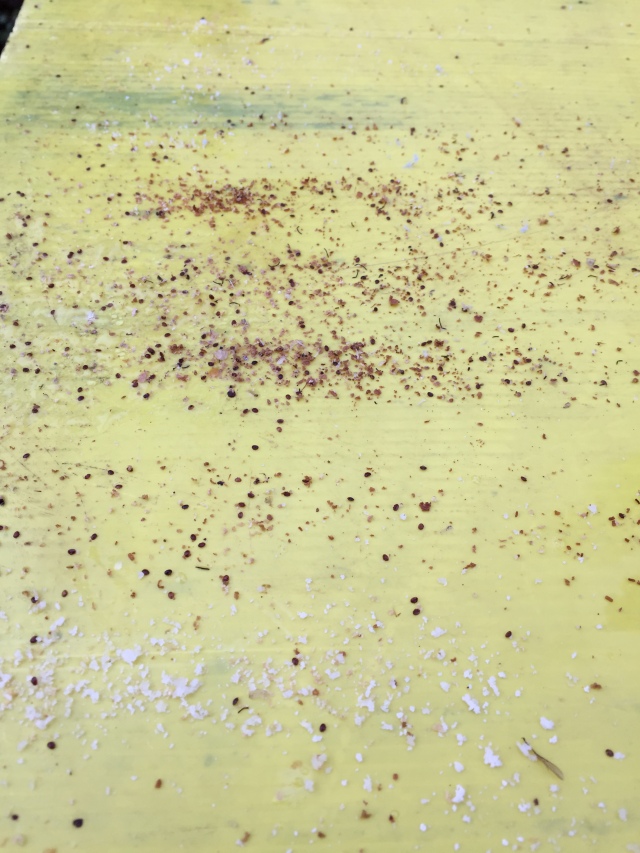
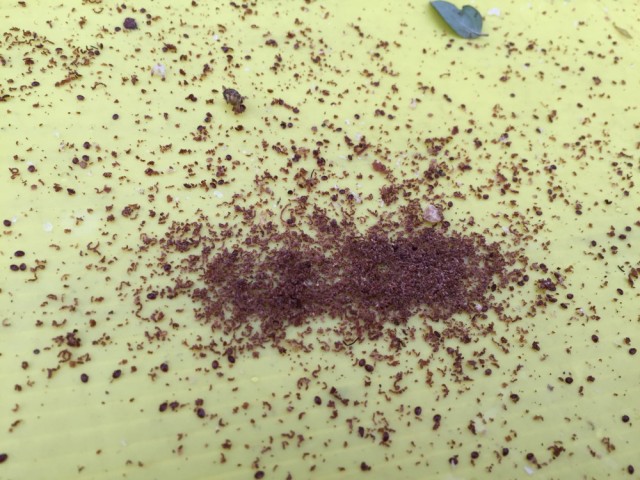
Each board tells a different story – some of the clusters are small and tight, others cover several frames. We have taken the boards out now as it’s not a good idea to leave them in all the time. This way the bees have ventilation at the bottom and plenty of insulation at the top, thanks to Tom’s specially built insulated roofs plus insulation foil from Wickes which we pack over the crown boards.

Varroa monitoring board

I checked the hive entrances and discovered that Melissa’s mouseguard had somehow come undone and fallen down on one side, leaving the entrance open. I put it back in place with extra drawing pins; hopefully I wasn’t trapping a mouse inside!

Varroa monitoring board

At this time of year I wish I could spend my winter huddling inside like the bees.  I don’t enjoy my winter commute – leaving for work and coming home from work in the dark, waiting at chilly bus stops.

Frolicking frost

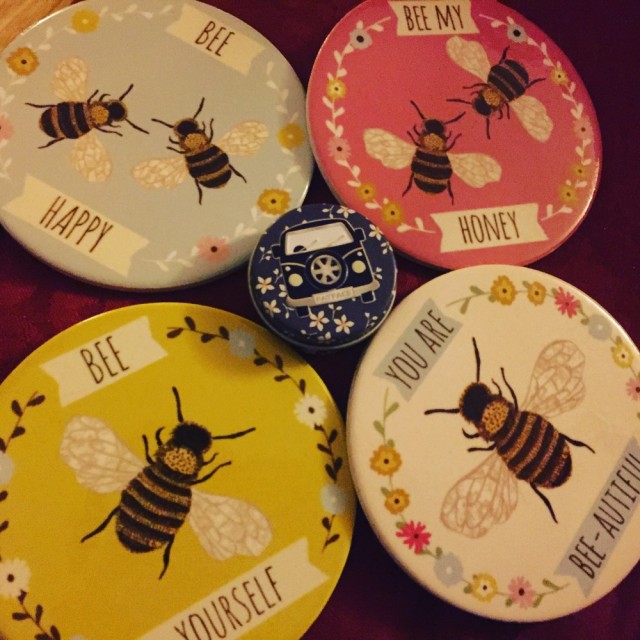
The solution? A nice cup of tea. This lovely ‘Bee puffer mug‘ by Lush Designs was one of my Christmas pressies.

Beekeeper mug

I can put my bee mug down on a bee coaster from Chickidee too, another lovely Christmas present. Finding bee-themed baby clothes is my next mission 🙂

Bee coasters

Posted in Uncategorized | 25 Comments

New LASI oxalic acid research published

A comment by the lovely Amelia from afrenchgarden.wordpress.com on my last post led me to look at the University of Sussex’s Laboratory of Apiculture and Social Insects (LASI) website.

I was dismayed to see a new press release, ‘Scientists determine how to control parasite without harming bees‘, which advises beekeepers not to use the trickling or spraying oxalic acid method (which is what most beekeepers I know use). Instead sublimation (also known as vaporisation) is recommended.

“Professor Francis Ratnieks, head of LASI, says that beekeepers should cease using the other two methods (“trickling” and “spraying”, in which a solution of oxalic acid is used) as they are harmful to the bees and less effective at killing Varroa.”

Research accompanying the press release was due to be published today (Tuesday 5 January 2016) in the Journal of Apicultural Research, but unfortunately this journal is not publicly accessible to non-subscribers. I’ll try to see if I can access it through work as I would like to read the research study – it’s called ‘Towards integrated control of varroa: comparing application methods and doses of oxalic acid on the mortality of phoretic Varroa destructor mites and their honey bee hosts’ by Hasan Al Toufailia, Luciano Scandian and Francis Ratnieks.

The press release says the trickling and spraying methods “cause harm to bee colonies, resulting in reduced winter survival”. I wonder why harm is caused, how great the harm is, and whether it outweighs the harm caused by not treating for varroa at all. Emma and I have never had any colony losses following oxalic acid trickling and I cannot recall other beekeepers having experienced this either, but perhaps LASI have found colonies to be weakened by it afterwards.

Hopefully Beecraft and BBKA News will mention the study in their February issues.

EDIT 29/02/16: The research has now been published and I’m grateful to the Journal of Apicultural Research for generously making it freely available to the public: Towards integrated control of varroa

Treating with oxalic acid. Courtesy The Food and Environment Research Agency (Fera), Crown Copyright.

Treating with oxalic acid. Courtesy The Food and Environment Research Agency (Fera), Crown Copyright.

Posted in Uncategorized | Tagged | 22 Comments

An unusually warm winter for the bees

Happy New Year everyone! December here in London was unusually warm, with a high of 16°C (60.8°F) recorded at Kew Gardens. This has caused the bees to go through their stores faster than usual and also encouraged them to go foraging when they should really be tucked up inside conserving their energy. Back on the 19th December I needed my bee suit as so many bees were flying and even returning with two colours of pollen!

Fondant

Above is a hole one of our hives had made in their fondant. It’s lovely to put your hand on the plastic over the cluster and feel how warm it is. By the way they do also have plenty of honey stores, but they seem to like to go up to the top of the hive where it’s warm. Our colonies do this every winter.

Jonesy's fondant

Jonesy’s hive had eaten up all their fondant in under a month! You can also see that they’d even started building a bit of comb in the empty packet.

Winter drone

The warm autumn/winter has caused more drones to be around than usual – I spotted this live one on the roof of a hive. He was in good condition so must have been expelled recently.

Dead drones

Another hive had all these ex-drones stuck in the mouse guard. They looked recently dead.

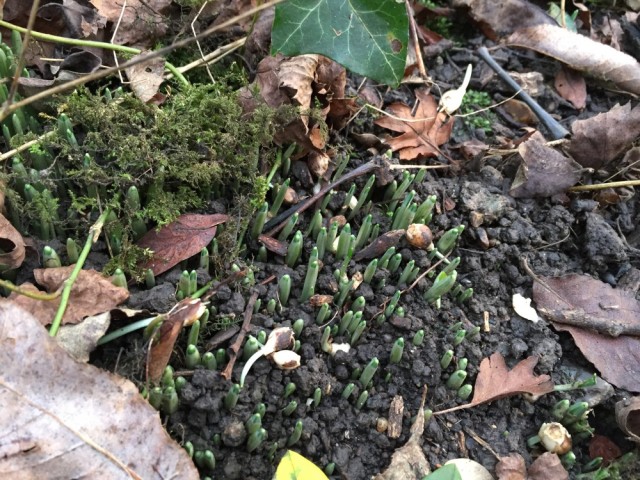
Snowdrop tips, December

Snowdrops were peeking through the earth at the apiary a month earlier than usual and daffodils have been spotted in London. There are pros and cons to all this for the bees –

Pros

  • A warm winter allows the bees to raise more brood – useful if you want to get a spring honey crop
  • The bees can take more cleansing flights which helps with hive hygiene and makes disease outbreaks less likely

Cons

  • Risk of starvation increases if we don’t keep an eye on them
  • Less likely to be a brood break to help keep varroa numbers down
  • Warm weather encourages bees to fly even though not much forage is available
  • Brood raising and foraging will reduce the usual longer lifespan of winter bees

Any others I’ve missed? Or any you disagree with?

Northern England has been suffering floods, so I know I’m lucky to have only warm weather to worry about. One beekeeper posted on the BBKA Forum “having to do emergency beehive move tomorrow now I can get to the hives, due to flooding and a stream breach……too dangerous to try to get to them before and also had a cowshed 2ft under water to sort out with 30 cows in it, which had to take priority”.  Thirty cows to worry about on top of potentially water-logged bees, can you imagine? At 1.05 on this video you can see a brief clip about the effect the floods had on a York beekeeping business: UK floods.

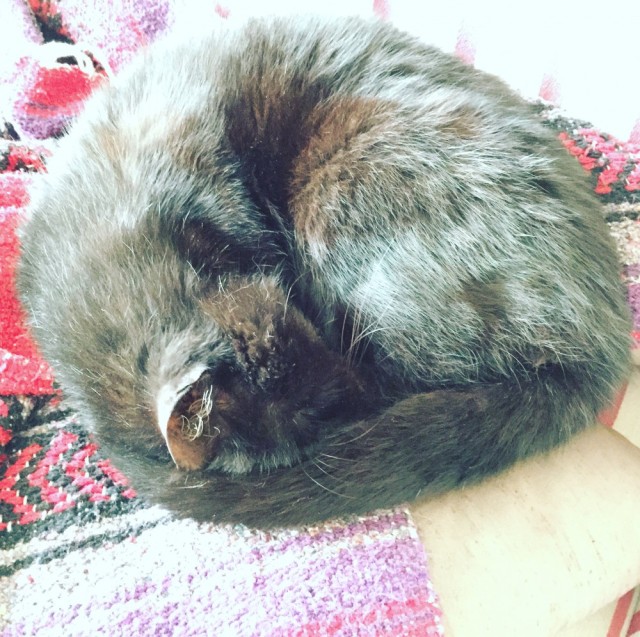
Cat in a ball

If I could ask my cat Bob what weather he likes best, I think he’d go with warm and cosy please. Me too Bob, me too.

Posted in Uncategorized | Tagged | 24 Comments

The things people want to know about bees

I’ve been looking back at the web searches people used to find my blog during 2015.

The most popular was ‘honeyflow’, with ‘honey flow’ and ‘honeyflow.com/commercial’ also in the top 10 (the last demonstrating that some people prefer to enter urls into search engines rather than their address bar). I wrote a post about the Flow hive back in February: Will the honey flow for you?. There were so many variations on Flow hive searches to find my blog that I should thank the inventors for sending all those visitors my way!

At number 6 was ‘braula coeca’, a now rare honey bee pest. I believe this is probably not because a lot of people are looking for information on it but because there’s not a lot of information out there. If you write about a niche subject, there’s more chance people will find your content. I wrote about this funny little jockey in 2013: Honey bee pests, diseases and poisoning revision post: Braula coeca: the ‘bee louse’

Courtesy The Food and Environment Research Agency (Fera), Crown Copyright

Braulacoeca (top) compared to Varroa (right), Tropilaelaps (centre bottom) and Melittiphis (left). Courtesy The Food and Environment Research Agency (Fera), Crown Copyright

People are also trying to find out about chilled brood, stone brood and husbandry methods like shook-swarms and the Bailey comb change. I would always recommend going to the National Bee Unit’s Beebase website for expert bee disease and husbandry information you can trust: nationalbeeunit.com – especially their free advisory leaflets, training manuals and fact sheets.

Some of my favourites were the more obscure searches:

pile of dead bluebottles in an old building

paw print plum blossom on snow

has any one experience of meeting warm sweet honey – yep, tastes best eaten straight from the hive

how a university research garden should look like

someone who passed the exam has not read the book (wonder how well they did)

a honey bee habit – many of us do have a bee addiction

show me some lovely elsa cakes please

Well ok – cakes made this week by a friend of Elsa’s, she kindly brought them down to the apiary for us – they were so delicious:

Christmas fairy cakes


Unknown search terms: 10,726. Google has been encrypting the vast majority of search terms since 2013 – officially to protect user privacy, though funnily enough subscribers to Google AdWords get to see the terms.  SearchEngineLand covered this in 2013 if you’re interested: Post-PRISM, Google Confirms Quietly Moving To Make All Searches Secure

Posted in Uncategorized | 19 Comments

Royal Jelly – a story by Roald Dahl

If you’ve ever read Roald Dahl’s short stories for adults, you’ll know they’re very different in tone to his more famous children’s books. My mum had both his Kiss Kiss and Switch Bitch collections and I re-read them quite a few times as a child, including the story Royal Jelly.

This week I was in the Barbican Library near my work and stopped to check out the returned shelves. One of the books there happened to be Kiss Kiss, so I got it out specially to read Royal Jelly again. As a child my knowledge of bees was basic, so the story had a new fascination now that I’m a beekeeper.

The plot involves a married couple who have just had a long-awaited child. The mother, Mabel Taylor, is “half dead with exhaustion”, out of her mind with worry because the baby girl will hardly take any milk. This baby is eating so little that at six weeks old she weighs two pounds less than she did at birth. Then an idea comes to Mabel’s husband, Albert. He is a professional beekeeper and whilst reading his beekeeping magazine comes across an article on royal jelly. The article details the wonderful properties of royal jelly, including the tremendous weight gain of a honey bee larva fed on it. ‘Aha’ thinks Albert – and proceeds to add royal jelly to his little girl’s feed. The strategy works, with the baby greedily lapping up this new formula and crying for more – but this new enriched milk also has some unexpected side-effects.

Reading the story now, I was surprised by how detailed and accurate Dahl’s descriptions of bee biology and beekeeping generally were. He must have done a fair amount of research to write the story. For instance, take the articles listed in the contents page from his bee journal: Among the Bees in May; Honey Cookery; Experience in the Control of Nosema; The Latest on Royal Jelly; This Week in the Apiary; The Healing Power of Propolis. The story was first published in 1959 and yet these could be articles from a current journal.

His descriptions of royal jelly were accurate according to scientific knowledge at the time. For example, Albert Taylor explains to his wife that it “can transform a plain dull-looking little worker bee with practically no sex organs at all into a great big beautiful fertile queen”. Worker larvae receive pure royal jelly for only the first three days of their lives, after which they are fed a mixture of royal jelly, honey and pollen. In contrast a larva chosen to become a queen receives only an abundance of royal jelly throughout her larval life, so much so that she is literally floating in it.

For years it has indeed been accepted opinion that royal jelly is the miracle food which has the ability to turn an ordinary female larva, laid from an identical egg to her sisters, into a queen. However, some new research published in August 2015 suggests that what really matters is what larvae chosen to become queens aren’t fed – the pollen and honey their ordinary worker sisters get. In 2008, Australian scientist Dr. Ryszard Maleszka managed to create queens in his lab without feeding them any royal jelly (by silencing a set of genes). One theory is that receiving no pollen provides chemical protection for the queen’s ovaries, as she is sheltered from the potential toxic or metabolic effects of plant chemicals.

All this is a rather round-about way of recommending this story to you and also mentioning that in April 2016 I’m expecting a little drone – just in time for swarm season. Having read the story, I will not be feeding him any royal jelly!

References:

Posted in Bee biology | Tagged | 35 Comments

Tucking the bees in for winter

It has taken a while to come, but at last we have proper see-your-breath-in-the-air, see-the-sparkling-frost-in-the-mornings cold. The kind of cold that stops honey bees flying. I walked round the apiary yesterday and the hives could have been abandoned, so quiet were the entrances. Hiding inside – several thousand bees, hundreds of woodlice, a few gigantic spiders and at least one hibernating queen wasp.

Apiary in November sunshine

It is too cold for syrup now, so a slab of fondant has been placed over their crown-boards. Pepper’s girls also have one super, Melissa’s two. Peppermint’s bees were a new split from Pepper’s hive this year and didn’t manage to fill out a super, but they do have plenty of honey in their brood box.

Apiary in November

Mouse-guards are on, chicken wire to protect against woodpeckers has been placed around the hives and we are using special insulated roofs Tom made for us. Varroa boards left out so that the hives have ventilation from below through the open-mesh floors. I think of it as going into battle, assembling all the weapons we have against the elements and creatures that prey on bees. The bees will do most of the work of course, huddling protectively round their queen as outside the wind howls, the rain lashes and the frost bites.

Woodpecker chicken wire protection

These are a few last details but really preparing the bees for winter goes on all year long. You are always preparing the bees for winter – because the best weapon is having healthy bees to begin with. A combination of luck, the local environment and how well you looked after the bees during the year.

It’s things like how clean your equipment is, how recently you replaced your brood combs, how low you kept varroa levels, how much honey you left them, how many times you managed to inspect the colony without squashing the queen or tripping over and dropping boxes of bees everywhere. What was the weather like, were new queens able to mate well, could the foragers fly often, were there good sources of forage around for them to find? If all that went well, then the colony has a good chance of surviving whatever winter can throw at them. Just don’t forget to put your mouse-guard on.

What are your beekeeping weapons of choice against winter’s fury?

Posted in Uncategorized | Tagged | 20 Comments

A visit to the country… with bonus bees

Last weekend brought a perfect start to November. An appropriately misty October 31st was followed by a sunny Sunday, showing off the dew glistening on the enormous spider webs hanging from the scaffolding outside our house.

To take advantage of a rare Sunday with no jobs to do, Drew and I took a trip to the country in our camper van. Our destination was the National Trust’s Hughenden Manor, in High Wycombe, Buckinghamshire. As Drew has lifetime National Trust membership we both get in for free. Having traversed through a labyrinth of multi-laned roundabouts, which we always seemed to end up in the wrong lane for, we arrived at a beautiful manor house with an even more beautiful garden full of gently falling leaves.

Hughenden Manor

Here’s what the house looks like. It used to belong to our (so-far) only Jewish born Prime Minister, Benjamin Disraeli. I’m sure he would have approved of its use as a cartography centre during World War II, churning out painstakingly accurate hand-drawn maps which our pilots crossing Germany used to find their targets.

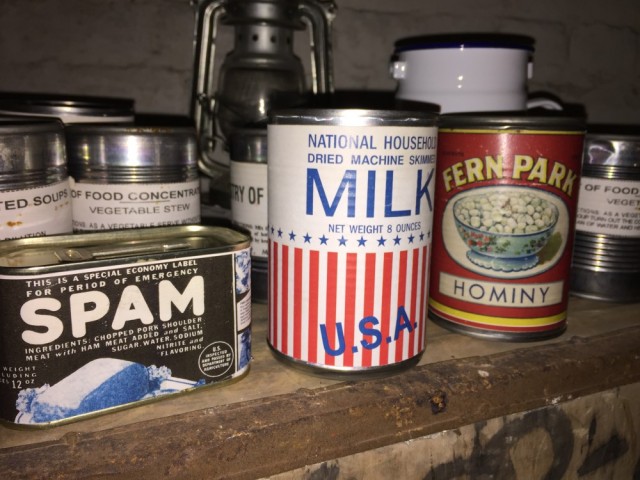
War time food, Hughenden Manor

A war-time display in the manor’s basement shows the type of food the artists who lived there ate. My father was a war-time baby and is very fond of condensed milk; sliced bananas with half a can of condensed milk poured over the top was a common snack while I was growing up.

Bee hives, Hughenden Manor

I had genuinely not come looking for bees, but I found them. I leaned over the fence and took in the scent of the hives. As it was a sunny day, with bees zipping frantically in and out, I could catch the sweet smell of nectar. Apiaries definitely have their own aromas which perhaps are more noticeable to a beekeeper familiar with them, as Drew couldn’t detect it.

Honey bee on mallow flower

I tracked the bees down inside the sheltered vegetable garden. I think this may be a mallow flower, or at least related to one. Please correct me if I’m wrong. The 1st November and the bees were still enjoying themselves on these and a wall full of mature ivy.

Honey bee on mallow flower

Not just honey bees either. I was astonished to see this bumble bee.

Bumble bee on mallow flower

I suppose I shouldn’t have been surprised, considering it’s been a warm autumn and there have been reports of buff-tailed bumble bees breeding throughout the winter in Southern England. Is anyone else still seeing bumbles here?

Scarecrow

This gentleman looks ready for winter.

Autumn leaves

The trees were ablaze in their autumn shades, glowing amber, russet, red, gold and green. We walked lazily along the paths, kicking up dry piles of leaves and observing fat squirrels hopping up trunks.

Autumn leaves 2

Drew and autumn leaves

Today London has turned soggy and we’re huddled inside watching rain steaming up the windows. My cat Bob is wisely staying warm and cosy under the duvet. I expect the bees are at home too, taking stock of their stores. Will their weighty vaults of honey combs be enough for the coming months of winter? Now is an anxious time for beekeepers. All we can do is watch and wait; and I have my own waiting of another kind to do too.

Posted in Uncategorized | Tagged | 23 Comments

London Honey Show 2015

Today I went to the fifth annual London Honey Show at the Lancaster London hotel. The Show includes the honey competition, talks and stalls to visit. This was the first year it’s been held at the weekend rather than a weekday evening. It seemed a bit less busy than usual, but that may have been because it was on for longer.

Below are the London honeys entered in the tasting competition. You can see the variety of colours from pale yellows to dark reds.

Honeys for tasting

Some cute art work done by children at a local school.

Children's art work

I especially liked the ecstatically grinning bees below, which have wings the size of butterflies.

Children's art work

Hotel hives

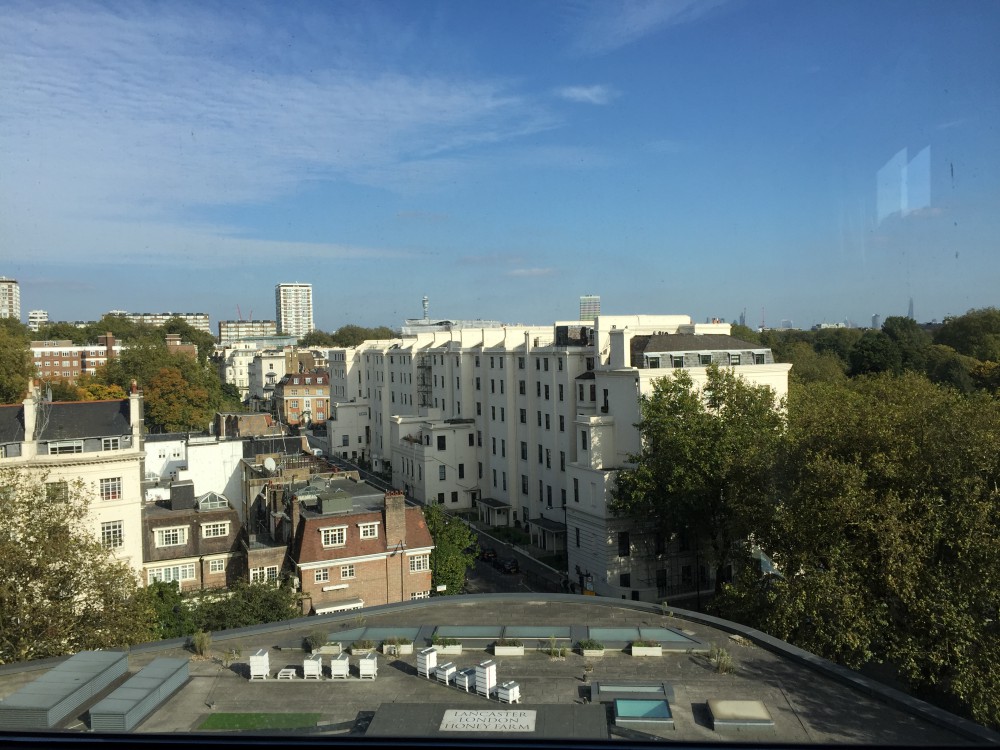
The hotel has hives on their roof; one of the two employees who helps looks after the bees showed us up to a room with a view of the hives. Though there are nine hives down there, only one is occupied at the moment, following problems with colonies dying out due to varroa.

Lancaster London hives

I missed the first talk but arrived in time to hear James Hamill, “Tales of beekeeping from around the world”.

James owns the Hive Honey Shop, a family-run business on Northcote Road, SW11. He has over 100 beehives and practises migratory beekeeping, moving the hives to secret locations in remote areas. He does rooftop beekeeping in London too and has kept bees for the royal family at St James’ Palace and Highgrove.

He meets with the beekeepers whose honey he sells to make sure their honeys are minimally processed, rather than heat treated and blended together from multiple hives.

His life made me very jealous, as in-between running the shop he likes to travel internationally to meet beekeepers in other parts of the world. He showed us photos from many places including Uganda, St Lucia, Turkey and Tuscany. He donates equipment to the beekeepers he visits and also purchases honey and old hives for his collection of historical beehives. His attic contains hundreds of honeys!

He has trekked to watch the honey hunters of Nepal, who construct their rope from natural materials gathered that day, then scale cliffs to take the giant combs of Apis Dorsata bees. They will slaughter a goat before setting off – if the goat had a healthy liver they go ahead, if not this is a sign from god not to go. The honey hunting expedition is a perilous one.

James watched the local children standing underneath the cliffs as the honey was collected. They held their mouths open in delight as the honey rained down, not caring despite getting stung all over by the wrathful bees. Not just the honey is taken but the larvae too, which is a great source of protein. It’s eaten boiled up with saffron.

A member of the audience asked how many colonies James lost last winter – he said none (apart from two nucs). He puts this success down to “absolute cleanliness”. He changes his equipment each season, using different summer equipment and winter equipment. Frames are changed each year. He uses wooden hives so that he can scorch them with a blowtorch and destroy potential diseases and pests (as Emma and I do too). For this reason he dislikes polystyrene or plastic hives, as they require chemicals to clean them. He uses thymol as a varroa treatment and has also used eucalyptus and peppermint oils.

Competition winner!

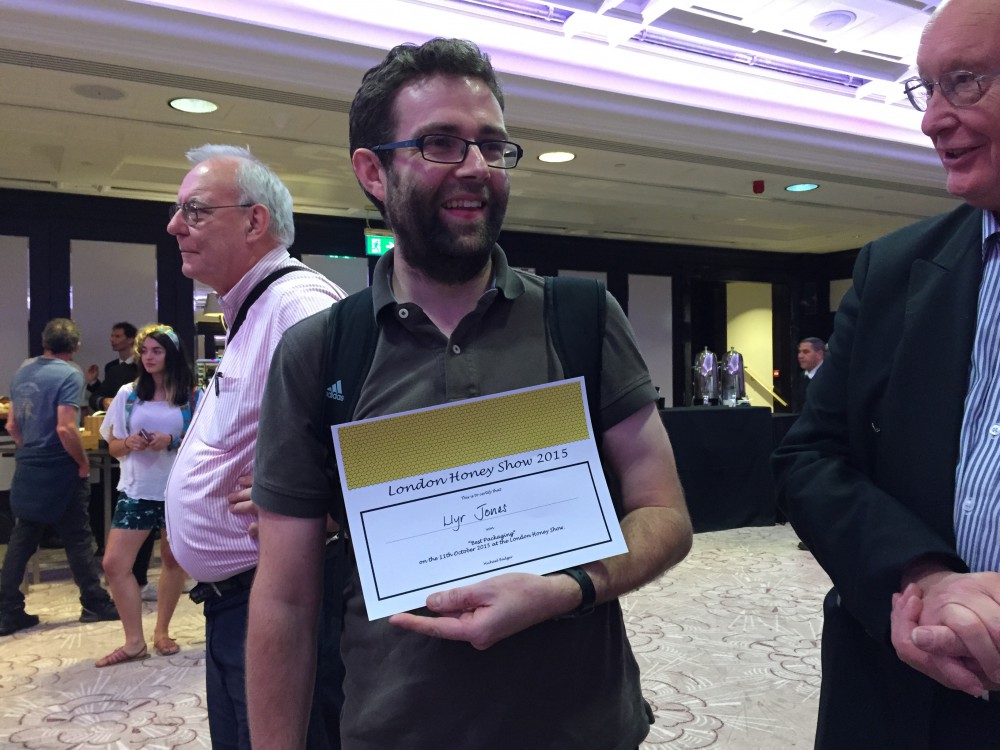
Jonesy won the best packaging award for his Kew honey. A win for Ealing!

Jonesey winning

Kew Honey

Posted in Events, Honey | 16 Comments