A follow-up post to ‘Middlesex Beekeepers’ Day – Terry Clare, Queen rearing for the average beekeeper‘.
Below are my notes from Dr David Aston’s talk. David is President of the British Beekeepers Association (BBKA), a Master Beekeeper and holder of the National Diploma in Beekeeping (NDB). I have paraphrased, but the thoughts and facts are his.

David Aston
Look about you next time you travel across the country. The UK environment is experiencing destruction everywhere, with hedgerows being slashed and the mechanical flail whipping back foliage that creatures could live in. Meanwhile, in our gardens many of us are obsessed with tidying away any mess; in doing so we are taking away the homes of creatures that could have lived there.
As beekeepers we should not blame the weather for everything. We can overcome most of the problems. At a recent conference on the health of honeybees which David attended, one of the themes which emerged from the papers presented was that well fed bees are more resistant to disease. Their ability to cope with pesticides is very dependent on how well fed they are. Just like with us humans, nutrition is key.
Nectar
Honey bee colonies require around 120kg of nectar a year just to survive. Bumblebees live on a knife edge as a bumblebee worker only has about 40 minutes flight time on a full stomach. (So next time you see a sluggish bumblebee on the ground, don’t assume she’s doomed. If you can get her to a flower that provides nectar, she could regain her energy).
Pollen
A colony will only keep a supply of about 1-2 weeks worth of pollen at a time. Pollen is important in late summer for laying down winter storage protein; the workers will need it to start feeding young brood in spring.
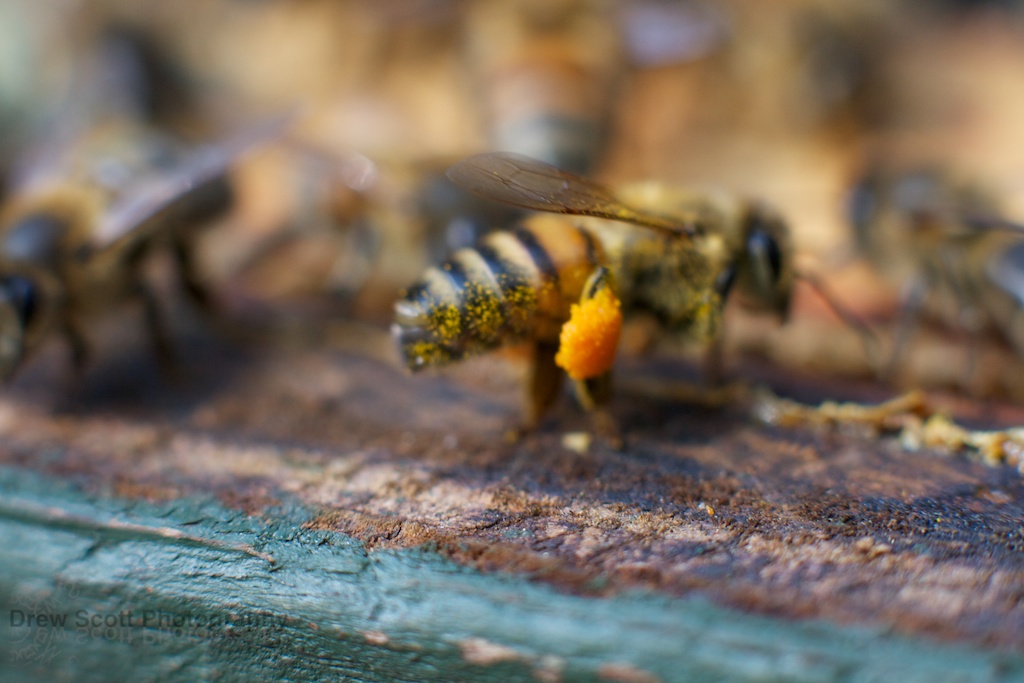
As well as protein, pollen also supplies essential amino acids (+K, Na, Ca, Mg) and lipids, which are essential for brood food production by the workers. Each worker requires 125-145mg pollen over her lifetime.
Not all pollen is equal: the bees need a mix of pollens and those high in protein are especially valuable. David showed us a chart of the percentage of crude protein in various pollens, which I jotted down hurriedly and will try to replicate here.
| % of crude protein in pollen |
| Inadequate pollens |
|
| Poor pollens |
|
| Average pollens |
|
| Above average/excellent pollens |
|
When beekeepers in France take their bees back after leaving them at sunflower fields for pollination contracts, the bees are so protein deficient it tends to take 3-4 months for them to get back to normal protein levels.
If you are worried that your bees are not finding enough pollen, David mentioned that he uses Nektapoll twice a year (a kind of fondant containing pollen substitute).
Time of dehiscence (when flowers are open for business)
Most flowers do not release nectar all day long; there are particular times of day at which they provide the most nectar. The bees are aware of this and learn when to visit particular species. For instance, poppy provides nectar in the early morning, dandelion mainly morning, crocus at midday, apple & pear mainly afternoon and the broad bean in the afternoon.

Dandelions and daisies in the sun
Adaptation of bees to flowers (and vice versa)
Scientists know now that bees carry an static electricity charge: a flying bees has 450 volts potential. The stigma of a flower is well earthed and the anthers well insulated. Pollen is drawn towards the charged bee and can be pulled across a 0.5mm air gap.
The shape of bees’ eyes is really crucial. The spherical shaped eyes allow bees to measure angles accurately in flight.
We should train ourselves to watch where nectar and pollen comes from and how bees work the flowers. If we become used to watching bees away from the hive this closely, we may begin to notice details inside the hive more readily.
National Pollinator Strategy
David reminded us that the government is putting this in place to improve forage for pollinators and it will hopefully be coming soon. There is more information on the strategy at gov.uk/government/publications/bees-and-other-pollinators-their-health-and-value. Talk to your friends and neighbours, try to encourage them to plant bee-friendly flowers.
A member of the Harrow association asked for ideas on how they could meet the increased demand for training from new members. David suggested that rather than just offering beekeeping classes, local Beekeeping Associations could try holding taster days for people who would like a chance to see some bees and learn about how to help them, rather than keep bees themselves.
My thoughts on the talk
I’m going to continue my summer walks looking for bees on flowers with renewed enthusiasm. There is so much to learn about bees’ diets and how they interact with flowers. At some point I plan to take the BBKA’s Module 2 exam, Honeybee products and forage.
As I looked around me during the talk, I couldn’t help noticing that most people were probably about thirty years older than me. I don’t think a single other person was in their 20s or 30s. And I thought about how most people my age in London don’t have a garden, or a home of their own, or any prospects of being able to afford one.
How can my generation increase bee-friendly forage? Other than getting involved in community projects, guerrilla gardening or giving money to charities like treesforcities.org, I don’t think we can. That will have to be enough for now.
On Saturday morning I’m going to help out at the new Radbourne Walk project to create a wildlife corridor along the Northfield allotments, we will be clearing a section of path, sowing a wildflower meadow and making a loggery for stag beetles. I have some gingerbread in the oven 🙂















 Adventuresinbeeland's Blog