Leaving the EU: what does it mean for British bees and beekeepers?

It was a shock to find out yesterday that Britain had voted to leave the EU. Until the first poll results started coming in I had hoped that, as with the Scottish referendum, the remainers would win out in the end. But then I live in London and we tend to vote differently to the rest of England.

While most of my friends were left as gloomy, worried and angry as I was by the result, reactions were more mixed on the British Beekeepers Association (BBKA) Facebook group. Beekeepers involved in bee research or working for the National Bee Unit (NBU) are concerned. The NBU currently receives half a million in funding annually from the EU for the UK apiculture program – see the funding tables for EU member states in 2014-16. This funding helps pay for our excellent bee inspectors, who carry out apiary inspections, provide technical assistance to beekeepers and work to prevent bee pests and diseases spreading.

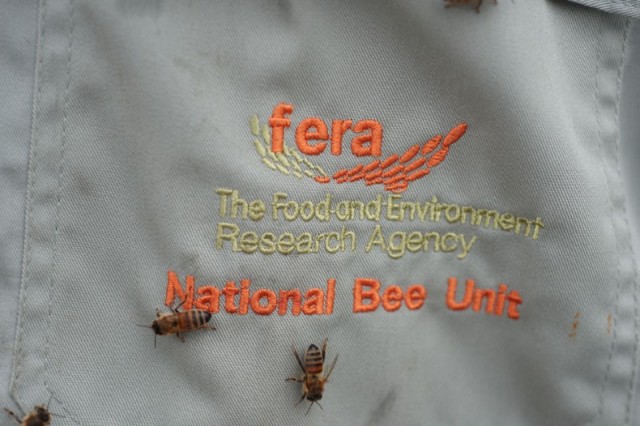
FERA NBU Beesuit

A NBU inspector’s bee suit. Courtesy The Food and Environment Research Agency (Fera), Crown Copyright

Those who voted to leave are of course optimistic about how the result will affect beekeepers. They argue that there will now be more money to go round and that now the government has the freedom to ban imports of bees, which could help with disease control and promote local gene pools. My answer to that would be that I can’t see a Conservative government – or any government – ploughing funds into supporting beekeepers or prioritising banning bee imports. We’ll be lucky if they don’t spend the extra cash on privatising national forests, eliminating the green belt and building some beautiful duck houses.

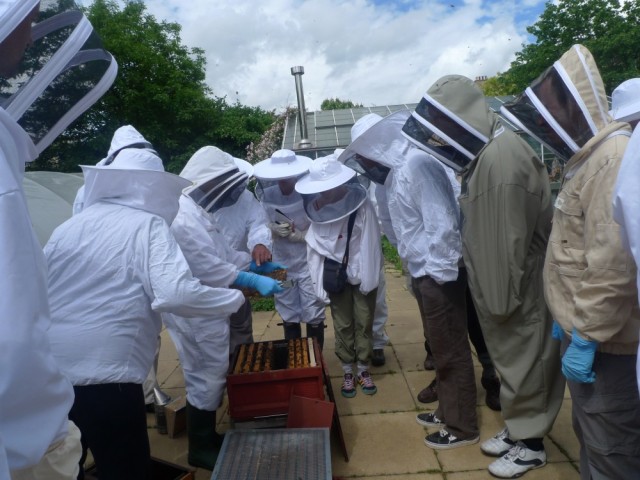
A NBU training session for London beekeepers

A NBU training session for London beekeepers

Some have lovely ideas that BBKA members should club together and fund the NBU shortfall in funding. I’m sure some of us wouldn’t mind chipping in, but bear in mind that even putting up subscription fees by a pound annually causes much debate at the BBKA Annual Delegates Meetings. Us beekeepers are known for being stingy buggers money savvy. If the bee inspectors could be persuaded to take payment in honey and home brewed mead that might do it.

Here are a couple of posts written before the referendum on how the EU supports environmental policies:

  • The environmental argument for the UK remaining in the European Union – by Jeff Ollerton, Professor of Biodiversity in the Department of Environmental and Geographical Sciences at the University of Northampton. One of those “experts” the leave campaign scoffed at. He makes the point that environmental issues cross borders,  so working together in coordination with other countries is beneficial for wildlife.

None of us knows for sure what is coming next, but whatever happens I hope British beekeepers will fight together to protect services for beekeepers and flowers for bees.

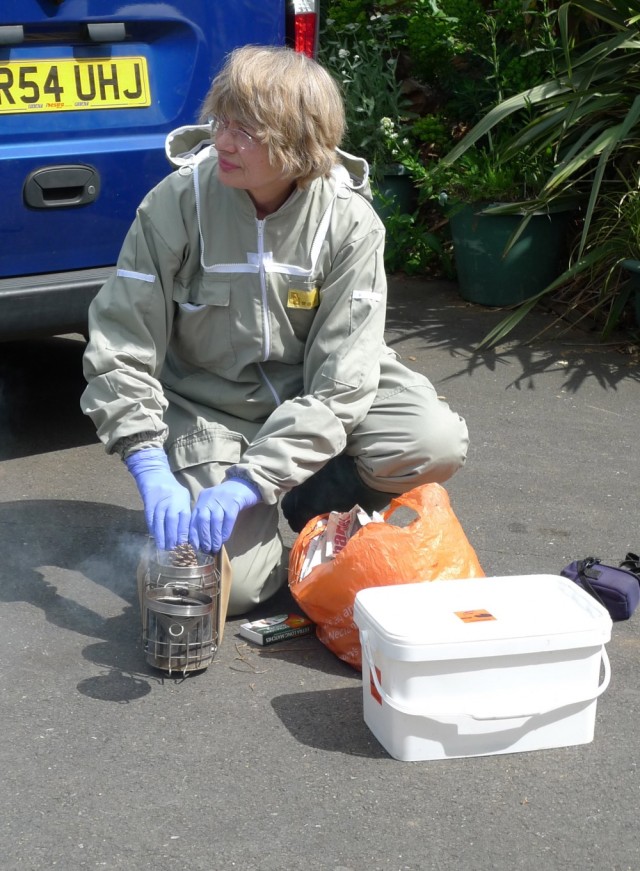
Caroline Washington, a former NBU bee inspector

Caroline Washington, a former NBU bee inspector

Posted in Uncategorized | 36 Comments

What’s flowering now: early June

The flowers have moved on since my last post in May. Some are still with us – white dead-nettle, gorse, dandelions, green alkanet; while others, like horse chestnut and daffodils, have faded. London bees now have a new mix of wild and garden flowers to choose from. Here’s what I’ve been finding them on in local parks.

Two pink comfrey bushes in Elthorne park rough were humming with buff-tailed bumblebees. There are also white varieties of comfrey. It is listed in Prof. Dave Goulson’s list of ‘The best garden flowers for bees‘ – he says it has a “Very long flowering period, from May to August, and one of the very best plants for bees. Visited by long and short-tongued species, the latter often robbing from holes bitten in the tops of the flowers.”

You can see some lovely photos of a male early bumblebee (Bombus pratorum) stealing from comfrey on a post by TrogTrogBlog: Nectar robbers. Honey bees also benefit from the holes bitten by short-tongued bumblebees.

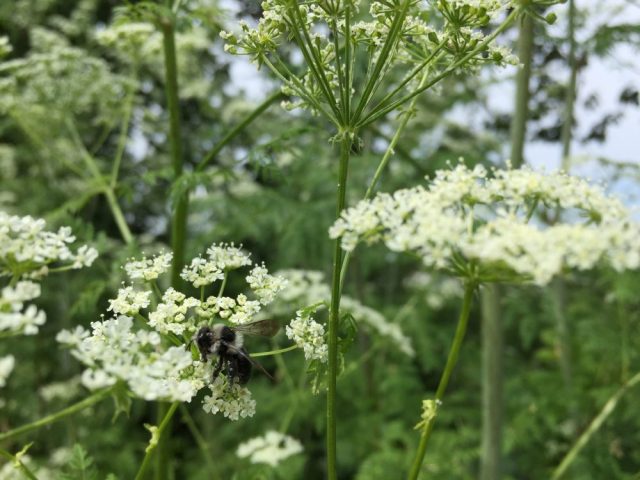
In the fields of Elthorne rough, masses of graceful cow parsley and hogweed grow tall. A few honey bees and bumbles can be found on their delicate little white flowers, along with shiny metallic green beetles. I recommend the post ‘Hogweed days‘ on the Everyday Nature Trails blog to find out more about the pollinators that visit hogweed.

Honey bee on cow parsley

Honey bee – I think on hogweed

I was particularly pleased to find an Ashy-Mining bee, with its pretty grey and black stripes. Judging by the BWARS description, this is a female, which have “two broad ashy- grey hairbands across the thorax.” 

Ashy mining bee on cow parsley

Ashy mining bee on cow parsley

Along the edges of the paths are blackberry brambles, which are popular with both bumbles and honey bees. In his Guide to Bees & Honey, (2010, p.221) Ted Hooper says blackberry is “Well worked by bees even at fairly low temperatures, supplying both nectar and pollen in quantity. Honey of good flavour, medium amber, tending to granulate with a care-grained texture. Pollen load pale brownish grey.

In the fancier, more formal Lammas park, I found carder, bumble and honey bees on these purple irises and a orange balled flower. Not knowing what the orange balls were, I looked online to find that the plant is called… the orange ball tree (Buddleja globosa). It originally comes from south America.

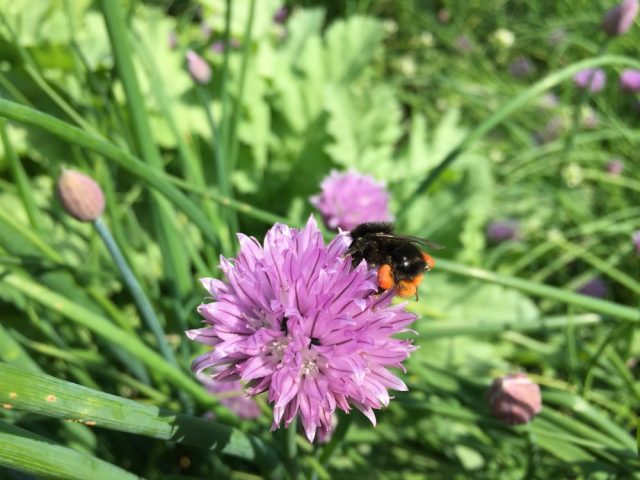
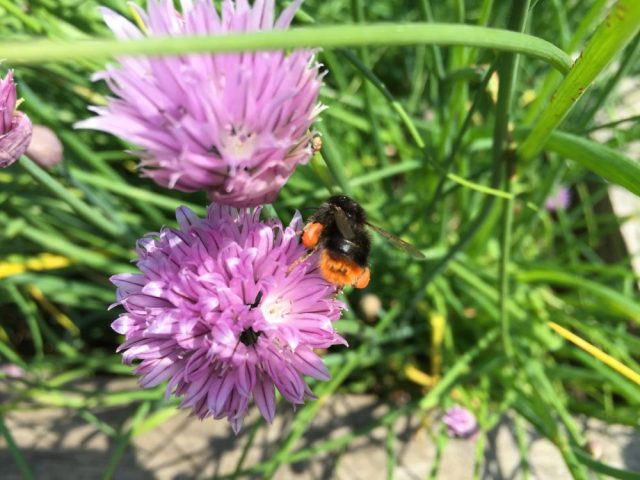
And in the kitchen gardens of Walpole park are chives, which were being visited by this Red-tailed Bumblebee (Bombus lapidaries). The pollen co-ordinates well with its bottom!

Red tailed bumblebee on chive

Red tailed bumblebee on chive

Coming soon: white clover, thistles, knapweed, rosebay willow herb, himalayan balsam and ragwort.

And below is an advert for the powers of royal jelly – look how chubby those cheeks are now 🙂

IMG_1454

Posted in Foraging | Tagged | 27 Comments

What’s flowering now: early May

Ealing is particularly beautiful in April and May. Many of the roads and parks near me are lined with white and pink blossom trees. On a sunny day you can stand under them and hear the hum of bees high above, and spot dark shapes flitting between the flowers. As the petals fall they become colourful confetti for the pavement, swirling gently in the wind.

Blossom

EDIT: Thanks to Honeymedic for his comment about the tree above – “It may be another cultivar but your first tree looks very like Eucryphia Nymansensis which does not generally flower until August but then the bees in my garden go mad on it. In its native Chile, Euchryphia Cordifolia is the source of the wonderful healing honey ULMO.”

Ealing also has many horse chestnut trees, which are now covered with white candles of flowers. These are popular with honey bees.

horse chestnuts

Though from a distance horse chestnut flowers appear white, they have a touch of yellow within when their flowers are un-pollinated and excreting nectar. After a horse chestnut flower has been pollinated, the yellow blotch turns a red/pink magenta to let pollinators know. Additionally after pollination the flower has a change in scent that bees pick up, so that they avoid wasting their time visiting that flower. Have a look next time you’re under a horse chestnut.

hairy footed bee on gorse

Me and Tom have been going for walks together and doing some bee spotting. Well, I walk and Tom gets pushed. We have four parks in walking distance and pretty gardens to walk past too. There are still a few front gardens which haven’t been turned into car parks. Can you see the bee above on gorse? Sorry for the bad photo but I have been using my phone as it’s light and I have so much baby stuff to carry.

hairy footed bee on gorse

I believe this gorse visitor is the beautifully named Hairy-Footed Flower Bee. It likes nesting in old walls and its favourite flower is lungwort (pulmonaria).

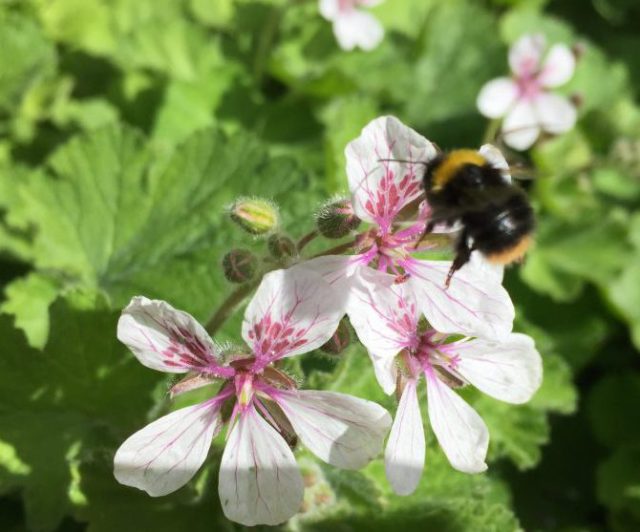
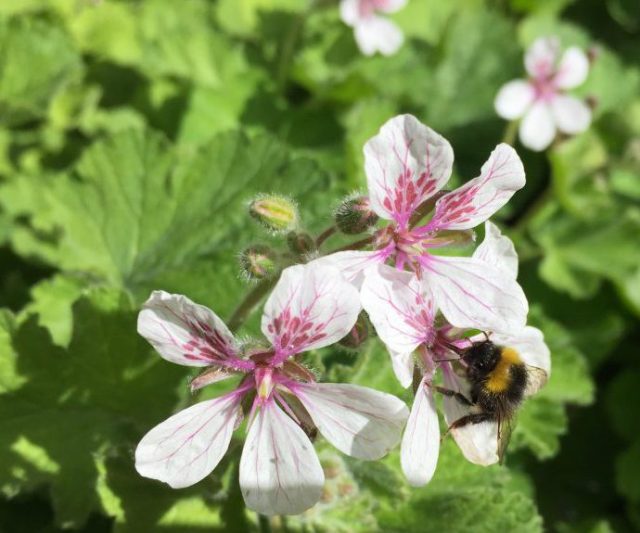
Bumble on pink flower

This might be an Early bumblebee (Bombus pratorum)? If anyone knows what the pink flower is, please let me know.

EDIT: Thanks to Lucy Garden, Julie, Amelia, Mark and WesternWilson for commenting that the pink flower may be a geranium. Amelia added “There are a lot of different perennial geraniums and I find them very useful in the garden as some are very tough and can smother anything in rough sites yet the bumble bees love them.”

Bumble on pink flower

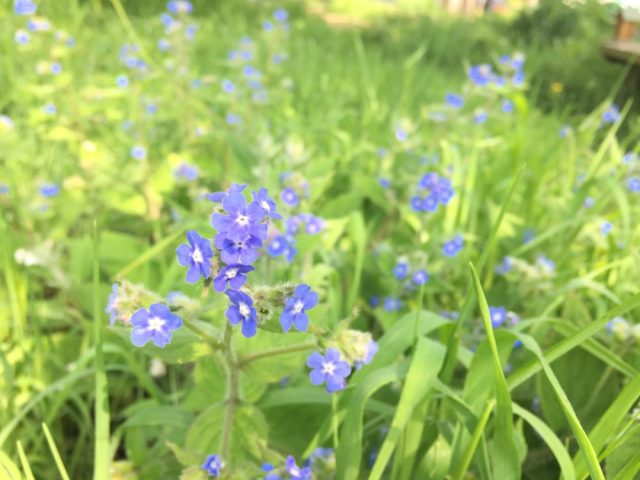
I have been disappointed as I’ve not been seeing as many bumbles as I’d expect at this time of year. Was the mostly mild winter bad for them? I’ve been walking past sunny banks of green alkanet (evergreen bugloss) and not seeing a single bee.

Green alkanet (evergreen bugloss)

Green alkanet (evergreen bugloss)

honey bee on green alkanet

I did see a few honey bees on the green alkanet but not many. Perhaps they are distracted by the magnificent horse chestnuts.

Carder bee white nettle

This is a common carder bee on white dead-nettle. Nettles are such great plants for wildlife and I find them pretty too.

white dead-nettle

Tulip and forget-me-nots

People go crazy for big showy flowers like tulips, but arguably the delicate forget-me-nots behind are just as beautiful. A bee would prefer the forget-me-nots.

Daffodils

Daffodils are still around, but they’re not a great flower for honey bees. If you look at p.26 of the BBKA News April 2011 edition you will see a couple of letters about daffodils. Daffs contain toxic chemicals (known as alkaloids) that include lycorine. The wild daffodil is pollinated principally by bumblebees — Bombus terrestris, B. muscorum, B. hortorum, B. lapidarius — and Anthophora plumipes (hairy footed flower bee). However honey bees are rarely seen on daffodils, and Adrian Davis from Canterbury BKA suggests that this is because they store food for longer than bumbles. Possibly by not collecting daffodil pollen (or nectar) they avoid the build up of lycorine in the hive.

IMG_1139

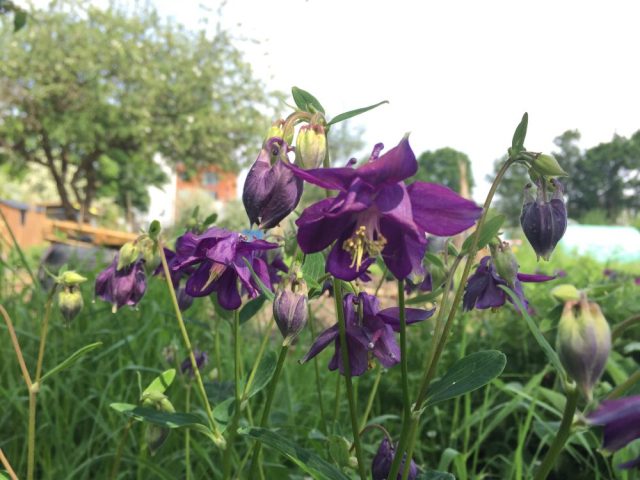
Anyone know what this unusual purple flower is?

EDIT: Thanks to Lucy Garden and Julie for commenting that the purple flower is an aquilegia aka columbine.

Tom one month old

Finally, not a flower but Tom a week ago.

Posted in Foraging | Tagged | 30 Comments

A new drone

A new little drone has arrived in my life, just in time for swarm season. As he is very cute I won’t be kicking him out in the autumn 🙂

Thomas Scott

We’ve named him Thomas Dylan Robin. He’s now seventeen days old.

Tom one week old

There were some complications in my last week of pregnancy when I was diagnosed with obstetric cholestasis, a liver problem which affects around 1 in 140 pregnant women. It causes extreme itchiness, particularly in the feet, so much so that sleeping is very difficult. Even when I did eventually get to sleep, I was scratching myself in my sleep. The hospital recommended I was induced at 39 weeks, as some studies suggest obstetric cholestasis causes a small increased risk of stillbirth.

I ended up staying in hospital three days while they waited for a bed to become available. One of Ealing’s maternity wards has closed down recently, causing extra pressure on the hospital I was at. I was waiting around in a ward full of women in a similar situation. Every now and again one of them would actually go into labour and I would hear their screams, which didn’t make for a relaxing wait! Eventually a bed became available at midnight on Friday and Tom emerged after a drama-full thirteen hour labour. I envy the queen bee’s simple egg-laying task!

Posted in Uncategorized | 44 Comments

Spring cleaning at the apiary

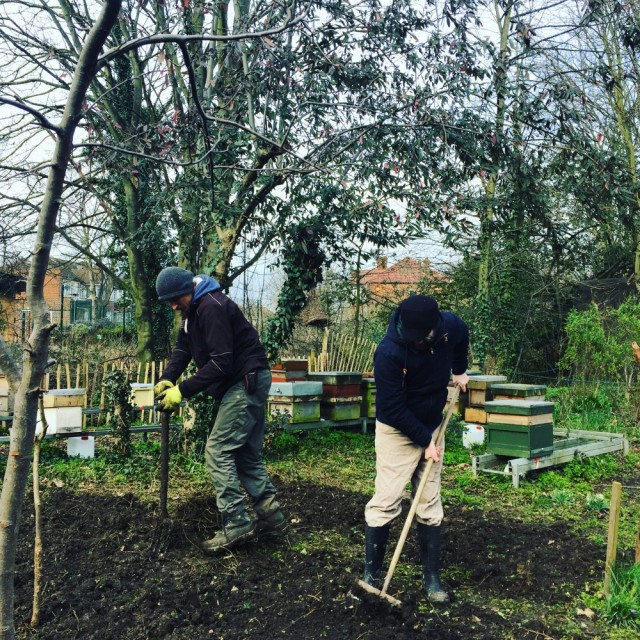
In the past few weeks Ealing beekeepers have been busy improving the association apiary and preparing the bees for spring. Tom has been running easy-going monthly volunteering sessions fuelled by plenty of tea; jobs done so far have included pruning, cleaning, removing rubbish, organising the storeroom, putting in new fencing and planting wildflowers.

Below you can see the muscles getting stuck in to turn over the soil, ready for wildflower planting.

Digging

After the heavy work had been done, Elsa and I put down a mix of seeds and sawdust Tom had brought along. Then Kathy raked the top soil over to stop the seeds blowing away. Since the photo was taken Tom has put a lovely log border round the plot so that people don’t keep walking over the soil. It will be exciting when the flowers start coming up!

Raking seeds

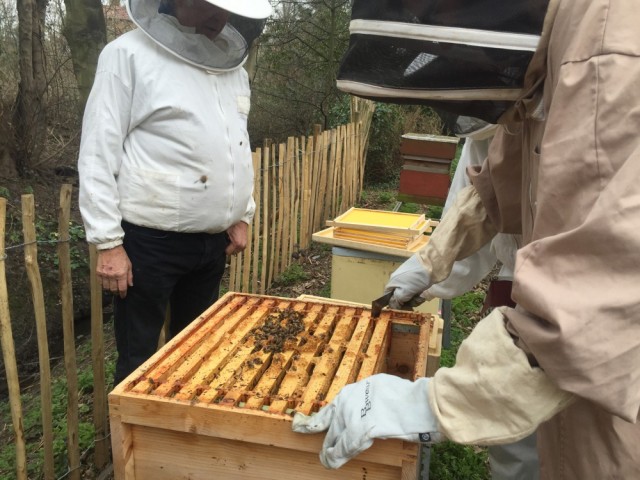
Last weekend John Chapple and Alan Gibbs demonstrated a shook-swarm on a couple of colonies at the apiary, which a large group of beginner beekeepers came down to watch. Changing brood combs annually by doing a shook-swarm or Bailey comb exchange is a mandatory requirement for colonies kept at the association apiary. It’s a spring-clean for the bees, helping to combat diseases like AFB, EFB and nosema by removing the old brood comb and giving the bees fresh foundation to build from. Doing a shook-swarm also helps with varroa control.

Jonesy’s colony was small, so he shook-swarmed it into a poly nucleus hive to help the bees keep warm. You can see the nuc and new foundation frames on his right.

Jonesy shook-swarming

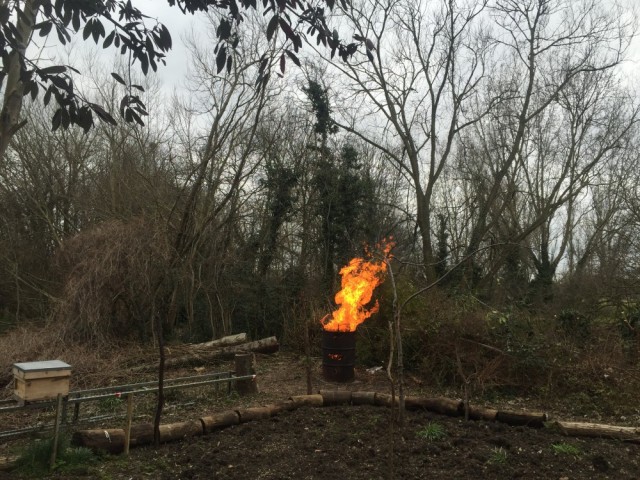
Once the queen and the rest of the colony have been safely transferred onto the new frames of foundation, the old brood frames and any brood can be burnt, killing off any varroa lurking in the brood in the process. Unless a nectar flow is on, colonies should always be fed with strong 2:1 sugar syrup so that they can draw out new comb. Below you can see Pat’s burner consuming the old brood frames, with Tom’s nice log border in the foreground.

Pat's burner

Pat’s burner

Emma and I inspected last weekend and found that Peppermint and Melissa’s colonies were weaker than usual at this time of year. They had very little brood and we weren’t confident that they would cope well with a shook-swarm, so we have decided to postpone comb changing till after Easter, when we will probably use the gentler (but more time-consuming and non varroa ass-kicking) Bailey comb exchange method. For anyone interested, information on both methods is available from the National Bee Unit’s Beebase fact sheets – see the ones on ‘Shook swarming’, ‘Care of colonies after shook swarms’ and ‘Replacing old brood comb’.

You may have seen Emma’s post last week, ‘The decay of spring‘, where she talked about the sad loss of one of our colonies recently. Pepper’s dead bees were found clinging to frames containing a small amount of very crystallised, hard honey – when a cold snap hit us in February it seems the colony just didn’t have enough energy to keep themselves warm.

In hindsight perhaps we should have given them less space overwinter – this time we left two supers of honey on, whereas usually we’ve left only a single brood box or brood box and one super. The larger the hive space, the more energy it takes the bees to keep warm. It also meant the cluster was further away from the soft fondant block over the crown board, which might have been easier for them to eat in cold weather than the crystallised honey.  This is the first time I’ve lost a colony since I started beekeeping in autumn 2008. I have been very lucky not to have lost any bees before – lucky and also I’ve benefited from great advice given by more experienced Ealing beekeepers. It is sad but you learn from it and hopefully avoid making the same mistake next time.

To end on a cheerier note, here are some pics of local bees visiting cherry laurel and crocuses. Cherry laurel pollen is the same creamy colour as its flowers, while crocus pollen is orange.

Tomorrow I will be 38 weeks pregnant, so the baby could arrive very soon! Amazingly both my bee suits still fit 🙂 Afterwards I plan to continue beekeeping, but Emma has kindly said she will do most of the inspecting this year. I hope to join her for inspections once or twice a month and will continue updating this blog. It will remain a blog about beekeeping rather than babykeeping, but occasional baby pictures may be included!

Posted in Colony management, Disease prevention | 36 Comments

Are rhododendrons toxic to honey bees?

Short answer:

It depends on the species of rhododendron – and also on the sub-species of honey bee visiting the rhododendron.

The common rhododendron, Rhododendron ponticum, certainly does produce toxic nectar.  However, Irish research suggests the nectar may only have a negative effect on honey bees in countries where the rhododendron is an invasive species outside its native range – and even then, they’ll probably avoid visiting it anyway. Here’s why…

Long answer: 

Rhododendron ponticum is known as a source of toxic nectar which causes bees to produce ‘mad honey’, used by European armies through the ages as a weapon of war.

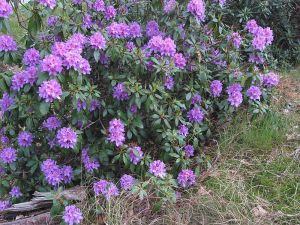
Rhododendron ponticum

By Rasbak – Own work, CC BY-SA 3.0, https://commons.wikimedia.org/w/index.php?curid=800114

The honey would be left in the path of invading legions; the soldiers would eat the sweet treat and end up vomiting and dizzy from grayanotoxin, a toxin contained in rhododendron honey. The effects rarely prove fatal to humans but probably would have halted or slowed down armies for a while. The grayanotoxin is the plant’s defence against herbivore attack.

Just two to three teaspoons of the spring honey made by Himalayan Giant honey bees (a subspecies of Apis dorsata) can result in temporary paralysis for a day or so, according to Mark Synnott’s article ‘The Last Honey Hunter‘ in National Geographic. A market for the honey exists because some people believe it improves sexual performance – this can go very wrong!

Which bees visit Rhododenron.ponticum?

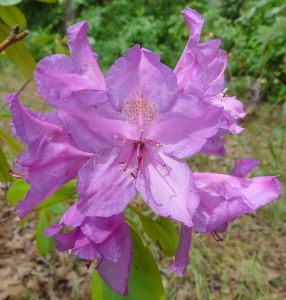
Rhododendron ponticum

Rhododendron ponticum By First Light at English Wikipedia, CC BY-SA 3.0, https://commons.wikimedia.org/w/index.php?curid=6644210

R.ponticum was introduced to Ireland in the 18th century and has invaded large areas of the countryside, where it is regarded as a pest. Yet research led by Prof. Jane Stout, Professor in Botany and Dr Erin Jo Tiedeken, Research Fellow at Trinity College Dublin, has found that its flowers are visited almost exclusively by bumblebees, with occasional visits from solitary bees, flies, ants and wasps.

Professor Stout and Dr  Tiedeken found that the nectar’s grayanotoxins cause palpitations, paralysis and death within hours – for honey bees.

They also tested the grayanotoxins on an Irish species of mining bee, Andrena scotica; this species did not suffer increased mortality but had its behaviour severely affected, for example becoming paralysed or spending increased time grooming.

In contrast the nectar has no apparent effect on worker buff-tailed bumblebees. Professor Stout suspects that the subspecies of honey bee that makes mad honey in the rhododendron’s native range has probably evolved to resist the toxins in a similar way to the bumblebees.

Who knows their rhododendrons…from their rhododendrons?

My beekeeping buddy Emma (Mrs Apis Mellifera) sent me a useful link from the Poison Garden website which suggests that most of us will be unable to tell what is R.ponticum and what is a hybrid – and therefore potentially less toxic – plant.

Pontifications on poison: rhododendrons

“Rhododendron is thought to appear in around 1,000 species and those species produce innumerable hybrids. This means there are very few people expert enough to identify exactly what Rhododendron a particular plant is.

In terms of appearance and flowering, that doesn’t matter too much but it has been found that the concentration of the main toxin is species/hybrid dependent so plants that appear to the layman to be identical may produce different degrees of poisoning.” – John Robertson, thepoisongarden.co.uk

It even depends where the rhododendron is growing…

To complicate matters further, Kew Gardens researchers have discovered varying levels of nectar toxin levels even within different R.ponticum plants: Hidden poisons in rhododendron nectar (see the section ‘The changing chemistry of invasive plants’).  A landscape scale chemical analysis comparing R.ponticum plants in Ireland with R.ponticum plants in the species’ native range of Spain and Portugal found that toxin levels were lower overall within the Irish plants.

The researchers suggest that within their invasive range (as studied in Ireland) the plants “reduce or stop entirely the production of nectar toxins to ensure sufficient pollination success (Egan et al., 2016)“. That makes sense – it’s in the best interests of the plants to attract pollinators.

So, do beekeepers need to worry?

In conclusion, it sounds like rhododendrons are unlikely to cause British beekeepers many problems. If we do have R.ponticum near us, the research carried out by Professor Stout and Dr  Tiedeken suggests that our honey bees will probably avoid it; additionally the plants are likely to be less toxic than in their native range. If we only have hybrid rhododendron species nearby, the hybrids are likely to be less toxic too.

Rhododenrons may only be a problem for beekeepers surrounded by large areas of R.ponticum, which could smother out other plants and reduce the amount of forage available for honey bees.

See more:

  • Grayanotoxin Poisoning: ‘Mad Honey Disease’ and Beyond
    A scientific paper on mad honey. Contains a fascinating description from the Greek warrior-writer Xenophon in 401 BC on the effects of the honey on an army –  “those who had eaten a great deal seemed like crazy, or even, in some cases, dying men”.
  • A rare case of “honey intoxication” in Seattle
    Rusty at Honey Bee Suite reports on the rare case of a man who may have been poisoned by honey purchased at a local farmer’s market. Rusty’s observations have led her to believe “that rhododendron is not a preferred forage for honey bees and they probably collect it only in rare circumstances when other more favorable blooms are not available.”
  • Mad honey
    A 2018 post by Scottish beekeeper & scientist The Apiarist, who has a particular interest in rhododendrons because he’s surrounded by them.
  • “Mad Honey” sex is a bad idea
    That got your attention!
  • Hallucinogen Honey Hunters documentary
    A tribe in Nepal hunt wild rhododendron honey with natural psychoactive properties. One falls unconscious after overdosing on the honey.
  • The strange history of ‘Mad Honey’
    Emma Bryce writes about Turkey’s hallucinogenic rhododendron honey (deli bal), produced on remote mountainsides smothered with vast fields of cream and magenta rhododendron flowers.
  • The Last Honey Hunter‘ by Mark Synnott (National Geographic, July 2017, p.80-97)
    Stunning photos of 57 year old Mauli Dhan harvesting ‘mad honey’ from steep Nepalese cliffs. Mauli climbs for the honey since a spiritual dream many years ago set him on his path. In his people’s tradition it is bad luck for anyone who has not had this dream to take the honey.
  • Poisons in rhododendron nectar
    Philip Stevenson (Plant Chemist) and Alison Scott-Brown (Plant/Insect Ecologist) from Kew’s Natural Capital and Plant Health department report on the toxicity of natural chemicals in the nectar and leaves of Rhododendron.
  • Bitter Sweet Nectar: Why Some Flowers Poison Bees’ by Stephanie Pain, BBKA News, February 2016
Posted in Foraging, Honey | Tagged | 26 Comments

Notes from a talk by Norman Carreck – colony losses, native bees, pollen diversity and the small hive beetle

Yesterday I went to a talk by Norman Carreck, which was organised by the London Beekeepers Association (LBKA). One of the great things about being a beekeeper in London is being able to hear expert speakers like Norman. He is currently Science Director of the International Bee Research Association (IBRA), based at the Laboratory of Apiculture and Social Insects at the University of Sussex.  He has kept bees since he was 15, obtained the National Diploma in Beekeeping in 1996, is a member of the Technical and Environmental Committee of the British Beekeepers Association, a member of the Examinations Board for the National Diploma in Beekeeping, a member of the “Bee Health Advisory Forum” for the Defra “Healthy Bees Plan”, the UK member of the Executive Committee of the international honey bee research network “COLOSS” and Senior Editor of the Journal of Apicultural Research.
Norman Carreck

Norman Carreck

Despite all Norman’s achievements he came across as an unassuming and modest speaker, who took plenty of time to answer everyone’s questions afterwards. His talk was about research projects carried out by COLOSS  (which stands for Prevention of honey bee COlony LOSSes), on the themes of colony loss monitoring, local bee vs imported bee survival, pollen diversity and the small hive beetle.

How COLOSS works

It’s an international, non-profit association set up following the publicity surrounding colony collapse disorder in 2006, when many beekeepers first reported losing large numbers of colonies. There are 722 members in 89 countries worldwide, with membership open to scientific professionals interested in the well-being of bees. COLOSS holds regular meetings, but has very little money, so the individual members fund themselves to attend. Norman told us that in a way this lack of money is an advantage – as it means members aren’t competing with each other for central funding from COLOSS, which encourages mutual cooperation.

Colony loss monitoring

To try to gather data to establish whether honey bee losses are a genuine global phenomenon, COLOSS members came up with a standardised questionnaire for beekeepers. A lot of thought went into the questions in order to take account of the differing lengths of international beekeeping seasons and practices. Norman mentioned that although both the British Beekeeping Association and National Bee Unit do annual surveys which ask beekeepers some of the same questions, COLOSS has had difficulty getting the results of these surveys – which has been a frustrating situation.
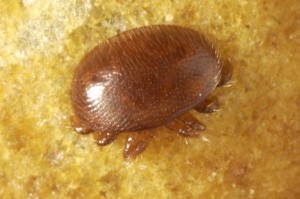
A female varroa mite - © Crown copyright 2010 "Courtesy The Food and Environment Research Agency (Fera), Crown Copyright"

A female varroa mite – © Crown copyright 2010 “Courtesy The Food and Environment Research Agency (Fera), Crown Copyright”

The surveys carried out so far indicate that colony losses do in general seem to be higher than 30 years ago – but there are no obvious patterns to this – with losses varying between countries from year to year. Climate itself doesn’t appear to be a big factor, as beekeepers have developed their own systems to cope with their particular climates. Weather is important but doesn’t explain all the losses. Varroa is very important, with higher losses occurring when beekeepers don’t treat against mites. Areas of intensive agriculture also tend to have high losses – this may be due to a lack of forage diversity for the bees, particularly at times of the year when the main farming crops have finished flowering. The most recent results available are for losses over the 2014/15 winter.

Are people keeping bees suitable for where they live?

COLOSS scientists wanted to compare how successfully individual strains of the European honey bee (Apis mellifera) cope in a range of environments. To do this they set up an experiment comparing 16 genetically different strains at 21 locations, across 11 European countries. At each location, a local strain of bee was compared with two other strains. For three years, six colonies of each strain (so 18 in total) were monitored for honey production, disease, colony size etc at each site. They were not treated for varroa, which meant several died early on.

The results of this study were published in a number of papers, including ‘The genetic origin of honey bee colonies used in the COLOSS Genotype-Environment Interactions Experiment: a comparison of methods‘ (Francis et.al, 2014) and Honey bee genotypes and the environment‘. Across all the locations, there was no one strain that consistently had better survival rates. BUT there was a statistically significant difference between the survival rates of local and non-local bees – local bees survived longer. One reason for this could be that local bees have adapted to cope with local strains of pathogens. Whatever the reason, the study indicated that local bees do better. Food for thought for beekeepers who regularly import queens from the other side of the world or buy in packages from hundreds of miles away.
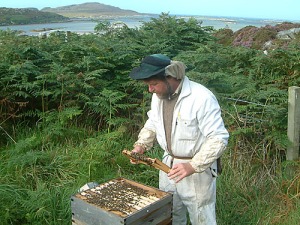
Andrew Abrahams

Andrew Abrahams

There has been some doubt over whether it’s possible to keep your bees pure, considering the queen honey bee will mate with as many local drones as can catch her. Andrew Abrahams is the only beekeeper on the Isle of Colonsay in Scotland and asked one of the Scottish heritage bodies for assistance in getting legal protection for his dark European honey bees. He was initially refused it and told bees shouldn’t be on the island at all, but eventually he won protection in a new Scottish government order which makes it an offence to keep any honey bees on the islands except the dark European honey bee, Apis mellifera mellifera. For more on this, see:

I notice Andrew runs beekeeping courses on the island. My husband Drew spent many summer holidays as a child on Scottish beaches, including stays on Colonsay… hmm maybe he can be persuaded that we really need to show our new baby the beauty of the Scottish islands and their wildlife!

Anyway, a study on the ‘Genetic integrity of the dark European honey bee‘ (Pinto et al 2014) confirmed that Andrew Abraham’s bees are pretty pure Apis mellifera mellifera; more surprisingly, even openly mated bees from Sussex University campus had a lot of Apis mellifera mellifera in them. Local strains survive well. COLOSS are currently putting together a book on sustainable bee breeding, to advise beekeepers on making the most of the bees we have rather than importing them.

Pollen diversity

CSI Pollen logo

In 2014 COLOSS began a “C.S.I. Pollen” study asking beekeepers to help collect data on the diversity of pollen collected by their bees. To take part, each beekeeper needed three colonies, each fitted with a trap to collect pollen on ten dates over a year. After each collection, the beekeepers were asked to separate out 20g of the pollen on a white tray and count the number of different pollen colours they could see.  Norman commented that this is not a perfect test as one plant may produce pollen grains which look like different colours (for example maize pollen is darker when wet), but at least all the beekeepers have done the sampling in the same way, so the data is standardised.

During 2014, 465 beekeepers in 24 countries took part. The initial data gathered from English and Welsh beekeepers during 2014 indicated that pollen diversity declined as the beekeeping season went on. The study was expanded during 2015, with many more beekeepers from 27 different countries taking part. The original data is still being analysed and a draft paper has been written.

The surveying will continue in some countries during 2016, including England, Wales, Scotland, Ireland and France. More volunteers are needed, so contact Norman if you’re interested.

Small hive beetle (Aethina tumida)

Like the Asian hornets, most UK beekeepers will be aware of these pests and the threat that they may reach us sooner rather than later. Norman described the beetles as “fairly repulsive things”, which make varroa mites look attractive in comparison.
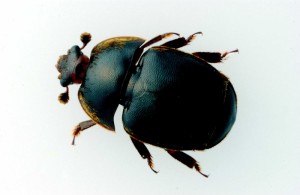
Small hive beetle, Crown copyright

Small hive beetle, “Courtesy The Food and Environment Research Agency (Fera), Crown Copyright”

The beetle larvae hatch out in the hive and feed on comb containing pollen or honey, damaging the comb by tunnelling through it and defecating, which makes the honey ferment and run out of the combs. Heavy infestations of the larvae turn the combs into a sloppy mess that U.S. beekeepers call a “slime out”.

Once ready to pupate, the larvae leave the hive and burrow into soil, before emerging as adult beetles 3-4 weeks later. The adult beetles seek out bee colonies to mate in, then the females lay masses of eggs within cracks and crevices amongst the hive to start the cycle again.

One of the challenges in keeping the beetles at bay is that we don’t know how far the larvae travel to pupate. Norman could only say that they can wander “quite a long distance”. Additionally, the adult beetles fly – again we don’t know how far. More research is needed to confirm this.

1996, Florida
The beetles are native to sub-Saharan Africa, where they are a minor pest but not a serious problem. As usual the activities of humans moved them around the world, with the result that in 1996 beekeepers in Florida suddenly found their colonies full of the beetles. They wiped out many colonies and rapidly spread to several different states, where they remain today.

2004, Portugal
Beetles turned up in Portuguese colonies containing queens imported from the US (another reason not to import foreign queens). Some were discovered in the cages the queens had been released from. The Portuguese authorities moved quickly to burn all infested colonies and fortunately the beetles were eliminated.

2014, Southwest Italy
Beetles were discovered in Italy in 2014, causing panic. The Italian authorities started destroying lots of hives by burning, then sprayed insecticides to kill any beetles which might have been pupating underground. They found 61 infected sites and destroyed over 3,500 colonies. However, due to the sheer number of beekeepers in the area, not all apiaries were inspected.

Around 20,000 packages of bees were exported from Italy in 2014. In the UK our National Bee Unit inspectors tracked down any packages imported from Italy and inspected them – all were found to be clear of beetles. Other countries were not so thorough; for example the Polish government said it did not have the financial resources to inspect imported packages.

To try to help, COLOSS ran articles on the beetle in IBRA’s Bee World journal and organised a task force. A book called The small hive beetle in Europe which Norman has edited will be available soon. At a conference organised to debate the options available, it was clear that the patience of Italian beekeepers for the government’s policy of destroying hives was wearing thin. Compensation from the government took a year to arrive and then only compensated the beekeepers for colonies destroyed, not for loss of income from queen exporting or honey sales. Rumours began that beekeepers were not reporting beetles to authorities and quietly destroying infected colonies instead (or perhaps not destroying them).

2016, Italy
Some more cases were found in December 2015… with virtually all sightings including adult beetles, which indicates that they’re breeding. Norman suspects the chances of eradicating the beetles in Italy are slim.

Coping with the small hive beetle

African bees have developed strategies to deal with the beetles, for instance entombing them in propolis traps. European honey bees do this too, to a certain extent. So we don’t entirely know why they are such a problem for European honey bees. One theory is that African plants provide more propolis, so African bees just have more of it available to contain the beetles.

After the initial problems in the US, many beekeepers there have now learnt to live with the beetles. Sloppy beekeeping seems to be the main issue which allows the beetles to get out of hand and reproduce in vast numbers. Good apiary hygiene, such as processing honey immediately, not storing old comb/keeping honey combs in fridges or freezers, helps keep numbers low. Smaller hives also assist the bees in keeping beetles contained, as does not inspecting too often (beetles are released as beekeepers move combs apart and break propolis seals open).

Norman is sure the beetles will reach the UK eventually. They are attracted to the smell of rotting fruit and have even reproduced in rotting bananas under laboratory conditions. This means they could potentially move around the world in fruit consignments or pupating in pot plants, not just through bee imports.

They like dry, sandy soil, so damp, waterlogged clay soil like we have in some areas would deter them. They could potentially do well in the New Forest, which has light, sandy soil. Unfortunately the early detection methods we have are not good. Traps work well if you have lots of beetles; but if you only have one beetle in your hive there are plenty of other nooks or crannies it could end up in. Our WBC hives would be perfect for beetles to hide in!

See also…

The Laboratory of Apiculture and Social Insects at the University of Sussex, which Norman is based at, is running some workshops this summer/autumn. These are only £10 to attend and must be booked in advance as they are popular. You can choose from:

And a couple of videos of Norman lecturing:

This post is dedicated to my cat Bob, in honour of his steely determination to stop me typing it. 
Posted in Events | Tagged | 14 Comments

Middlesex Federation Day Part 2: Pam Hunter, How nutrition affects colony health

My second post on the Federation of Middlesex Beekeepers’ Associations annual ‘Federation Day‘. Below are my notes from the second speaker, Pam Hunter.

Pam is a Master Beekeeper who has been keeping bees for over 25 years. She is now Chairman of the BBKA Examinations Board, sets and marks module exams and is an assessor for the Basic, the General Husbandry and the Advanced Husbandry exams. She has a particular interest in the interaction of plants, bees and the environment as well as the more biological/scientific aspects of bees and historical aspects of beekeeping.

Pam Hunter, How nutrition affects colony health

Pam explained in detail the different substances contained in nectar and pollen. She recommended an Australian government publication with the cute name ‘Fat bees, skinny bees‘, the pdf of which is free to download. This goes into the chemical composition of nectar and pollen and explains the nutritional requirements of honey bees.

Pam Hunter

Pam Hunter

Pollen is very precious, providing bees with protein, fats, minerals, organic acids and vitamins.

It is needed in large quantities when raising brood – partly because some is directly fed to the brood, but mainly because young nurse bees need to eat lots of pollen to produce ‘brood food’.

[After Pam’s talk I investigated exactly what’s contained in brood food – this special food for the growing larvae contains a mix of white food (from workers’ mandibular glands), clear food (from the hypopharyngeal glands in workers’ foreheads) and yellow food (from pollen). For workers the mix is on average white:clear:yellow in ratio 2:9:3 (ref. Mid Bucks Association Module 5 study notes, p.29).]

Pollen

Nurse bees feed on pollen so that their hypo pharyngeal glands develop. The young nurse bees have puffed up, fat hypopharyngeal glands, full of enzymes busy turning pollen into brood food. In contrast, the glands of older foragers no longer producing brood food are all shrivelled up.

Most of us beekeepers know that the queen is not really in charge of the colony, but Pam went one step further by telling us that the older foragers are dominated by the young nurse bees. In her view, it is the nurse bees who are really in charge – they are at home keeping an eye on brood, pollen, honey, water and propolis levels, so know what the colony needs.

Not all pollen is equal
Pollen can have widely varying crude protein levels of between 2.3 – 67%, with at least 20-30% protein being desirable. Pam said it is highly likely that some pollens are lacking ‘essential amino acids’ like Isoleucine. Certain amino acids are ‘essential’ because they can’t be made by the bees themselves but have to be consumed through food.

In 2014 I went to a Middlesex Federation Day talk by Dr David Aston, who at the time was President of the British Beekeepers Association (BBKA). He showed us the below chart of the percentage of crude protein in various pollens, which I jotted down hurriedly (so any mistakes are mine). As you can see, he has blueberry, weeping willow and sunflower listed as particularly poor for bees.

% of crude protein in pollen (source David Aston)
Inadequate pollens
  • Pollens which are inadequate for honeybee nutrition: blueberry, weeping willows, sunflower
  • Coniferous trees such as pine, spruce, fir and cedars are also especially poor.
Poor pollens
  • Sunflower: 13%
  • Maize: 15%
  • Weeping willow: 15%
  • Lavender: 20%
Average pollens
  • Pussy willow: 22%
  • Oil seed rape: 24%
  • Vetch: 24%
  • Dandelions, sweetcorn, elm, ash have average pollens too
Above average/excellent pollens
  • Almond: 25%
  • White clover: 26%
  • Pear: 26%
  • Vipers Bugloss: 35%

Bee with orange pollen

Fresh is best
Research suggests that bees need a great variety of pollen and that it is not wise to stockpile pollen frames because its nutritional value deceases rapidly after collection – by about 75% after a year. This makes late pollen sources like Michaelmas daisies, sedums and ivy and early sources like hazel important, so that the bees can get fresh pollen with greater nutritional value.

Pollencolours

Fatty goodness
The fats provided by pollen also play an important part in metabolism. Some fats are metabolised to fatty acids and glycerol, providing energy for muscle contractions in flight or when clustering. Fat is also needed for proper larval development. Experiments have found that honey bee larvae deprived of fat are more likely to die early on. Both humans and bees do need some cholesterol! The audience looked cheerful when Pam told us this.

Vitellogenin
Pollen is also needed so that the bees can store food reserves in their bodies, in the form of “magic stuff” called vitellogenin. It’s a ‘glycolipoprotein’ – a complex molecule containing protein, fat and sugar. It’s very important for building fat stores in winter bees. Winter bees are stuffed full of fatty deposits, including these vitellogenins. Pam mentioned that Randy Oliver has a lot of information on vitellogenin on his website and indeed he does:

  • Fat Bees – part 1 – Randy talks about brood food, the benefits of vitellogenin for larvae and nurse bees, how it helps bees overwinter and how vitellogenin levels influence foraging and swarming behaviour.

Nectar mainly provides the bees with carbohydrates, in the form of sugar. Nectars contain different combinations of sucrose, glucose and fructose. Foragers add the enzyme sucrase (contained in their saliva) to the nectar they collect, which breaks down sucrose to produce glucose and fructose.

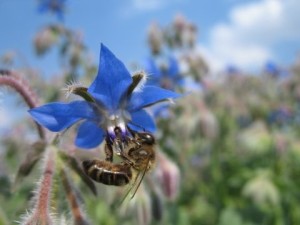
Honey bee on borage. Courtesy The Food and Environment Research Agency (Fera), Crown Copyright.

Honey bee on borage. Courtesy The Food and Environment Research Agency (Fera), Crown Copyright.

A honey which contains a high amount of sucrose can be a sign that it’s been produced by feeding the bees sugar syrup – but not always. A Yorkshire beekeeper was once accused of feeding his bees sugar before it was discovered that borage is an unusually high sucrose nectar. The England Honey Regulations 2015 make allowances for this, requiring that honey has a sucrose content of not more than 5g/100g, with a few exceptions for certain honeys, including borage, which can have up to 15g/100g (see page 10 of the regs).

In this August 2010 Statford-upon-Avon & District Beekeepers’ Association newsletter, Peter Edwards writes “This high sucrose level combined with low glucose results in a honey that will not set – so this makes it popular with the packers as it can be used to produce clear honey with an almost indefinite shelf life. The next problem with borage honey is its total lack of flavour unless mixed with something else.  Pure borage honey is completely white and looks, and tastes, like sugar syrup with maybe just a hint of cucumber skin – yuck!”

Factors affecting nectar flow

Pam talked about some of the difficulties bees face in collecting nectar. There are all sorts of factors which affect how much nectar flowers provide:

  • Humidity
  • The moisture & PH of soil
  • Sunshine – it’s said that dandelions only produce nectar if they’ve been in sunshine for two hours. Many plants – oil seed rape for example – don’t produce nectar in cold temperatures. Pollen availability is much less affected by the weather.
  • Time of day – bees go to apple blossom for pollen in the morning and nectar in the afternoon.
  • Age & vigour of the plant – young blackberry plants produce more nectar.

What makes a good colony?

Pam concluded that a healthy colony needs a steady supply of nutrients. She gave us a couple of quotes she likes:

“The very best queens will not be produced except under the best conditions!” (A.L.Gregg)

“If queens were not well fed in the early larval stage, they will be superseded early” (A.I.Root, The ABC of Bee Culture)

Without protein, a colony can survive on pure sugars for some time, but the bees will not be able to develop their hypopharyngeal glands and rear brood. If pollen being collected has a low protein content, nurse bees can feed fewer larvae. During protein shortages brood may be eaten by the adult bees.

There is also evidence that a lack of pollen can reduce the immunocompetence of bees. In controlled trials by DeGrandi-Hoffman et al (2010), a reduction in virus levels was seen in bees fed good pollen supplies.

As discussed earlier on by Pam, not all pollen is equal – she quoted a study by Schmidt et al (1995), which involved feeding colonies either rape, sunflower or sesame pollens. The bees fed sesame or sunflower pollen lived shorter lives (31 days on average for the bees fed sunflower pollen, compared to 51 days for the bees fed rape pollen). The authors suggested that honey bees used to pollinate monocrops of sunflower or sesame flowers should be provided alternate floral or nutritional supplements to maintain colony health. This will have particular relevance to beekeepers in France, which has vast sunflower fields.

See also…

My hive partner Emma’s write-up of Pam’s talk: Federation of Middlesex Beekeepers Day 2016.

Pam mentioned that Professor Geraldine Wright‘s lab in Newcastle is doing the first new work on honey bee nutrition for many years. There is still lots we don’t know.

And a lot of Pam’s talk overlapped with the content of the BBKA Module 2 (Honey bee Products and Forage) and Module 5 (Honey bee Biology) exams, which the Mid Bucks Association have produced excellent study notes for: Module 2 study notes and Module 5 study notes.

Posted in Events | Tagged , | 13 Comments

Middlesex Federation Day Part 1: Professor Field, Why do we use insecticides?

Yesterday I went to the Federation of Middlesex Beekeepers’ Associations annual ‘Federation Day‘. Each year the Middlesex associations (Ealing, Enfield, Harrow, North London, Pinner & Ruislip) take it in turn to host a day of beekeeping talks; this year the day was organised by the Enfield association, in a remote area of north London which took me around 2 hrs 45 mins to reach from my part of west London!

The travelling was worth it as I learnt lots from three expert speakers.  Below are my notes from the excellently-named first speaker, Professor Field. She works at Rothamsted agricultural research station, focusing on understanding insecticide mode of action and resistance at the biochemical/molecular level and then using this to develop better pest control strategies. Recently she has played a role in developing Rothamsted’s policy on the effect of neonicotinoids (neonics) on bees and a lot of her talk was spent giving us an update on the neonics situation.

Why do we use insecticides and what are the threats for bees?
Professor Linda M. Field. Head of Department, Rothamsted Research

Professor Linda Field

Professor Linda Field

Advantages of neonics: 

  • Very selective to insects, not toxic to mammals
  • Systemic – travels through plant to leaves and flowers if used as a seed dressing (this has turned out to be less of an advantage than initially thought, as it means neonics end up in the nectar and pollen). Avoids the need for costly sprays which are potentially more damaging to local wildlife.
  • Pests take a long time to develop resistance to neonics
  • If used properly, little evidence that they directly kill bees

Problems with neonics

  • The question is not “Are they killing bees?” but “Are they having a sub-lethal effect which causes problems for bees?” – for instance, stopping foraging bees finding their way home. There is evidence that this is the case, but we don’t understand why this might be.
  • To gather research in the field, large-scale experiments are required to find out if neonics are a problem. These studies are not being funded by governments.

Lots of other factors beside pesticides are causing bees problems – varroa, viruses, weather, loss of forage – these are important but less easy to control and stop.

Where are we with neonics now?

In 2013, Regulation No 485/2013, the European Commission restricted the use of three neonicotinoid pesticides, clothianidin, thiamethoxam and imidacloprid, preventing the use of seeds treated with them in EU member states.

No-one has monitored the overall effect of the ban! The EU is not providing money for research into neonics. We have some scientific papers from independent organisations, but the research has been done in varying ways using different methods, making it hard to compare. A decision is unlikely to be made on what to do next until spring 2017.

The most recent EU report was in April 2015, by the European Academies Science Advisory Council (EASAC): Ecosystem services, agriculture and neonicotinoids. Professor Field recommended the conclusions at the end of the report (p.29) to us as the “easy bit to read”. She went through some of the report’s conclusions and gave us her comments on them:

“There is an increasing body of evidence that the widespread prophylactic use of neonicotinoids has severe negative effects on non-target organisms that provide ecosystem services including pollination and natural pest control.” (Conclusion 5)

Professor Field agreed with this but added that equally there are also papers which have found the opposite.

“Current practice of prophylactic usage of neonicotinoids is inconsistent with the basic principles of integrated pest management as expressed in the EU’s Sustainable Pesticides Directive.” (Conclusion 7)

Professor Field commented that people often take the word ‘prophylactic’ as implying unnecessary usage, whereas most farmers can reliably predict that certain pests will turn up each year. As mentioned above, one of the advantages of neonics is that pests take a long time to develop resistance to them. When the neonics ban was put in place here, weevils began destroying oil seed rape crops, resulting in some farmers spraying with pyrethroids 4-5 times in an attempt to kill them – but the weevils had developed resistance to pyrethroids. By the time farmers and agricultural advisers realised this, the sprays had also killed beneficial insects that might have helped control the weevils.

“Widespread use of neonicotinoids (as well as other pesticides) constrains the potential for restoring biodiversity in farmland under the EU’s Agri- environment Regulation.” (Conclusion 8)

Professor Field said there is a lot of debate going on about how to combine habitat diversity and farming. Should we try to share farming land with native species and make it biodiverse? A nice idea but not optimal for either farmers or wildlife. Or farm some areas of land intensively while leaving other areas aside for biodiversity? There is evidence that this approach may help rare species more.

Current UK situation

The UK government temporarily lifted the ban and allowed about 5% of farmers to sow neonic treated oil-seed rape in autumn 2015. This applied to farmers in areas where there is high resistance to pyrethroids in cabbage stem flea beetles, a pest of oil-seed rape. There are a lot of oil-seed rape crops out there which survived the initial onslaught but are full of beetle larvae waiting to attack. We may see farmers start to plant more field beans and pulses.

The COLOSS 2014-15 winter losses data showed low honey bee colony losses in the UK compared to many other European countries. The overall proportion of colonies lost (averaged out across all 31 countries surveyed) was 9%, the lowest since the COLOSS international working group started collecting data in 2007. But we really need the 2015-16 winter data to try and see if the ban has had an effect. There will be all sorts of factors affecting colony losses in any case, including the weather and varroa. We still have limited national data on numbers of solitary and bumble bees, which the EASAC report noted are more vulnerable to the risks from neonicotinoid use.

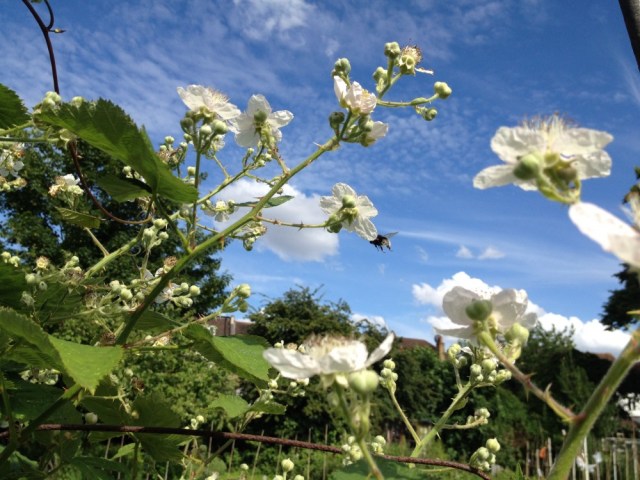
Bramble flowers against the sky


Insecticides and pollinators – are they incompatible?

Professor Field concluded that we can have both, through:

  • Biological controls – for example plants that naturally repel insects or plants that are naturally resistant to pests. GM has the potential to engineer plants to be naturally resistant.
  • Cultural controls – rotating crops more, mechanical sowing.
  • Using pesticides as a last resort when other methods don’t work!

I was left feeling ambivalent about neonics. In some ways they are better than the pesticides that came before – none of us want to go back to DDT. At the same time, I would rather have a countryside which is more welcoming to pollinators. I support the EU ban because at least it’s trying something – at least it’s an attempt to protect pollinators, see what the effects of neonics are and if banning them can help.

See also Emma’s write-up of the day on her Miss Apis Mellifera blog, I missed the beginning of Professor Field’s talk but she was there for it all: Federation of Middlesex Beekeepers Day 2016.

Posted in Events | Tagged | 13 Comments

What’s flowering now: early February

Everything is early this year. So we have snowdrops at the apiary:

Snowdrops

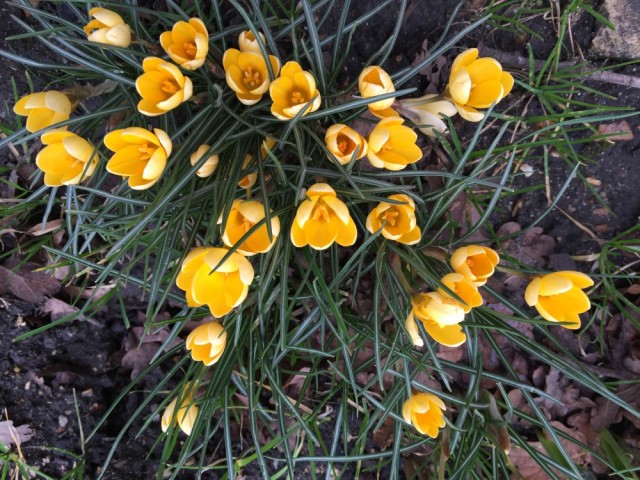
Crocuses at Northfields allotments:

Yellow crocuses

Purple crocuses

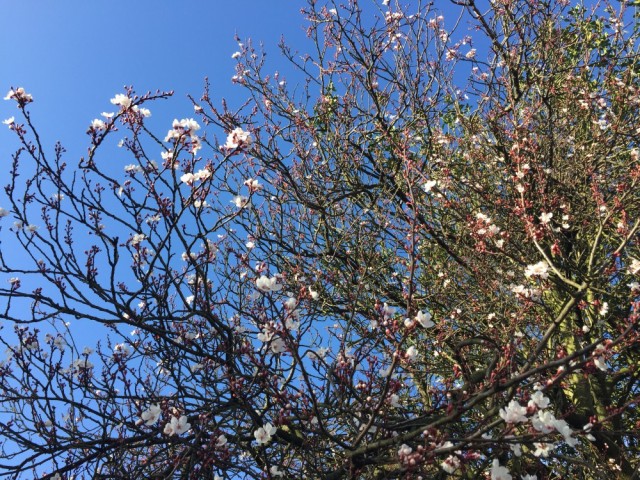
Blossom on the trees:

Blossom

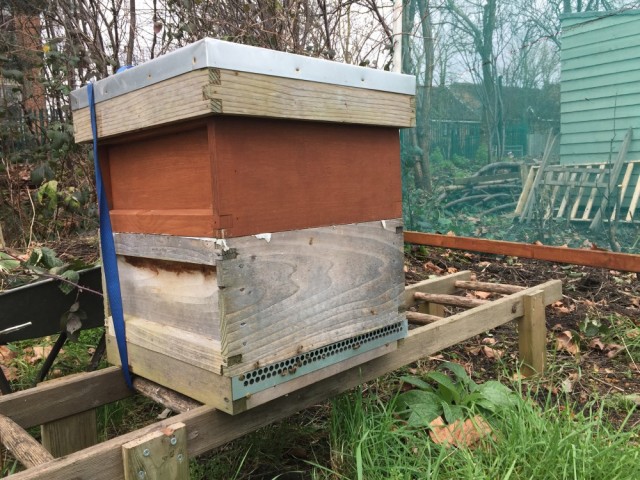
It were a mild day today, so the allotment bees were out and about.

Allotment hive

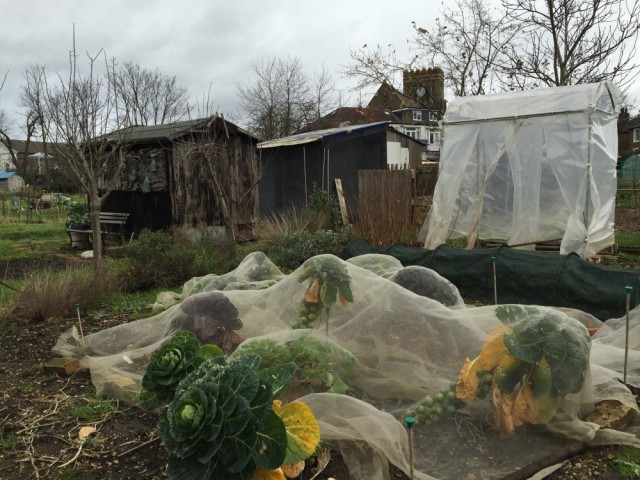
The plots were quiet except for birds hopping over the bare earth. The main crops in view were the strange shapes of brussel sprouts.

Brussel sprouts

All is quiet with the bees at the moment, but before we know it spring will be underway and the first swarms will be here.

Thanks to Margaret Anne Adams, who posted helpful December 2015 advice from the Regional Bee Inspectors on the BBKA Facebook page: INSPECTORS_ ADVICE.docx – apparently there have been outbreaks of European Foulbrood (EFB) in the Shropshire/Welsh borders. Part of the advice given to prevent these outbreaks is to change brood combs regularly and avoid re-using combs from colonies which have died out. Now is a good time to prepare new frames ready for spring Bailey or shook-swarm comb changes.

Posted in Uncategorized | 26 Comments