6th Honey bee pests, diseases and poisoning revision post: diagnosing and treating for acarine (tracheal) mites, and a bit of beekeeping history

A 6th revision post for the British Beekeeping Association’s Module 3 Honey bee Pests, Diseases and Poisoning exam, which I plan to take in March. I’m taking the BBKA’s correspondence course, so I have a tutor setting me papers which she then marks. I’m only on paper 2, the questions seem to go on forever…

3.a)  describe the symptoms which might lead you to suspect the presence of the Acarine mite, Acarapis woodii, in a colony?  

There are often no outward signs of the mite’s presence in a colony. Beekeepers should be suspicious if a colony does not build up properly in spring, as the mites shorten the lifespan of the bees (though nosema may be a more likely culprit). We should also be on their guard after poor summers, when bees are confined to the hive and mite transferal between bees is easy. Plenty of nectar means more flying bees and fewer opportunities to grab onto a new host. The result is that infested bees born in autumn will have their lives shortened whilst overwintering.

Sometimes acarine mites have been found on bees crawling or trembling by the hive entrance. This crawling may be caused by virus paralysis, but whether the mite acts as a vector for the virus or just happens to be present too is not known. Of course varroa is now present in virtually all UK hives and could also be acting as a vector, which complicates assigning blame. Crawling also happens for reasons unconnected with acarine or the paralysis virus.
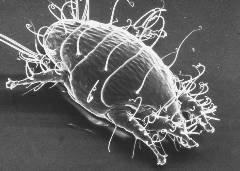
Tracheal mite

Acarine (tracheal mite)/small guinea pig. Courtesy The Food and Environment Research Agency (Fera), Crown Copyright.

b) how could you confirm the presence of this mite in the colony; include details of the size of the sample required, how the sample is obtained and how the bees are dissected as well as where the mite is normally found within the body of the bee?

Microscopic examination is required to confirm the presence of acarine.

The mite is usually found within the main thoracic trachea of the honey bee. Obtain a sample of around thirty bees. If crawling bees have been found unable to fly within about 3 metres of the front of the hive, collect these. Otherwise, try to collect foragers. The bees may be living, dying or dead. If alive, first kill them humanely with an ethyl alcohol solution or in a freezer at -20°C.

If attempting to analyse the sample yourself, pin the bee’s body on a wine cork through its thorax, between the second and third pair of legs. With a single edged razor blade or scapel, cut off the bee’s head and first pair of legs and remove them with tweezers. Next, carefully use fine tipped tweezers or a scalpel to remove its neck collar and fully reveal the main branches of the trachea. Pull the collar upwards in a circular motion; it should pull off easily, usually in one piece.

Image below from dave-cushman.net.

Inspect the bee’s trachea with a microscope at x40 magnification. You are looking for ‘staining’, blotchy dark patches caused as the mites damage the walls of the trachea when they pierce it with their mouth parts to feed on the bee’s haemolymph. Healthy tracheae are smooth and pearly creamy-white looking. Badly infested tracheae are discoloured from yellow to dark brown or black. If you are lucky the eggs, nymphs and adult stages of the mite may also be seen in the trachea.

Alternatively bee samples can be sent to the National Bee Unit in a sturdy card box (not plastic); for a charge of around £40 they will analyse the sample for you.

Acarine infested trachea

Courtesy The Food and Environment Research Agency (Fera), Crown Copyright. The healthy trachea is on the left side of the image, the acarine infested trachea on the right.


c) how does the mite spread from one colony to another? 

Mites migrate to other bees as they touch.  They do not seem to be able to transfer across comb or any other static object, so the most likely cause of transferal between colonies is worker bee drifting, drones paying visits to other hives or beekeepers moving combs containing adult bees between colonies.

d) write a short account about the life of the mite; include its lifecycle, what it feeds on, how and when the mite invades the body of the  bee  

The acarine mite (known as tracheal mite in the US) lives in the main thoracic trachea (respiratory tubes) of the honey bee. A fertilised female will find her way into a bee’s trachea and lay 5-7 eggs soon after the bee emerges from its cell – she prefers her host to be only one to two days old. There is some evidence that she prefers drones as hosts, due to their larger tracheas.

The eggs hatch about 3-4 days later, and after a period as immature nymphs the males larvae develop into adult mites within 11/12 days and the females within 14/15 days. The mite family feed on the haemolymph of the infested bee through the walls of the trachea, piercing it with their mouth parts. After becoming sexually mature adults, the brothers and sisters mate in the trachea and the fertilised females leave to find new hosts.

Impregnated adult female mites find a new host by leaving their original host’s trachea, clinging onto one of the bee’s body hairs with one or two hind legs, usually clustering under the wings first and then waving their remaining legs around until a suitable young bee (typically under three days old) comes along. They will be able to tell by the smell of the bee and also because the trachea is protected by hairs which are softer on young bees – the hairs across the spiracle quickly harden and prevent entry after the bee is a few days old.

The mite grabs the hair of her new host with her front legs (where she is probably attracted to the wing roots by their vibrations or by puffs of air (Pettis) from the first spiracles) and makes her way down the first thoracic spiracle to enter the trachea.

e)  what is the effect of the mite on the individual bee.

  • The breeding mites can eventually block the first pair of the bee’s tracheal tubes, shortening its foraging lifespan.
  • Severely infested bees cannot fly and eventually die.
  • Crawling and ‘K-wings’ may indicate infection with Chronic Bee Paralysis Virus (CBPV), which is often also present.

B4.a) in the debate over the cause of the so called Isle of Wight Disease, it has been suggested by Dr Bailey and others that many of the signs of this disease were not the direct result of Acarine but due to the presence of a secondary virus infection; discuss the reasons behind this assertion and name the virus infection implicated

In the early twentieth century, a mystery disease ravaged British bees. It was first observed in 1906 upon the Isle of Wight (for my American readers, this is a beautiful island about 5 miles off the south coast of England). Beekeepers there noticed that their bees were crawling on the ground around their hives, dying so fast that whole colonies were wiped out at the height of summer, when they should have been most strong.

The devastating affliction reoccurred at least three times from 1906 to 1919. By 1907 the disease had wiped out most of the bees on the island – it then spread to mainland England and wreaked havoc there. Huge numbers of bees had to be imported from Europe, so much so that some beekeepers claimed our darker British subspecies of Apis mellifera had effectively become extinct.

Looking back at 1906, when the disease first emerged, there was a gorgeously sunny April, drawing crowds to the Isle of Wight beaches. This was followed by an absurdly cold May – frosts and temperatures as low as -5°C (23°F), even in London. It was too cold for honey bees to venture out, at a time when colonies were full of young, spring bees. This created ideal conditions for a number of problems and parasites to take hold – such as dysentery (diarrhoea) due to the bees being unable to take cleansing flights. Of course if bees begin defecating on the combs this can spread Nosema, if it happens to be present. Acarine mites can also spread easily from bee to bee due to the number of bees squashed in together tightly.

Hello bees!

Beekeeping in 1906 was very different to today. Beekeepers just did not have the same level of understanding about how diseases spread, with the result that all sorts of inadvisable practices were carried out, from keeping hives close together in apiaries to frequently moving combs and bees between different hives. These practices were recommended at the time, but must have helped spread the Isle of Wight disease. As travel and trade increased, it may be that the acarine mite first arrived in Britain through the Isle of Wight and Southern England at the start of the twentieth century. Meeting this parasite for the first time would have stressed colonies out more than we would now expect from acarine mites.

Although investigations in 1919 revealed the presence of acarine mites in all afflicted hives on the Isle of Wight, leading to the mites being identified as the likely culprit, it’s now thought that the crawling behaviour observed was probably due to Chronic Bee Paralysis Virus (CBPV). It was in the 1950’s that Dr Leslie Bailey (who worked in the Bee Disease Section of the Rothamsted Research Station) first suggested that CBPV was spread by the mite, with many of the colony losses in the 1910s ultimately being due to attack by this virus.

Edit – comment by Pam Hunter, 23/01/13: The combination of virus and acarine has a more profound effect than either alone.  Viruses were not known at the time of the Isle of Wight disease but they can synergise with other infections. Now that we have varroa, this also synergises with acarine to have a far more profound effect than either alone.

Diseases and parasites such as nosema, acarine and varroa may not always kill colonies outright, but can weaken the immune systems of the bees, allowing viral infections to take hold. The descriptions given by beekeepers at the time of crawling bees with trembling wings we now identify with CBPV. It is only since the arrival of the electron microscope that scientists have been able to identify these viruses.


b) two main treatments for Acarine were advocated in the past. What were these
treatments?

What a mean question! Now I have to memorise treatments that aren’t even used anymore?!

I think the answer is ‘Folbex‘ (Chlorobenzilate imregnated paper strips) and Folbex VA (Bromopropylate impregnated paper strips). The strips were set alight and allowed to smoulder in the hive, producing a smoke that penetrated through the hive. This treatment would be applied in the evening when all the foraging bees had returned; the hive would be closed up to hold in the smoke fumes and opened the following morning. In an out-apiary, the hive could be opened up after an hour so that the beekeeper did not have to return the next day.

Image below from dave-cushman.net.

There was also a treatment known as the ‘Frow‘ remedy, named after Richard Watson Frow MBE, a station master and amateur beekeeper. He published his treatment for others to read in the British Bee Journal’s 17 November 1927 issue. The remedy was based on a 1920s Daily News article on dealing with household pests.

It contained various dubious substances, Nitro benzene being involved in all formulations and generally the major constituent. Safrol, Ligrion, Petrol (gasoline) and Methyl Salicylate were all used as ingredients in different ratios and at different times.  It was usually administered by giving small doses of about one millilitre on to a felt pad, daily or on alternate days, for a period six to ten days, then removing the pad after a further week to ten days.

To be fair, somehow the treatment worked, and Frow generously made the recipe freely available for beekeepers. For his contribution to beekeeping he was made a Member of the British Empire (MBE) in 1946. (This information on the Frow treatment comes from http://www.rogerparsons.info/frow.html and dave-cushman.net).

ii) why are they now not available?

Acarine is not considered a major disease in the UK, so there is no commercial incentive to produce a treatment.

The Frow treatment was highly inflammable and poisonous to bees and humans – two very good reasons why its use is not legal now! Its main component, Nitrobenzene, is highly toxic and possibly carcinogenic to humans. Inhalation of nitrobenzene vapors can  cause headaches, nausea, fatigue, dizziness and in rare cases can even be fatal.

Edit – comment by Pam Hunter, 23/01/13: Both had a poor therapeutic ratio – i.e. the amount required to kill the mite was too close to the amount that would harm or even kill the bees.

c) if a hive of your bees has Acarine, what, if anything, could you do about it?

Currently there is no authorised treatment for acarine mites in the UK. The beekeeper may wish to consider requeening. Some honey bee sub-species are more susceptible than others – acarine is a bigger problem in the US, where many beekeepers use Italian/New Zealand crosses. Bees native to the UK appear to have evolved a tolerance to the mite.

Try to arrange hives in a way that minimises the risk of drifting. I have a blog post on doing this – honeybee drifting. Also try to discourage robbing – ideally feed bees inside their hives in the early morning or evening, when foragers are not out looking for food, and never feed bees communally in the middle of the apiary. Keep strong colonies with narrow entrances.

There is some evidence that thymol is effective against acarine, so using Apiguard or a similar thymol based authorised anti-varroa treatment might help. Edit – comment by Pam Hunter, 23/01/13: Some think that several years of using thymol has reduced acarine considerably. 

In the US, some beekeepers have found feeding ‘grease patties’ to be effective. To make these, cooking oil is combined with white granulated sugar so that the sugar becomes oily and can be formed into a patty shape. A large spoonful is placed on greaseproof paper and placed on top of the brood combs, with an eke to give space. The idea is that young bees eating the patty will have their odour masked. This helps prevent the female acarine mites from recognising them as suitable young workers.

Photo below of a grease patty from tonitoni.org

Good husbandry techniques are also important. Inspect colonies regularly to make sure all is well and take samples for testing from any colonies that seem to be failing to thrive for no apparent reason.

d) if a colony died out from Acarine, is it safe to use the combs and other hive parts without the need for sterilization?

Yes, as acarine mites cannot survive on comb without the presence of bees. Eggs are only laid inside the bees’ trachea, not elsewhere in the hive. However, regular brood comb replacement and hive part sterilisation is good practice against several other pests and diseases, such as nosema, EFB and AFB.

Printer-friendly pdf version.

References:

Posted in Disease prevention | Tagged , | 8 Comments

5th Honey bee pests, diseases and poisoning revision post: nosema, acarine and amoeba.

A 5th revision post for the British Beekeeping Association’s Module 3 Honey bee Pests, Diseases and Poisoning exam, which I plan to take in March.

B1. you suspect that a colony of honeybees has Nosema disease; describe fully
a) the signs and symptoms that aroused your suspicions  

Nosema apis and Nosema ceranae are extremely common spore-producing fungus parasites, which are very likely to be affecting your bees. It’s also likely that you won’t have a clue they’re there, as the symptoms are not obvious.

Nosema spores enter via the mouth parts of a bee and travel into its mid-gut. In the case of an older foraging bee, they will typically pick up spores from trophallaxis (food-sharing) with other bees or drinking water sources contaminated by bee droppings. Younger house bees are more likely to be infected as they clear away excrement or clean comb in the hive. Normally bees are very clean creatures, but if long periods of bad weather prevent cleansing flights, a bee suffering from dysentery just can’t hold it in anymore. The younger house bees then try to clean up the mess, ingesting the destructive spores in the process.

Photo below of Nosema ceranae from http://www.biosecurity.govt.nz.
Nosema ceranae

How nosema develops inside a bee

The spores invade her digestive epithelial cells, which line her mid gut – the function of the mid-gut is to produce digestive enzymes which enable the bee to digest the pollen and nectar in its diet. The spores germinate and feed happily away on the content of these cells, rapidly multiplying by cell division until the gut contains 30-50 million nosema spores once the infection is fully developed.

This impairs the digestion of pollen, shortening the lifespan of the bee (sources disagree on how much, with various books/websites quoting 50%, 10-50% and up to 78% – the earlier the bee picks up the spores, the more dramatically its lifespan is likely to be shortened). Infection is more devastating in younger bees, which will not be able to digest enough pollen to develop their hypopharyngeal glands and be able to produce brood food.

Nosema ceranae also suppresses the vitellogenin (Vg) gene in nurse bees, a gene which paces the onset of foraging and influences worker longevity. When Vg expression is suppressed, nurse bees transition to become foragers more quickly than a healthy bee would, resulting in a shorter lifespan.

Within around five days in each individual epithelial cell, spore reproduction ceases and the cell is ruptured and destroyed. Some of the spores invade new host cells, others pass through into the midgut and then down the small intestine into the rectum. From there they are excreted in the bee’s faeces and can contaminate other bees.

Diagram below showing nosema apis lifecycle from Scientificbeekeeping.com, © Springer Life Sciences. The spore injects its contents into a gut epithelial cell, multiplies, and eventually causes the cell to burst and release the new spores back into the gut. Nosema can also reproduce “vegetatively” cell to cell.

Just how bad is nosema? 

How badly the colony is affected as a result will depend on the percentage of bees infected – if a high percentage are infected then it can have a serious effect on the colony. The symptoms to watch out for are a colony that fails to build up in spring, with lower brood production than you would normally expect. Honey production is also affected, due to a decrease in foraging time spent as bees die off early. Colonies usually survive and have fewer infected individuals once warmer late spring weather appears and bees are able to fly out to excrete away from the hive.

Some slight differences have been observed in the symptoms caused by the two species Nosema ceranae and Nosema apis. Dysentery spots and visible adult bee mortality in front of the hives are sometimes associated with N.apis but reported to be generally absent with N.ceranaeN.apis appears to thrive in colder weather whereas N.ceranae, which originated in Asia, seems to prefer warm climates and is more common during summer months. 

Could nosema ceranae be implicated in colony collapse disorder (CCD)?

There is some evidence that N.ceranae infections are more voracious than Nosema apis; in Spain N. ceranae infections have been observed to be characterised by a progressive reduction in the number of bees in a colony until the point of collapse. As the colony becomes under increasing pressure, secondary diseases frequently appear, including chalk brood and American foul brood.

There has even been some speculation that N. ceranae could be a contributing factor in CCD – if the colony breaks down, the queen can be found surrounded by a few bees, confusedly attending to brood that is already sealed. Infected bees tend to altruistically prevent spreading the infection by flying away and not returning to the hive. Newly emerged bees may not test positive for nosema, allowing the culprit to go undiscovered. However, more recent research has failed to confirm a link and researchers in the US have concluded that it is not the primary cause of CCD.

b) how you would confirm that the disease is present

Definite confirmation requires microscopic examination of the abdomens of older adult bees, which can be collected from the hive entrance. Infection is highly variable in a colony, but foragers tend to contain the higher spore loads. Collecting bees leaving to go on cleansing flights rather than returning will be more effective. Send a sample of 30 bees to a microscopist or the UK National Bee Unit service in a small sturdy box (not plastic, which causes rapid sample degradation).

From a Beecraft magazine article – Bee Craft, Nosema ceranae Jan 2008:

“Abdomens of worker bees are ground up in a mortar with a little water and a drop of the resulting liquid spread onto a microscope slide. The tell-tale rice grain shapes can be seen using a microscope with a magnification of 400x. If you take a large enough sample of bees, you could probably detect minute levels of Nosema in many colonies. For a realistic result, it is recommended that you use around 30 bees.”

Diagram below from Scientificbeekeeping.com. The difference between the two species is very slight, but N.apis tends to have a more transparent centre and N.ceranae more of a slender, ‘bent’ shape.
nosema spores

The extent of infection is determined by counting the spores on a microscope grid and calculating the average number of spores per area and estimating from that the number of spores per bee.

Under the light microscope the spores of N. apis and N. ceranae appear as white/green, rice shaped bodies. Telling the difference between the two species is not easy, but some say an expert eye can spot it. On average N.apis spores are one micron larger in length than N.ceranae. Additionally N.ceranae spores can appear ‘bent’ and thinner than N.apis spores; however treatment is the same for both species. Genetic examination is the only reliable technique to distinguish between the two.

c) the action that should be taken to treat the disease if confirmed  

Fumadil B, the antibiotic previously used for treating nosema, has recently become no longer approved for sale in the UK (since December 2011). Without this treatment at our disposal, moving the colony onto fresh comb that contains no nosema spores is the best option.

Our best defence against nosema is good husbandry practices such as regularly changing brood comb, avoiding crushing bees through clumsy handling (this can release millions of nosema spores inside the hive) and maintaining strong well fed colonies, headed by young prolific queens.

As always, avoid moving brood frames between hives and do not feed honey from other colonies to bees – nosema spores can remain latent over a year on combs and for three to four months in honey. Wash hive tools between hives with a solution of one part washing soda to five parts water (e.g. 1kg of soda dissolved in 5 litres of water). Bee keepers should also consider re-queening susceptible colonies with queens from more tolerant stocks of bees better able to cope with Nosema infection.

d) how you would get the bees onto new sterile combs to allow you to remove the original frames for sterilisation  – give two methods.

Bailey comb exchange – all infected brood comb is removed gradually, over a period of about a month. A new brood box filled with foundation is placed over the existing one. Once the bees have drawn out some of the foundation, the queen is found and placed in the new brood box. A queen excluder is placed between the two brood boxes, so that she cannot move down to the old one. Heavy 2:1 mixture syrup should be fed to encourage the workers to draw out new comb quickly.

Three weeks later, once the larvae in the old brood combs have emerged, these frames can be removed and either burned or fumigated with acetic acid. Acetic acid is very corrosive stuff, so beginners should be cautious when trying this and seek advice from more experienced beekeepers first. The Bailey comb exchange is best done in early spring, such as March in the UK.

See the FERA Beebase website’s Replacing Comb factsheet for a more detailed explanation of the Bailey exchange method.

Shook-swarm – this is a dramatic spring clean for the bees, removing all their old brood comb with larvae cocoons/faeces, varroa and possibly nosema spores and giving them fresh new foundation to build on. Best done on a warm, sunny day in early Spring. 

First move your hive to one side and put a ‘new’ hive and foundation frames in the location of your old one, with a queen excluder on top of the floor (between the floor and the brood box). The queen excluder stops the queen absconding in the first week, and putting the new hive in the old location ensures that any foragers return to the right place.

Next, find the queen (easy, right?!) and put her safely in your pocket in a queen cage. Remove four frames from the centre of the new hive and place them to one side. Shake all the workers into the gap and return the queen. The old brood comb can now be burnt. Feed 2:1 strength sugar syrup to the colony to help them draw out new comb quickly and return regularly to top this up. The queen excluder can be removed a week later.

See the FERA Beebase website for a free downloadable shook-swarm factsheet which is worth following step-by-step if you’re shook-swarming for the first time.

B2. a) give a simple account of the structure and function of the alimentary, excretory and respiratory systems of the adult honeybee worker

  • Ailmentary systems

Digestion and excretion are the functions of the alimentary canal and its associated glands. Immediately inside the bee’s mouth the canal extends into a cavity with muscular attachments to the front of the head, so that it can expand and contract, providing small amounts of suction to help pass food from the proboscis and into the oesophagus. Waves of contractions are produced by muscles in the oesophagus, working nectar back into the bee’s initial ‘honey stomach’ or ‘crop’, where it is stored for a while.

At the end of the honey stomach is an important valve called the proventriculus, which stops the nectar going further until it’s needed.The proventriculus has four lips that are in constant movement, sieving out solids such as pollen grains and spores from the nectar and passing them back as a fairly dry lump into the ventriculus (mid-gut).

When the bee needs sugar, the proventriculus opens up and allows some nectar through into the ventriculus, where enzymes break the nectar down into molecules small enough to be passed through the gut wall into the haemolymph.Any waste residue is passed into the small intestine and held as faeces in the rectum until the bee is able to leave the hive for a poop. During long periods of cold weather in winter the rectum can expand to almost the whole length of the abdomen before the bee is able to fly out. This is when bees are more likely to have trouble ‘holding it in’, especially if they are suffering from dysentery.

Illustration below by R.E. Snodgrass from http://www.extension.org. Alimentary canal of worker (Phy-Rect), together with pharyngeal glands (1Gl), and salivary glands of head (2Gl) and of thorax (3Gl), as seen by cutting body open from above and pulling the ventriculus (Vent) out to left.

  • Excretory systems

As a bee digests its food, the food breaks down and the resulting products are circulated by the bee’s haemolymph (a bee’s equivalent to our blood). The useful products provide energy and bodybuilding substances. The waste products need to be expelled by the excretory system, which acts as a sophisticated filtering system. As well as removing waste substances, it also adjusts the levels of particular substances in the haemolymph, ensuring the correct balance between water and salts and that osmotic pressure and acidity remain within narrow limits.

  • Respiratory systems

The bee breathes through tubes called trachea, which carry oxygen throughout the bee’s body to where it’s required. In more complex animals such as mammals, oxygen is transported to body tissues by blood, but the haemolymph of insects is not involved in transporting oxygen.

The trachea open to the air around the bee through holes in the cuticle called spiracles, which in many cases are provided with a closing mechanism. Air enters the tracheal system through the spiracles and is diffused around the bee’s body.

Diagram below of the internal anatomy of a honey bee found at chdphd.com/PhD/Chapter2.php, adapted from Dade (1977) and Winston (1987).

honey bee anatomy diagram
b) explain how Acarine, Nosema and Amoeba affect these systems.

      • Acarine is a small mite named Acarapis woodi which lives in the main thoracic trachea (respiratory tubes) of the honey bee. A fertilised female will find her way into a bee’s trachea and lay 5-7 eggs soon after the bee emerges from its cell – she prefers her host to be only one to two days old. There is some evidence that she prefers drones as hosts, due to their larger tracheas.
Tracheal mite

Tracheal mite/tiny guinea pig. Courtesy The Food and Environment Research Agency (Fera), Crown Copyright.

The eggs hatch in about five days, and the little larvae (which Ted Hooper describes in Guide to Bees and Honey as reminding him of “tiny guinea pigs”) develop into adult mites about nine days later. The mite family feed on the haemolymph (blood equivalent) of the infested bee through the walls of the trachea, piercing it with their mouth parts. Their life cycle is complete with fourteen to nineteen days, after which they mate in the trachea and the fertilised females leave to start a new family in other young bees.

Grabbing a new host

The female mites find a new host by leaving the trachea, clinging onto one of the bee’s hairs with one or two hind legs, and then waving their remaining legs around until a suitable young bee less than nine days old comes along. She will be able to tell by the smell of the bee and also because the trachea is protected by hairs which are not so dense in young bees. She grabs the hair of her new host with her front legs and is drawn into the first spiracle through wing vibrations and puffs of air. Guinea pigs never did anything so dastardly!

Effect on the colony

The poor bee can have a trachea stuffed full of the mites, which has the effect of blocking its trachea, shortening its lifespan. Some honey bee sub-species are more susceptible than others – acarine is a bigger problem in the US, where many beekeepers use Italian/New Zealand crosses. Bees native to the UK appear to have evolved a tolerance to the mite.

It is thought that acarine usually weakens a colony and makes it susceptible to other diseases rather than killing colonies outright. The National Bee Unit give a guideline figure for the U. K. that if 30% of bees in a colony are infested then the colony will die in the following spring, but say that generally in Europe a realistic threshold could be set at about 10%.

It was probably a viral infection such as Chronic Bee Paralysis Virus and not acarine (as was originally thought) that killed so many colonies in the infamous Isle of Wight disease outbreak of 1904.

Diagram below of tracheal mite life cycle found on the Mid Atlantic Apiculture Research Consortium website, @MAARECnews

tracheal mite lifecycle

  • As described above, Nosema spores multiply in the ventriculus (reaching 30 – 50 million spores) and impair the digestion of pollen, thereby shortening the life of the bee.

The spores germinate in an ingenious way – inside each spore is a coiled filament that is attached to one end of the spore. This filament everts quickly from the spore and injects a host mid-gut cell, pouring the contents of the spore (nucleus, membranes, etc.) into the host cell cytoplasm.

  • Amoeba is caused by a parasite named Malpighamoeba mellificae. Its cysts are ingested by nurse/cleaning bees and germinate in the rectum.

The spores migrate to the malpighian tubules (the bee’s ‘kidneys’), attack the cells lining the tubules and after 3-4 weeks will divide to create more cysts, that then accumulate in the rectum and are excreted. The cycle then begins again when hive bees ingest the cysts whilst cleaning.

So the cysts take longer to develop than nosema spores – and the number produced is also sixty times less. A bee also has numerous malpighian tubules, so not all the tubules are likely to be damaged.

Whether amoeba infection has much effect on the bee is not clearly known. However, infections are very often found in association with nosema and it is likely that a dual infection will be more damaging to the health of the honey bee. Considering how many really nasty parasites and pests honey bees have to fight, amoeba cysts appear to be pretty benign parasites. Hurray! Their cuddly round shapes are often seen under the microscope when examining a sample for nosema spores.

Microscope picture below from Scientificbeekeeping.com. Amoeba cysts are larger and more oval than nosema spores, and don’t glow in the center.

Printer-friendly pdf version.

References:

Posted in Disease prevention | Tagged , , | 11 Comments

Winter beekeepers

We are having a cold snap of frosty mornings and even light sprinklings of snow occasionally. Last Saturday some hardy Ealing winter beekeepers gathered round our outside table, sheltered from the elements only by a canopy to keep the rain off and tea to warm the insides. The local robin hopped round inquisitively, doubtlessly hoping for Don’s usual present of meal worms, or perhaps some cake crumbs.

On such a dour day, I felt something special was required to lift the spirits, so I brought along a chocolate cake. This recipe is from the ‘River Cottage Handbook No.8: Cakes‘, which is my favourite cake book and really contains every cake recipe you could ever need. Often I find chocolate cakes can be a bit dry or too sweet, but the ground almonds and buttermilk in this one gave it a lovely texture and taste.

Chocolate cake

There was not much beekeeping to be done, just a quick walk round the apiary to heft hives and check on their weight with the help of Andy Pedley’s scales. He found our hive weight to be 32 kilos, of which he estimated 20 kilos would be honey stores. This he thought sufficient to get the bees through winter. They have already started eating their winter fondant and made two holes in the centre, so we will need to keep an eye on that over the coming months to ensure they don’t run out.

Pat and John honey dipping

Emma went on holiday and brought back some delicious honey for Pat and John!

Pat Turner and John Chapple honey tasting

Bee Blessed honey

I was very lucky too, as she gave me some beeswax candles and lip balm. Thank you Emma!

Tomorrow is the Ealing beekeepers annual AGM and Christmas party. After the business of the AGM, the day descends into a frenzy of eating good food and drinking (those brave enough get to try the hearty homemade beer and mead concoctions brewed up by wise old beekeepers).

Some funny conversations have been going on in Twitter about Ealing cakes.

First I posted a recipe for fried honeybee pupae, to which @dunbarrover replied that he finds raw pupae very tasty.

Emma kindly replied that she would rather eat my cakes, unless forced to eat larvae by the event of a zombie apocalypse.

We were then challenged by @dunbarrover to provide proof that our cakes were proper ones.

Emma took up the challenge.

Success! The cake was accepted as a good old wholesome cake, not “gaudy cupcake strumpetry”.

Happy winter beekeeping everyone  – not long now till the winter solstice, after which the queen’s laying will gradually start to pick up again in response to slowly increasing day lengths. We will be doing oxalic acid soon, as a couple of weeks after the first frosts is the ideal time, when there is least likely to be brood in the hive.

Posted in Uncategorized | Tagged | 12 Comments

4th Honey bee pests, diseases and poisoning revision post: viral diseases, patchy brood, bald brood, stone brood and nosema

I’ve now received my first set of feedback from my BBKA correspondence course tutor, Pam Hunter. She went through all my answers very thoroughly and gave me the additional advice “Try not to be dogmatic – ‘may’ rather than ‘will’ etc.  Remember when you do the exam that those marking the papers are individuals and rarely is anything in beekeeping totally black and white so the examiners probably have their own take on many aspects!”

With that in mind, on to paper 2:

A1. why does requeening with queens from an non related strain sometimes reduce the incidence of viral diseases, e.g. Paralysis, in an apiary?

Sometimes viruses can be transmitted vertically from queens to their eggs; queens may gain some viruses from drones during mating. For this reason you would not want to replace a queen leading a colony with viral diseases with one of her daughters.

Additionally, some strains of honey bees display more hygienic behaviour than others, for instance increased hive cleanliness, continual cleaning of the queen, cleaning nursery cells before eggs are laid inside, removing diseased and dead bees rapidly and doing plenty of mutual grooming. Therefore, requeening with a queen selected from a hygienic strain could help produce more hygienic bees who keep down levels of diseases more effectively.

Queen bee

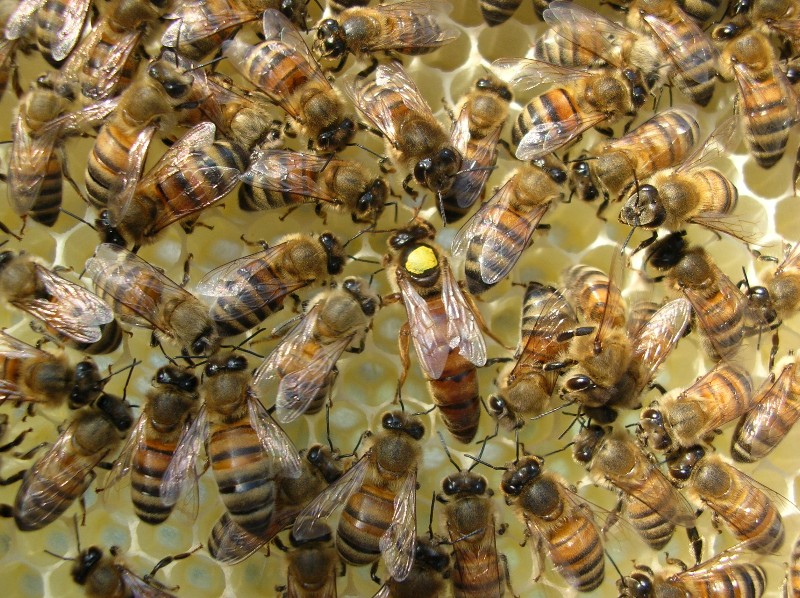
Queen bee and her court. Courtesy The Food and Environment Research Agency (Fera), Crown Copyright

A2. patchy pepperpot brood is associated with several diseases and conditions. Suggest reasons for this.

The bees will perforate cappings to try and investigate larvae which they sense are dead or unhealthy. In the case of European Foul Brood (EFB) and other diseases affecting unsealed brood, worker bees may remove the dead larvae, leaving a patchy brood pattern. It is also possible that a queen is not laying in certain cells because there are EFB  or American Foul Brood (AFB) scales present, adding to the patchy pattern.

Edit – comment from Pam Hunter 17/1/13 – inbreeding can give pepper pot brood – the empty cells are quite healthy and have been cleaned as the bees know if the larvae are diploid drones and will remove them.

Chilled brood in our hive, April 2012

Patchy chilled brood in our hive, April 2012

A3. a) why is bald brood commonly found in colonies containing Greater Wax Moth larvae? 

Bald brood occurs when cell cappings are removed whilst the larvae are still inside. The wax-moth larvae tunnel in straight lines through the comb just below the cappings and produce silken tunnels, to which their faeces and bits of wax become attached. The worker bees subsequently remove the cappings when they realise something is wrong. Luckily the honey bee larvae often remain healthy and pearly white, and usually pupate normally.

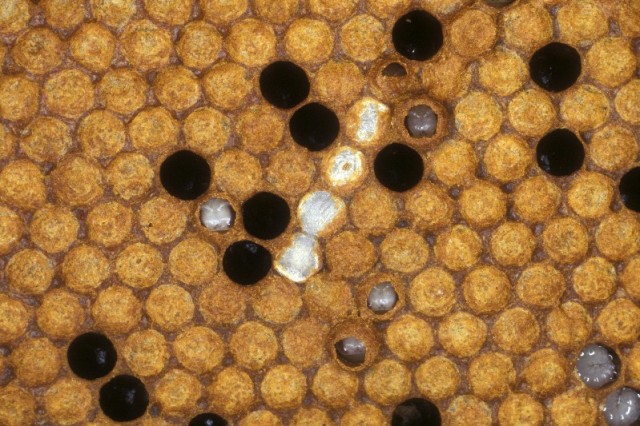
Bald brood with wax moth larvae activity.

Bald brood with wax moth larvae activity. Courtesy The Food and Environment Research Agency (Fera), Crown Copyright.

The bees will sometimes remove the silk tunnels created by the larvae. The cappings are not always completely removed by the bees, so there may be a round hole in the capping or a slightly raised ridge at the edge.

b) sometimes bald brood is found in colonies where the wax moth is absent; account for this. 

Some strains of honey bees have a genetic trait causing them to leave small patches of brood uncapped. If this is the cause of the bald brood, you will see small patches of bald brood rather than the straight lines caused by the wax-moth larvae. Varroa can also be a cause when hygienic bees remove cappings to get at the mites inside. Bearing this in mind, the FERA National Bee Unit photo below probably shows bald brood which has not been caused by wax-moth.

Bald brood

Bald brood. Courtesy The Food and Environment Research Agency (Fera), Crown Copyright.


A4. write a paragraph on Neglected Drone Brood and Stone Brood. 

Neglected drone brood may be due to a drone laying queen or laying workers. In both cases new workers are not being produced, only drones which cannot help raise the brood. This leads to a shortage of nurse bees, resulting in unsealed brood which may be neglected and dying.

Edit – comment from Pam Hunter 17/1/13 – Drone brood may also be neglected if the weather turns bad and there is a lot of other brood to look after but a shortage of nurse bees.  Most likely early in the season if the weather was good and there are drone larvae around the edges of the nest. 

The way to distinguish between a drone-laying queen and laying workers is that a queen will lay single eggs in the cell bottom, whereas laying workers have shorter abdomens, so multiple eggs may be present stuck to the sides of the cell. In these situations drones will be laid in worker size cells, so the resulting drone pupae will be abnormally small and emerge worker sized. The subtle sign distinguishing adult drones which were laid in worker cells is that they will look like workers, only with bigger, beadier eyes than their sisters.

Stone brood is a very uncommon disease; for this reason it’s rarely mentioned by beekeeping manuals and I’ve found it hard to find out much about it. You are unlikely to see it in your hives, so I’d be interested to hear from any beekeepers who have experience of it! It’s a fungal brood disease caused by the fungi varieties Aspergillus fumigatusAspergillus flavus and Aspergillus niger, which are commonly found in soil.  When a bee larva takes in these spores they can hatch in its gut and penetrate the gut wall. The spores grow rapidly, killing the larva in the process.

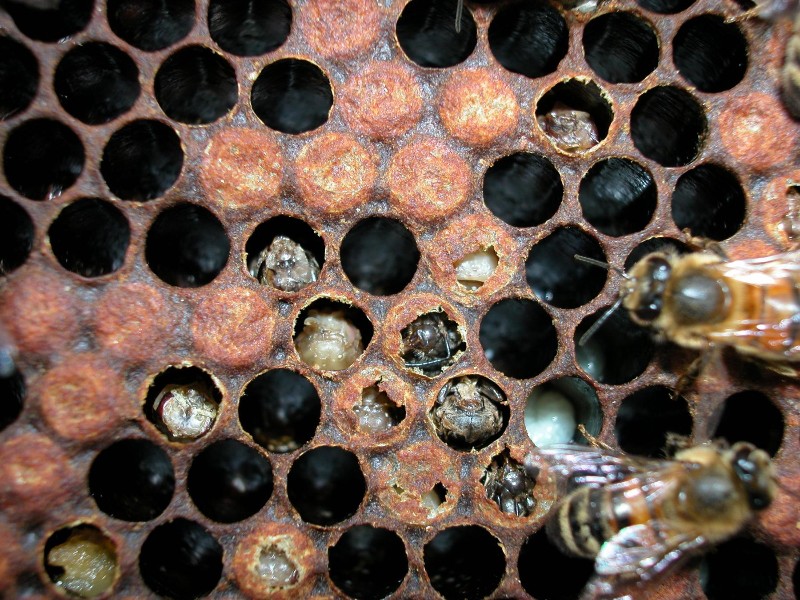
Infected larvae become white and fluffy and die after the cells are capped. Eventually the fungus erupts from the larval remains and forms a false ‘skin’ which turns first yellow and then green as the bee’s body becomes covered with powdery fruiting fungal spores. At first stone brood has a similar look to chalk brood. However, after death stone brood infected larvae become hard and difficult to crush (hence the name ‘stone brood’). In contrast chalk brood mummies can be crumbled easily using your fingers.

Worker bees clean out the infected brood and the hive may recover depending on factors such as the strength of the colony, the level of infection, and how hygienic the workers are. In some cases adult bees can be affected, with their abdomens becoming hard. Interestingly, the Aspergilles fungus can also infect other animal species such as birds, and cause breathing problems for humans.

Whilst searching for images of stone brood online (I failed to find any reliable ones from trusted sources), I came across this beer named after it! Still, it sounds tasty for a beer named after a fungal disease –

“Up on the roof of the Lymestone Brewery, the Lymestone bees have been busy making the sweetest honey from local fields and gardens. Literally stung into action, Brad the Brewer has created this rich, dark beer from the Lymestone bees honey and the finest chocolate malt. Velvety chocolate gives way to a balanced bittersweet finish. Easy drinking and very moreish” – from the Beersay blog.

Stone brood beer

Stone brood beer: rich, dark honey and chocolate malt

A5. describe briefly the lifecycle of Nosema.

There are now two species of nosema found in colonies in Britain, Nosema apis and Nosema ceranaeNosema apis is a unicellular fungus parasite. It produces a spore that can survive in comb for a long time, although the spores are not as resistant to extreme temperatures as those of AFB.

Nosema ceranae is similar but used to be only a parasite of the Asian honey bee, Apis cerana. Unfortunately, as with varroa, the movements of beekeepers have caused it to be transferred to European honey bees (Apis mellifera) and arrive in Britain. This is particularly unfortunate as studies have revealed that European honey bees die more quickly from N. ceranae infections than N.apis infections. Queens infected with N. ceranae have been shown to die about three weeks after becoming infected by diseased worker bees in their colony.

How nosema spreads

Nosema spores get into an adult bee through its mouth; this happens as house bees clean up faeces from combs and frames, in the process unknowingly ingesting the nosema spores.

The spores invade the digestive cells lining the main digestive mid gut of the honey bee. They feed happily away on the content of the bee’s gut cells, rapidly multiplying within a few days, until the gut contains 30-50 million nosema spores once the infection is fully developed. This impairs the digestion of pollen, shortening the lifespan of the bee. The expanding number of spores also causes the bee’s gut cells to rupture, creating lesions in the lining of the ventriculus (ventriculus is another word for the midgut in insects). These lesions may facilitate the access of bee viruses to the internal haemolymph of the bee.

In winter and spring it may be too cold for the bees to fly, causing them to shed faeces on the comb, rather than during cleansing flights. Bees infected with nosema will shed spores in their faeces, which can then be ingested by their sisters, especially young bees cleaning cells and comb faces. Crushing bees during inspections should be avoided as this can release millions of nosema spores. This shows the importance of changing brood combs regularly – preferably annually, and all in one go by doing a shook-swarm or Bailey comb exchange. Changing only two or three brood combs at a time allows spores from the remaining combs to be transferred onto the new combs.

Nosema and dysentery

Nosema is very widespread but often goes unnoticed by beekeepers because the only noticeable symptom is that the colony could be slow to build up in the spring. Many beekeepers believe brown spots of dysentery on their hive is an indication of nosema, but in fact bees can have dysentery without having nosema, and vice-versa.

The connection is that nosema can be spread rapidly if the bees do develop dysentery, due to nosema spores in the dysentery faeces that worker bees come in contact with whilst cleaning the hive. Dysentery itself is caused by excess water accumulation in the rectum, for instance if the bees have been unable to fly for several days due to bad weather.

Printer-friendly pdf version.

References: 

Please do leave comments and feedback 🙂

Posted in Disease prevention, Exams | Tagged , | 16 Comments

Friends of the Earth ‘Bees in Danger’ awareness meeting, 21st November 2012: Part 2

A follow-on post from yesterday’s, on a Friends of the Earth ‘Bees in danger’ meeting I went to on Wednesday night. Our second talk of the evening was from Rob Mitton, an MSc student from Royal Holloway College, who explained scientific findings so far on the effects of neonicotinoids on bees.

Neonicotinoids are a class of neuro-active insecticides chemically related to nicotine. They work as neural agonists, building up in the brain of insects and exciting too many neural paths, leading to paralysis and death. They have been introduced fairly recently, after their development began with work in the 1980s by Shell and the 1990s by Bayer. The neonicotinoid imidacloprid is currently the most widely used insecticide in the world.

Rob’s research has focused on Bombus terrestius (buff-tailed bumbles) in particular, the species most favoured by farmers for pollination. His study involved dosing colonies with sugar water containing realistic field concentrations of neonicotinoids, and comparing the effected colonies with a control group. Unfortunately he wasn’t allowed to discuss his findings yet, because his research has not yet undergone peer review.

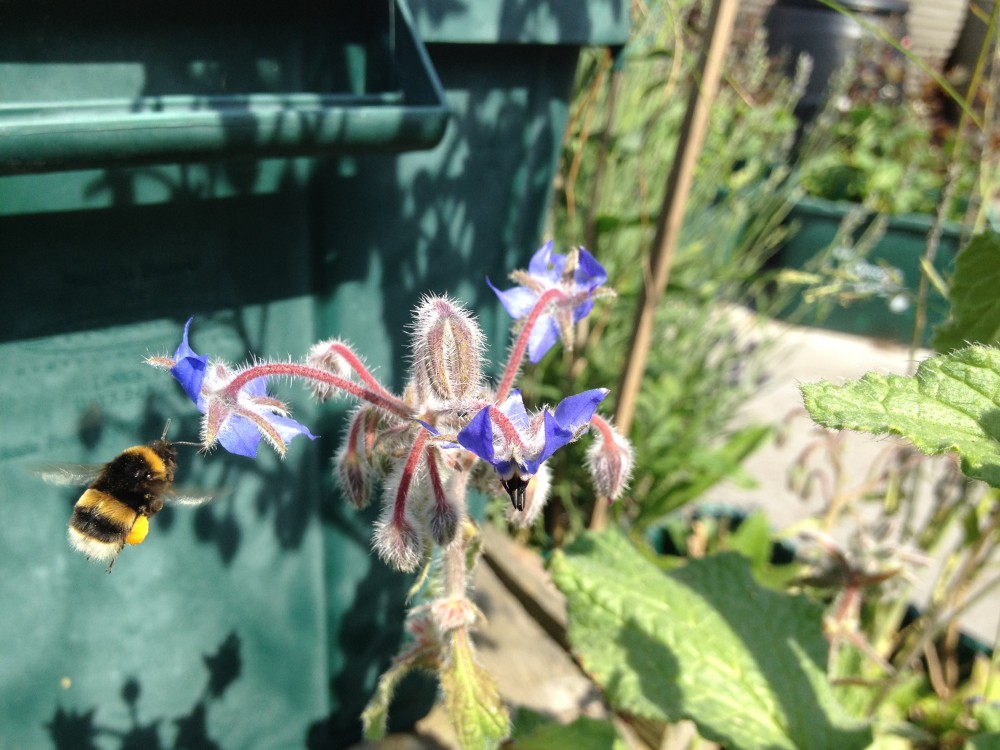
Bumble bee landing on borage

Bumble bee landing on borage

However, he did tell us plenty about research studies carried out by other scientists, and how pesticides work.

The LD-50 test

When the Department for Environment, Food and Rural Affairs (Defra) decides if a pesticide is safe for use, it uses the ‘LD-50’ benchmark. If a certain dose of pesticide kills 50% or above of the test subject, for example bee colonies, it is not approved for use; but at levels 49% or under dying the pesticide can be approved.

Side-effects

So Defra is only looking to see what percentage of bees in their test studies die, typically over a fairly short time period. But in real life, bees are not necessarily killed outright by exposure to neonicotinoids, but instead suffer olfactory memory side-effects such as difficulty learning and remembering fruitful food sources. This ‘olfactory memory’ issue has been shown in research carried out in  laboratory controlled conditions; now we need more research in the field to force governments to take it seriously.

Double trouble

So far, most pesticide research required by governments before they approve a pesticide for use is done as short, sharp acute exposure studies. In reality, out in our towns and country-side, colonies are foraging over long time periods and face combinations of pesticides used in conjunction with each other by different gardeners or farmers.

One pesticide might not cause acute problems, but what happens when bees pick up multiple doses from several places? When each forager returns to the hive she regurgitates some of her nectar to share with her sisters (trophallaxis), so what one bee receives many others quickly do too. Experiments using coloured nectar have found that within 24 hours of nectar being brought back by just ten foragers 50% of the colony had the nectar within their honey stomach.

Neonicotinoids and pyrethroids together

Rob proudly told us that Dr Richard Gill, Postdoctoral Research Assistant at the University of Holloway, has just had his paper ‘Combined pesticide exposure severely affects individual- and colony-level traits in bees‘ published in the king of journals, Nature. In conjunction with two colleagues, Richard studied how being exposed to the combination of two pesticides (neonicotinoid and pyrethroid) at concentrations that could approximate field-level doses affected Bombus terrestius bumbles.

Some of the bumble colonies in their study were fed sugar water with the two pesticides in, but no pollen, and fitted with tiny RFID tags to track their foraging activities. The pesticide dosed group came back with less pollen than the control group. The team also found that the pesticides increased worker mortality, leading to significant reductions in brood development and colony success.

Buff tailed bumblebee on elderflower

Buff tailed bumblebee on elderflower

Inspecting helps varroa reproduce?

There was a lot of lively discussion and questions from the audience afterwards. One man introduced himself as a “natural beekeeper and scientist” and then went on to suggest that inspecting hives causes varroa to reproduce more quickly. He reckons that varroa reproduce best at lower temps than the 34-35°C (93-94°F) temps the bees strive to keep their brood nest at – so by opening the hive, beekeepers cause the temperature to be lowered, helping the varroa out. I wanted to investigate his theory further, and found this information on scientificbeekeeping.com

“Avoid shade and keep colonies warm and dry. There are several reports of colonies faring better against mites when kept out in the open. Rosenkranz (1988) found that varroa prefer relatively cool temperatures of 75-88°F, well below the central brood nest temperature of 95°F. Harris, et al. (2003) state that “research by others has shown that high temperatures and extremes in relative humidity within the broodnest of a colony of bees will reduce the number of varroa mites that lay eggs.”

Hmm, our colony is in the shade, but not much we can do about that as the whole Ealing apiary is in the shade. Without trees the risk of vandalism would probably go up considerably. But is opening a hive up for a short time period really going to cool the bees down substantially? I am very skeptical about this. The advice from Beebase and our bee inspectors is to inspect regularly, and I don’t want to lose my bees to AFB/EFB or risk them swarming.

A gardening tip I heard at the meeting: use nemotode worms as an organic form of pest control. No slug pellets please!

Further reading:

Defra took a fresh look at the effects of neonicotinoid pesticides, following the publication of several new studies in 2012 suggesting that low doses of neonicotinoid insecticides can have sub-lethal effects on bees with consequences for bee populations.

They concluded that none of the studies gives unequivocal evidence that sub-lethal effects with serious implications for colonies are likely to arise from current uses of neonicotinoids. However, they have decided to update the process for assessing the risks of pesticides to bees in the light of recent research developments. The new process should include the development of a new risk assessment for bumble bees and solitary bees, alongside an updated risk assessment for honey bees.

Posted in Bee biology | Tagged , | 18 Comments

Friends of the Earth ‘Bees in Danger’ awareness meeting, 21st November 2012

Last night I went to a Friends of the Earth meeting in West Ealing about their ‘Bee Cause‘ campaign. (For anyone who isn’t familiar with them, FoE are an international charity working to protect the environment).

Bee Cause campaign

Quentin Given, the Ealing Campaign Coordinator, gave a very enthusiastic speech about the campaign and the reasons to support bees.

From Friends of the Earth’s point of view, bees are obviously an appealing cause for several reasons – they’ve been in the media a lot recently, are photogenic, tangible and valued or even revered by many cultures. They’re a good way to engage people.

The worrying figures in their FoE Bees Briefing Report include:

  • Two UK bumblebee species have become extinct
  • Managed honey bee colonies fell by 53% between 1985 and 2005 – John Chapple was very skeptical of this, as BBKA membership numbers have risen in the last few years. Also, there is no official national count of hives and many beekeepers remain ‘under the radar’ and don’t register their hives on Beebase. Would be interested to know where the FoE got their figures.
  • Wild honey bees are nearly extinct in many parts of the UK – this must be anecdotal?
  • Solitary bees gave declined in over half (52%) of the areas studied.

Although I’m a honey-bee beekeeper, my main concern is actually for the bumble and solitary bees, because they do not have beekeepers looking after them. Honey bees as a species are not under threat of extinction, whereas many other bee species are.

Friends of the Earth have already taken many positive steps as part of this campaign, including distributing 10,000 free packets of wildflowers. They are calling for a suspension in the use of neonicotinoid pesticides and a shift in farming practices. The government have drafted a national action plan to help bees, but in FoE’s opinion it merely states what the government is already doing, rather than putting forward any new proposals. The final draft is due out in December 2012.

Some rather wonderful launch events were arranged for the campaign:


Image from http://carolannsteinhoff.com.
  • Local FoE campaign groups had their own launch events, including the brilliantly named ‘Keep the buzz in Leighton Buzzard
  • Guided bee walks, honey tastings, film showings and skep making workshops have also been going on around the country.
  • FoE are working with fifteen community groups to set up bee-friendly public gardens, and hope to add more groups as the campaign goes on.

How can we help?

  • By increasing bee-friendly forage in our gardens. Think simple, open flowers with easy access to nectar and pollen.
  • FoE have an online Bee Cause Petition asking David Cameron to introduce an effective National Bee Action Plan.
  • Plantlife, the UK’s wild plant conservation charity, have a quick online survey on wildflower meadows which they need people to complete – ‘Save our Magnificent Meadows‘. I’ve done it and it really does only take five minutes or less.

My next blog post on the meeting will focus on the second talk at the meeting, given by Rob Mitton of Royal Holloway College about the effects of neonicotinoids on bees. And also some dubious claims made by a certain member of the audience!

Posted in Uncategorized | 23 Comments

Book review – Cooking with Honey, by Deborah de Long (2012)

I should say that I have met Deborah in real life, I love her blog (Romancing the Bee) and she has dedicated one of her recipes, Honey Lavender Gelato, to Emma and me, on account of one of our past queens being named Lavender. So I am a little biased; still this really is my favourite book of honey recipes I’ve found so far!

Despite being a beekeeper, and often busy making lots of cake for hungry beekeepers, until recently I hadn’t done much cooking with honey. This book looks very likely to change that. It has all sorts of dishes within – salads, main courses, cocktails, cakes, puddings… So far this week I’ve tried out two of Deborah’s recipes, photos below…

Kentucky honey jam cake

Kentucky honey jam cake

So this bouncy beauty is Kentucky honey jam cake – Deborah’s recipe here. I happened to have some home made blackberry jam my manager had given me in the fridge, and was intrigued by the idea of putting the jam in before cooking.

As you can see, my version is much more homely than Deborah’s!  I don’t think it matters as the cake tasted gorgeous. A subtle, warm spice flavour comes through, and every so often you get the nice surprise of a sweet raisin or date.

I used two layers rather than three as I don’t have three pans all the same size. I also didn’t have time to make the caramel icing, so just sandwiched the cake together with strawberry jam. I altered the method slightly too, mixing in the flour and eggs together a bit at a time to cut down the risk of the mixture curdling.

Leicestershire honey

Emma kindly bought me this amazingly creamy white Leicestershire honey at the London Honey Show. It almost looks like butter!

Leicestershire honey 2

Leicestershire honey: white and creamy

Also made this week: courgette fritters (zucchini if you’re American). Deborah’s website recipe does not contain honey, but the book version does. Very tasty, and the recipe made enough to last me and Drew as a side for two meals. I am into fritters and often make a sweetcorn & halloumi version for our annual Ealing Beekeepers Christmas party.

Zucchini (courgette ) fritters

British readers: bear in mind that the recipe ingredients are measured in cups. I happen to have a set of cups given to me as a present by a lovely American friend, but if you don’t, you’ll need to buy some or convert the amounts yourself.

Related posts by Deborah:

By the way, if you choose to buy this book or indeed any other items from Amazon, please consider going through the Bumblebee Conservation Trust’s Fundraising page. Each time you access Amazon.co.uk via their link and make a purchase this brilliant charity receives a donation worth 8% of your total purchase, at no extra cost to you.

Posted in Uncategorized | Tagged | 19 Comments

Bella Italia: visits to Italian bees and their keepers

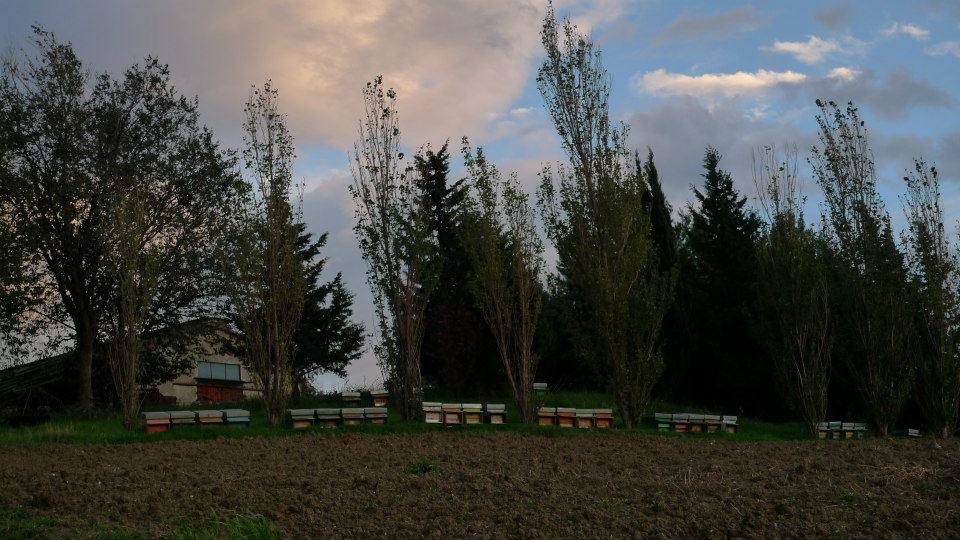
Last week I spent a few days in Italy, near the little village of San Constanzo, in the Italian region of Marche. Drew’s Scottish aunt Alison lives there with her Italian husband Pino, and they kindly let us stay in one of their spare rooms. If you’re interested in staying in a lovely part of Italy, near the sea and rolling countryside, this is their bed and breakfast website – Alison Scott.

Bull eating carrots

Bull eating carrots

Above is Alison feeding the local farmer’s bull carrots. He has two bulls, both surprisingly shy. They came up cautiously for the carrots, and let us stroke their big fuzzy heads. In about six months time the farmer will turn them into steaks, so they deserve their carrots.

I left a country where I had been shivering in a winter coat and scarf, and touched down in a place where summer seemed to still exist. A golden glowing globe was present in the sky, so much so that I could walk around without a coat on!! Below are some photos of the lucky warm Italian bees and their keepers, taken by me and Drew.

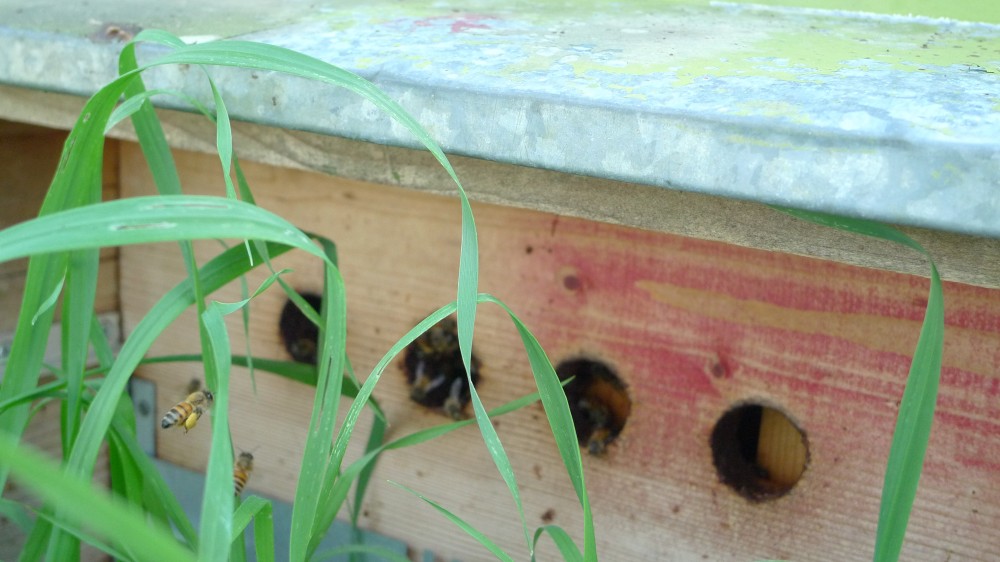
Italian bees flying home

Bees on the farm zooming home. Although this location must be very productive, since about thirty hives are located there, the grass was very long around the hive entrances and I felt the hives could do with being on higher stands.

Long distance Italian beehives

Pastel colours on the skyline.

I like the bee on the left arriving home with an impressive load of pollen. The hive must be quite hard to defend with all these holes? Each hive also had a small entrance hole at the back, which I noticed a few wasps nosing around. Wonder if the beekeeper will put mouse guards on.

Borage and moth

Borage and moth

In Italy, borage was still out. I saw some pretty brown carder bees and lots of these moths visiting it.

The bee highlight of the trip, however, was visiting Alison’s friend Domenico. He is a skilled farmer and beekeeper (and also a complete flirt!). When Alison told him about me taking exams, he modestly insisted that I could teach him a thing or two, and that he was embarrassed to show me his hives. I have been keeping bees four years; Domenico has been keeping them since he was 15 and is now 83. When I replied that on the contrary, he would be the one who could teach me, I wasn’t being modest!

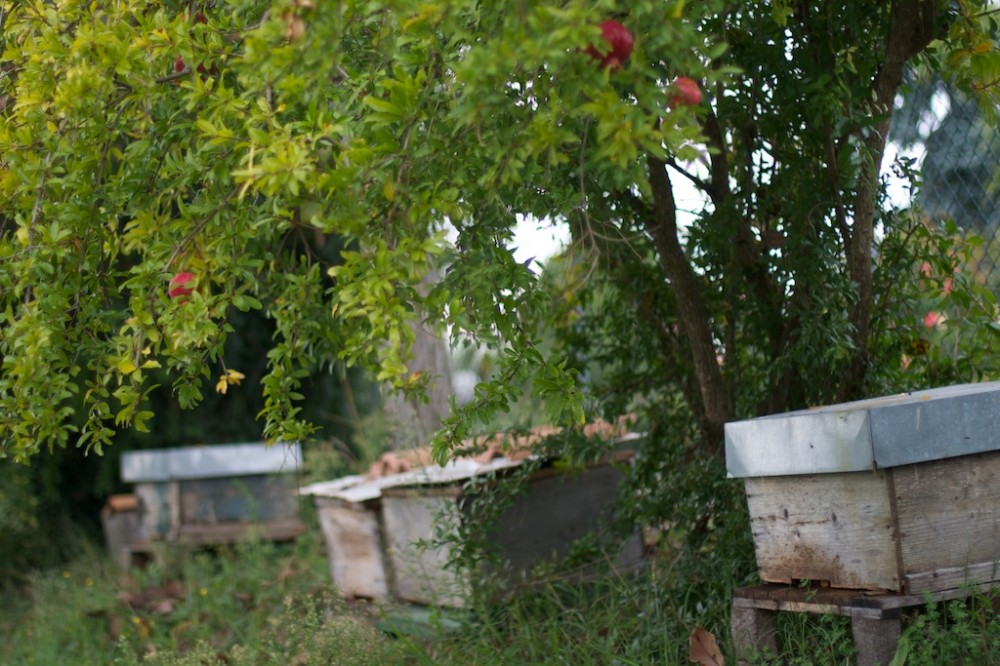
Domenico’s hives, shaded by pomegranate trees. Copyright Drew Scott.

Above are some of his hives, under pretty pomegranate trees. In the summer these must provide welcome shade for the bees. As well as honey production, Domenico grows grapes, pomegranates, olives, apples and pears. Additionally he keeps chickens and bulls. All this activity certainly seems to keep him fit and young looking. Alison told me she regularly sees him shimmy up trees to pick fruit.

Below, Domenico is opening up one of his hives in a fetching yellow suit.

Domenico at work

Domenico at work. Copyright Drew Scott.

I look on, while he talks away in Italian (I can’t speak any, and our translator Alison had momentarily gone away). A few bees instantly flew out and landed on my fleece, trying to crawl up inside my arm. Domenico shook them off and I kept my hands in my pockets after that. This was towards the end of our week, when the weather had taken a turn towards chilliness, so perhaps that had made them a bit moody.

Domenico showing me his hive

Copyright Drew Scott.

February 2012 was unusually cold and snowy in the Marche area, so many beekeepers lost their hives. Domenico asked me how I insulate mine, so I explained about using polystyrene in the top. Of course varroa is also a problem, so he uses Apilife Var strips, which are based on essential oils including thymol.

Domenico's honey

Domenico’s honey. Copyright Drew Scott.

Above is Alison holding a very heavy frame of honey. Domenico usually gets three to six supers per hive. I didn’t know how to explain that I’m lucky to get one! Normally the honey crop is over by August, but this year the acacia flowered late and produced a big late crop. Amazingly, the six hives he currently has were split from one swarm in September 2011. Beekeeping really is a different game over there.

Domenico, Alison and me

Domenico, Alison and me. Copyright Drew Scott.

I’m wearing a head scarf because I wasn’t sure if Domenico would have a spare veil for me to wear, and bees have a tendency to get stuck in my hair. By the way, he has a very strong grip! And check out the size of his hand compared to Alison’s in the bottom right corner. Big hands to grab bulls with.

Domenico

Domenico. Copyright Drew Scott.

He has a brilliant face, so full of character. Thanks for showing me your hives, Domenico!

The view from Alison's garden

The view from Alison’s garden

Double rainbow

After rain, a double rainbow shimmered above the fields.

Alison and Oslo

Alison and her affectionate tabby, Oslo. Copyright Drew Scott.

Drew at the seaside

Lastly and best of all, my gorgeous fiance at the seaside. His camera is never far from his side.

Posted in Uncategorized | Tagged | 33 Comments

3rd Honey bee pests, diseases and poisoning revision post: the lifecycle of Varroa destructor and monitoring & treatment techniques

B3 a) describe the life cycle and natural history of Varroa destructor & b) how does it develop within the colony? 

Varroa is the number one killer of colonies in the UK, so it’s really worth studying. Whereas European/American foul broods are dreaded but fairly rare diseases, unless you live in Australia or a remote island, varroa mites will be in your hive – whether you notice them or not.

Varroa destructor was originally a parasite of the Asian honey bee, Apis cerana. Through the movements of humans it has spread in recent decades to the Western honey bee, Apis mellifera, which unlike Apis cerana has not yet evolved any natural defences against it.

A female varroa mite – © Crown copyright 2010 “Courtesy The Food and Environment Research Agency (Fera), Crown Copyright”

The life cycle of varroa mites has two stages: a reproductive stage inside sealed brood cells and a phoretic stage as a parasite on adult bees.

An egg-carrying female mite will enter an uncapped cell with a larva inside and bury herself under the larval food, where the bees (and beekeepers) can’t detect her whilst inspecting. She uses specialised tubes to breathe during this time. A smell is given off by larva ready to be capped; female mites sense this earlier than adult bees and receive a cue to enter cells just before they are ready for capping (mites enter day 8 after the egg is laid, while worker & drone cells are capped on day 9).

Immature mites on pupa

Immature mites on pupa. Courtesy The Food and Environment Research Agency (Fera), Crown Copyright

About four hours after the cell is capped, the female mite will emerge from under the larval food and begin feeding on the developing honey bee larva, creating a lesion which her offspring can feed from as they develop. She then lays a series of eggs – first a male egg, then 4-5 female eggs, laid at regular 30-hour intervals. It takes about 6-7 days for a female egg to reach adulthood. The young mites hatch and mate with each other within the cell, obtaining energy to do so by feeding on the developing honey bee larvae. You’ll be pleased to find out that mites mate on their own faeces, which give off a pheromone smell enabling them to find each other in the dark of the cell.

The male mites cannot survive outside the cell, and they die after copulation since their mouthparts are modified for sperm transfer rather than feeding. Therefore the females must be fertilised before the bee emerges from the cell. The success rate of producing new mature fertilised female mites is about 1.7 to 2 in worker brood, but increases to 2-3 in drone brood as drones take 3 days longer to develop.

Once the honeybee larvae emerges, the young female mites crawl out too and spend some time feeding phoretically on the backs of adult honeybees, before they can carry out the cycle again by hiding within an uncapped cell. During the summer female mites live for about 2-3 months, during which time, if brood is available, they can complete 3-4 breeding cycles.

The mites’ flat shape allows them to squeeze between overlapping segments of a bee’s abdomen to feed and helps them avoid removal by grooming bees. It used to be thought that the mites feed on the bees’ haemolymph (blood) but in 2019 new research showed that they are actually feeding on their nutrient-rich fat body (see . The feeding creates a potential entry point for colonies of microbes.

Varroa damage

Varroa damage: normal bee on left, bee carrying several phoretic mites in the centre, deformed bee on the right. Courtesy The Food and Environment Research Agency (Fera), Crown Copyright

c) How is it spread to other colonies?

  • Foragers carrying mites drifting into, or robbing from, other colonies
  • Drones carrying mites visiting other colonies
  • The beekeeper moving brood frames between hives or transporting infected colonies to new areas
  • Varroa mites have been found on flower-feeding insects such as certain species of bumble-bees, scarab beetles and flower-flies. Although the Varroa mite cannot reproduce on these insects, its presence on them may be a means by which it spreads short distances and finds new honey bee hosts.

B4. a) describe the various methods which beekeepers can use to detect the presence of the Varroa mite (and pyrethroid resistant Varroa) in their colonies and monitor the degree of infestation. 

Looking out for deformed wings and adult bees carrying mites, and waiting to treat until you see these signs, is not enough. Colony collapse due to a severe varroa infestation can take only a few weeks, and may affect even strong colonies, so do not assume that levels will remain low because so far no mites have been spotted.

Testing for pyrethroid resistance

Varroa in some areas (most places in the UK) have developed resistance to pyrethroids, which are the active ingredients of the widely used varroacides Apistan and Bayvarol. The presence of such mites can be identified by resistance testing, but the first obvious sign is likely to be the collapse of colonies after pyrethroid treatment fails to control mite infestation.

It is quite straightforward to test for pyrethroid resistance. A sample of live bees should be removed and put in a jar with a strip of Apistan fixed in the lid and mesh at the bottom. The jar is left in the dark for some hours over a piece of card and then the number of mites that have fallen through the mesh are counted – this represents the susceptible population of mites. The bees in the jar are then killed by shaking vigorously in soapy water and the washings filtered through a strainer. Any more mites coming off in the rinsing water are the resistant ones. A percentage resistance can then be calculated, e.g. if 6o fall down initially and another 40 subsequently, the population is 40% resistant. (Info from my correspondence course tutor, Pam Hunter).

In a severe infestation, there will be a poor brood pattern, and some larvae will die, while many of those that survive will have stunted growth and deformed wings.

Below are a couple of monitoring methods beekeepers can use to help monitor how bad infestation is.

  • Drone trapping

Varroa mites prefer to breed in drone brood. Drones take 24 days to develop whereas workers take 21, so drones give the mites time to fit in more breeding cycles. The mites identify the drone brood by its different smell, which is a result of the more protein rich diet fed to drones.

In England drone trapping can be used as a method of varroa monitoring and/or control during April, May and possibly June. To do this put a drawn super frame into the brood box, to encourage them to build drone comb in the gap underneath, or a frame with drone foundation or drawn drone comb, depending on the size and strength of the colony. Put the super frame at the side of the brood nest, not the middle.

Once the drone comb is sealed, cut it off the super frame. You can do this 2-3 times during the summer. Before you destroy the drone brood you can uncap some to see how many mites are inside.

Uncapping drone brood to check for varroa. Courtesy The Food and Environment Research Agency (Fera), Crown Copyright

Put your uncapping fork in deep, right into the neck of the drones. Fork out a hundred drones and count how many larvae have mites to get an idea of mite numbers in the hive: 5% infestation is light; between 5-10% light control techniques like drone trapping can be used; at over 25% infestation is severe and high-efficiency methods like Apiguard will be needed. Note that younger varroa mites are pale coloured and the mites move rapidly away from the light, so rotate the uncapping fork to ensure that you see all mites present.

  • Varroa board monitoring

Draw a grid with several squares on your monitoring board and smear it with vaseline, then put it under your open mesh floor for a week. The grid pattern makes it easier to count mites and the vaseline ensures the mites stick to the vaseline and aren’t blown off when you inspect the board. A week later, count the number of mites and work out an average daily drop count. If there is a lot of debris which makes it hard to count mite numbers, put the debris in a jar with a lid before mixing with methylated spirits and shaking vigorously: once the debris settles, the wax, propolis and other debris will sink, the mites will float.

To assess how bad the problem is based on the daily drop count, the season and the type of hive must be taken into account – UK colony collapse thresholds would be a daily drop of 6 in May, 10 in June, 16 in July and 20 in August. The Beebase varroa calculator is a helpful tool which can tell you how bad the problem is based on the time of year.

Varroa damaged brood

Varroa damaged brood. Courtesy The Food and Environment Research Agency (Fera), Crown Copyright.

b) give a detailed account of Integrated Pest Management

An integrated pest management strategy should be used throughout the year – this means using monitoring mite levels at regular intervals and using a variety of control techniques. Using several different control methods during the year makes it harder for the mite population to reach harmful levels. Good husbandry techniques, such as regular brood inspections, laying out apiaries to minimise the effects of drifting, and making sure your feeding techniques do not encourage robbing, are a starting point to help ensure healthy bees.

c) what treatments for Varroosis is permitted in the UK. Give a detailed account of how to carry out four forms of treatment.

  • Shook-swarm

I have a blog post explaining how a shook-swarm works, ‘A successful shook swarming‘. Ideally this is carried out in early spring, in late March – early April. The bees are shaken onto new foundation frames and all the old brood comb, containing lots of mites taking advantage of the new spring brood to breed, is burned. Sugar syrup is fed so the workers can draw out new comb quickly. This is a helpful non-chemical anti-varroa treatment because a large percentage of the mites are destroyed, followed by a short break in the queen laying while new comb is drawn out, which further cuts down on mite reproductive cycles.

  • Icing sugar

The advantages of this method are that it’s cheap and easy to do. It can also be done with supers on, unlike thymol based treatments like Apiguard which might taint the honey with their smell. The icing sugar works by inducing the bees to groom. A flour dredger or a honey jar with holes punched in a lid work well. Work in pairs to do the treatment, with one person holding out each frame horizontally and another person dusting the sugar over each side.

As the treatment doesn’t kill mites, but only knocks them off, it is only any good in a hive with an open-mesh rather than a solid floor. Since it only affects phoretic mites clinging onto adult bees, which only make up about 30-40% of the mite population, it is a low efficiency treatment and generally only reduces mites by about 20-30%. This may sound good, and is better than nothing, but really an 80% effective treatment (such as Apiguard or oxalic at the appropriate times of the year) is needed to have any real effect on mite numbers.

It’s best not to rely on sugar dusting alone to keep varroa levels down. This is true generally of varroa control: you cannot rely on one treatment alone, but should use several different methods throughout the year. Randy Oliver has done some practical experiments for his Scientific Beekeeping blog and found that “Sugar dusting can be quite effective for reducing the mite population in broodless (or nearly broodless) bees”, but in colonies rearing brood, weekly dusting “did not make mite populations plummet” – ‘Powered sugar dusting – sweet and safe, but does it really work?‘ Part 1, 2017

Apiguard, a natural thymol based treatment, can be given in August once your supers have been removed (otherwise your honey will stink of thyme). Starting Apiguard in August allows the hive to produce several generations of healthy bees before going into the winter. Two 50g treatment packs are given, one initially and the second 10-15 days later. Small colonies or nucleuses can be given a half dose.

Apiguard

The treatment works because the worker bees dislike the heavy thymol scent. They start removing the gel to clean the hive and remove the foreign smell, distributing it round the colony and killing off varroa mites in the process. Both adult mites and developing mites inside capped cells are affected, but honey bee larvae are safe. Tape up your varroa monitoring board whilst treating so the fumes stay in the hive. Apiguard should be done while the weather is still warm, as it is most effective – 90-95% effective – in the optimum conditions of an external ambient temperature of more than  15°C and active bees. This is because distribution of the Apiguard gel depends on the bees transporting it round the hive during the process of hive cleaning, and this activity increases as the external temperature rises.

  • Oxalic acid 

If you do an oxalic acid trickle, the treatment can be carried out once either in December or January whilst brood levels are either non-existent or low. This will ensure the varroa mites have nowhere to hide; it also avoids damaging brood, as trickling can harm uncapped brood. We don’t know for sure how oxalic acid works, but one theory is that it damages the proboscis of the varroa mites, preventing them from feeding from the host bees.

Choose a bright and warm winter’s day when the bees are loosely clustered, so that as they move inside the cluster they distribute the chemical onto the mites. Put a varroa monitoring board over the mesh-floor, as it feels good to count the number of dead mites dropped onto it over the next few days; sometimes I’ve counted over a hundred in a week. Warm the product slightly until it’s lukewarm, remove the hive roof and crown-board, and trickle 5ml over each seam of bees. Do this very quickly to avoid chilling the bees too much. If the colony has been treated before and still has the same queen, it is unwise to use it again as it may harm the queen.
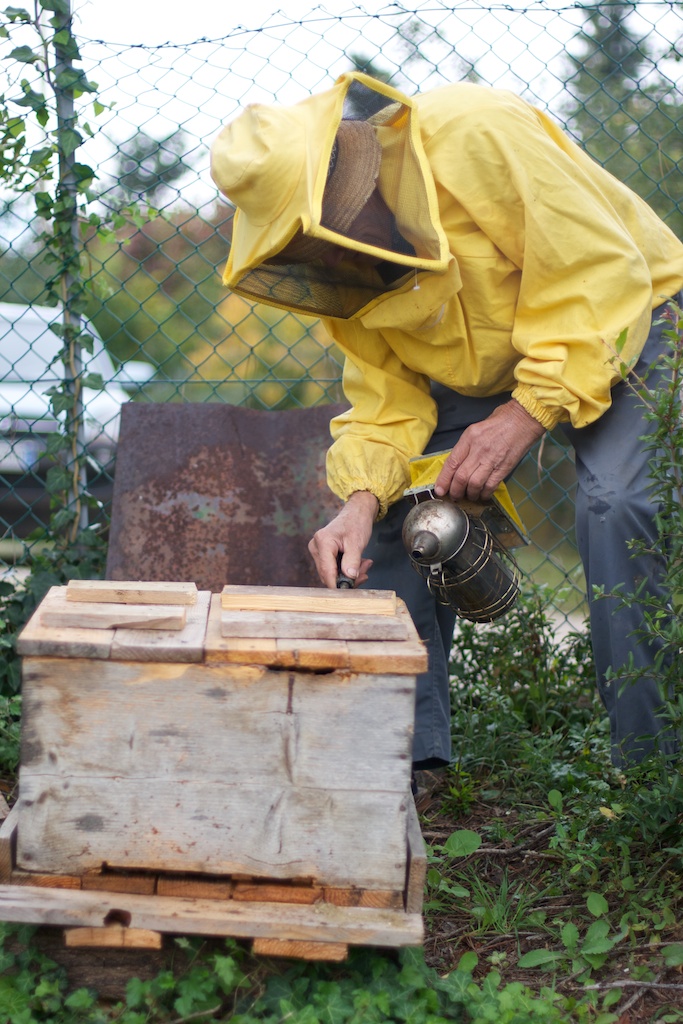
Another way of treating with oxalic acid is sublimation (vaporising), which can be carried out more than once annually as it is less harsh on the bees. Unlike trickling, it’s also not toxic to unsealed brood, so can be done at times of the year when brood is present.

The Apiarist blog, written by Scottish beekeeper David Evans, has an excellent, very detailed post on how to do oxalic acid trickling and the pros and cons of trickling vs sublimation: Trick(le) and treat.

Printer-friendly pdf version.

Is varroa your most feared bee pest? What treatments do you use?

References:

Posted in Bee behaviour, Uncategorized | Tagged , | 33 Comments

2nd Honey bee pests, diseases and poisoning revision post: Diagnosis and treatment of AFB & EFB

A 2nd revision post for the British Beekeeping Association’s Module 3 Honey bee Pests, Diseases and Poisoning exam, which I plan to take in March. This year I’m doing the correspondence course, so I have a tutor who will set me papers and give me comments on my answers. Continuing my attempt at the first paper set.

B1. a) draw up a table of the similarities and differences in the signs of EFB and AFB

Similarities

  • Brood pattern in both diseases scattered and irregular
  • EFB larvae sometimes make it through to the sealed brood stage before dying, in which case as with AFB there may be greasy, perforated sunken cappings
  • Some strains of AFB bacteria kill uncapped larvae and form scales
  • A very unpleasant odour may sometimes accompany both diseases, depending on the presence of certain other species of bacteria in the remains of dead larvae

Differences

  • Although both diseases can form scales, AFB scales are difficult to remove and EFB easy. AFB scales will always be in the lower walls of cells, whereas the EFB scales can be anywhere in the cell
  • Only AFB will produce a brown, mucus-like thread or ‘rope’ 10-30mm long when a matchstick is inserted into an infected cell and pulled out – the ‘ropiness test’
  • Lightly diseased EFB colonies can be treated with antibiotics or shook-swarm, whereas colonies with confirmed AFB present must always be destroyed

b) how is a hive of bees infected with AFB or severe EFB dealt with by a Bee Diseases Inspector

The colonies will be destroyed by the inspector. The entrances will be reduced as soon as disease is confirmed. The bees are killed, and then burned together with the combs in a deep pit. The hive boxes can be sterilised by thoroughly scorching with a blow torch. This is done automatically in the case of AFB diagnosis, and in the case of EFB will be carried out if the colony is too small for other treatment methods or is too heavily infected to respond to treatment.

c) if the colony has only a mild EFB infection how will it be treated

In the case of mild EFB infection two treatments are possible – the shook-swarm husbandry technique, or treating with the antibiotic oxytetracycline (OTC, as the formulation Terramycin®)

Shook-swarm

I have a blog post explaining how a shook-swarm works, ‘A successful shook swarming‘. Basically your bees are shaken onto new foundation frames and all the old brood comb burned. They’re fed sugar syrup so they can draw out new comb quickly. The old EFB bacteria are destroyed this way and it’s also a helpful non-chemical anti-varroa treatment because of the short break in the queen laying.

Antibiotic treatment with oxytetracycline (OTC)

In my previous revision post I briefly covered some of the pitfalls of using antibiotic treatment for AFB & EFB (particularly if you begin using it as a preventative measure).

The National Bee Unit’s own data from trials shows that the shook swarm technique is more successful than OTC for the control of EFB in England and Wales. From the Beebase EFB page info:

“In the Spring following treatment, shaken colonies were three times less likely to test positive for M. plutonius. This finding appears logical since OTC treatment does not remove the etiological agent present in the hive. In contrast, the Shook swarm method provides the bees with M. plutonius-free material. In addition, OTC treated colonies were five times more likely to show recurrence of EFB the following year than Shook swarm treated colonies.  A full copy of the project report is also available.”

If you had bed bugs, you wouldn’t just treat yourself against the little buggers, you’d treat your sheets too. Comb is the bees’ home, where they eat, sleep and produce young – they thrive on fresh new comb, just as it’s a healthy pleasure for us to slip into clean sheets at night.

Based on the data, my preference would be to use the shook-swarm technique rather than OTC antibiotics. In the field, your inspector will advise you on the best course of action based on the level of infection and time of year. In the unlikely event that you discovered in the depths of winter that EFB was present, January would not be a practical time to do a shook-swarm.

d) explain the life cycle of AFB and EFB and how they develop within the larvae and within the colony

EFB:

A (e)arly brood disease caused by the bacterium Melissococcus plutonius. It enters young larva through contaminated brood food and multiplies rapidly within the gut of the larva, competing with it for food. If a nectar flow is on and enough nurse bees are present to ensure a larvae is well-fed, a larva infected with EFB bacteria can survive – otherwise it is likely to die of starvation.

Unfortunately, some of the EFB infected larvae surviving to the sealed stage actually helps spread the disease. This is because when the cell is sealed the larva voids its gut prior to pupation, and does not fully cover the faeces with its cocoon. After it hatches out,  the nurse bees cleaning the cell will pick up Melissococcus plutonius bacteria and pass them on to the next larvae they feed. Whereas when unsealed infected larvae die and are removed by the bees, the bacteria inside them are enclosed in a double layer within the gut and the outer exoskeleton.

Severe EFB infection

Severe EFB infection. Courtesy The Food and Environment Research Agency (Fera), Crown Copyright

AFB:

An (a)fter capping, late brood disease caused by the spore-forming bacterium Paenibacillus larvae. First, young larvae less than 2.5 days old become infected by Paenibacillus spores present in their food – older larvae are not susceptible. The spores germinate into a rod-shaped bacterial cell vegetative stage soon after they enter the larval gut and continue to multiply until the developing larvae dies.

Death typically occurs after the cell has been capped, usually during the last two days of the larval stage or the first two days of the pupal stage. The dead larvae gradually dry up until forming dark brittle scales within a month or so. Each scale contains as many as 100 million infectious AFB spores and is very difficult for either bees or beekeepers to remove from the cell – meaning that it can infect further young larvae. These spores can remain viable for decades in combs and honey.

AFB scales

AFB scales. Courtesy The Food and Environment Research Agency (Fera), Crown Copyright

e) give a detailed account of the ways they are spread from one colony to another

  • Robbing – never leave comb or honey outside for the bees to clean up, as this encourages robbing
  • Drifting – arrange your colonies in a way that discourages drifting. I have a Module 1 revision post which suggests some techniques for this.
  • The beekeeper moving brood comb between colonies – always check for signs of brood disease first.
  • Using old comb for several years. Preferably all brood comb should be changed annually using a shook-swarm or Bailey comb exchange technique and the old comb burned.
  • Leaving dirty wax or comb around in the apiary.
  • Buying in old equipment – never buy old combs and sterilise any second hand hives by scorching them with a blow torch before use.
  • Bringing in unknown bees into an apiary, for instance a captured swarm or bees from another beekeeper. Quarantine new colonies for a few weeks first to make sure they are disease free before moving them into the apiary.
  • Dead hives can be a source of infection. If you find a dead colony of bees, seal the hive to prevent the remaining stores being robbed out, before examining the brood combs for signs of disease. Burn up the old comb after examination.

You can find more tips on good hygiene and comb replacement techniques in my Module 1 ‘Good apiary hygiene‘ revision post.

Inspect brood comb regularly for brood disease. Courtesy The Food and Environment Research Agency (Fera), Crown Copyright.

f) give a detailed account of the use of lateral flow devices to diagnose foulbrood.

Information from FERA ‘Foul brood diseases of honey bees’ leaflet: “The routine diagnostic method used by the NBU to confirm the presence of foul brood is a field kit called a lateral flow device (or LFD). The term lateral flow refers to the suspect larval material flowing horizontally across the kit membrane into which specific antibodies have been incorporated. The kits were specifically developed to confirm foul brood and work on the same principles as a human pregnancy test. There are two kits in use and each is specific for the foul brood disease in question.”

The principle of the LFD relies upon the capture of target bacterium between an antibody test line. Two blue lines will be displayed in the case of positive detection and a single line for a negative result.

One larvae at a time should be shaken for twenty seconds in the testing fluid, which contains a number of ball bearings to make sure the larvae is broken up, then a pipette is used to extract some of the liquid and place a couple of drops on the yellow testing device. After approximately three minutes, either one or two blue lines appear. One line is the control which should appear quite quickly, if it does not, the kit is defective.

Printer-friendly pdf version

Believe it or not this is only two thirds of the first paper completed!

References:

Posted in Disease prevention, Exams | Tagged , , , | 19 Comments