6th Honey bee Management revision post: the year’s work in the apiary (July to December)

Continued from my 5th revision post for the British Beekeeping Association’s Module 1 exam, which covered apiary work from January to June. Timings based on the Greater London area.

“The Candidate shall be able to give a detailed account of:-

the year’s work in the apiary and how this is dependent upon the annual colony cycle and the timing of local bee forage;”

July

July is often the driest, hottest and sunniest month of the year here (during 2010 averaging a low of 13.6°C/56.5°F to a high of 22°C/73°F in London), so it feels like the height of summer to us humans. Yet the summer solstice has passed. The workers observe the days getting shorter and reduce the Queen’s food slightly so that she begins laying fewer eggs.

The varroa population in the hive is likely to have been doubling every three to four weeks during the spring and summer. As the amount of brood is reduced in July, this means that a high number of female varroa mites will be trying to enter a smaller number of brood cells in order to reproduce. By July the queen will also be producing few or no drones, so multiple mites will be entering worker cells, causing damage to the developing workers. Your supers will still be on, so it’s too early for Apiguard treatment. If you have an open mesh floor hive, what you can do instead is an icing sugar shake. This should be seen as a complimentary technique to other forms of anti-varroa control; it is not as effective at killing mites as Apiguard or oxalic acid but is a suitable technique to use in July.

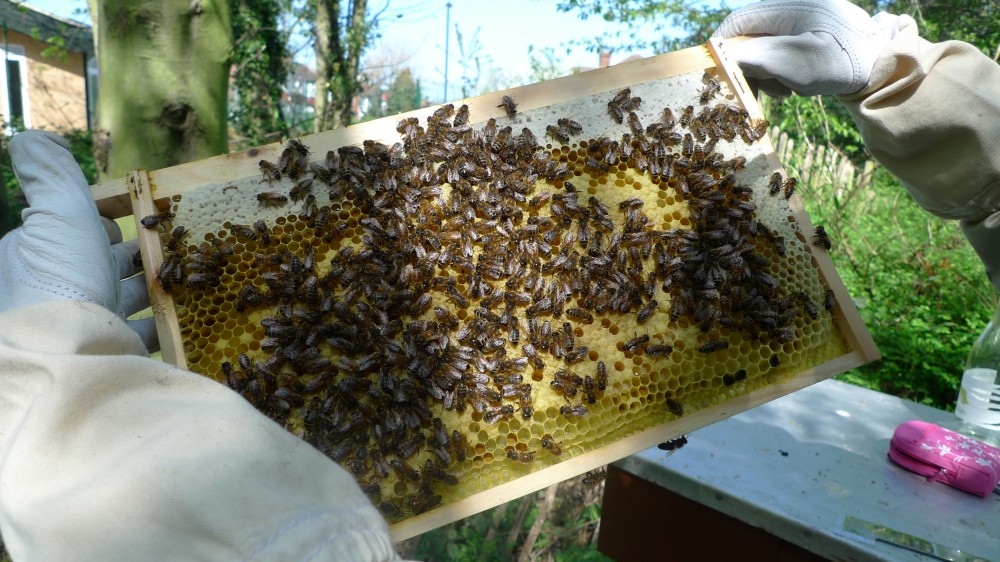
Icing sugar treatment is easiest done in pairs. Get someone to hold each frame out horizontally for you and then sprinkle over icing sugar using a fine mesh shaker. This encourages the workers to groom each other, removing mites in the process. They will fall through the open mesh floor and be unable to climb up again. Put your varroa monitoring board underneath – with vaseline smeared on – before starting the treatment and check afterwards to see how many have fallen down. Just sprinkling over the tops of frames without pulling each one out is not effective enough, that way the sugar just falls down the gaps between the frames.

If the weather is good, the bees are usually still pinging in and out of the hive entrance frantically bringing lots of pollen and nectar in. On hot days they may also come back with water, which can be hung in the cells and evaporated through fanning to try and cool the hive down. The adult bee population is now at its height, with the foraging bees being those developed from eggs laid in the last fortnight of April and first fortnight of May.

You should be aiming to get your honey off by the end of July, when the main nectar flow will be over. Towards the end of the nectar flow, you can try swopping super frames around in the hive so that capped frames are in the upper supers and uncapped frames are nearer the brood. The heat of the brood nest makes it easier for the bees to reduce the nectar’s water content to the correct level (around 18-20%) and draw wax, so that they can cap the frames more quickly. In the Ealing apiary hives often only have one super, but you can still help the bees by moving the capped frames to the outside and putting the uncapped frames in the warmer middle positions.

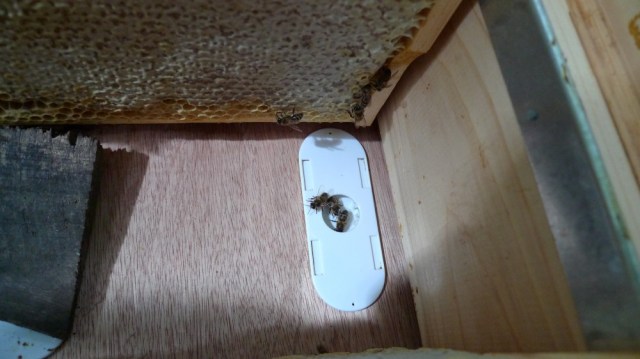
At extraction time a Porter bee escape can be put on the super, which allows the bees to go down but not up. Make sure there are no holes which might allow wasps to get in while the super is undefended.
Some things for the beekeeper to do:

  • Maintain regular brood nest checks for queen cells and colony health
  • Monitor for varroa
  • Icing sugar shake for varroa control
  • Add an extra super at the beginning of July if necessary
  • Harvest the honey supers at the end of the month
  • Keep an eye out for wasps, which can become a serious problem. Traps by the hive can help reduce their numbers. Dr Beekeeper has a good post with some tips for keeping wasps out of hives and making a trap from a plastic milk bottle: ‘The battle of wasps attacking bees: here’s how my bees are winning‘.
  • Also pay careful attention to anything hornet-like. European hornets are fine but the Asian hornet, Vespa vellutina, which can wipe out entire hives, is present in northern France and could easily cross over to the UK. If you suspect you have seen one tell your local bee inspector, try to get photos, or even better catch one, freeze and send to the National Bee Unit for identification.
Super frames (mostly) cleared of bees, ready for extraction


August

Once the main nectar flow stops the bees can become moody, so try to limit your inspections as much as possible now. When you harvested you may have found some frames which contained uncapped honey, which would ferment if extracted due to its high water content. Honey containing over 20% water also breaches UK Honey Regulations, so you would not be able to sell it.

What you can do with the uncapped honey (and also with honey remains in wet frames you have put through an extractor) is feed it back to the bees. To get them to store it in the brood nest ready for overwintering, you can place an empty brood box above the crownboard, then place a super containing the uncapped frames on top of that, with the roof on top. Put a few slashes through the frames with a hive tool to help make the honey easy for the bees to get at. The extra empty space above the brood nest, and the resultant loss of pheromone smell above, will make the bees think of the super frames as not part of their hive, so that they go up and rob them. Some bee keepers feed back to the bees by placing frames in the middle of the apiary; this is not a good idea as feeding bees honey from other hives can spread disease and encourage robbing mayhem by bees and wasps alike.

Apiguard, a natural thymol based treatment, can be given in August once your supers have been removed (otherwise your honey will stink of thyme). The treatment works because the worker bees dislike the thymol stink. They start removing the gel to clean the hive and remove the foreign smell, distributing it round the colony and killing off varroa mites in the process. Starting Apiguard in August allows the hive to produce several generations of healthy bees before going into the winter.

Tape up your varroa monitoring board whilst treating so the fumes stay in the hive. Apiguard should be done while the weather is still warm, as it is most effective – 90-95% effective – in the optimum conditions of an external ambient temperature of more than  15°C and active bees. This is because distribution of the Apiguard gel depends on the bees transporting it round the hive during the process of hive cleaning, and this activity increases as the external temperature rises. So don’t wait till late Autumn to do Apiguard. Also do not be tempted to treat using your own home made thyme concoctions, which do not regulate the release of thymol in the way Apiguard gel does, and can overwhelm bees, causing them to abscond.

Apiguard time

There is still plenty of late summer forage available for the bees – rosebay willow herb, ragwort, clover, thistle, lavender.

Some things for the beekeeper to do:

  • Feed back wet super frames to the bees in the way described above.
  • Once the bees have cleaned up the frames, store and protect from attack by wax moth.
  • Ensure the hives have enough stores to survive in the brood box after extracting. If not, feed sugar syrup.
  • Apiguard treatment for varroa.
  • Unite any weak colonies with other colonies, so that they can survive the winter. Check that these weak colonies do not look diseased first.
  • Put your entrance reducer in, as the main nectar flow is over for the bees and wasps may now start to become a problem.
Honeybee on a member of the thistle family.
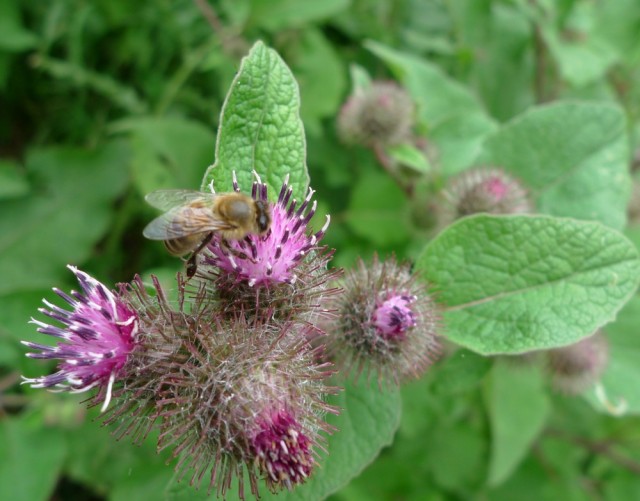
Honey bee on thistle

September

The last sweat of summer. I have noticed a trend in recent years for what feels like lacklustre wet and cloudy Augusts followed by sunny, warm Septembers. In 2010 September averaged a low of 10.9°C/51.6°F to a high of 19.3°C/66.7°F in London.

September is the month to begin preparing bees for the winter ahead. At this time of year the colony begins producing bees that will overwinter until the following spring. These winter bees are physiologically different to summer bees. They develop fat bodies which are reservoirs of protein in their abdomen. These fat bodies allow the bees to produce brood food in their hypopharyngeal glands in the late winter and early spring at times when it is too cold to forage or even for the bees to move away from the cluster to reach pollen stores in other parts in the hive. To ensure that these winter bees have well developed fat bodies, make sure the colony is well provisioned with food to last well into the following spring. If bees suffer from poor pollen supplies, they age more quickly and will die sooner.

In our last feed of the year, Ealing association beekeepers treat against nosema using Fumadil B. Nosema is a parasite that multiples in the gut of adult bees; it has no obvious symptoms but its main effect is to shorten an infected bee’s life by about 50%, so dwindling colonies which are slow to build up may be suffering from it. Nosema spores can withstand temperature extremes and persist on contaminated comb, another good reason to change brood comb each year. Fumadil B is a naturally occurring antibiotic which is dissolved into sugar syrup and fed to the colony. You can use a microscope to test a sample of your bees for nosema first to see whether you need to treat or not.

Some things for the beekeeper to do:

  • Carry out supplementary feeding to help the bees build up their winter stores. The bees will need at least 20kg/40lb of stored honey in the hive (just over one British national super’s worth) to survive the winter, especially if there is a wet spring.
  • Feed sugar syrup in the evening in a large feeder, using the stronger 2:1 sugar-to-water ratio, not the weaker 1:1 mix used in spring. The sugar must be white granulated sugar, never brown which upsets the bees’ digestive systems.
  • Remove the queen excluder, clean and store it ready for the next season.
  • Remove empty Apiguard trays.
  • Treat with Fumadil B in the last sugar syrup feed in late September.
  • Many beekeepers have problems with wasp robbing at this time of year, so it may be worth setting wasp traps by the hive.
September is drone kicking out time, when any unmated drones are forcibly removed from the hives by their worker sisters and left to starve. The little fellas below, photographed in September 2011, will be long gone by now.

October

Hopefully colonies will be well on their way to being prepared for the winter following autumn feeding, Apiguard and Fumadil B treatment to help get the winter bees as healthy as possible. Colonies should now have the required 20kg/40lb of honey stores. The weather will soon be getting too cool for the bees to process sugar syrup into stores; check if syrup in feeders is being consumed and remove it if not. If the syrup is not being eaten remove it, otherwise it will ferment and go mouldy in the feeder. Consider making a hole through the middle of your frames so the winter cluster can easily pass through them and reach their remaining stores (rather than having to go up and round frames). Heft the hives to get a feel for how heavy they are before going into winter.

It is a good idea to cut back foliage growth such as hedges, bushes and trees in the apiary at this time so that the hives receive plenty of sunshine and air. This is because hives that are in light conditions are less likely to suffer from isolation starvation, which can occur when bees reach the top of their stores and become too cold to move around the frames and find unused stores. Airy conditions help to reduce dampness, which is a greater enemy to bees than cold.

Hives should still be monitored for varroa every few weeks using a monitoring board (smeared with vaseline, so that the mites are stuck to the board and don’t fly off in a gust of wind the second you try to count them). The National Bee Unit’s varroa calculator – https://secure.fera.defra.gov.uk/beebase/public/BeeDiseases/varroaCalculator.cfm – can help in assessing how bad an infestation is and which treatments can be applied at a particular time of year.

Now is the time to start thinking about winter pests like nesting mice and woodpeckers after a meal. Putting on a mouse guard is standard essential protection in the UK; chicken wire to deter woodpeckers is also a good idea, especially if they’re a known problem in your area. Woodpeckers are beautiful creatures but they can reduce your hive into a pile of wooden splinters. Weigh down your hive roof with a brick or stone. If you do not have an open mesh floor, tilt it slightly forward so that any water blown into the hive entrance will run out.

Ivy is a very important late autumn forage source, providing the last nectar and pollen flow of the year, between the end of September to October. It produces a bitter honey which very rapidly granulates in the comb, so some beekeepers disapprove of it as winter stores as it can dry out and become difficult for the bees to feed on.

Some things for the beekeeper to do:

  • Put on mouse guards.
  • If green woodpeckers are around, protect hives with a chicken wire cage placed at least 300mm away from the hive.
  • Trim back foliage.
  • Make holes in the middle of frames for the winter cluster to pass through.
  • Clear the roof ventilator mesh of propolis.
  • If you don’t have an open mesh floor, put a matchstick under each corner of the crown board for ventilation.
  • Take off feeders if the bees are no longer taking sugar syrup down.
  • Enter a honey show! The long-running National Honey Show is held in October while the first London Honey Show was held in October 2011. The most outstanding winner of the National Honey Show to date is the late Mr Jim Watson of Warwickshire who won the cup on ten occasions, in 1973, 1975, 1981, and then for seven successive years 1983/89. The stuff of dreams – just one win would do for me!
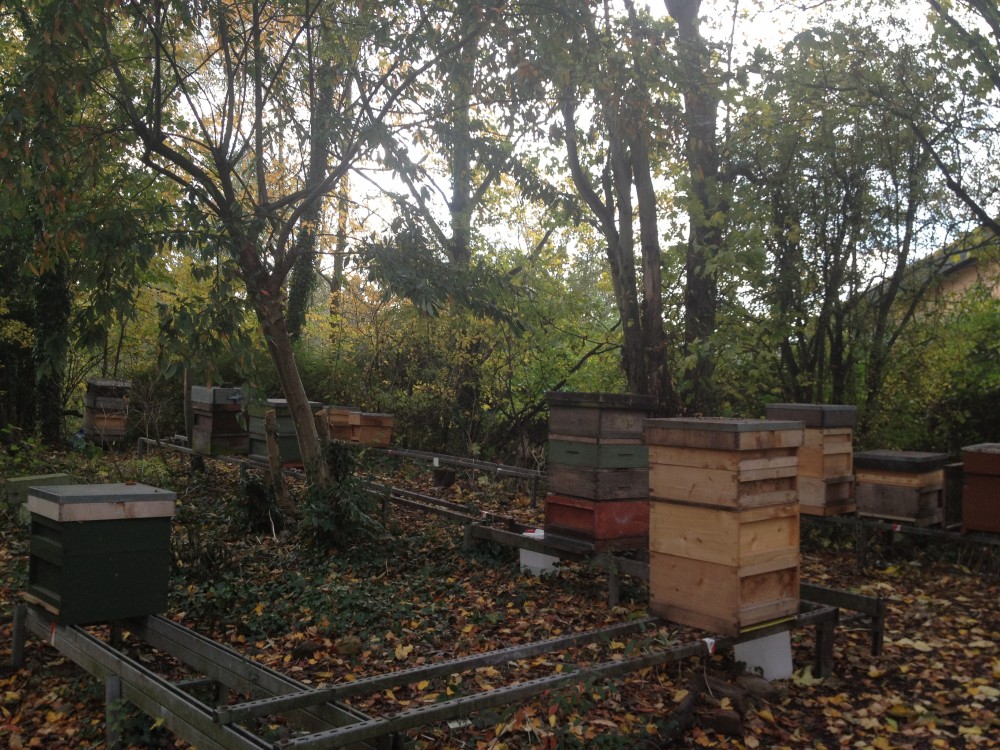
Autumn gloom sets in
November

Often November brings the first really cold frosts of winter. It will be too cold to open up the hive; it must now be left alone till March. Some insulation can be put in the top of hives between the crown board and the roof, although this is a controversial subject. Some beekeepers feel strongly that no insulation is necessary while others feel equally passionately that it is. Emma and I put bubble wrap and jiffy bags in the top of ours this winter.

Make sure the entrance remains clear of bees, use a small stick to poke out any little bodies caught in the mouse guard.

Some things for the beekeeper to do:

  • Put in insulation, if approved of.
  • Check entrances are clear.
  • Continue to use the monitoring board to monitor for varroa, but do not leave it in for weeks at a time as ventilation is needed. For one week during the month or every other week for a couple of days is sufficient.
  • Visit the apiary occasionally to make sure hives have not been blown over, attacked by predators or vandalised.
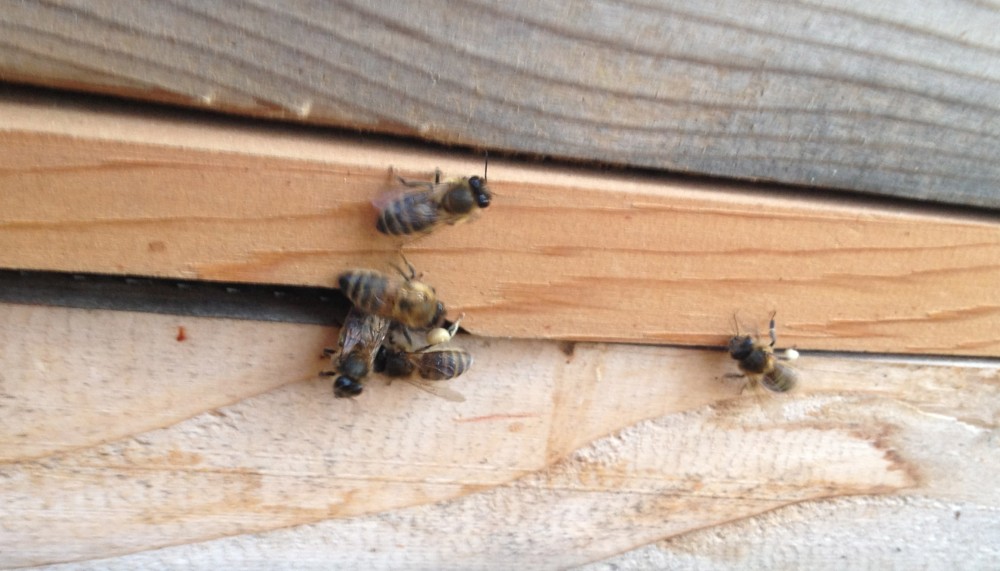
Even if the weather is too cold to collect nectar, the bees will often still be finding pollen in November. Below is a pic of some of my November 2011 winter bees finding pale pollen.
December

Bees are likely to only be flying on nice warm days for cleansing flights. English December temperatures tend to be between 2°C/35.6°F to 7.4°C/45.3°F, but temperatures are often slightly higher in an urban environment like London and the overall trend in recent decades has been towards rising temperatures.

Oxalic treatment should be carried out once either in December or January whilst brood levels are either non-existent or low. Oxalic treatment is carried out by trickling over the frames so the hives need to be opened up very quickly. If the bee cluster is at the top of the frames this can indicate a shortage of stores, so if this is the case and you haven’t already supplied fondant (also called bakers’ candy) do so now. I usually put a slab of fondant on over the crownboard at the beginning of December. For emergency feeding to particularly light hives the fondant can be put directly on top of the frames so the bees have more direct contact with it.

Some things for the beekeeper to do:

  • Oxalic acid treatment while brood is low and varroa mites are overwintering on the adult bees
  • Heft to check weight of stores; feed candy/fondant if stores are light and keep an eye on their levels
  • Make sure the hives have not been vandalised or attacked by woodpeckers
  • Check dead bees are not building up in the hive entrances and blocking the exit of live bees
  • If it snows, clear the snow away from the hive entrance. Bees tend to fly up towards the light, the intensity of which they monitor using the three simple ocelli eyes on top of their heads. The light reflected from the snow can confuse them, causing them to fly into it and freeze.
  • Check stored super combs each month during winter for wax moth damage. As long as the combs have never had brood in them they should be safe, as wax moth larvae need protein in their diet so can not survive on beeswax and nectar alone.
  • Produce beautiful Christmas presents from your wax and honey products.
  • Gratefully wish the bees Merry Christmas and a happy, honey-filled New Year.

References:

  • BBKA News incorporating the British Bee Journal (2011 issues)
  • Bee Craft Calendar 2012
  • Guide to Bees & Honey, Ted Hooper (2010)
  • Keeping Healthy Honey Bees, David Aston & Sally Bucknall (2010)
  • Module 1 Study Notes, Mid Bucks Beekeeping Association

Further reading:

  • Flower power‘ by Dr Sally Bucknall, p11, BBKA News November 2013 – an article on the benefits of ivy for bees. Dr Bucknall explains that because of its high glucose content, pure ivy honey crystallises easily in the comb and is not useful to the colony when stored. However, if the honey contains a mixture of nectar from other late flowers such as Himalayan Balsam, it may not crystallize.
Posted in Colony management, Exams | Tagged | 20 Comments

More signs of spring

They’re finding pollen now!  A sign that the queen is likely to be laying, as pollen is used to feed brood (as well as being eaten by young adult bees). They should have some pollen stores in the frames but they seem to prefer fresh sources. The amount of pollen required to rear a single worker larva has been estimated at 125-145 mg, containing about 30 mg of protein. On average workers collect pollen loads of 16mg (8mg x 2 pollen baskets), so collecting enough pollen to feed just one larvae requires around 8 or more foraging trips.

Foragers are willing to travel further for pollen than nectar, as pollen is a lighter load – although nectar gives them a higher energy return relative to effort. Larvae are mainly fed a brood food liquid from the hypopharyngeal and mandibular glands of nurse bees, but some pollen and honey is fed directly to larvae between days 3-5 of the larval stage (Mark L.Winston, The Biology of the Honey Bee).

I posted the video on the London Beekeepers page on Facebook and a couple of people commented that we should have taken the entrance reducer out over winter, in case piles of dead bee bodies congested the entrance, so perhaps Emma and I should think about doing that next week. I’m not too worried as we’ve been checking regularly for bodies and the entrances are clear.

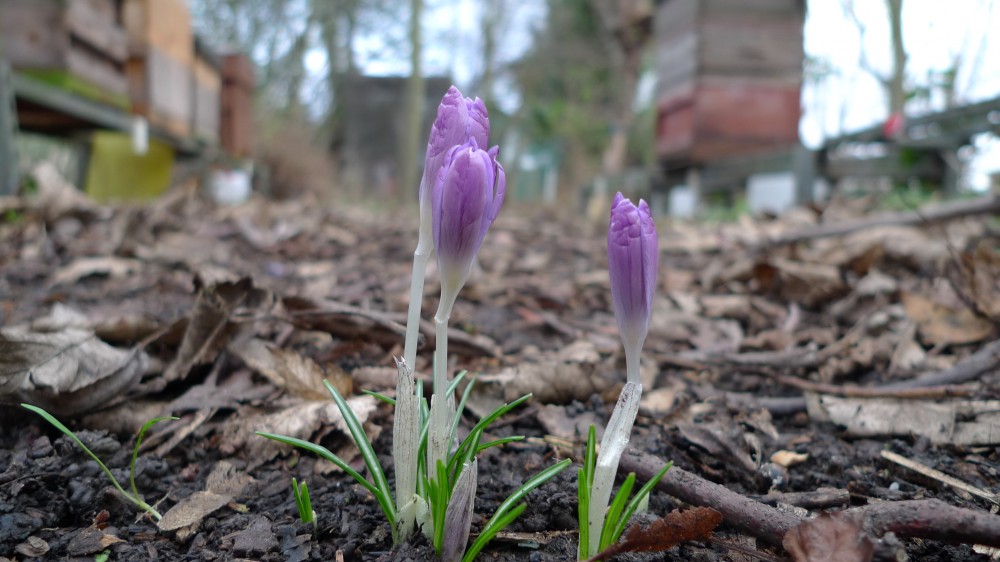
And crocus flowers are starting to rise hopefully out of the apiary’s mud. Next week perhaps we will see the startling orange pollen the flowers carry inside.

This morning, flowers cracked open
the earth’s brown shell. Spring
leaves spilled everywhere
though winter’s stern hand
could come down again at any moment
to break the delicate yolk
of a new bloom.

The crocus don’t see this as they chatter
beneath a cheerful petal of spring sky.
They ignore the air’s brisk arm
as they peer at their fresh stems, step
on the leftover fragments
of old leaves.

When the night wind twists them to pieces,
they will die like this: laughing,
tossing their brilliant heads
in the bitter air.

First crocus by Christine Klocek-Lim, 2007

Posted in Uncategorized | Tagged | 8 Comments

January apiary visit

Visited the apiary for a quick check on the hives today. I also found something else I have been waiting for…

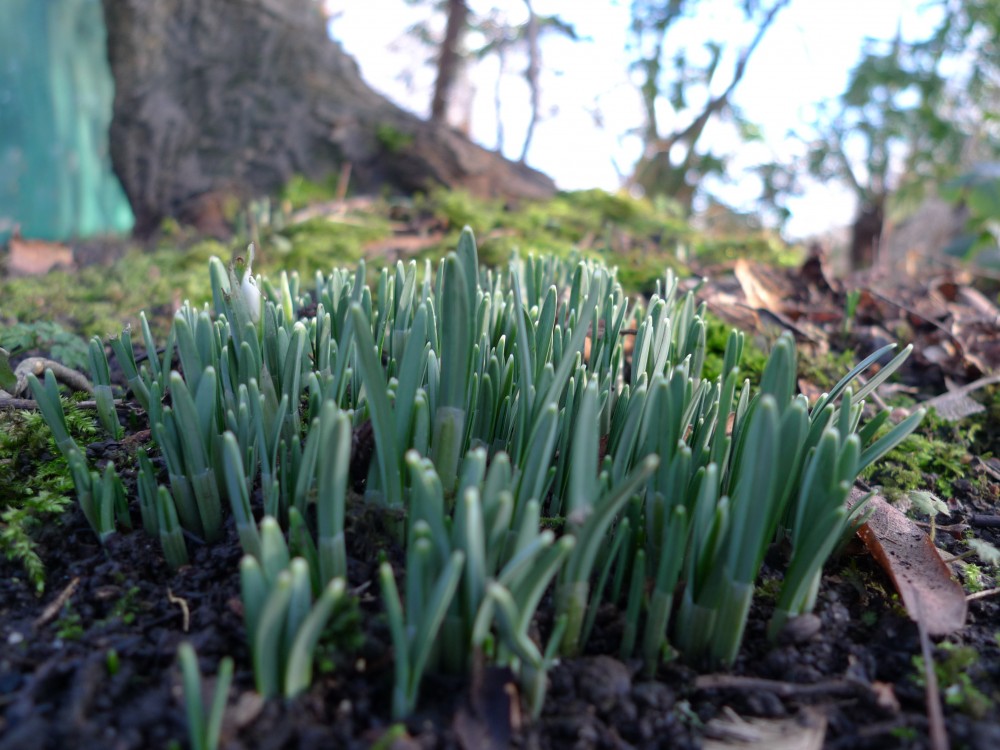
Snowdrop shoots peeking out from the ground. I also saw crocus leaves. Spring is coming!

There was not much beekeeping to do, only a quick check of the entrances to make sure dead bees were not blocking them, a peek at the fondant slabs to make sure they weren’t eaten through, and a look at the varroa monitoring boards.

Rosemary's varroa board

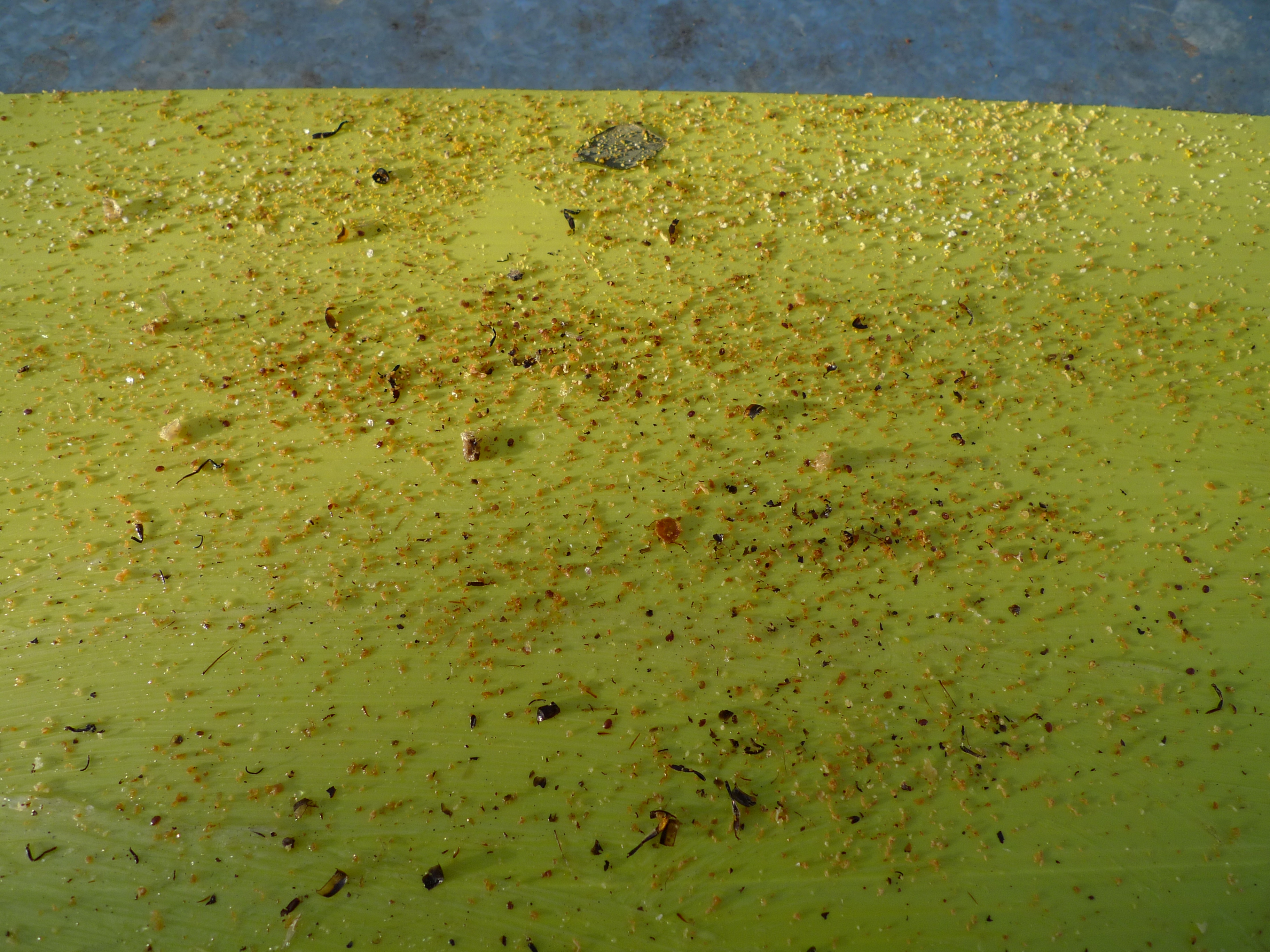
Rosemary’s board. I gave up counting but reckon there was a couple of hundred at least on there, in the space of a week. Hopefully that means the oxalic treatment worked. The mites are the shiny dark brown oval shaped things. It can be quite hard to see them amongst all the pollen and wax cappings at first.

Lavender's monitoring board

Lavender’s board had far fewer mites on it, probably because she has a smaller colony. Judging by the debris on the boards, both colonies are on the first few frames by the entrance. I’ve left the boards out now for ventilation purposes.

The light was beautiful today. I love taking photos at about 4pm in the winter, as everything gets softer. I’ve yet to notice the days doing much lengthening.

Posted in Uncategorized | 6 Comments

5th Honey bee Management revision post: the year’s work in the apiary (January to June)

A 5th revision post for the British Beekeeping Association’s Module 1 exam, Honey bee Management, which I’m taking in March. Onto 1.12 on the syllabus:

“The Candidate shall be able to give a detailed account of:-

the year’s work in the apiary and how this is dependent upon the annual colony cycle and the timing of local bee forage;”

The word ‘local’ is key here. What the bees are doing in urban London will be different from what they’re up to in the wilds of Wales, never mind what they’re plotting in Pennsylvania. You have to get to know your own local timings, just like a baker must know their oven and a carpenter their tools. Some ideas for London beekeeping below…

January

The bees are clustering, huddling round the Queen and surviving on their honey stores. If the weather is mild the cluster may be very loose. On warm days they will be taking ‘cleansing flights’ and fetching water to dilute honey stores.

Following the winter solstice (usually the 21st, sometimes 22nd Dec), the bees recognise the increasing day lengths. If the queen stopped laying completely during December, she will start laying again sometime in January.  To keep the brood warm enough the workers will need to maintain the centre of the brood nest at around 33°C (when no brood is present they can let it drop to about 20°C, which is warm enough to keep the workers active). The temperature will still be cold outside so the bees will be using up a lot of energy generating the required heat, so can get through their honey stores very quickly.

There will be little forage available yet, but the bees will seek out what fresh pollen there is for the new brood. The first snowdrops may be beginning to poke their way out of the ground. Other plants that may be out include crocus, winter flowering honeysuckle and the willow variety Salix aegyptiaca, a musk willow that under the right conditions will flower in January.

The British winter of 2011/2012 has been particularly warm…on 8th January Don Ember in South Yorkshire posted on the BBKA forum: “It does seem that, with weather like this, so mild and with intervals of quite strong sunshine, the bees are actually finding forage. Like last year, I have primroses already out in the same sheltered spot in the garden and I continue to see dandelions as well as the gorse I have mentioned before; I have some snowdrops about to open also.”

Some things for the beekeeper to do:

  • Oxalic acid treatment while brood is low and varroa mites are overwintering on the adult bees
  • Heft to check weight of stores; feed candy or fondant if stores are light and keep an eye on their levels
  • Make sure the hives have not been vandalised or attacked by woodpeckers
  • Check dead bees are not building up in the hive entrances and blocking the exit of live bees
  • If it snows, clear the snow away from the hive entrance. Bees tend to fly up towards the light, the intensity of which they monitor using the three simple ocelli eyes on top of their heads. The light reflected from the snow can confuse them, causing them to fly into it and freeze.
  • Attend local beekeeping association winter meetings, read beekeeping books in your warm cosy house as the wind howls outside
Snowdrops in snow photo by Iris Wijngaarden on Wikipedia: http://en.wikipedia.org/wiki/File:Snowdrop.JPG

February

Now the cluster will begin to break up. The queen will increase her laying if the weather is warm enough. The bees will still be surviving on their winter stores. February can bring nasty weather – rain, cold temperatures, strong wind, even snow, so it will still be too cold for opening the hive up.

Increasing numbers of welcome flowers start to appear: hazel, snowdrops, winter heathers, crocuses. I took the photo below at the apiary in early February last year.

Crocuses at the apiary

Some things for the beekeeper to do:

  • Repair or replace woodwork as needed
  • Scrape burr comb off spare hive parts and queen excluders etc and use a blowtorch to lightly scorch the inside of the parts.
  • Paint the outside of hives with a wood preservative or water soluble microporous paint so that the hive parts have time to breathe and dry before they are used again.
  • Make up frames, organise equipment. If doing a shook swarm or Bailey comb exchange in March ten new frames of foundation are needed per hive.
  • Heft to check weight of stores; feed candy or fondant if stores are light and keep an eye on their levels

March

Now the beekeeping season really gets going. The winter cluster breaks up, the winter bees die off, the queen starts laying in earnest and the bees start to forage for both pollen and nectar. They can find hazel, crocuses, willow, pears and plums.

March and April are critical times for bees. With the onset of spring, hive activity is increased, brood rearing is well under way, most of the winter stores have been eaten and   while the flowers mentioned above are out, spring forage pickings are still fairly low. And if the colony sends too many bees out foraging there is a risk that the brood will not be adequately nursed, and may become undernourished or chilled. There is a period from March until well into May when the brood outnumbers the adult bees.

Some things for the beekeeper to do:

  • If the weather is warm enough, a quick inspection of the colony to make sure the bees are healthy. It is best not to examine below 10°C, as more of the foragers will be at home and the colony more defensive.
  • The quick inspection should investigate whether the bees have enough food, sufficient room, are queen-right and disease-free.
  • Check the bees have enough stores to feed themselves and the growing brood nest, feed if necessary with a weak feed ratio of 1kg white sugar to 2 pints of water. If the weather is still too cold to open up the hive, heft.
  • Feed should only be given before the first super is put on, otherwise the bees will store it in the supers and your honey will be sugar syrup flavoured – i.e. not real honey!
  • Remove mouse guards and replace with entrance blocks.
  • Check the hive entrances are not piled up with dead winter bees.
  • To replace old comb, carry out a shook-swarm (we did this on March 19 last year) or begin a Bailey comb exchange.

The first block of fondant I gave my hive in winter 2010/2011 took two months for them to eat; look how much they had eaten of the second, given in late February 2011, just two weeks later. They really do require a lot of food at this time of year.

Fondant feast

How much my bees ate in just two short weeks


April

The first drones are usually laid in April. Drones become sexually mature 4-5 days after emerging as an adult bee. Colonies will not attempt to swarm before their first drones reach this stage, but once the first drones are flying you need to be on your guard for potential swarms.

As long as there is a good nectar flow, the queen will be laying strongly. Oil seed rape, cherry, hawthorn, apple and dandelion are available.

Some things for the beekeeper to do:

  • Most beekeepers carry out the first full colony inspections in April. Pick a calm sunny day, preferably above 14-16°C (some say 14°C, others 16°C) when the bees are flying freely. If the hive is opened on a colder day the bees have to use up a lot of energy re-establishing the correct levels of temperature and humidity for the brood.
  • Full colonies in April should be covering five to ten frames in their brood box. If they are not investigate for dwindling problems caused by nosema, acarine or varroa.
  • If the brood inspection reveals that the colony is building up slowly, stimulative feeding with a small amount of weak strength sugar syrup in a small contact feeder can help. Do this intermittently – the container being left empty for a few days between feeds mimics the arrival of erratic early spring flower nectar and will encourage a higher rate of egg-laying from the queen. Only do this when no supers are on.
  • Add a queen excluder and super when the brood box is full of bees
  • Start regular checks for early queen cells – it is not unusual to have April swarms in warm areas.
  • If you collect swarms, make sure your swarm collection kit is complete and ready for use
  • Place bait hives for swarms
  • If you keep your bees near oil seed rape you will need to bear in mind that the resulting honey granulates very easily in the comb. Keep the colony full (prevent swarming, do not carry out an artificial swarm either), so that it can maintain warmth in the honey supers and reduce the risk of granulation.
  • Drone trapping for varroa control can be done now (see my Varroa Control Workshop post for info on this).

Below is a frame of capped worker brood surrounded by pollen stores and capped white honey along the top of the frame, taken in April 2011.

Capped brood


May

The colony grows rapidly in May, responding to increasing day length and available amounts of nectar. The bees will instinctively want to grow the colony as part of preparations for swarming; their way of reproducing. You need to visit the bees weekly to  catch any swarms before they happen – bees usually swarm once queen cells in their hive are capped, which is day 8 after the egg is laid.

Oil seed rape, dog roses, cherry, horse chestnut, apples, dandelion, sycamore, field bean and raspberry are in flower. In my ‘What’s flowering now: late May‘ post last year, I photographed bees on bramble, poppies and wild mallow too. Some species will be most valuable for their nectar, others for their pollen. The colony will start collecting propolis during the warm summer months – it is too hard to collect at under 5C.

Some things for the beekeeper to do:

  • Watch for signs of the colony building up to swarming. These include drones, ‘play’ cells and a sharp reduction in the queen’s egg laying rate as the colony slims her down to a flying weight.
  • Watch for signs that swarming is imminent. Note any queen cells. Hold the frame horizontally in good light to see what is inside – is the cell nearly full-size? Is it highly polished? (If so it is ready for an egg to be laid). Is there royal jelly in the base? Can you see an egg (difficult against the white of the royal jelly) or larva floating on the royal jelly? In increasing order of urgency, these signs indicate swarming is due.
    Carry out an artificial swarm method rather than squishing every queen cell you see, as eventually you will miss one.
  • If you carry out an artificial swarm to control swarming there comes a time, after three weeks, when the worker brood in the original brood chamber has emerged but the new young queen has not been laying long enough for her brood to be sealed. This means all the varroa will be on the adult bees; if another healthy colony donates a frame with some unsealed brood – preferably with some drone brood on it – then many mites will be attracted to this frame, which can then be removed and destroyed when most of the cells are sealed.
  • Harvest any ripe oil seed rape honey. This granulates in the comb rapidly unless you quickly harvest and extract as soon as the nectar flow has stopped and the honey is ripe. Even using clearer boards or leaving overnight will result in granulation, after which the honey requires melting out using specialist equipment.
  • Add supers as necessary, one at a time, waiting until the first super is at least two thirds full before putting on the next.
  • Book the loan of a honey extractor from your association, if possible
  • Drone trapping for varroa control
  • Swarm collecting

A queen cell on the bottom of a frame packed with bees, taken in May 2011


June

The colony now reaches its maximum strength. In the UK the main nectar flow is often over a short three-week period in May-June. As long as enough pollen is being brought in to produce brood food, at the height of the season the queen may lay more than 1,500-3,000 eggs a day, depending upon her race and strain – more than her own body weight in eggs. Apart from short rest periods of 5-10 minutes, she will do this round the clock. The colony should soon have around 40,000-60,000 or more bees.

In my ‘What’s flowering now: late June‘ post last year, I photographed bees on blackberry bramble, thistle, hogweed, lavender and white clover.

Some things for the beekeeper to do:

  • Maintain regular brood nest checks for queen cells and colony health
  • Carry out swarm control techniques as necessary
  • Monitor for varroa
  • Drone trapping for varroa control
  • Collect swarms
  • Add supers

Our new queen hatched from our queen cell, June 2011 – all hail Queen Rosemary, marked out in royal blue.

Queen Rosemary

A honeybee on blackberry bramble, June 2011


This post is getting a bit long…July to December to be continued soon…does anyone have any suggestions for beekeeping tasks I’ve forgotten?

EDIT: July to December now posted here.

References:

  • BBKA News incorporating the British Bee Journal (2011 issues)
  • Keeping Healthy Honey Bees, David Aston & Sally Bucknall (2010)
  • Module 1 Study Notes, Mid Bucks Beekeeping Association
Posted in Colony management | Tagged , | 7 Comments

Bee ‘macro’ photos

I follow a lot of blogs by extremely good nature photographers (Garden Walk Garden Talk springs to mind; there are many others). This makes me very conscious that I am not among them.

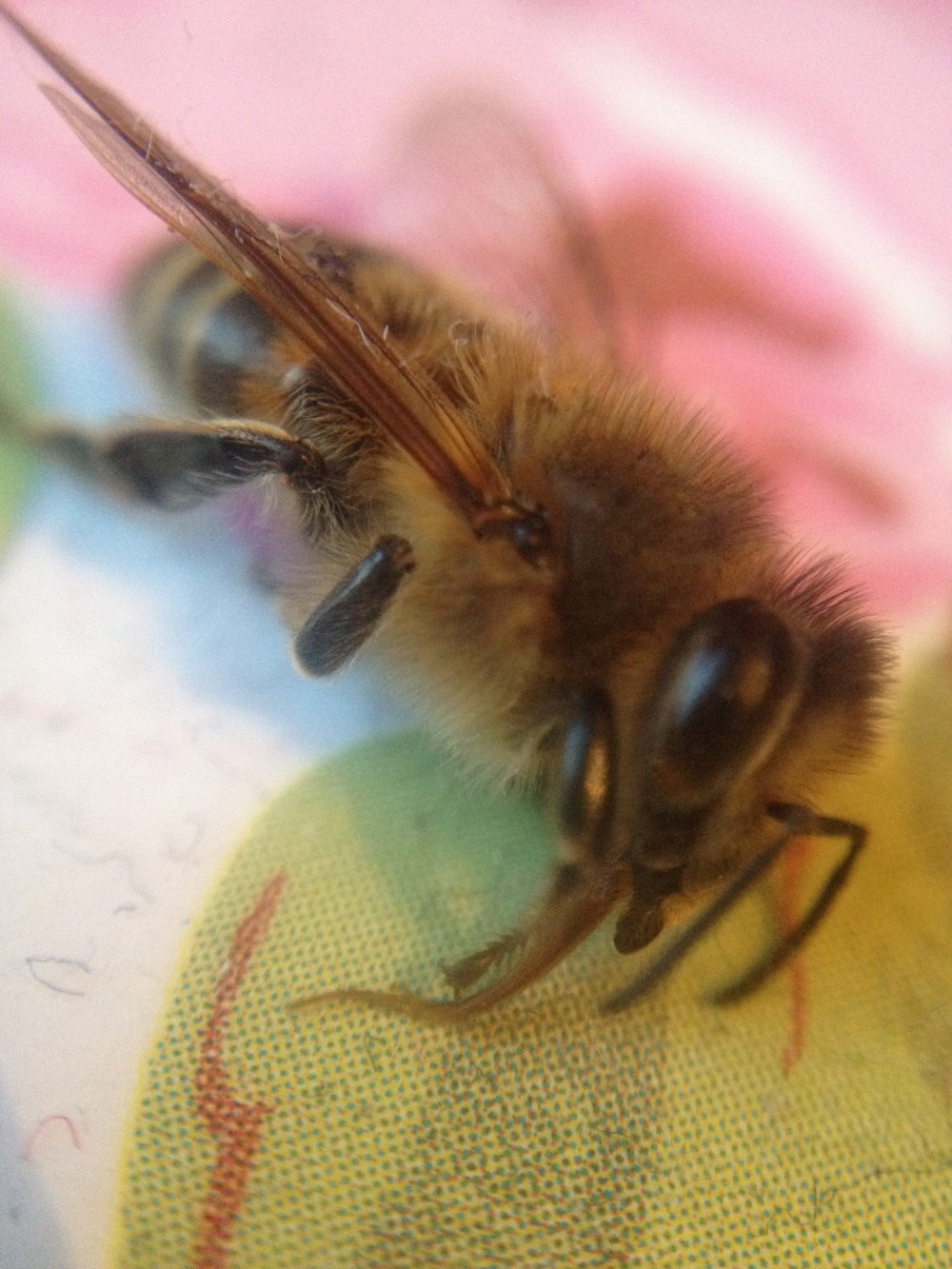
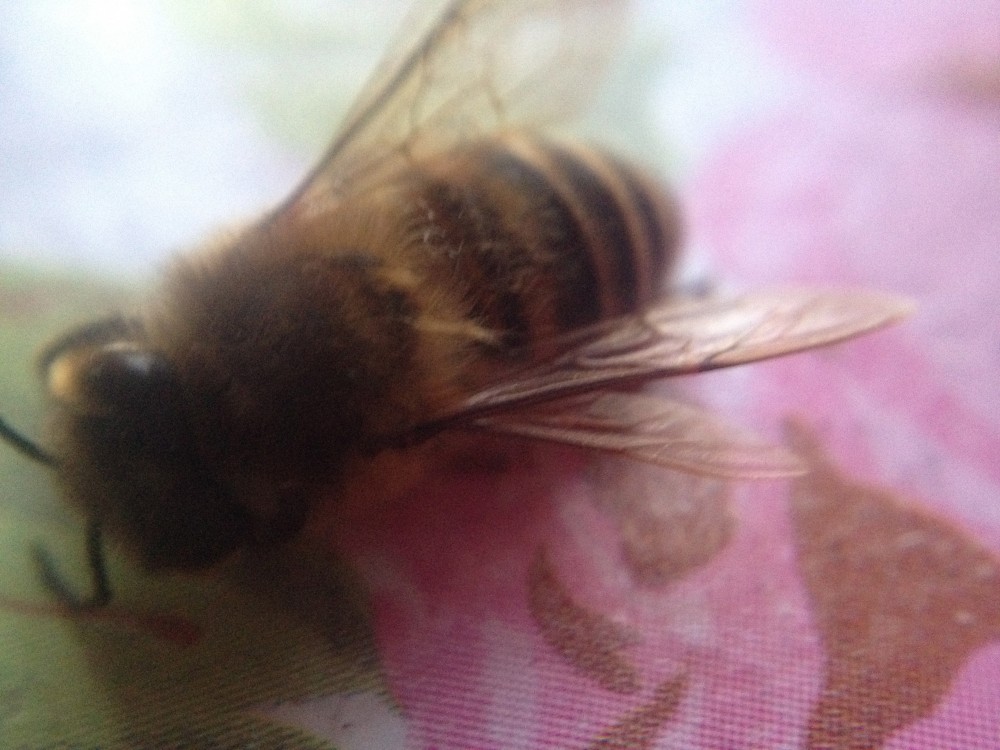
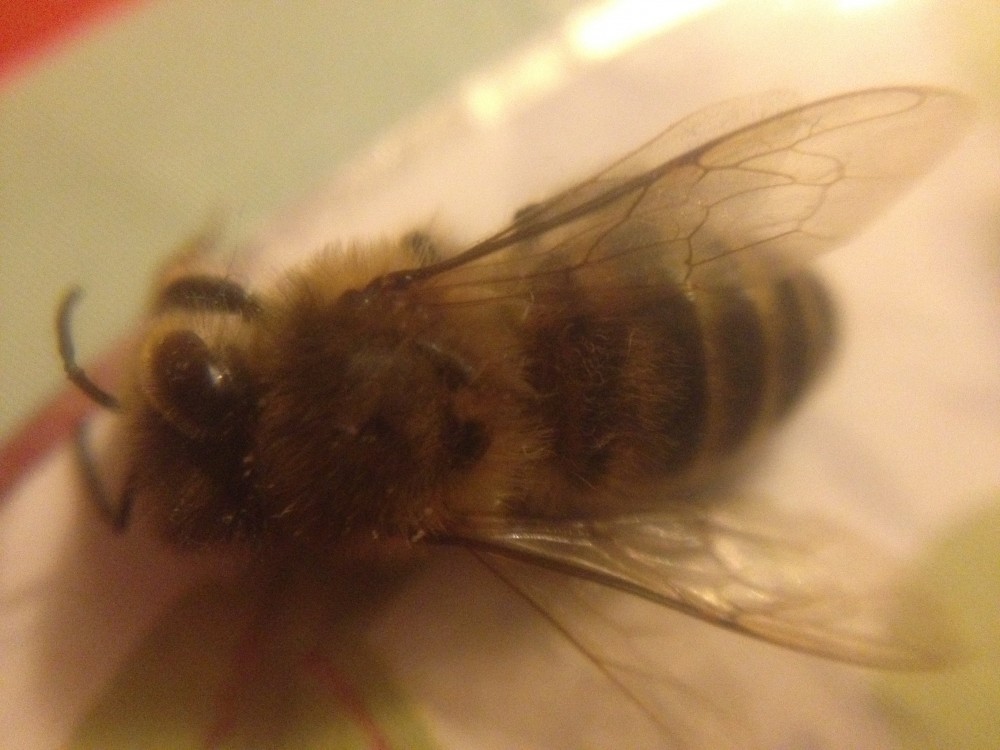
However, here are a few bee macro pics I had a go at using a new iPhone gadget which Drew bought me for Christmas. It’s a little lens on a rubber band that fits over my iPhone camera, see www.easy-macro.com. I found this worker stuck in the mouse guard of Rosemary’s hive.

The last two aren’t so good sorry. The bee had got a little dusty at this point!

Looking at a bee up close, you notice just how hairy they are. It’s one of the characteristics of the bee family, in contrast with wasps, which are mostly hairless.

Thanks for all your hard work little bee.

Posted in Uncategorized | 10 Comments

4th Honey bee Management revision post: good apiary hygiene

A 4th revision post for the British Beekeeping Association’s Module 1 exam, Honey bee Management, which I’m taking in March. Skipping forward a little again, onto 1.9 on the syllabus:

“The Candidate shall be able to give a detailed account of:-

1.9: good apiary hygiene

This is one of the points I feel a little more confident of, because we are lucky enough to have fantastic teachers like John Chapple and Andy Pedley down at the apiary, and they often talk about good hygiene.

Why try to be hygienic? The answer is obviously to try to keep your bees as healthy as possible, and avoid the spread of diseases such as Nosema, European Foul Brood (EFB) and American Foul Brood (AFB). It can also help ensure your honey doesn’t become contaminated in any way.

Here are a few points to consider:

Clothing

  • Bee suits

How clean is your bee suit? (Ask me this question and I’ll often start looking shifty). When did you last wash it? Your bee suit should be washed after each visit to the apiary (no, I don’t always do this. But I should). As well as being hygienic, washing your beesuit has the advantage of removing any alarm pheromones deposited by angry bees trying to sting you.

Bee suits can be washed in the washing machine with the veil removed. The more delicate veil can be soaked separately in washing soda, which is a mildly corrosive disinfectant and helps remove propolis. A solution can be made up by dissolving 0.5kg in a gallon of water.


Washing soda: the hygienic beekeeper’s best friend.

  • Gloves

New beekeepers are often sold long leather gloves – resist buying these! These are lovely and soft the first time you wear them, but soon get covered in propolis and become hard and stiff. They are also un-hygenic compared to disposable latex gloves, which are cheap and can even be obtained for free from petrol stations or hospitals (a tip from the money conscious local beekeepers I know!).

If you want extra protection the latex gloves can be worn over leathers. Our local bee inpector often does this.

  •  Boots

As you stomp through the apiary you are likely to put your boot in various sticky substances, so it’s a good idea to wash wellies or other footwear in soapy water. (I wish I could say I do this).

  • Personal hygiene

(This section has been added following the comment left below by Mike Mack, who suggested talking about beekeepers personal hygiene too.)

Bees are extremely sensitive to smell; indeed smells, in the form of pheromones, are a crucial way of communicating for them. So one way to avoid upsetting the bees and getting a few unwelcome stings in the process is to have a good wash first. But don’t put on perfumes or aftershave. Certain fabrics are smellier than others too – Mike mentions the bees not liking leather or wool in his experience. A plain light coloured cotton beesuit is best.

I like to dab on a little clove oil first as I read somewhere the bees like this smell. It seems to work and has the added advantage that I smell like apple pies all day.

Don’t drink alcohol before you go to the bees. This might sound obvious, but a lot of things that are obviously a bad idea when sober suddenly seem like a fantastic idea after a drink or two. How else do you explain the Irishman who came home after a few beers and decided the early hours of the morning was a good time to try to climb up a ladder with his beehive and put it on his roof? If only he’d known that bees don’t go to sleep..

Good habits within the apiary

  • Anything taken or scraped out of your hive, even a little bit of comb or wax, should be disposed of properly and not flicked willy nilly onto the apiary floor. Comb left on the floor encourages the wax moth and robbing by other bees. Bring a container or bag of some sort with you, perhaps a plastic takeaway box, and put any brace comb etc to be discarded within it as you go through the hive.

Often infectious diseases are spread not by the bees but by the beekeeper, perhaps via a hive tool, or by gloves, or by moving frames between colonies.

  • Ideally you should soak your hive tool in a bucket of washing soda solution in-between visiting each hive, or use a separate tool for each hive. In the apiary Andy and John try to discourage us from using our own hive tools in each other’s hives.
  • Frames should not be moved to another colony unless you are confident that both colonies are disease free.
  • Whilst inspecting avoid placing frames or supers directly on the ground or grass to prevent any chance of the honey or wax becoming contaminated.
  • If a colony dies seal up the hive and move away from live hives who might try to rob it out and pick up disease in the process. Burn the brood frames and dead bees.

Apiary layout

  • Sometimes worker bees can spread infection by drifting into one hive from another (drones do pay visits to other hives but not much can be done about this). To try and minimise drifting by the workers, arrange the hives to help bees easily find their own colonies. The entrances should face in different directions and be spaced well apart –  at least 1.2-1.5 metres is recommended. Different colour hives can help too.

Housing swarms and unknown bees

Be wary of swarms. As noted in my previous ‘how to begin beekeeping‘ revision post, they may carry disease. Occasionally they may not even be a swarm in the usual sense – bees from colonies infested with varroa have been known to abscond and find a new nesting area.

  • A swarm should be housed away from other colonies at first and monitored for any signs of disease. Keep in isolation until the health of the brood can be assessed.
  • It helps the colony if you feed them a weak sugar solution, but wait 48 hours until wax-building and foraging are under way before feeding. This ensures that any disease contaminated honey brought in the bees’ honey stomachs is used as energy for wax secretion and not stored in the frames.

Comb replacing

You wouldn’t lie in the same unwashed stinky bedsheets for several years running…

  • Brood frames should be regularly replaced – ideally annually. Nosema spores, bacteria and other pathogens can build up in comb and act as a source of infection. AFB spores are extremely resistant to ageing, heating and chemicals and infection can be carried within comb for as long as thirty-five years (Ted Hooper, Guide to Bees & Honey). 

You can tell when comb is old as it appears dark brown or even black in colour. A good rule of thumb is to hold the frame up to the light; it should be replaced if light cannot be seen through it (Aston & Bucknall, Keeping Healthy Honey Bees). The brood comb below looks pretty old.

In the Ealing apiary we replace all our brood comb each spring, either by doing a shook-swarm or the more gradual Bailey comb exchange. An even more gradual (but not as effective) method is to just replace a few frames each year and colour code your frames using the WYRGB queen marking colour codes to keep track of how old the frames are.

  • Money conscious beekeepers can destroy the comb in the frames and boil the woodwork in washing soda solution before reusing. Personally I would rather just pay the 80p or so for a new frame! But then I only have two hives. The comb should be burnt in a bonfire or thrown away in sealed domestic rubbish bags to prevent bees being attracted to the combs and possibly picking up diseases from them.
  • The brood boxes should be scorched inside with a blowtorch until the wood begins to singe coffee-brown, paying particular attention to the corners and crevices.
  • Super frames with clean unbroken comb which has not had any brood in can be reused for several years. Keeping the super frames saves the bees the effort of rebuilding the wax, letting them get on with honey production. However the frames should be stored carefully to avoid damage by wax moth or mould.

Frame storage

  • A good way to store super frames overwinter is to stack outside with a queen excluder on the bottom and another on top as a crown board below the roof. This allows air to circulate whilst keeping out mice and preventing mould. Spiders can get through to control wax moth, which should also be killed off by winter freezes.
  • If you are storing brood frames, these are more attractive to wax moths so you need to be more careful. Put the frames in a freezer for 5 days to kill off any hiding moths, then return outside and seal the boxes containing the combs. Sulphur dioxide strips, Certan spray and Acetic acid can be used to sterilise comb and control wax moth.
  • PDB (paradichlorbenzene) should not be used to control wax moth as it can accumulate in wax and transfer to honey. Neither should moth balls or any product containing naphthalene as they are poisonous to bees.

(Reference: Module 1 Study Notes, Mid Bucks Beekeeping Association)

What you’re trying to avoid – the slimy mess caused by wax moth larvae travelling through comb, excreting black mess as they feed. Photo from article by London Honey Shop – “Wax moth infestation – 5 ways to prevent this“.

Feeding

  • Don’t leave a pile of honey frames out in the middle of the apiary for bees to clean up after your honey extracting. It gets the honey cleared off but it also encourages robbing frenzies and the spread of disease. Only feed bees back their own honey within their own hive, not imported honey or honey from other colonies.

Records

  • Keep records of what you’re doing each week, especially after doing treatments. In the UK beekeepers are required by law to keep records of all substances they use to treat honey bee colonies for disease, including: the name of the product/substance used, manufacturer name, lot/batch number, expiry date, rate of application of the product, start and end time of the treatment period, how the treatment and packaging were disposed of. This is in case any concerns are raised about honey or other products from the treated hive.

Emma and I have paper records in the hive, which have the advantage that other people can see what we’ve been doing if we’re away on holiday.  For this year I have purchased a Beecraft ring binder and record card set, which will keep the record cards nicely clean and neat. I like having the blog as an electronic record too, as taking two buses to a dark apiary isn’t too convenient on a cold winter’s evening when I want to remember what I did this time last year.


Does anyone have any hygienic tips they want to share to help me pass my exam? I’d love to hear them.

References:

  • Collin’s Beekeeper’s Bible (2010)
  • Guide to Bees & Honey, Ted Hooper (2010)
  • Keeping Bees and Making Honey, Alison Benjamin & Brian McCallum (2008)
  • Keeping Healthy Honey Bees, David Aston & Sally Bucknall (2010)
  • Module 1 Study Notes, Mid Bucks Beekeeping Association

Other Module 1 revision posts:

Posted in Colony management, Exams | Tagged , | 18 Comments

Drizzling oxalic acid on bees

Not a cookery recipe but an anti-varroa treatment commonly used in the UK during December or January whilst the bees are clustering and little or no brood is present. The reason for doing the oxalic acid treatment at this time is that the varroa mites will be at their most vulnerable, overwintering on the adult bees rather than safely hiding in capped brood.

The acid cannot harm mites within capped brood but it will reach mites on the adult bees, giving it an average 90% success rate. The acid is mixed with sugar solution and then quickly drizzled between each frame with bees on. The acid has a corrosive effect on the probosis of the varroa mites, preventing them from sucking the haemolmyph (equivalent of our blood) from the bees. It also damages their respiratory apparatus, causing the little buggers to drop off the bees in droves.

I made a video of Ealing Association member Pat Turner doing a very professional job of administering the acid to his hive:

My favourite bit is when Pat says: “They don’t like it up ’em!”

Emma bravely took on the job of drizzling David’s colony, known as the moodiest in the apiary. I started trying to video this, but the bees became too interested in my hands, which were uncovered to film, so I hastily put my gloves back on. John Chapple had a veil on (unusually for him, oxalic acid time is one of the few occasions on which he wears a veil as the cold weather makes the bees moody) but not gloves, and received a few stings on his hands from David’s ladies. Here’s the very short video, showing off Emma’s stylish pink gloves:


We did our two hives and were pleased to find them both doing well and looking strong. Emma has done a great post on this giving more information on how the treatment works: http://basilandbees.wordpress.com/2012/01/01/giving-the-bees-oxalic-acid.

EDIT: I have since come across this great post on Eastvanbees’ blog, ‘Things I did this winter while waiting for the bees – Part 2′, in which he describes how he treated with oxalic using a vaporiser. This seems like a good alternative way of doing things if you live in a very cold climate or just would rather not open up your hive, as it can be done through the entrance without the roof needing to come off.

He also sent me a link to this great ScientificBeekeeping.com article on Oxalic acid Q&As, which explains in detail how oxalic works, how to apply, when to apply and probably everything there possibly is to know about oxalic, while a second follow-up post deals with how to do the vaporiser method.

Posted in Uncategorized | Tagged , , | 15 Comments

3rd Honey bee Management revision post: the criteria used in the selection of apiary sites

A 3rd revision post for the British Beekeeping Association’s Module 1 exam, Honey bee Management, which I’m taking in March. Onto 1.7 on the syllabus:

“The Candidate shall be able to give a detailed account of:-

1.7: the criteria used in the selection of apiaries

It will rarely be possible to find a perfect location for an apiary, but below are some factors to bear in mind when searching for a suitable spot.

Family, neighbours and the public

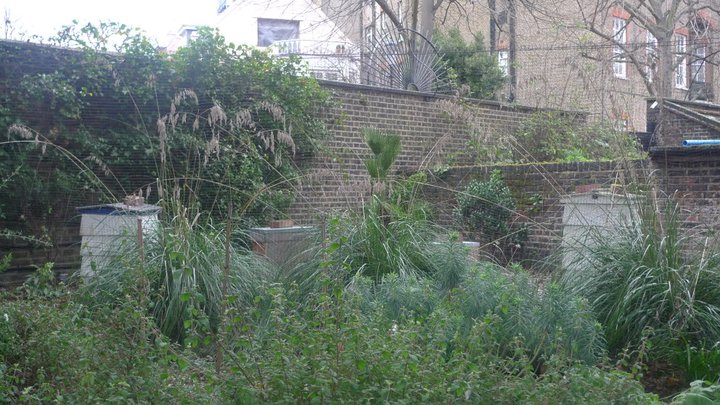
Unfortunately many people are afraid of bees. While honey bees are usually not aggressive whilst out foraging, sometimes the public confuses wasps with bees and may come blaming you when they get stung. To try and make your bees less visible, it’s good practice to enclose the apiary with a barrier of some sort, such as a hedge or fence to force the bees to fly in above head height. Below is a picture of the hives in the Chelsea Physic Garden, which have their entrances facing the wall and tall foliage and mesh between the hives and the public.

Keeping your hives less visible also helps reduce the chance of vandalism or theft. Sadly the Ealing Association’s apiary has experienced vandalism before when the hives were dumped in the stream bordering the apiary. Some Ealing members who keep their hives in allotments have also had damage done to their hives, whether from insecticide poured in or honey combs being grabbed and stolen. There have been many sad cases nationally when hives appear to have been stolen by beekeepers or at least people familiar with handling bees, who then presumably sell the hives on. In many ways other human beings are the biggest threat to your bees – keep your hives unobtrusively!

Keep your hives away from horse stables or bridleways. Bees need to collect water in the summer, and sometimes they like collecting the sweat from the back of horses. This can lead to the horse and rider getting irritated.

Beekeepers can reduce any potential problems with the public by keeping good tempered bees and replacing the queen in any bad tempered colonies. This will also make inspecting more pleasurable for the beekeeper.

Forage

Try to find out the amount and type of food sources available within your potential site, by taking a walk about and/or by asking local beekeepers. An area will have a maximum number of hives that it can support; so ten colonies, with all the extra work they entail, could end up bringing in the same amount of honey for you as five.

Think about sources of early and late supplies of pollen as well as the main nectar plants. The bees need pollen continuously whilst rearing brood, which in the UK is usually from February through to late September or even October/November if we have a warm autumn like 2011’s. Colonies only store about 1kg of pollen (about one week’s worth of their requirements), during summer – so a pollen shortage will quickly impact on the health and development of brood emerging 2-3 weeks after the shortage. Also look at your local soils – plants growing in very light sand and gravel soils will produce little nectar in drought years.

Bees usually forage within a 2-3 mile radius of their hives. It takes four pounds of nectar evaporated down to produce one pound of honey; it takes about a dozen bees to gather enough nectar to make just one teaspoon of honey, and each of those dozen bees needs to visit more than 2,600 flowers. So there will be a limit on how much forage is out there – no location supports an infinite amount of colonies. The density of bee forage in most areas will not support more than ten to fifteen colonies in one place.

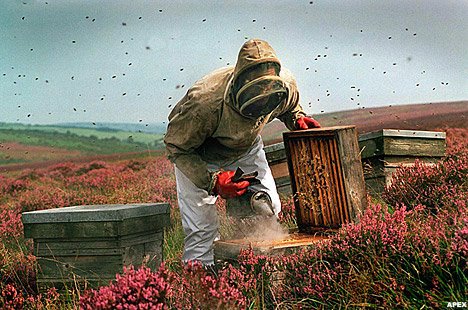
When is the forage available? Maybe the apiary site is within an urban area, in which case gardens and parks usually provide a variety of forage throughout the year. Alternatively you might pick a temporary apiary site in the countryside to exploit a seasonal crop such as heather or oil-seed rape, which your bees are moved to for a month or two. Prior permission needs to be obtained from the landowner. The traditional rent for an apiary is a pound pot of honey per hive annually.

Beehives on heather

A photo of Scottish bees moved to heather for their summer holidays (from the marphotographics.co.uk website). “Around the first day of August the Ling heather buds burst open, flooding the mountains with a vivid purple. At the end of the month this honey is removed and extracted.”

Seasonal beekeepers should take into account walkers, pony trekkers, shooting parties etc and place the hives away from footpaths. Avoid having hives near main roads too, as bees can be hit by passing cars as they attempt to fly or crawl over the road.

The photo above I found via the Beginner Beekeeper page on Facebook, posted by Benoit Lesueur.

Environment

  • A flat site is easier to place hives on!
  • South facing is warmest.
  • The site should be sheltered from wind, so that foragers don’t struggle to land at the hive entrance and the roof stays on. A hedge provides good cover, as the small amount of wind coming through prevents areas of turbulence which occur behind a more solid surface such as a wall.
  • It should be a site which does not flood. Hives on moorland have been partly submerged and even washed away after torrential downpours. Generally avoid muddy sites or low-lying areas near rivers.
  • Keep hives away from the bottom of dips in the land as these are likely to be frost pockets and therefore a few degrees lower in temperature. Bees won’t start foraging until the temperature immediately outside the hive warms up enough (12-14°C for nectar foraging).
  • Most books advise that sites under trees are unsuitable because they are usually damp. Bees naturally produce water vapour as part of their metabolic processes. Excess moisture is usually removed by bees standing at the entrance and fanning, but if the location is too damp, they may not be able to sufficiently reduce the humidity and mould may start to grow on the woodwork and pollen stores.

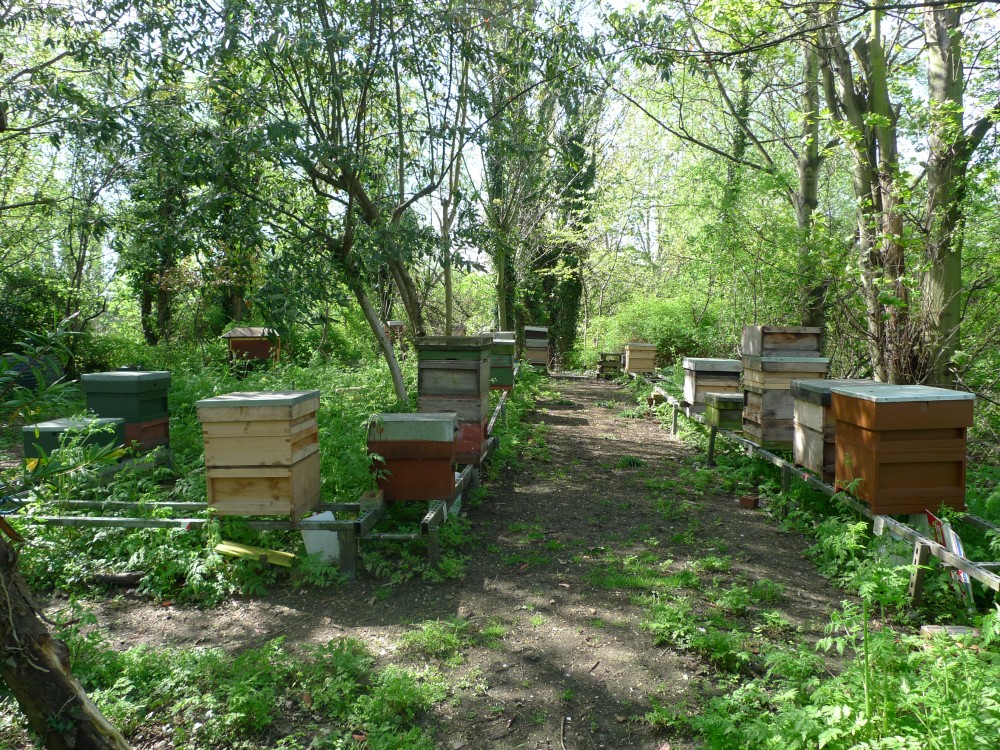
Below is a photo of the Ealing Association’s apiary.

The apiary in April

Yep…we do have a lot of tall wooden things growing out there. Which many people blame for the low honey yields most beekeepers at the apiary get. One super here is doing pretty well, two is exceptional. On the plus side the trees hide the hives from members of the public who might want to steal or vandalise them. But they do shade over the hives, making the apiary temperature cooler than out in the open.

  • Dense foliage cover can make hives too wet and cold; however some shade in the afternoon helps prevent bees having to work hard to cool the hive or even dying from heat exhaustion or collapsing honey combs. Position your hives where they will be woken up by morning sunshine but shaded during the hottest part of the day.
  • If your hives are in a rural location, fence them off from livestock like cows or horses which might like to use them as a scratching post and knock them over.
  • The bees will need a water source to produce brood food, dilute honey stores and cool the hive in hot weather. If a suitable pond or stream is not available consider providing a shallow water source in a sunny position, with stones bees can rest on to avoid drowning. Place this away from their main flight paths to avoid fouling. Adding a distinctive smell, such as peppermint essence, will help the bees find the water.

Access

Easy access to a site throughout the year, with a hard path down to the apiary, is important. Honey supers are heavy, so if you are using an out apiary it helps if you can park your car nearby. Sites which require climbing fences or ditches to enter are a bad idea.

If you have no garden and plan on placing your hives on an urban rooftop, think about what you would do if American Foul Brood (AFB) was diagnosed and your local bee inspector required the hive to be burnt. Do you have somewhere you can light a bonfire? Calling an external company in to destroy a hive is expensive.

Space

You need room to stand while inspecting and somewhere to put the roof and supers down. Generally you should allow nine times the hive footprint area per hive, though this is not a strict rule as two hives placed side by side reduce the overall space needed.

Make sure you have enough room to add a hive or two. Swarming means two colonies can quickly become four during a single season. Even if you plan to recombine hives following an artificial swarm, you will need extra space temporarily.

References:

  • Collin’s Beekeeper’s Bible (2010)
  • Guide to Bees & Honey, Ted Hooper (2010)
  • Heather Honey essay by Colin Weightman
  • Heather Honey‘ by Tony Jefferson, BBKA News, No.216 – August 2013, p.19-21
  • Keeping Healthy Honey Bees, David Aston & Sally Bucknall (2010)
  • Module 1 Study Notes, Mid Bucks Beekeeping Association

Other Module 1 revision posts:

Posted in Uncategorized | Tagged | 9 Comments

2nd Honeybee Management revision post: how to begin beekeeping

This is a 2nd revision post for the British Beekeeping Association’s Module 1 exam, Honey bee Management, which I’m taking in March.

I’m skipping forward a bit on the syllabus, onto:

“The Candidate shall be able to give a detailed account of:-

1.6: how to begin beekeeping, including the acquisition of bees, sources and type of personal and other equipment, the approximate costs of equipment and bees and any precautions necessary

This seems easy now, but wasn’t to start with. How to begin? Let’s break 1.6 down a bit.

How to begin

It’s a good idea to find out if beekeeping is really for you before going ahead and spending several hundred pounds on equipment and a few thousand little faces peering expectantly up at you. Some ways to gather information first:

  • Join or at least start visiting a local beekeeping association (in my case the Ealing and District Beekeepers Association, where I keep my bees). Depending on the weather, they should be able to show you inside a few hives.
  • Take a basic beekeeping course, which many associations run annually
  • Read some beekeeping books for beginners, for example Bees at the bottom of the garden (2001) by Alan Campion, which was the first beekeeping book I purchased as part of the Ealing basic course. I now have around 20 books…Keeping bees and making honey (2008) by Alison Benjamin and Brian McCallum is another good one for beginners, lots of photos. Both of these are UK oriented. Beekeeping techniques vary greatly depending on your climate, so buy a book focused towards your local area.
  • Read the British Beekeeping Association (BBKA) About Beekeeping leaflet by Roger Patterson

The acquisition of bees

Once you’ve got to know the local beekeepers, taken an introductory course, opened up a few hives and drunk a lot of tea, you should feel ready to take the first step of getting your own bees. I cheated here – a nice lady called Ann Fox very kindly gave me mine. Most people will need to either buy their bees, as a nucleus or full colony, or wait for a swarm.

– Buying a nucleus or full colony

Most books recommend starting in spring with a nucleus, which is a manageable size for a beginner and you can then watch them expand as the year goes on. A nucleus is a mini hive, containing 4-5 frames of bees and a laying Queen, with healthy, disease-free brood and stores. Keeping the bees in a nuc helps keep them warm during nippy British springs, as it is a smaller space to heat. Once your colony grows and fills all the available space you’ll want to move them into a full size hive. So starting with a nucleus does mean quickly needing to buy more equipment, but then spare equipment is always handy. Below is a pic of our nucleus in May 2011, following an artificial swarm to split one hive into two.

Below are our bees travelling up from the nuc into their new full sized home (we’d already shaken most of them in).

The last of the nuc bees slowly proceeding into their new home

Be careful where you buy your bees from. It is easiest to buy your bees from a local beekeeper who you know and trust and can easily talk to if you have any problems. This way the bees will also be suited to your local climate.

Of course this is not always possible, in which case you need to go to a commercial supplier. The British Beekeeping Association forums have had posts by beginner beekeepers who have been unlucky enough to buy bees from dodgy suppliers – for example, ‘New hive no queen‘. Sometimes suppliers will throw together an imported queen with unrelated bees, which can lead to the queen being rejected and killed by the workers during the stress of transportation. The BBKA has produced Nucleus guidelines which beginners should read before buying. Any substandard nucs should be photographed on arrival and the supplier informed immediately.

– Waiting for a swarm

The patient beginner beekeeper can get a hive ready and wait for a swarm. Beekeeping associations often keep a list of people looking out for one. In the UK they’re likely to turn up between May to August. The main advantage is obviously that they’re free! A potential disadvantage is that they may be bad tempered or carry disease – you take what you’re given. A swarm should be housed away from other colonies at first and monitored for any signs of disease. It helps the colony if you feed them a weak sugar solution, but wait 48 hours until wax-building and foraging are under way before feeding. This ensures that any disease contaminated honey brought in the bees’ honey stomachs is used as energy for wax secretion and not stored in the frames.

Sources and type of personal and other equipment

My previous post on the hive types and frame sizes used in the UK covered some of the hives available. It is often easiest to pick the hive most commonly used in your local area. This means you can take frames from a neighbour’s hive and put them in your own if needed, for example if your hive has become queenless and you need eggs for your bees to raise a new queen. Most beginners in the UK use a National.

A list of equipment needed:

For the hive 

  • A stand to place the hive on, to lift it 15-18 inches off the ground
  • Hive floor (preferably open mesh, so that varroa mites fall through)
  • Brood box(es)
  • Brood frames and foundation – 11 frames in a National box; awkwardly frames come in packs of 10
  • A dummy board – these make inspection easy
  • Queen excluder
  • Super box(es)
  • Super frames and foundation
  • Crown board
  • Clearing board/bee escape for harvesting
  • Roof
  • Entrance reducer for the autumn
  • Mouse guard for winter
  • Feeder

For inspecting the hive

  • Smoker – a large one stays alight longer
  • Bee suit – light-coloured
  • Gloves – these can just be rubber washing up gloves, which are easier to clean than more expensive leather ones
  • Hive tool
  • Wellies – good protection against moody bees
  • Bucket and washing soda to keep hive tool etc clean (if inspecting multiple hives)

The approximate costs of equipment and bees

Often expensive, but I’m told not as expensive as golf.

A nucleus from a commercial supplier containing the nucleus and bees can cost £130-175; less if you buy one from someone nice locally.

A flat pack National hive on its own costs around £125. A kit of an empty hive plus suit, gloves, smoker, feeder and hive tool from a big national supplier like Thornes will cost around £275-350. A fancy Omlet Beehaus costs £495, so be really sure you like bees before buying one of these. A boxed package of 10,000 workers and a laying queen can then be bought separately and placed in the hive. The disadvantage of packaged bees is that they only contain feed, not brood, so you need to wait three weeks before the colony has new young bees.

Second-hand hives sold locally or online will be cheaper, but beware of old wood containing disease or lots of holes, which wasps or other bees could get through to rob. One tiny hole in a super could lose you your entire honey harvest during the 24 hours you put your bee escape on before taking the super off, as I know from personal experience (arrrgh). Especially avoid second-hand brood frames. They may look fine, but nosema spores are invisible to the human eye.

Clever people can save money by constructing their own hives. Drawing plans for many types of hives are available online. Check that you are using plans compatible with the frame sizes or any other equipment you plan to buy.

Another way to save money is buying equipment through your local association. Because they are buying in bulk, they can get discounts from suppliers, which they can then pass on to you. Similarly a new honey extractor costs a lot of money, but associations often loan them out to members on a rota basis.

Taking all this into consideration, you can see that initial costs can vary greatly depending on how you go about things – whether you buy bees or wait for a swarm, what type of hive you choose, whether you buy it new or make it yourself. For a beginner buying everything new, in 2012 the costs could easily come to £400-£500 for your bees and equipment, and more if you buy a fancy Beehaus hive.

…and any precautions necessary

Take into account your neighbours. If your next door neighbour is highly allergic to bees, maybe you don’t want to keep bees in the bottom of your garden (even if they are really annoying). Also bear in mind local restrictions, for example not all allotment managers allow bees on allotments so check first.

Make sure you have enough spare time to look after your bees properly, especially in the summer. Your neighbours won’t appreciate your bees constantly swarming, and other beekeepers won’t be pleased if your bees are spreading disease.

Joining either the BBKA or a local association that is a member of the BBKA will provide you with public liability and bee disease insurance as well as other membership benefits like the regular magazines. As a beekeeper, you need to ensure that you are protected should you or your bees be accused of causing damage to other people or their property, whether the event relates to your apiary, collecting a swarm of honey bees or participating in a show. Bee disease insurance covers against losses of beekeeping equipment as a result of notifiable honey bee diseases.  The joining fee is small – £33 annually for the BBKA at the moment.

Beekeepers in England, Scotland and Wales can sign up to Beebase, run by the government’s National Bee Unit. You will then receive a free annual visit from a qualified bee inspector who will check your hive for any signs of disease or pests. We’re very lucky to have such a scheme and it’s well worth taking advantage of.

Posted in Colony management, Exams | Tagged , | 7 Comments

1st Honeybee Management revision post: hive types and frame sizes used in the UK

This is a 1st revision post for the British Beekeeping Association’s Module 1 exam, Honey bee Management, which I plan to take in March.

Over the next few months I’m going to aim to do a post on each item on the syllabus, starting with:

“The Candidate shall be able to give a detailed account of:-

1.1 the types of hives and frames used by beekeepers in the United Kingdom, including comparative knowledge of frame sizes of the following hives, National, WBC, Smith, National Deep, Commercial, Langstroth and Dadant.”

I find it quite annoying that we’re being asked to memorise frame sizes – in real life I cannot imagine how this would be useful. If I really need to know the different frame sizes, I can look them up on the internet. But it’s point 1 on the syllabus, so here we go…

Langstroth

Named after the famous Rev. Lorenzo Langstroth, who is credited with having being the first person to use the concept of ‘bee space‘ to have removable frames in a top-opening hive (a few European side-opening hives had previously used bee space).

Langstroth realised that bees will leave a gap of about 6mm (0.25 inches) – 9mm (1/3 inch) between frames unfilled with either propolis or comb, instead leaving it as a space for themselves to walk around in. Spacing out the frames appropriately therefore allows beekeepers to inspect with ease (in theory!), rather than finding all the frames stuck together with burr comb or propolis. His patent is available to read online via Google Patents.

His idea revolutionised beekeeping and made it possible as a commercial industry; since he patented his design in 1860 a top-opening, removable framed hive has become the standard choice for around 75% of the world’s beekeepers. The National, Smith, Commercial etc are all variations on Langstroth’s original design, with a few differences here and there – mainly in the size and number of frames used. Langstroth’s original dimensions are popular with commercial beekeepers and used extensively overseas but not so much here in the UK.

Brood frames – 10
Brood body dimensions – 508 x 414mm
Max no. of bees per brood box – 61,000
Comb area (inches sq) – 127

National (also known as the Modified National)

This is what me and Emma, and the vast majority of beekeepers in our apiary and across the UK use, as shown in my photo below.

So why is the National so popular in the UK? Well, it’s a practical, simple, single-walled design. It has handy grooves in the side acting as hand grips to lift the boxes with. Some beekeepers find one National brood box too small – one is designed for a colony no larger than 55,000 bees – and add an extra brood box (for a double brood system) or an extra super as a brood box (brood and a half). As you can see in the photo above, Albert had his New Zealand bees on two brood boxes and two supers this summer as they were a large colony. Giving bees more space can help prevent swarming.

Brood frames – 11
Brood body dimensions – 460 x 460mm
Max no. of bees per brood box – 55,000
Comb area (inches sq) – 93

National Deep

To prevent having to use a double brood or brood and a half system for bigger colonies as mentioned above, National Deep brood boxes were created in a 14 x 12 inch size, giving a brood space slightly larger than the Commercial or Langstroth. This does make it heavier to lift.

Brood frames – 11
Max no. of bees per brood box – 72,000
Comb area (inches sq) – 143

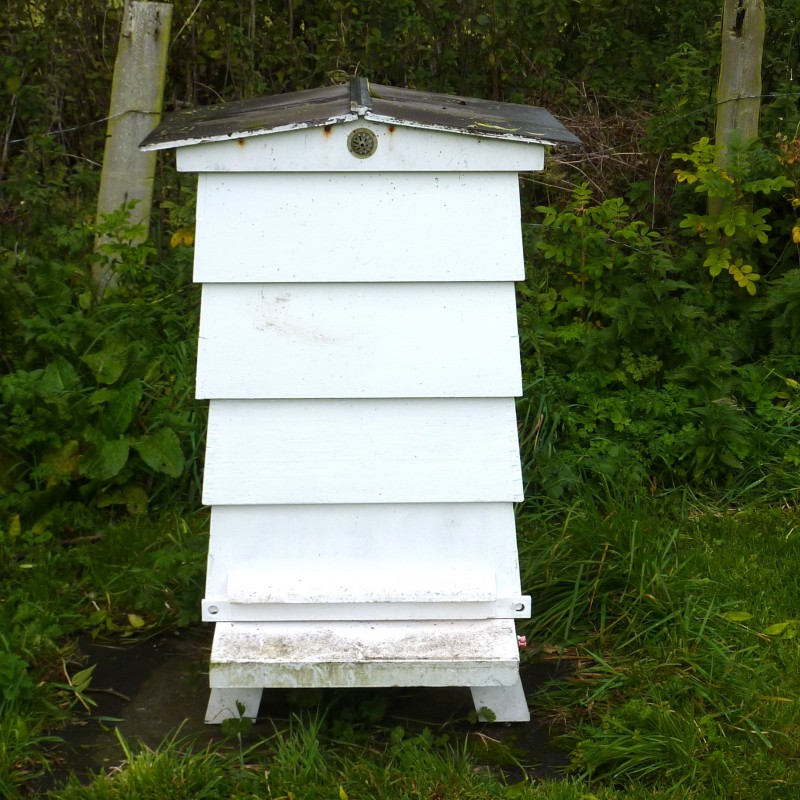
WBC

Named after its inventor, William Broughton Carr, this is the classic English country garden style beehive.

WBC hive

(Photo from English bee suppliers www.stamfordham.biz)

Is it not a thing of beauty? But rarely used nowadays as its double-walled design makes it cumbersome to move and inspect. Inside is a standard box shape hive which provides a small brood chamber suitable for a colony no larger than 45,000 bees.

The extra wall insulation makes it good in cold winters; however this can also mean it takes longer for the hive to warm up in the early spring sunshine. The extra wood also means extra cost – Thornes are currently selling a assembled WBC for £351.27 compared to £266.42 for a National or £298.02 for a Deep 14″x12″ National.

Brood frames – 10
Brood body dimensions – 460 x 419mm
Max no. of bees per brood box – 45,000
Comb area (inches sq) – 93

Smith

Mainly used up in the cold wilds of Scotland, and named after their Scottish inventor, W. Smith of Peebles, who originally designed it for heather working. The frames have the same surface area as National frames, but smaller handles or ‘lugs’, creating a slightly smaller box. The brood chamber is suitable for up to 50,000 bees.

Brood frames – 11
Brood body dimensions – 464 x 416mm
Max no. of bees per brood box – 50,000
Comb area (inches sq) – 93

Commercial (also known as Modified Commercial)

These hives have the same dimension as a National, but with no grooves on the side so that the hive is a simple cuboid shape. This allows the frames to be larger, with shorter handles, making the brood box suitable for up to 70,000 bees. The brood box and supers are picked up using small hand holds cut into the outer wall of the hive. These small hand holds can be hard to grip a super full of honey with, so some beekeepers use National supers on top of a Commercial brood box.

Ted Hooper recommends the Modified Commercial in southern Britain and the National in a “colder, more austere area”.

(Photo from Fortune Favors the Bold blog)

Brood frames – 11
Brood body dimensions – 464 x 464mm
Max no. of bees per brood box – 70,000
Comb area (inches sq) – 130

Dadant

Named after a Frenchman, Charles Dadant (1817-1902), who emigrated to America, where he designed this hive, believing Langstroth’s brood box to be too small. Not used very often in the UK, but the favourite hive in France, and popular with commercial beekeepers due to its large capacity. Introduced around 1863, it was used by Brother Adam at Buckfast Abbey to breed his gentle and productive Buckfast bees. It’s the largest Langstroth style beehive available, able to house 85,000 bees in a single brood box. Single walled.

Brood frames – 11
Brood body dimensions – 508 x 470mm
Max no. of bees per brood box – 85,000
Comb area (inches sq) – 159

In summary

A smaller hive is more suited to colder areas and less prolifically laying queens; a larger hive better for warmer areas and strong laying queens. I must confess I find it hard to get very excited over all this talk of dimensions. I also wonder why we are not asked to discuss top-bar varieties of hives, which are perhaps more common in the UK than, say, the Smith. The BBKA is perhaps still a very traditional institution! Think I won’t bother memorising all the frame sizes – all the numbers do my head in – instead will focus on doing well in other areas of the syllabus.

Posted in Exams, Hive types | Tagged | 17 Comments