A week after shook-swarming

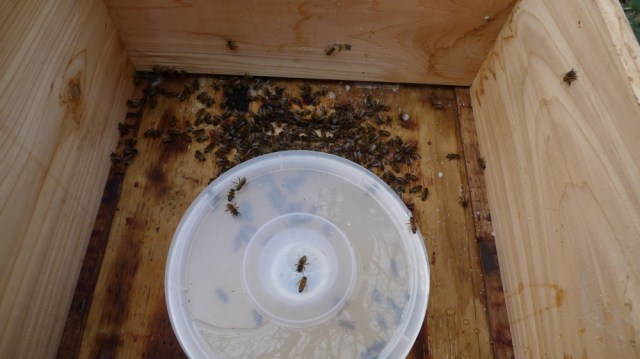
Had a quick peek in the hive today, a week after shook-swarming them. I had been a bit worried before I lifted the crown board up because lots of them had managed to drown themselves in the sugar syrup yet hardly any of the syrup had been drunk.

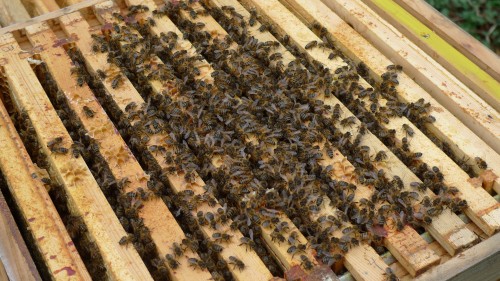
There was no need to be concerned though, as during the lovely weather this week they had managed to draw out nearly four frames, in which nectar and many shades of pollen were already stored – so they have quickly built up plenty of stores to feed new brood with. The queen has already laid neat rows of eggs, so next weekend I probably will see capped larvae, depending on when exactly the eggs were laid – eggs take three days to develop into larvae and worker larvae are capped six days after hatching out (9 days after being laid).

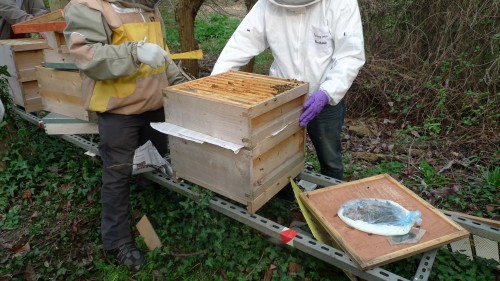
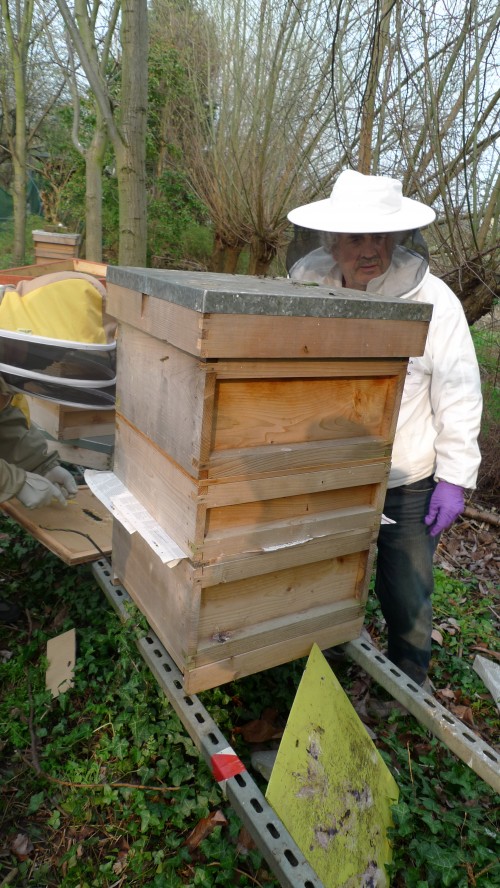
I feel very grateful that mine are doing ok so far, as there seem to have been heavy losses locally this year. About seven hives in the apiary have died out or look likely to. So I’ve been very lucky with mine. Today the other beekeepers combined two hives which weren’t doing so well – one was strong in terms of numbers of bees, but had lost its queen, the other was weak with only a couple of frames of bees. Some pics below…

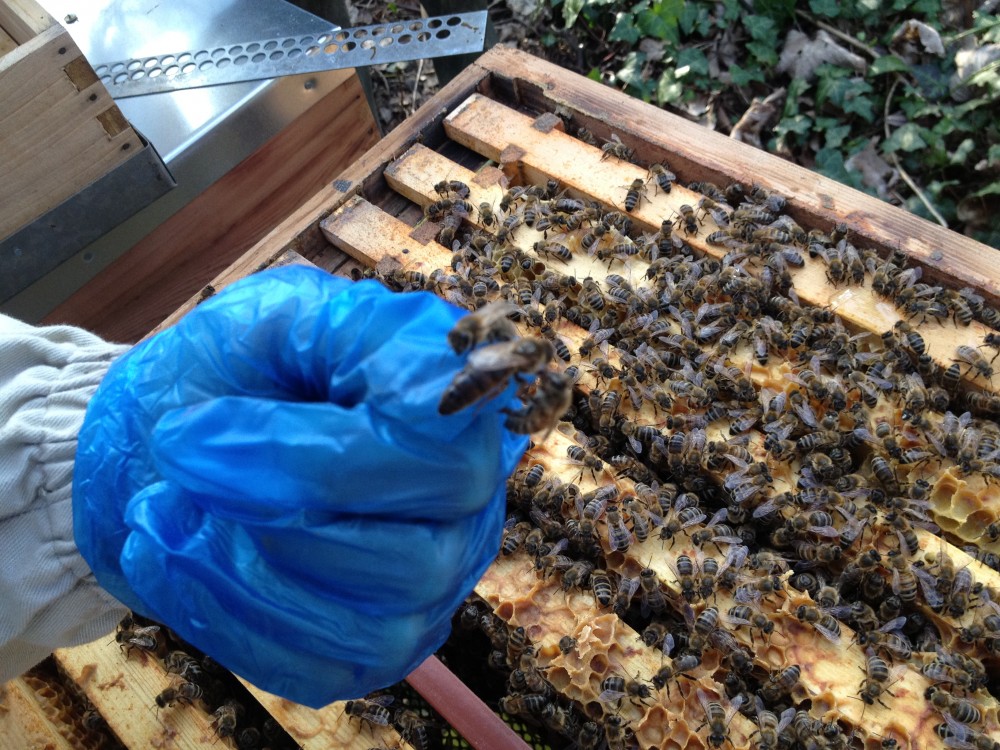
The strong colony, with only drone brood and no queen to be found

Shaking all the bees off the crownboard into the weaker colony…

Putting newspaper between the two colonies gives them time to get used to each others scents, so no attacking happens. They will chew up the newspaper in the next day or so and the two colonies will be united.

Putting the stronger colony on top…

And two become one.

Hopefully this colony can now go on to be a strong one.

Posted in Colony management | Tagged | Leave a comment

A successful shook swarming

Yesterday I shook-swarmed my hive at the apiary, with the help of Alan Gibbs, one of the very experienced beekeepers down there. It’s a spring clean for the bees, removing all their old comb with larvae cocoons/faeces, varroa and possibly diseases and giving them fresh new foundation to build on.

I was very glad to have Alan helping me as I’ve only done a shook-swarm once before two years ago. First, you put a ‘new’ hive and foundation frames in the location of your old one, with a queen excluder on top of the floor (between the floor and the brood box). Once the new hive is where your old one used to be, any returning foragers should arrive there.  You then remove four frames from the centre of the new hive and place them to one side.

Removing the frames creates a gap to shake your bees into. I must admit my shaking technique is rubbish, it took me at least three or four shakes to get all the bees off each frame whereas Alan could remove them all in one shake. I was also brushing stragglers off with a bee brush. My queen was unmarked as I hadn’t been able to find her last summer, again Alan’s help came in handy as he marked her for me with a smart blue dot, last year’s colour.

Before the queen was found we had been going through the frames quite slowly, trying to find her. Afterwards we speeded up with the shaking as we didn’t have to worry about damaging her. Alan encouraged me to get every last bee in, saying “during a shook-swarm, every bee is precious”. We waited as a fuzzy new young bee emerged, biting her way out and emerging into what must have been an unusual welcome – no workers on the frame, only human smiling faces. We shook her in too.

My colony was bigger and healthier than I expected, spread over the two brood boxes and having several frames of stores and a few of brood. The queen had even been laying drone brood as well as worker, which is not usually the colony’s priority at this time of year. It was sad to burn up the frames of brood afterwards, I had to keep reminding myself that it’s for their own good in the long run. Even before the shook-swarm no varroa were on the monitoring board this week; hopefully the vast majority of the mites will have been feeding on the relatively small amount of spring brood and will have been burnt up in the old frames.

See the FERA Beebase website for a free downloadable shook-swarm factsheet which is worth following step-by-step if you’re shook-swarming for the first time.

I have been kicking myself today as I popped back to top up their sugar syrup and found this:

The bees you can see inside the feeder are dead, I forgot to put anything covering over the other crown board hole and they’ve all got up into the hive roof. Then some must have climbed into the feeder through the lid, before falling in and drowning. I stupidly didn’t bring a smoker or beesuit today as it’s a hassle to drag all my equipment on the two buses I take down to the apiary. So I think I’ll have to go back sometime this week and try and smoke them all down so I can cover over the hole and stop them getting in the feeder. For now I’ve put a brick on top of the feeder to weigh down its lid and try to get the gap too small for them to get in.

See also:

Going for a walk along part of the Grand Union Canal in Hanwell today lots of blossom was out and I spotted this worker diving into the white flowers:

An enormous bumble was also foraging on the blossom, she was so heavy the flowers were breaking under her weight. Good to see that some food is out there for them and spring is on the way at last. It was even warm enough for a drink outside in The Fox pub afterwards 🙂

Posted in Colony management | Tagged | 7 Comments

6th Honeybee behaviour revision post: honey bee foraging

This might be my last revision post for my BBKA Module 6 Honeybee Behaviour exam on Saturday! And I’ve only got half way through the syllabus.

Section 6.7: the behaviour of the foraging bee and its work methods in the field including orientation;

Which honey bees forage?

It is the oldest female workers in the hive, aged between 3-6 weeks of age, which forage for the colony. They literally work themselves to death doing so. The lifespan of a worker bee is dependent not so much on chronological age as the amount of work she does. Workers have glycogen reserves in their flight muscles which last for approximately 800km of flight; after these are exhausted the bee is unable to create more and will collapse and die.

During the foraging seasons around 25-30% of the colony’s population is potentially a forager bee, depending on the availability of flowers and the needs of the colony. Once bees are old enough to forage they will remain doing this task for seven to eight days on average before they die. So the bees you see returning to the hive laden with pollen are likely to be reaching the end of their days.

Albanian honeybee on a poppy

Albanian honey bees on poppies.

What do honey bees forage for?

They leave their home to collect four essential products: pollen, nectar, water and propolis. What they collect is dependent on time of year and temperature, for example nectar is generally collected at minimum temperatures of 12-14°C or above and propolis is too hard to collect at under 5°C. A study by Ribbands (1949) found that around 58% of bees collect nectar only, 25% pollen only and 17% both nectar and pollen.

Bee on blue flower 2

Honey bee foraging at Osterley Park, West London


How far do they go?

Honey bees generally forage within a 1km radius from the hive, but in extreme cases go up to 13km for particularly rewarding sources. A study has found that they forage for nectar up to 13km, for pollen up to 6km and for water up to 2-3km (‘The Foraging Honey Bee’, JJM van der Steen, BBKA News February 2015). Pollen is a lighter load, but nectar gives them a higher energy return relative to effort (8:1 gain pollen, 10:1 gain nectar if a 40% sugar nectar). Foraging trips usually take ten minutes for nectar and thirty to eighty minutes for pollen – perhaps pollen is more time consuming to collect because it needs to be brushed and packed into the bees’ pollen baskets.

How much do they collect?

On average loads of 30-50mg of nectar, 16mg (8mg x 2 pollen baskets) or 25mg of water are collected – impressive considering a honey bee only weighs about 100mg. The amount collected depends on the distance flown to find the nectar source and on the nectar sugar concentration, with bees collecting less of a nectar if it is low in sugar. Both nectar and pollen collectors need to visit anywhere from 1-500 flowers to collect a full load and will go on an average of 10-15 trips a day.

It takes four pounds of nectar evaporated down to produce one pound of honey; it takes about a dozen bees to gather enough nectar to make just one teaspoon of honey, and each of those dozen bees needs to visit more than 2,600 flowers. The amount of flowers available place a limit on how much honey a colony can produce to meet its needs – no location supports an infinite amount of colonies.

Annually, an average colony requires 60-80kg of honey, which requires a minimum of 125kg nectar to be collected and then evaporated down to create honey. This will take the colony around 4,000,000 foraging trips. The numbers are staggering and really make you appreciate the colossal effort the bees go to in order to produce their golden prize. Large amounts of protein in the form of pollen is required too – 15-30kg pollen annually, depending on the amount of brood in the colony.

Albanian honeybee on clover

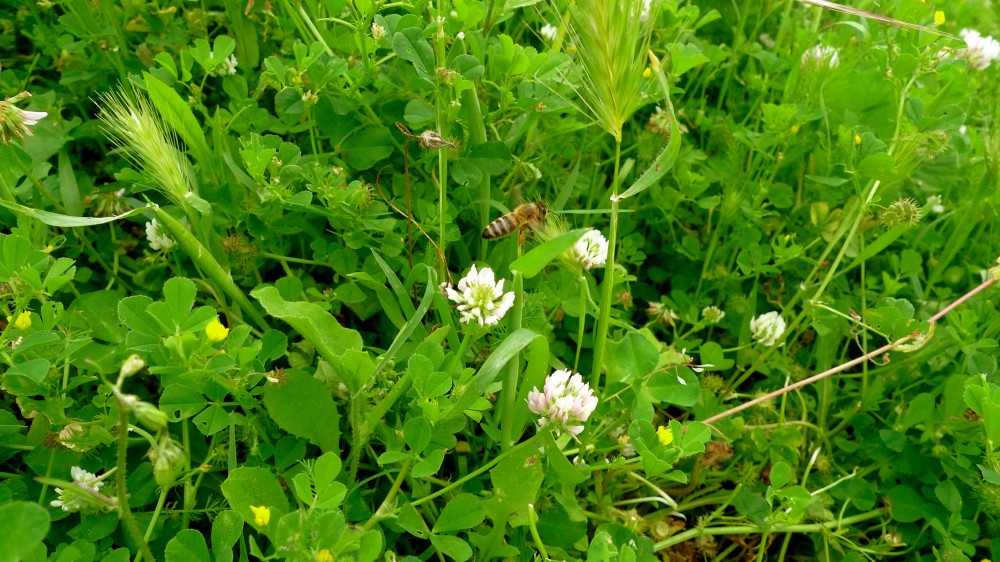
White clover is a honey bee favourite


Finding the flowers…

Workers watch the round, transition and waggle dances given by their fellow foragers and judge from the sugariness of nectar samples offered, the number of dancers for a particular crop and the enthusiasm of the dancers in terms of waggle intensity which flowers are best to visit. To help themselves orientate and successfully follow the dance instructions they rely on the direction of the sun, polarised light patterns if it is a cloudy day, the smell of flowers and the earth’s magnetic fields (workers have cells with iron containing granules in their abdomen). Younger bees rely more on wagtail dances to find forage, older bees tend to remember the location of flowers.

New discoveries are happening all the time into the ways flowers attract bees and how bees detect the most promising flowers. In February 2013 the journal Science published a paper on ‘Detection and Learning of Floral Electric Fields by Bumblebees‘, by Dominic Clarke, Heather Whitney, Gregory Sutton and Daniel Robert.

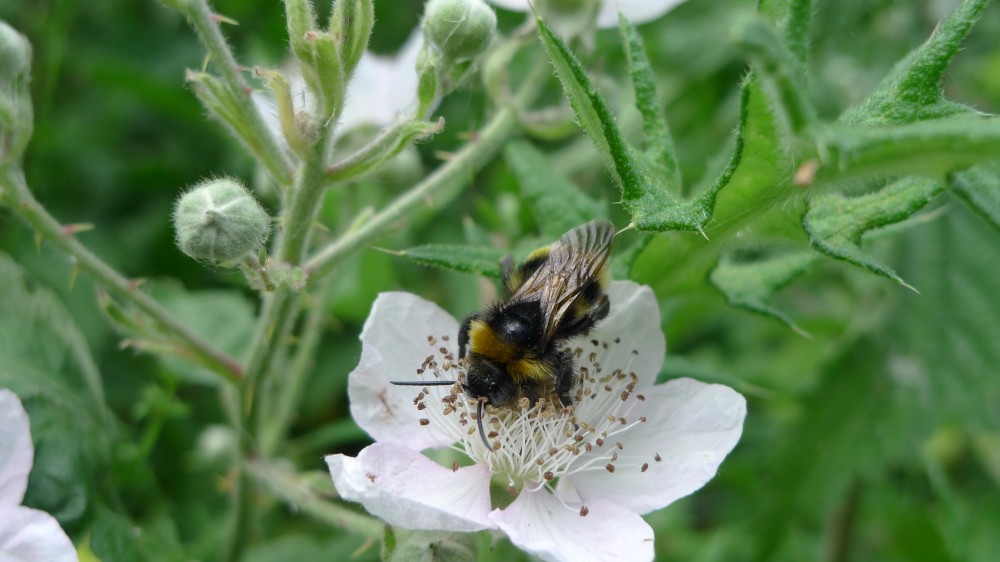
Bumble on blackberry bramble

Scientists have known for a long time that bumblebees build up a positive electrical charge as they rapidly flap their wings in flight; when they land on flowers, this charge helps pull pollen towards their hairs. Now Daniel Robert and a team at the University of Bristol have found evidence that bumble bees are aware of these electric fields and use them to guide their activities, to see if flowers have been recently plundered by other bumblebees or not. These findings may well apply to honey bees too. See the Nature.com article ‘Bumblebees sense electric fields in flowers‘ for more information on this discovery.

Coffea flowers

Another major finding reported during 2013, again in Science, is that some plants, for example the coffee plant (Coffea), use caffeine to manipulate the memory of bees and tempt them back. Their nectar contains low levels of caffeine, which appears to enhance the long-term memory of bees for where those particular flowers are located. The plants benefit from repeat bee pollination by producing more fruits and seeds. Read more about this on the National Geographic website – ‘Bees Buzzing on Caffeine‘.

Their work methods…

To collect nectar bees land on the flower, insert their proboscis inside, and pump nectar up into their mouths. Sometimes the bees can cheat the flowers by gaining their nectar reward without picking up any pollen, for example bumble bees occasionally chew holes in the side of blueberry flowers to get at the nectar and honeybees take advantage of these holes afterwards.

There are many different ways of pollen collection:

  • Open flowers – petals are arranged in a broad, open cup around the flower’s pollen organs. the bee bites the anthers, which produce the pollen (male reproductive cells) with her mandibles and uses her forelegs to pull the anthers towards her body. Examples of this are orchard flowers like apple, cherry, pear, plum.
  • Tubular flowers – bees insert their proboscis into the flower’s central nectariferous areas searching for nectar; as they do this pollen gets stuck to their mouthparts and legs.
  • Closed flowers – bees force the petals apart with their forelegs and gather pollen on their mouthparts and legs.
  • Spike or catkin flowers – bees run along the spikes or catkins picking up pollen on their body hairs.
  • Presentation flowers – bees press their abdomen against infloresence marks, causing a pollen mass to be pushed out of the flowers.

Honey bees are particularly efficient pollinators because they tend to return to the same flowers each day as long as there is a good nectar flow. They will visit their crop of choice at the same time each day, as flowers tend to release nectar at a particular time, for example chestnut trees produce morning nectar.

Below is a bee on an apple flower…unfortunately apple nectar is  low in sugar for a spring blossom and not very attractive to bees. However, the pollen, which is a greenish to pale yellow colour, is useful.

References:

  • The Foraging Honey Bee’, JJM van der Steen, BBKA News, February 2015, p.43-46
  • The Honey bee Around & About, Celia F. Davis (Bee Craft Ltd, 2009)
  • Plants and Honey bees: Their relationships, David Aston and Sally Bucknall (Northern Bees Books, 2009)

More revision/Module 6 themed posts:

Posted in Bee behaviour, Exams | Tagged , , | 2 Comments

5th Honeybee behaviour revision post: bee communication

Another revision post for my BBKA Module 6 Honeybee Behaviour exam on Saturday.

Section 6.5: the methods of communication used by the honeybee including food sharing (trophallaxis), dancing, scenting and vibration;

Of all the ways human beings communicate, probably the only one we have in common with honeybees is dancing. We don’t generally regurgitate food into each other’s mouths or waggle our bum in the air to release pheromone messages, for which we can all be grateful.

In bee world, the main communication methods between one bee and another are:

  • Trophallaxis (fancy word for food sharing)
  • Pheromones
  • Dancing
  • Vibrations

Many of these can occur simultaneously, for example during the waggle dance foragers will offer other bees a taste of the nectar source.

The world of bees: the colony is in constant communication

Trophallaxis

A Greek commenter below has kindly explained that ‘trophallaxis’ is an ancient Greek word over 5,000 years old, from the words trophi (food) and allaxis (exchange). Thanks Alex!

One of the ways a guard bee patrolling the hive entrance recognises fellow colony members is the colony’s common smell. Experiments using coloured nectar have found that within 24 hours of nectar being brought back by just ten foragers 50% of the colony had the nectar within their honey stomach. If several colonies are close by and sharing large areas of a single crop such as rape, they will often become irritable because lots of drifting occurs and they cannot tell each other apart.

Trophallaxis more often takes place by an older worker giving to a younger worker rather than vice versa. One bee will beg from another by pushing its tongue towards their mouth parts. The giver bee will respond by opening her mandibles, regurgitating a drop of nectar and pushing it forward on her tongue.

During trophallaxis the antennae of the two bees will touch, allowing them to pass on scent messages such as queen substance.

Pheromones

Smell is as useful to bees as sight is to humans. They live in a world of scent which we unfortunately have reduced and polluted by introducing cars and concrete where flowers once wafted their heavy perfume into the breeze.

Pheromones were only discovered in the 1950s and are substances which are secreted to the outside by an individual and received by a second individual of the same species, in which they release a specific reaction which may be behavioural, developmental or physiological. Some important honeybee pheromones:

Pheromones which are attractive to bees…

  • Queen substance, mainly made up of the queen’s mandibular 9-oxodec-2-enoic acid (9-ODA) secretion, which attracts drones on mating flights, keeps the colony calm and inhibits workers laying.
  • Open-brood pheromone – really two pheromones, brood ester pheromone (BEP) and E-β-Ocimene – is a pheromone given off by uncapped brood. It is attractive to workers and they are loath to leave uncapped brood, so can be used as a way to encourage a newly captured swarm to stay. It also has the effect of suppressing workers’ ovaries, preventing laying workers. Read more about this on Rusty at Honey Bee Suite’s blog post ‘What is open-brood pheromone?
  • Nasonov pheromone, a lemony aroma which is released by workers raising their abdomens in the air to reveal their Nasonov glands and fanning their wings to disperse the scent. It is used to mark scentless locations such as water or a new colony location. I have seen my bees do it when their hive was moved a couple of feet, presumably to help returning foragers find their way home. Similarly, when a virgin queen leaves the hive to mate, workers will mark the entrance with Nasonov pheromone to guide her back.A chemical called Geraniol is part of the scent produced by the Nasonov gland. It is so alluring to bees that they can be side-tracked while flying even by something as visually unappealing as a fishing line which has had its end dipped in geraniol (BBKA News, April 2018, p.117). Its seductive smell is also used by waggle-dancers to mark their flight trails and the flowers they lead recruits to.
The Nasonov gland being revealed at the tip of this bee’s abdomen
Nasonov gland scenting


Pheromones which are unattractive warning signals…

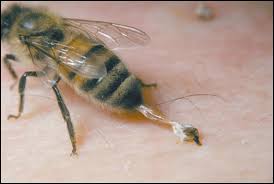
  • Isopentyl acetate, the primary alarm pheromone from the honeybee’s sting gland, a strong banana like aroma which attracts all the other bees to come and sting you. Queens and young worker bees up to three days old do not produce it.


Pheromones which are defence mechanisms…

  • 2-heptanone is a pheromone produced from the worker mandibular glands. Until as recently as 2011, it was thought to be an alarm pheromone used by guard bees to ward off robbers or used by foragers to scent-mark recently visited and depleted flowers.

However, 2012 research by a team of researchers from Greek and French organisations in collaboration with Vita (Europe) Ltd, the UK-based honey bee health specialist, has contradicted these theories. Their work uncovered for the first time that the compound has local anaesthetic properties. Independent tests have verified these findings.

Astoundingly, honey bees can use their mandibles to bite smaller parasites like varroa mites and wax moth larvae, in the process secreting 2-heptanone into the bite wound. The compound’s paralysing effect works for up to nine minutes, giving the time bee to eject the enemy from the hive – a particularly effective defence against pests which are too small to sting.

The ‘grooming’ behaviour which some beekeepers believe helps ‘hygienic’ honey bees to control varroa populations may reveal itself to be biting behaviour.

For more on this fascinating discovery:

Dancing/vibrations

The waggle dance is the famous one, but there are many different types of bee dances: round, transition, buzzing runs and the DVAV (dorsoventral abdominal vibrating dance).

The most amazing thing is that these dances are done in the dark of the hive. The bees rely not on watching the waggle dance but on feeling its vibrations to understand the complex information contained. Their Johnston’s organs at the base of their antennae pick up movement and vibrations and are most sensitive in the range of 200-350Hz. There are other similar vibration sensors in many of their joints, particularly in their legs. Whilst walking around on comb, bees are constantly experiencing the vibrations produced by the colony.

One of the simplest dances is the round dance, used to tell other foragers that there is high sugar content food somewhere within 15m of the hive, and to go out and find it. No indication of direction is given. It’s the dance that encourages robbing if a silly beekeeper leaves some honey out in the apiary.

The transition dance is usually given if food is between 15 and 100m away. It’s half way between a round dance and a waggle dance. Some species have a slower transition dance, others more direct.

The well-known waggle dance tells bees where food sources over 100m are located. It’s a figure of eight shape with the waggle in the middle. The dancer will stop to exchange the nectar she’s collected with watching workers so they know what they’re looking for.

The direction of the dance relative to the vertical face of the comb indicates the direction of the nectar or pollen in relation to the sun. As honeybees can perceive polarized light, the sun does not have to be shining for the dance to be successful. The nearer and more high quality the forage, the faster the dance and the more waggles in the middle.

Waggle dance diagram:

The DVAV (dorsoventral abdominal vibrating dance) is believed to be ‘get a move on’ message. A worker will mount or grab another bee and vibrate their abdomen on top of her. It’s used to recruit more foragers during a nectar flow and also on queens just before a swarm exits the nest.

The buzzing run seems to be an excited dance. The worker runs through the colony buzzing her wings. Other workers she runs into will pick up her movement and start running around buzzing too. It’s used as a signal for a swarm to exit the hive or take off once a new home has been found.

The shaking dance is thought to be a grooming request. A worker will stand on the spot shaking her body from side to side until another worker runs over and nibbles the difficult-to-reach spot between the thorax and abdomen.

References:

  • Fragrant clues: Geraniol points the way’, Jurgen Tautz, BBKA News April 2018, p.117
  • Honey factory – this post on ‘The Prospects of Bees’ blog has some interesting notes on honey bee dances, taken from a 2013 lecture by Dr. Thomas Seeley, a Professor in the Department of Neurobiology and Behavior at Cornell University and renowned bee genius.
  • Honey bee pheromones: common scents’ by Rusty Burlew, Honeybeesuite.com, February 2016 – explanations of honey bee pheromones, in alphabetical order by common name.
  • Why do bees buzz’, Dan Basterfield, BBKA News October 2013, p.13

More revision/Module 6 themed posts:
Posted in Bee behaviour, Exams | Tagged , , , , | 9 Comments

4th Honeybee behaviour revision post: social organisation of the colony

Another revision post for my BBKA Module 6 Honeybee Behaviour exam on Saturday.

Section 6.5: the social organisation of the honeybee colony including worker policing

Honeybee colonies rely on large numbers of more or less sterile individuals working together to raise young and look after the colony’s needs on behalf of a few reproductives, the queen and the drones. The colony system is based on individuals belonging to one of three castes, with labour divided up accordingly…

The Queen:

The star of the show, the colony’s egg laying machine.  The diploid (two sets of chromosomes) queen lays day and night during the spring and summer, with only short breaks to feed and rest.

Queen Lavender perched on Emma's finger

The queen has certain weapons to keep the egg laying to herself. 9-ODA (9-oxodec-2-enoic acid) is the main component of her ‘queen substance’ pheromone mix which inhibits the workers building queen cells and worker ovary development. The system usually works well, with a queen-right colony having on average only 0.1% of the workers producing adult males and only 0.01% of the workers having full-sized eggs in their ovaries.

Should the colony lose its queen, the absence of queen substance and a lack of pheromone given off by growing brood will cause the workers to raise a final set of drone sons. Eggs laid by workers can be spotted because their abdomens are too short to reach the bottom of the cell, so the eggs will be stuck to the side. More than one egg may be laid in a cell and they are laid in a haphazard, spotty manner rather than the methodical, neat laying pattern of the queen’s rows of eggs. In a queen-right colony workers will police the eggs, removing and eating eggs laid by their worker sisters because they will not smell of the queen’s pheromones.

A queen’s pheromones also stimulate comb construction and foraging in general, particularly for pollen. The minimum number of worker bees required to be together before comb building begins is lowest (50 bees) in the presence of a laying queen and progressively increases in the presence of a virgin queen (75 bees) and a dead queen (200-300). Queenless bees build no new comb no matter how big the colony is.

A honeybee queen and her court. The workers take it in turns to feed, lick and groom the queen, picking up some of her pheromones as they do so. They will then go on to touch other worker bees, helping to distribute queen substance around the colony.

The Worker:

Also diploid, workers live for about 40 days in the summer, taking on jobs in a sequence moving gradually out from the brood nest into the outside world. Winter worker bees can live for several months as they spend most of their time clustering in the hive, conserving their energy so they can survive to spring.

Bee on blue flower 2

The Drone:

The laziest colony members, drones are male and haploid, possessing only one set of chromosomes from an unfertilised egg. They have no father, only a grandfather. Although drones make little contribution to everyday colony life, their only purpose being to mate with a young queen, some beekeepers feel the workers like having drones around and handle differently if drones are removed. There is also some evidence that their large bodies can help keep brood warm in cold weather. 

To help them fulfil their role as mating machines, drones are big with strong abdominal and flight muscles. They have larger antennae carrying ten times as many sense organs as those of a worker, helping them detect the wafting pheromone of a young queen up in the sky. Having found a queen by scent, the drone’s enormous eyes come into play, helping him keep her in sight as he flies up behind her for mating.

Drones will often pay visits to neighbouring hives, perhaps in the hope that they may find a virgin queen to get a head start on the chase once she leaves.

A handsome drone in prime mating condition, his chunky thorax almost looking like a lion’s mane. Was he successful? We’ll never know.

Drone face

More revision/Module 6 themed posts:

Posted in Bee behaviour, Bee biology, Exams | Tagged , | 5 Comments

More revision & shook-swarm notes

One of the Ealing beekeepers, Andy Pedley, kindly gave me a lift to a BBKA module exam revision session held in Harrow yesterday – the exam is next week, eek! The lady running it, Jo Telfer, was really nice and went through some of the Module 6 past questions with me. She got us all to sit and try writing our answers to one of the essay style questions for half an hour, which was very helpful. She pointed out that timing is very important and we mustn’t be distracted by spending too long on questions not worth many points. Also writing essay plans in the margins is a good idea so examiners can see what you would have written about if you run out of time.

Went down the Perivale apiary afterwards to check on my bees. They were as busy as ever, the fondant Pat gave them three weeks ago was nearly completely finished and the foragers returning to the hive had all sorts of different colours in their pollen baskets. Here’s some pics…

Close up top view

If you look carefully at the bees below you can see the different pollen colours, from bright yellow on the mouseguard to oranges and browns on the bees higher up. Also the difference in the colour of individual bees, the madam flying in on the far left has quite a amber upper abdomen whereas many of the others are much darker, which suggests they probably had different drone fathers.


12th March 2011

After taking this photo I removed the mouseguard, as Jo told me she’s just taken hers off as it’s safe to do so now and it brushes some of the pollen off the bees as they come back in.

As if that wasn’t enough beekeeping activity for the day, I then went on to the monthly training session which the Ealing beekeepers have. We were mainly talking about the shook swarm we’re doing at the apiary next week, after which Pat gave us a talk on queen rearing.

Shook swarm notes

  • The Beebase website has a free downloadable shook-swarm factsheet which is worth bringing with us and following step-by-step
  • Bees on new comb do better than bees on old comb, which is why we do a shook swarm or Bailey comb exchange at the apiary every spring
  • We need to shake each colony into a hive we have prepared with a open mesh floor, a queen excluder on top of the floor, a brood box with eleven new frames (if a National hive) and a dummy board, a crown board and a roof
  • Also need 2-1 spring strength sugar syrup ready, made from white granulated cane sugar
  • After finding the queen and shaking bees into their new hive need to keep coming back to replace the sugar syrup, which they will sometimes consume in a day
  • Do on a nice warm day, preferably 15C but 12C upwards would do
  • Can cut out any honey stores in brood before burning the frames if you want to make mead or honey marmalade
  • The queen should be laying again within a week, after which you can take the queen excluder away
  • Can remove first 1-2 frames of brood the queen produces if you want to destroy as much varroa as possible, but this will delay your colony’s development

So next Saturday will be busy – Module 6 Honeybee Behaviour exam in the morning, followed by a Shook swarm with an unmarked queen in the afternoon if the weather’s warm enough. Don’t know which I’m more nervous about!

See also:

Posted in Colony management, Exams | Tagged | 2 Comments

Fondant munchers

Mixed emotions at the apiary today. Happiness because my bees are doing well, sadness because we looked at more dead hives today.

Bear in mind that the last lot of fondant I put on took two months for my bees to eat, and now look what they did to the new fondant block in just two weeks:

fondant

They’re really going for it! And bringing lots of a light brown/grey biscuity pollen back:

Anyone know what this pollen might be?

Wikipedia has a pollen colour chart, check out this blue Siberian squill pollen:

Sadly one of the apiary beekeepers, Stan, discovered today that one of his two colonies had died. I never know what to say when someone loses their bees, it must be so disheartening after the hard work put in during the year. There was a lot of dysentery so nosema may be to blame. A beekeeper with a microscope at home took one of the pooey frames with him to analyse. There were plenty of stores and it was a big colony so it wasn’t starvation or cold that was to blame. Another beekeeper’s nucleus had been invaded by mice which had eaten the honey out of the frames, even though the entrance hole was tiny.

We’re going to be shook-swarming at the apiary next week if the weather’s warm enough, but it’s been so cold lately we may have to wait another week.

A final link: http://www.beesinfrance.com/2011/black-white-bees/ – these photos of a black & white French Ashy Mining Bee are stunning, I’ve never seen anything like her. We need to look after our solitary bees too!

Posted in Uncategorized | Tagged , | 2 Comments

Honeybee & Bumblebee talk notes

On Saturday I helped out with the food at a seminar held by the Ealing & Harrow beekeeping associations. Baklava went down very well with the beekeepers, even though I cheated and used Cornish honey rather than Greek. Here’s a few notes I took from one of the talks by the brilliant Dr Juliet Osborne…

Dr Juliet Osborne, Dept of Plant & Invertebrate Ecology, Rothamstead Research Institute. ‘Honeybees & Bumblebees – what is happening to them?’

Pollination value

87 of the world’s crop species require bee pollination to some extent – 35% of global food production (Klein et al, 2007). These species include most fruit crops (especially orchard fruits), salad crops (e.g. courgettes, peppers, tomatoes etc), seed & oil crops (sunflower, rape, beans) and some crops which may surprise people (coffee, cocoa). It’s hard to estimate the value of bee & insect pollination to the UK crop market, but estimates vary from between £200m-430m.

Are bees dying out?

Because there have been many stories on Colony Collapse Disorder and disappearing bees in the media over the last couple of years, many people have the impression that honey bees are dying out or at least reducing in number. In fact the situation is more complicated that that. A recent study by Aizen & Harder (2009) found that globally, honey bee stocks are actually increasing (see abstract: http://www.cell.com/current-biol…. However they also found that we’re becoming more dependent on crops that depend on animal pollination, which may cause problems with global pollination capacity.

In some places honey bees have indeed declined – the UK, USA, USSR, Germany. But in others stocks have risen – China, Argentina, Spain. There have been no reports of high colony losses in the Southern hemisphere – South America, Africa, Australia – which are areas with either no or lower varroa levels. There is some evidence that high losses are perhaps associated with varroa & its associated viruses. Promising anti-varroa discoveries have been made recently, so hopefully in the future we might be able to better control it.

Dr Osborne’s work…

Bees have a variety of stresses in their lives, both inside the hive (e.g. beekeeper’s interventions, varroa mites, disease) and outside (e.g. pesticides, bad weather, lack of available forage). Dr Osborne and her team are currently carrying out a three year project looking at how these inside and outside factors combine to affect bees. They track foraging bees using tiny 16mm aerials which only weigh 3mg. When the forager arrives back at the hive they remove the aerial so she doesn’t get stuck inside!

The team are only into the first year of their project but have already made some interesting discoveries from their radar data. Having radar tracked the first orientation flights of young bees, they found that bumblebees start by doing complex loops and only do 1-3 practice flights before starting foraging. In contrast, honey bees do very simple loops and take up to 18 practice flights before foraging. It may be that honey bees follow waggle dances even in their first flights, explaining the ‘there and back’ simple loops.

Bumblebees are important too…

Sadly, in the UK most bumblebee species have decreased in range and one may be extinct. Many species are now only present in the West country, South East and Norfolk. There are about 23 species of bumblebees in the UK, six of which are common. Bumblebees don’t store honey, so they are very vulnerable in spring to changes in the weather, although they can forage in cooler temperatures than honey bees. They need plenty of food and undisturbed nesting sites, having a particular preference for vacated small animal nests. Some nest underground in shortish turf; the most vulnerable are the surface nesters, whose nest will be destroyed by any management of the turf.

We have one newcomer here, the handsome ‘tree bumblebee’, Bombus hypnorum. It was first seen in 2001 near Southampton and has since spread rapidly northwards. It loves living in bird nest boxes and can unfortunately be quite aggressive compared with our native species, sometimes stinging without provocation. A pic of Bombus Hypnorum (see more on the BWARS Bees, Wasps & Ants Recording Society website):

Dr Osbourne reminded us that gardens are good habitats for bumbles. They like undisturbed, un-mown areas best, in tussocky grass. Old bird boxes and compost heaps are also good. In her opinion, the bumblebee bee boxes you can buy from garden centres just don’t work! So those of us with gardens should be letting them grow as wild and messy as possible if we want to encourage bees and other wildlife. As beekeepers we should be encouraging the public to keep any unwanted bumblebee nests in their gardens, and if they cannot be persuaded, try to move the nest to somewhere suitable. This is best done at night when most of the bumbles will have returned home.

Posted in Uncategorized | Tagged , , | Leave a comment

3rd Honeybee behaviour revision posts: the queen’s egg laying behaviour & seasonal variations in the size of a colony

On with the revision posts for my BBKA Module 6 Honeybee Behaviour exam. I’m trying to work my way through the 21 sections on the syllabus, but the exam date is March 19th, so I’d better start doing more than one of these a week!

So, section 6.3: the queen honeybee’s egg laying behaviour and its relationship to changing circumstances in the hive and external factors relating to climate and season;

and, since it’s related…

6.4: the seasonal variations in the population size of a honeybee colony and an explanation of such variations;

Queens can mate up to 4 weeks after they emerge; after this time it is too late for a queen to mate and she becomes a drone layer. Given good weather, queens generally mate in the first 2 weeks of their adult life. 

Once the queen has mated, she soon begins laying eggs, usually within the space of a week after mating. So a good young queen should be mated and laying eggs by 21 days after emerging; but allow an extra week if the weather has been poor. 

Queen Rose

One of our 2011 queens, Queen Rose

Her two ovaries are enormous compared to a worker bee’s, with each of the ovaries consisting of 150-180 egg producing ovarioles, compared to 2-12 in a worker ovary. Her spermatheca can hold up to seven million sperm, and it usually takes 2-4 years after mating before all the sperm are used up.

She inspects each cell carefully before backing into it and producing first a sticky substance for the egg to stick to and then the pearly white cylindrical egg, laid at the bottom centre of the cell in a standing position (a laying worker’s abdomen will not reach the bottom of the cell, only the cell sides). Think of her as a bee version of Kim & Aggie from the Channel 4 show ‘How Clean is Your House’, as she is extremely picky about how well the worker bees have cleaned the cells and will not lay into one which has not been cleaned to her satisfaction.

She uses her forelegs to judge the size of the cells built by the worker bees – worker cells are smaller, drone larger. If the cell size is that of a worker, she will release a sperm on top of the egg she lays. If no sperm is attached to the egg, it will develop into a drone. After each egg is laid she moves onto the next cell and repeats the process. It must be an extremely monotonous life after the excitement of flying high in the sky for her triumphant mating flights.

Seasonal differences

A young, well-mated queen’s laying rate depends on a few factors:

  • supply of food, particularly pollen
  • seasonal factors, such as temperature
  • if the colony is going to swarm soon

Winter – spring

The colony huddles together in a ball shape during winter, keeping the queen warm in the centre. The colony’s population will drop to around 10-15,000 and the queen will be laying very few eggs, because only at the centre of the cluster will the colony be able to keep brood warm enough.  In the UK there is likely to be a broodless period during December and possibly longer, during which time the bees can drop the cluster temperature to 21-24°C.

Even within the depths of the cluster, the worker bees can sense the minutes of daily sunlight beginning to increase following the shortest day of the year, the winter solstice on 22nd December. Within a few days of the solstice, they will slowly begin to raise the cluster to a warmer brood-rearing temperature of 34-35°C. This increase in warmth triggers the queen to begin to lay a small number of eggs.

As plants begin to flower in early spring, and workers return laden with the first spring pollen, the queen’s lay rate increases. This increase will only be interrupted by periods of poor weather. A colony trying to raise brood in the winter, before the first flowering plants appear, will need to rely on good supplies of pollen collected during the previous season.

Another of our 2011 queens, Queen Lavender

Another of our 2011 queens, Queen Lavender

Spring – summer

In the UK the main nectar flow is often over a short three-week period in May-June. As long as enough pollen is being brought in to produce brood food, at the height of the season the queen may lay more than 1,500-3,000 eggs a day, depending upon her race and strain – more than her own body weight in eggs. Apart from short rest periods of 5-10 minutes, she will do this round the clock. Laying such a huge amount of eggs takes a great deal of energy, so a ‘court’ of workers follow her around supplying her with food. The colony should soon have between at least 30,000-60,000 bees, causing a high-risk of swarming, which will reduce the colony population by up to 50% or more if there are after swarms.

Summer – autumn

After peaking in May-June the queen’s lay rate will start to drop off from July onwards, as the colony switches to concentrating on building up stores to survive the coming winter. As less brood is being laid, and workers live for about 40 days, by mid August there is a rapid reduction in worker population. There will be less available forage and the temperature will cool as winter arrives. Over the winter she will either lay very few eggs or stop laying completely.

Swarming

It is the worker bees who make the decision to swarm, usually as colony population peaks. In the week before swarming they starve the queen to reduce her size and get her light enough to be able to fly. They also act as particularly vicious personal trainers, chasing her around the frames and shaking, pushing and biting her to force her to keep moving. The reduction in food and weight loss causes her egg laying rate to fall before she leaves with the rest of the swarm.

References:

  • Celia Davis, 3,6,12 and Counting, BBKA News, April 2013, p9-10. 
  • Dan Basterfield, Very Simple Queen RearingBBKA News, April 2013, p19-20

More revision/Module 6 themed posts:

Posted in Bee behaviour, Bee biology, Exams, Queens | Tagged , | 7 Comments

Dead bee inspecting, shook-swarming and bees in Oman

Last week it was cold and wet and no bees were to be seen. Today was surprisingly warm, and taking a look at the floods of bees zooming into hives around the apiary I decided to put my bee suit on.

crocuses

There were loads of my lot hob-nobbing on their front porch, smeared with a bright yellow pollen – possibly from the snowdrops or purple crocuses which have sprung up around the apiary? To my horror, I found when I popped my head in the hive that they had completely finished off their fondant. Luckily Pat, one of the many nice Ealing beekeepers, has some at home which he sold me; he’s going to pop it in my hive when he goes down to the apiary on Tuesday.

pollen covered bees

bee close up

Went on to the monthly meeting the Ealing Association has in a local scout hut, every second weekend in the month. This week John Chapple (the Queen’s beekeeper!) brought in a hive from his garden, which had sadly died (a living, or not-so-living example, as he put it!). He wanted us to try and guess what had killed them off. A lot of dead bees had fallen through to the floor, where something had eaten off their heads. Some earwigs spilled out of the hive still wiggling away, but the gardeners amongst us pointed out that earwigs are vegetarian, so spiders got the blame for the beheadings. John eventually gave us his opinion that the cluster had got split into two, causing them to die of cold. There were plenty of stores but not enough bees to form enough of a cluster. John pointed out that with most of his hives he punches a hole through the centre of each frame to allow bees easy access through, which he hadn’t done with this one.

Next we were given a reminder about how to do the ‘shook swarm’ procedure which we need to carry out at the apiary sometime in March. The National Bee Unit have on their website a free step-by-step pdf factsheet on how to do this. Very basically it involves shaking your bees into a new hive with new frames of foundation and burning all your old frames, in order to help prevent disease. Since everyone at the apiary started shook swarming about four years ago there hasn’t been a case of European Foul Brood, whereas before it used to reoccur almost annually. I’m a bit nervous about doing it, both because the bees aren’t necessarily grateful for being shaken into a new home and because my queen is unmarked, so I hope I can find her. If you shake a queen in you risk damaging or losing her, so you’re supposed to find her first and keep her safely in a queen cage in your pocket.

Finally John gave us a fascinating talk about his travels to see bees in Oman. There are not enough bees to pollinate the palm trees there at the moment, so the palm trees are being pollinated by hand by cheap labour. The government is therefore keen to encourage beekeepers, and providing someone has passed an exam will supply them with free queen cells. Bees are also valued for their honey, which fetches a great price over there. This is partly because Omani bees are smaller and produce much less honey than western Apis Mellifera honey bees – about a frame and a half of honey per hive a year. The bees are usually kept in a single box with no supers as they do not need extra space for stores. John said the Omani government are extremely well-informed about bees, as they recognise that their oil will eventually run out and they may need to fall back on their previous top exports, dates and limes.

Bees in Oman face several difficulties ours do not here, from the danger of the heat rising to levels at which their wax melts to persistent predators such as giant hornets and ants. Omani hives have hornet traps and their legs stand in pools in oil to prevent ants climbing up. The traditional way of keeping bees is in hollowed out palm trees, but nowadays most beekeepers use Langstroth style hives. John has taken lots of photos and the plan is to have a little slide show, so I will look forward to seeing those.

This isn’t related to anything above, but I found this great photo on the internet of a man far braver than me:

Posted in Colony management, Disease prevention | Tagged , , , | 5 Comments