Spring seems far away

The apiary snowdrops had progressed a little further in their journey up and out of the earth this weekend, but it was a bleak damp day for us beekeepers to be huddling round our cups of tea. No bees were flying. I longed for the hum of a summer’s day.

Bought a jar of pollen collected by a local beekeeper for £4. I plan to feed it to my bees, to try and help them out as the queen starts laying more brood. First I must mix the pollen up into a patty, but finding a recipe is proving difficult. Most I can find on the internet feature pollen substitute rather than pollen itself. This recipe looks quite good, except that I would need a lot of brewer’s yeast. Anyone know a good recipe?

I have been revising for the BBKA Module 6 exam I’m taking in March (eek!) by reading hardcore bee biology textbooks. No pretty pictures of bees on flowers in these; instead about twenty scientific studies are referenced on each page and the only pictures are anatomical diagrams or graphs relating to developmental time scales. I must admit there are times I find it hard to concentrate; there are so many different numbers to remember and the chemical names of pheromones (e.g. 9-ODA – 9-oxodec-2-enoic) are not named for ease of remembrance.

But even if I fail the exam, which is quite possible, at least I will have learnt lots. The more I learn the more fascinating yet mysterious bees seem. For example, each year Drone Congregation Areas, where the drones eagerly await their queen, exist in the same place. Drones do not survive the winter, so this knowledge can’t be passed down from drone to drone. We still just don’t know how they pick the areas, with theories including topographical features and even magnetic effects, as drones develop large quantities of magnetite in their abdomens.

A nice thing to end on – someone (thanks Mo!) sent me this fab link today: http://www.wired.co.uk/news/archive/2011-01/24/bee-feeding-dress. “Artist and insect-lover Karen Ingham has created a range of clothing covered with a nectar-like food source that attracts and nourishes bees.”

Posted in Exams | Tagged | Leave a comment

January’s bees are flying

Visited my bees for the first time since mid-December to wish them Happy New Year. To my surprise, they popped their heads out of the hive to see me (or, more likely, to poo) and were flying all over the place. It’s got milder over the past week, but still wasn’t that warm today – maybe about 13°C?

Here’s a couple of them hobnobbing together:


Just after taking this photo one landed on my bare hand. Not wanting to get stung, I carefully lifted her up to the roof and luckily she walked off my hand. I took the roof off to peek inside and was happy to see loads of bees under the crownboard nibbling away at their fondant, which they ignored for ages when I first gave it to them. Such a relief to see they survived the snow last month, in what was the coldest December documented since nationwide records began 100 years ago, with an average temperature of -1C. Despite the cold, it may be that the weather actually suited those bees in colonies large enough to keep warm. Beekeepers always say wet is worse than cold – dampness can cause stored pollen to go mouldy – and December was also an unusually sunny and dry month.

My bees haven’t got through the winter yet. Brood rearing starts in early spring, initiated by increasing day length. More losses from starvation occur when rearing begins than during the depths of winter. One of my fellow beekeepers opened their hive today to find all the bees dead on the comb. Felt really bad for him and just hope it doesn’t happen to my little bees.


Posted in Uncategorized | Tagged | Leave a comment

Module 6 here I come

I’ve taken the probably over-ambitious decision to take the British Beekeeping Association’s Module 6: Honeybee Behaviour written exam in March. I have about 9 weeks left to revise, which I’ll need because when I downloaded a past exam paper this week I discovered I could only answer one question!

The BBKA offers seven exam modules: Honeybee management, Honeybee products & forage, Honeybee diseases, Honeybee biology, Honeybee behaviour, Selection & breeding of Honeybees & Honeybee management & history. I’m jumping straight to Module 6: Honeybee behaviour because it seemed the most interesting – sorry Module 1 but I don’t care much about memorising the different frame sizes of various hive types!

Beekeepers who pass all eight modules plus the practical ‘Advanced Certificate in Beekeeping Husbandry’ receive the official BBKA accolade of ‘Master Beekeeper’, which my Basic Assessment examiner last summer had sewn onto her beesuit.

Here’s a few questions from the Module 6 past paper I purchased:

Q1: Name in full the primary pheromone from a virgin queen that attracts drones on her mating flight

(A: 9-ODA – 9-oxodec-2 -enoic – really hope I don’t have to spell this out in full!)

Q4: Where in the hive is the ‘dance floor’ said to be located?

(A: the vertical face of the comb near the entrance, where worker bees do their dances to show other bees where they’ve found some cracking flowers)

Q10: The repellent pheromone that acts to deter foragers from an already visited flower is which of these options -Heptanone b: Geraniol c: 9-HDA d: Iso-pentyl acetate?

A: 2-Heptanone. The pheromone 9-HDA is emitted by queen bees for a calming influence that promotes stability of the swarm. Geraniol is a pheromone produced by the scent gland of honey bees and attracts other bees to the location. Isoamyl acetate and 2-Heptanone are both alarm pheromones used by bees. The former is used as a beacon to attract other bees and provoke them to sting, while the latter is a potent pheromone used by foragers to scent-mark recently visited and depleted foragers, which indeed are avoided by foraging bees. (Answer given to me by Andrew Brown on the Q&A website Quora, which is a bit like Yahoo Answers only good).

Q14: List three ways in which trophallaxis is used to advantage by honeybees

A: Trophallaxis is just a fancy word for food sharing. During the exchange of nectar bees pass on scent messages. Food is also exchanged as part of the wagtail dance from the dancing bee to onlookers, so they know what they’re heading for. Sharing a common food source gives bees a distinctly similar smell, helping bees in a colony to recognise each other (similar to us eating brussel sprouts at Christmas?).

Some of the questions require one word answers, others are mini-essay style questions. They aren’t exactly general-knowledge stuff – I could hardly find the answers to any within my enormous edition of Collin’s Beekeepers Bible. To revise I will be buying books on the recommended reading list and have also downloaded the excellent free study notes available from the Mid Bucks Beekeepers Association blog, which gave me the answers to the questions above.

Today the local Ealing beekeepers met up for the first time since Christmas and we watched a video of beekeepers in India. The Asiatic Apis Cerana honeybees which beekeepers there keep are very gentle, so much so that the beekeepers in the video wore no protective clothing and were reaching in with ungloved hands to break off comb from hives. They also were moving bees from one hive to another by scooping them up with bare hands! Made me feel like a right coward for always having my beesuit firmly on.

There was also some discussion about the need for secure places on allotments or similar locations where beekeepers can keep bees. The Ealing association knows of about 170 hives in the Ealing area – as not all beekeepers are members there are probably about 200-300 hives in total. So we’re beginning to feel a little squashed for space! Suitable places are hard to find because vandalism is such a problem. So if anyone in the local area wants to volunteer their garden or allotment as a space for a hive Ealing beekeepers would love to hear from you.

Posted in Bee behaviour, Exams | Tagged , | Leave a comment

New varroa treatment

The Guardian reported yesterday on some promising sounding new research into a way to make the varroa mite self-destruct.

The treatment involves introducing harmless genetic material which encourages the mites’ own immune response to prevent their genes from expressing natural functions, causing them to self-destruct. (I in no way understand how this works, but this is what the article says!) Tests by other scientists have shown the treatment can be added to hives in bee feed. The bees move it into food for their young, where the varroa hides.

The original research paper is here: http://www.biomedcentral.com/content/pdf/1756-3305-3-73.pdf

If we can get nurse bees to feed their brood a treatment that kills varroa, this would be ingenious indeed. It’s one thing carrying out tests under lab conditions and another getting it to work in real life though. Bees are stubborn creatures and I’ve found they’ll often ignore any food I give in favour of what they can collect outside, which is presumably tastier. Perhaps they’ll develop additional ways for beekeepers to give the treatment, such as by syringing over the brood.

I agreed with the comment left on the Guardian story by BeesinArt on the problems caused by monoculture:

“Certain crops though, such as borage, can gain up to an extra 1/4 yield per acre or so, if there there is one hive of bees placed alongside the field per acre. It’s lovely to see 100 beehives alongside a 100 acre field of borage. Imagine the clouds of honeybee workers over the borage field. But, although one can see many bumblebees taking advantage of the borage bonanza, it only lasts a few weeks at most. What then is there for the bumblebees when this mono crop is cut and harvested? Devastating then to see the same bumblebees desperately seeking nectar from horizontal borage plants cut the day before!”

This is the main reason I think organic farming is a good idea, because organic farms tend to plant a wider variety of crops and plant borders with wild flowers. Jordan’s (the oats & muesli people) are one of the companies doing great work in helping bees by supporting farmers to plant more nature friendly plants. Unfortunately the trend in farming certain fruit & veg recently seems to be towards developing enormous pest-free greenhouses which wild bees can’t even get into.

Posted in Disease prevention | Tagged , | Leave a comment

Giving acid to bees

Oxalic acid time at the apiary today. Oxalic acid is a naturally occurring acid that’s one of the beekeeper’s best weapons against the evil varroa mite – it burns their feet and they drop off the bees!

We do this treatment in December because there should be no brood now – if brood was present the acid could damage it. Also, no brood means all the mites are out on the adult bees, where we can get at them.

A group of us proceeded round the apiary one hive at the time, dribbling a pre-mixed and slightly warmed solution of 3.2% oxalic acid mixed with sugar syrup. 5ml at a time goes in-between each frame with bees on.

We had a smoker but only needed to use it on a couple of particularly feisty hives. One poor lady had her top half covered up in a jacket-style bee suit but still got stung on the legs through her trousers! I was relieved to find my bees alive and as well behaved as ever.

Dribbling the acid on a nuc:

Posted in Disease prevention | Tagged , , | Leave a comment

Christmas candy

Today I popped down quickly to see my bees, or at least their hive. With the drop in temperature the apiary was completely still, with no bees flying at all that I could see. The snow’s melted by now, so I wasn’t able to take a pretty picture of snow-topped hives (unlike The Surrey Beekeeper, who has taken some stunning ones), but here’s what their Christmas fondant looks like:

I lifted it up quickly to see if they’d been nibbling on it, but there were no signs that they had. They have two brood boxes of honey stores, so perhaps they’d rather have yummy flowery tasting honey than boring sugar fondant. They will not be eating very much in general, as during winter they huddle together in a rugby-ball shaped mass and slow their activities right down to a point where they are nearly comatose. If you’re interested, the Brockwell Park Community London beekeepers have written a great blog post (Candy is dandy) explaining why we feed bees fondant and not honey.

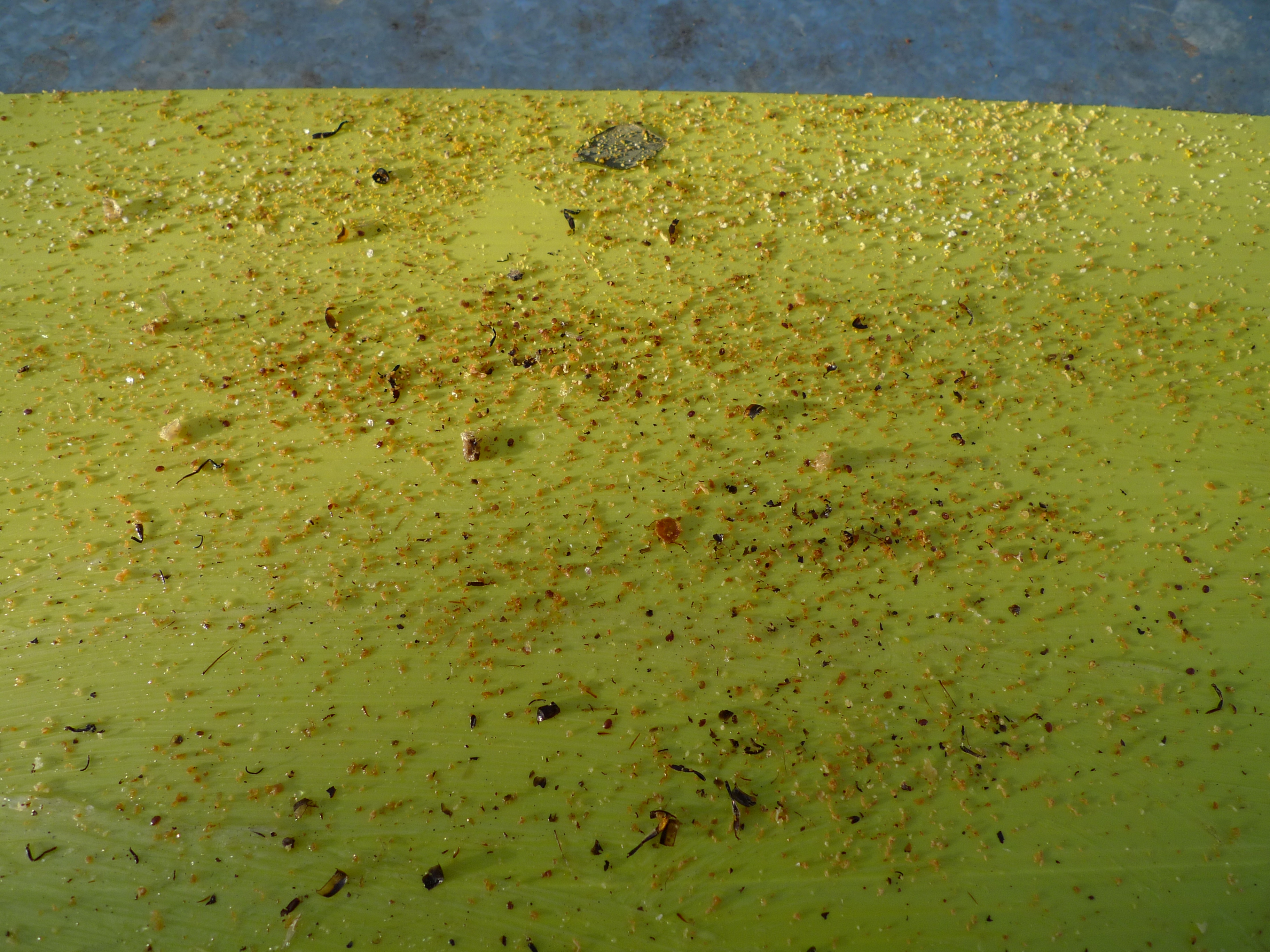
Here’s what the varroa board’s looking like:

The way the pollen has fallen tells me they’re clustering towards the middle front of the hive at the moment. The clusters position changes as the bees eat their stores in one part of the hive and slowly move on to another. Somewhere in the middle of the cluster, in the warmest position, will be the queen. Like penguins huddling together, the bees on the outside become colder than those on the inside so now and again they rotate positions. There seemed to be less varroa on the board than previously – about 50 in two weeks – which is encouraging.

Yesterday was the Ealing Beekeepers Association annual Christmas party, which was a lot of fun. One of the beekeepers told me about beekeeping in Iran, where he used to live. In certain parts of Iran the winter is too cold to keep the bees outside, so beekeepers bring the bees inside a dark room in their houses, until the weather is warm enough for them to be brought outside again. As the room is dark and the bees usually only fly during the day, during this time the bees do not leave the hive for their normal cleansing flights to defecate, so as soon as they’re brought out again they are in a furious mood and go mad at the beekeeper whilst pooing everywhere!

Posted in Uncategorized | Tagged | Leave a comment

14/11/10

Finally put my mouseguard on:

Now only bees or creatures the size of bees can get in. Hopefully a little mouse hasn’t crept in there already.

Had a look at my varroa board, which I last checked two weeks ago. The varroa board is a piece of cardboard which sits under the wire mesh hive floor. Once the mites fall through the wire mesh they are unable to crawl back up again. I gave up counting varroa mites after I reached 100, which seems a lot in two weeks. My FERA booklet on varroa classes a high infestation of mites as >8 dropping per day in October and says that “If the mite drop in a colony is >15 mites per day you must do something and treat immediately”. In November-December Lactic/Oxalic acid are options, I’ll talk to some of the experienced beekeepers next weekend and see what they recommend.

You can see the mites in the photo below, they are the little shiny brown oval buggers. They overwinter by feeding on the bees, sitting on the top of their abdomens, where the bees can’t reach when they groom themselves. A British study has found that they prefer the left side of the bees, probably because the left side allows the mites to place their mouthparts closest to the bee’s midgut, which is likely to contain higher concentrations of many nutrients. The varroa mites not only weaken the bees but are associated with the transmission of pathogenic diseases between bees. I hope my poor little bees can hang on in there over the winter.

Rosemary’s varroa board

A less close up shot from another hive, plenty of pollen and wax cappings here.

Lavender’s monitoring board

Posted in Disease prevention | Tagged , | Leave a comment

Bee news

There’s been quite a bit of bee related news in the papers this week, some good, some not so good…

The bad news

The good news

  • The UK’s five rarest bumblebees are making a comeback, with the help of wildlife-friendly farming. Putting in pollen and nectar-rich flower margins to fields, growing red clover hay meadows and rotating the grazing of animals on land has helped in farms in Kent and East Sussex.

>>The shrill carder bee, Britain’s rarest bumblebee. They have pale greenish yellow chests and the queen makes a shrill sound when she flies.

  • Bees are very clever (possibly could be classed as bad news for the beekeeper!). So clever that their tiny brains beat computers at finding the shortest route between flowers discovered in a random order.
Posted in Uncategorized | Tagged , | 2 Comments

Starting beekeeping – a practical checklist

Yesterday I went to a Ealing beekeepers association session. We were working through a ‘Starting Beekeeping – Practical Checklist’ produced by the BBKA following requests by beekeepers teaching beginners.

There are eight sections to the checklist: Background, Manipulation, Basic disease, Annual cycle, Basic Queen skills, Extraction, Specific diseases and Basic apiary management. We were going through each section in plenty of detail and a fair bit of laughing, so only fitted two in during two hours, Background and Basic disease.

Some of my notes from the Background section:

Can I control/restart a smoker?

Even some of the most experienced beekeepers admit to having problems keeping their lighters going. Big smokers keep going longer, so buy the biggest you can find. Put in newspaper first, then something like egg boxes or sawdust. Always light the smoker from the bottom – a long gas lighter or cook’s blowtorch is useful for this. Put grass on the top to stop sparks coming out and burning the bees.

Do I have clothing I am confident with and that can be cleaned?

Bee suits can be washed in the washing machine with the veil removed. The veil can be soaked separately in washing soda, which helps remove propolis. Ideally wash your suit after each visit to a hive. New beekeepers are often sold long leather gloves – resist buying these! These are lovely and soft the first time you wear them, but soon get covered in propolis and become hard and stiff. They are also un-hygenic compared to disposable latex gloves, which cost around £4 for packs of a hundred or can even be obtained for free from petrol stations or hospitals! If you want extra protection the latex gloves can be worn over leathers.

Do I have ‘things’ in my pocket? (queen cages, matches etc)

A suggested tool kit for your pocket:

  • Tin of drawing pins for marking frames/attaching mouse-guard in the winter
  • Queen cage and marker pen in this year’s colour
  • Matches or lighter for your smoker
  • Foam rubber – use pieces of foam to seal up any gaps or reduce the entrance
  • Sharp nail scissors if you clip your queen’s wings to stop her swarming. John Chapple told us a story about going beekeeping with the expert beekeeper Clive de Bruyn, who told John that he did this with his teeth! Not something I’ll be trying!
Edit: recommend this blog post – 25 really simple beekeeping tips – for further ‘what to keep in my pockets’ type advice.

Be aware of apiary hygiene

Anything taken or scrapped out of your hive, even a little bit of comb or wax, should be disposed of properly and not flicked onto the apiary floor. Comb left on the floor encourages the wax moth and robbing by other bees. Ideally you should soak your hive tool in washing soda in-between visiting each hive, or use a separate tool for each hive.

I only took notes on the Small Hive Beetle (SHB) from the Basic Disease section:

Be aware of the appearance of SHB larvae and adult

The Small Hive Beetle is a bee pest which is not known to have entered Britain yet, but here in London we are in a high-risk area as lots of places nearby import food. The beetle can survive outside the hive, so could come in on fruit from Africa or the US.

One of our local beekeepers, Andy Pedley, is a ‘Sentinel Apiarist’ working with the government to look out for the beetle. Andy uses little traps in his hive which he checks regularly. If he found a beetle in the trap, he would put it in a plastic bag and alert our local Bee Inspector immediately. He also has to check the roof, crown board and any cracks and crevices in the hive where the beetle might lay its eggs.

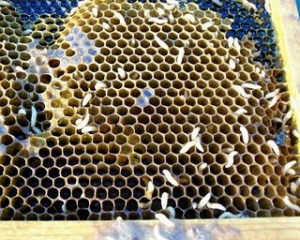
Once the eggs hatch the larvae chews up honey comb and turns it into a slimy mess. If a frame with the larvae on is held up the larvae ‘surf the comb’, travelling up and down trying to get away from the light. Once ready to pupate the larvae drop out of the hive and pupate in the ground before emerging as little black beetles. As they are native to Africa, they may or may not survive in the damp of UK soil. In Africa beekeepers can kick their hives and stamp on the beetles as they drop out.

The SHB adult

The SHB larvae

Posted in Disease prevention, Money saving | Tagged , , , , | Leave a comment

Michaelmas daisies, bees’ feet and pheromones

Another wet, damp day at the apiary yesterday. But my little bees were still out in force, carrying back swollen pollen baskets filled with a bright yellow and golden pollen. I asked John Chapple what they might be finding, and he suggested Michaelmas Daisies and other members of the Aster family, shown in the pic below. The Daisy takes its name because its blooms historically coincided with the Feast of St Michael on 29th September. Asters are also sometimes known as ‘September’s flower’.

My October BBKA News newsletter arrived this week. It had a couple of exciting articles on bee biology (my favourite beekeeping topic) inside it…

1. An article on bees’ feet. While beekeeping I rarely stop to consider their feet – I’m more worried about their posteriors – but their feet turn out to be quite fascinating. They contain a pair of claws and an adhesive organ, the arolium or pad. The claws are usually protruded to enable the bee to grip whichever surface it is traversing. The article mentions that the claws can be:

“a drawback because the bee can be unable to disengage itself from hairy surfaces like a beard or good head of hair with a sting being the usual outcome!”.

Yes, as I’ve found twice now. Both times a bee landed on my head and seemed to get stuck inside my hair, frantically moving about buzzing angrily until it eventually stung me. So bald beekeepers have an advantage!

Bee bum

The claws are also involved in wax manipulation while comb is built and for workers to hang together while clustering to secrete wax or in a swarm. Queens have small claws, workers medium size and drones largest of all. Why should drones, who clearly do no wax manipulation work or indeed any work at all, have the largest claws? One theory is that they come in ‘handy’ during mating, when the drone approaches the queen from behind and above, grasping her firmly in his last moments before the act of consummation.

November 2013 update: The BBKA News Nov 2013 issue contains another interesting article on bees’ feet, titled ‘Do Bees’ Feet Have Suckers‘, by Ian Stell, Master Beekeeper. He explains that it’s likely bees can hold on upside down on a smooth flat surface such as glass using electromagnetic forces produced between molecules close together, known as Van de Waal’s forces. If the surface is rough enough bees can grip using their claws, and the entire weight of a swarm can be supported by the bees at the top gripping onto a branch, while the rest of the bees grip onto each other.

2. Pheromone smell variations. Another fascinating discovery for me was that variations in the genetic makeup of the workers can produce small variations in the chemical constituents of various pheromones. Along with the sources of pollen and nectar in the hive this gives each colony an individual ‘colony odour’ – which helps guard bees identify potential robbers because they smell different. However, if a robber bee manages to evade the guard bees and nip through the entrance her smell is masked by the hive odour and she can pretend to be part of the colony.

The world of bees: the colony is in constant communication

The world of bees: the colony is in constant communication

So powerful is a bee’s sense of smell that they can tell whether they are full sisters – ‘super-sisters’ with the same father or only half sisters with another worker bee in their hive (a queen will mate with multiple drones, so her daughters have multiple fathers). The mating process of honey bees means that the genetic makeup inherited from their father is identical and thus they are more closely related to each other than normal sisters, hence the term super-sisters.

These groups of super-sisters are able to differentiate themselves because the minor genetic variation between them results in very similar pheromone constituents and thus very similar smells compared with their half sisters. These subtle smell differences can even be used in the recognition of eggs laid by a different sister class of worker. This, in combination with pheromones produced by the queen, is sufficient to ensure an unfertilised worker egg is destroyed and not allowed to develop. Queens also have their own individual smell of course, which helps drones recognise their queenly sisters and (generally) avoid mating with them!

Trophallaxis

Although the beehive is dark, for bees it must be lit up by the rich variety of smells which make up their world – the smell of brood wanting food, the smell of brood ready to be capped, the sweet smells of nectar, pollen and honey, that of their full super-sisters and half-sisters, and the reassuring smell of their queen.

Posted in Bee biology, Queens | Tagged , , | Leave a comment