September bees

The honey harvest is over and London temperatures are cool; since returning from San Diego at the end of August, where I wore shorts every day, my winter coat and scarf have already been pulled into action a couple of times. The bees know winter is coming (as does any Game of Thrones fan). Look at them frantically bringing home the pollen, bringing home everything they can now while a few flowers are still out there.
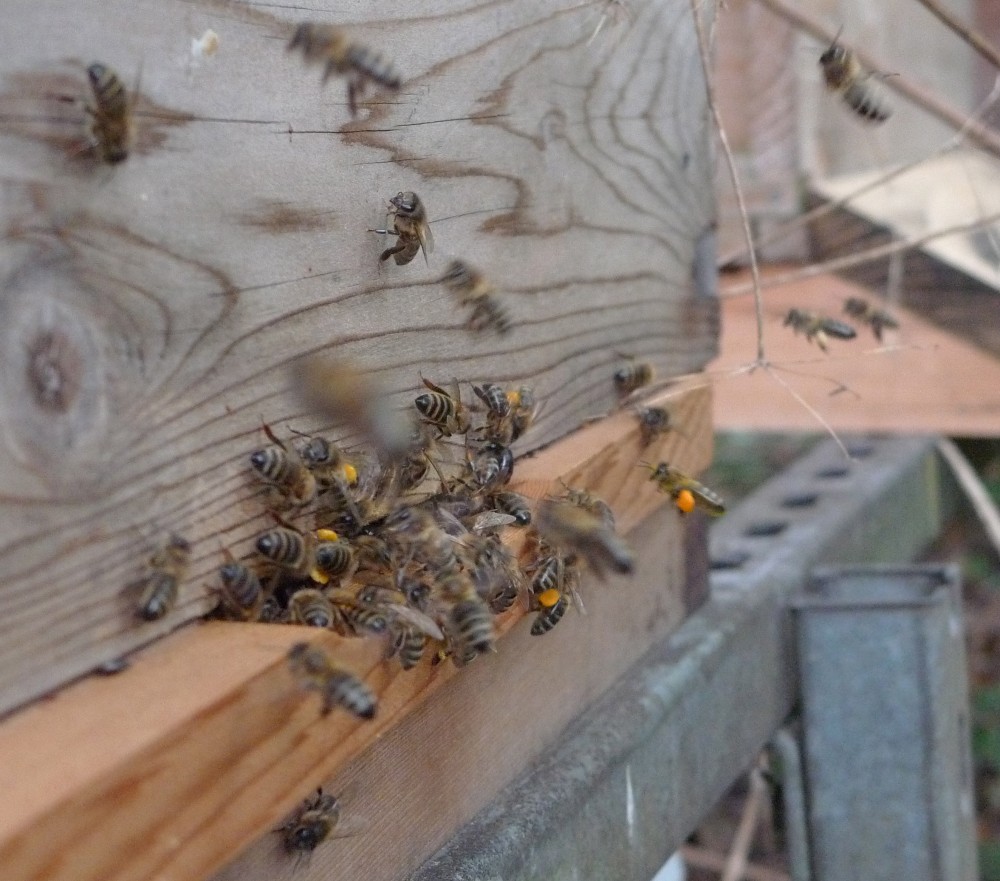
Bees bringing pollen in

That bright tango orange pollen was a mystery to me until I saw a post in the British Beekeepers Association forum about it. Other beekeepers are seeing it too, and they think dahlia or nasturtium. You can see a lady just popping in through the mouse guard with some below.
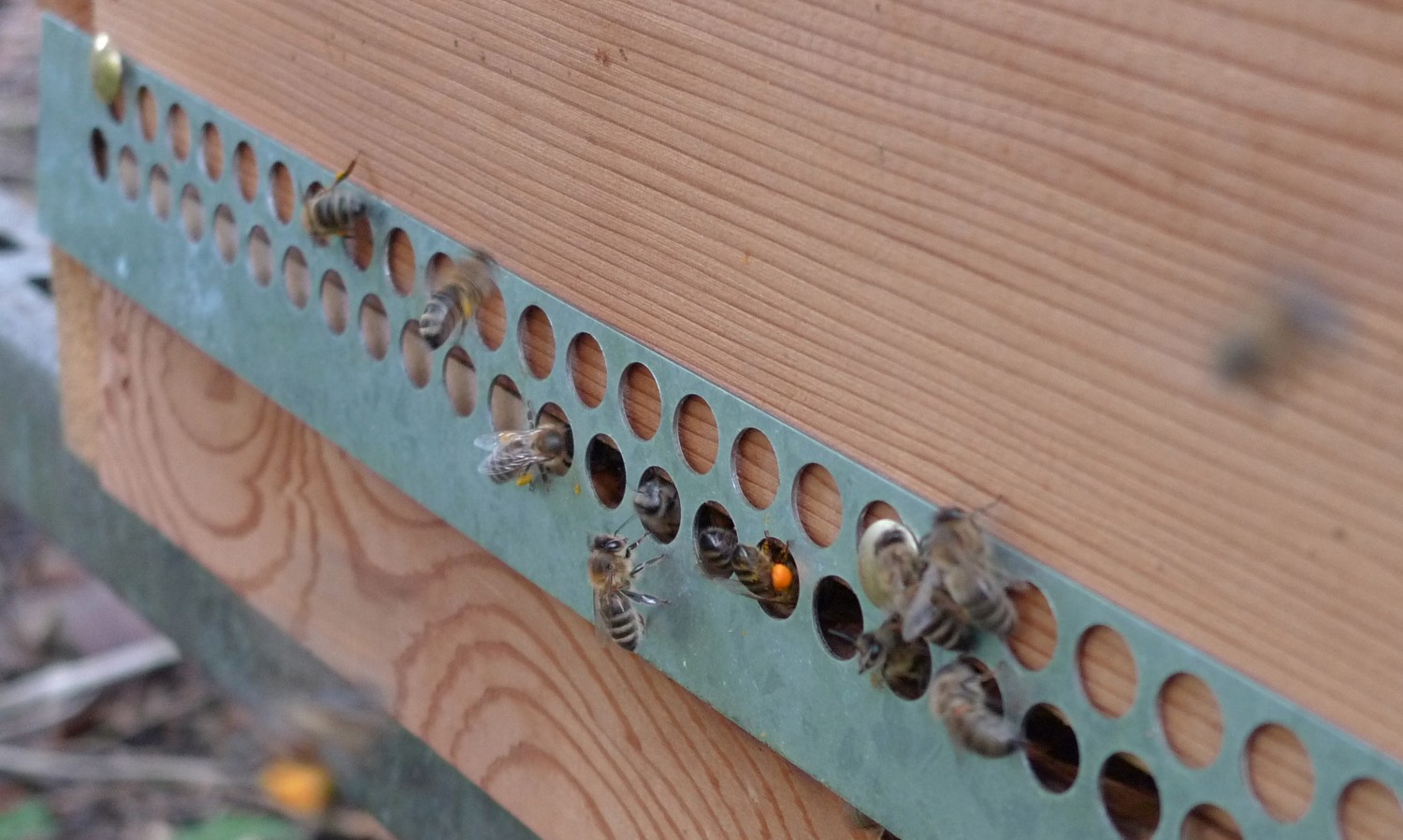
Orange pollen

Emma and I opened up our hives on Saturday to check they’re doing ok for stores. Rosemary’s hive, shown below, is almost taking up the whole brood box. They couldn’t really be doing much better. They still have a fair amount of brood, on about 6 frames I think, all worker brood now – it’s too late for drones. Time to kick out their hungry brothers.

Rosemary's hive

We had created a space above the brood box using an empty super and then put another super on top with a few super frames we didn’t harvest. The gap makes them see the super as not part of their hive, so they go up and rob it, storing the honey in the brood box. We want them to be on just the single brood box over winter, which is the convention in the apiary, though I think there are arguments in favour of double brood boxing or brood-and-a-halfing a strong colony. Below you can see the ladies eagerly lining up round a few chunks of honey we cut out from the now otherwise cleaned out super box.
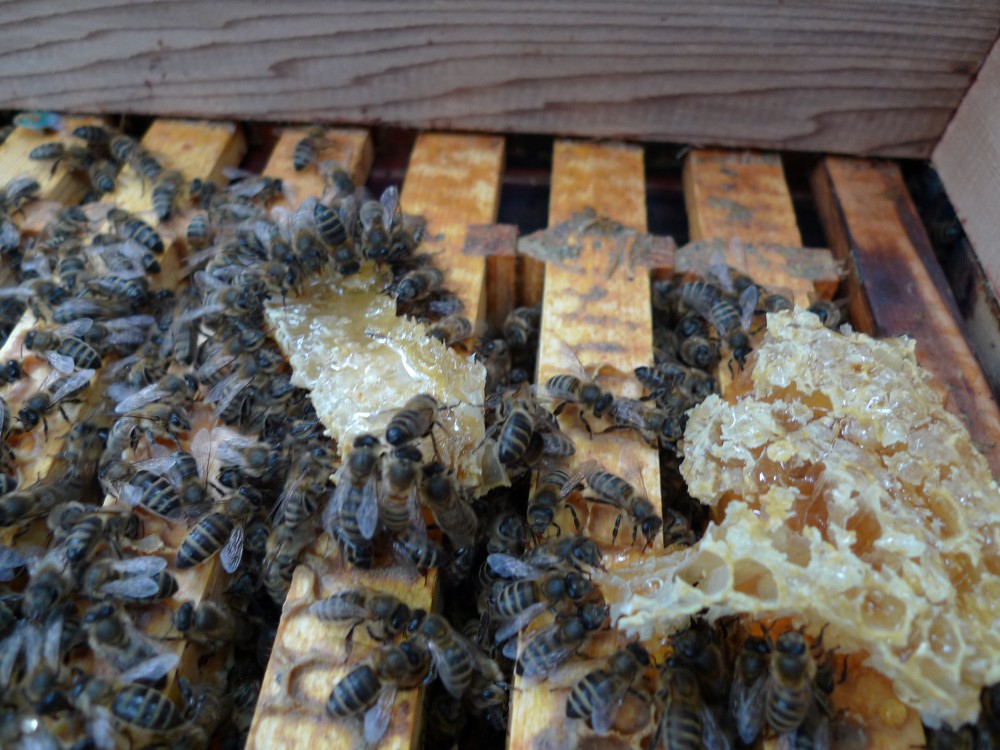
Honey munchers

Little honey munchers

Lavender’s hive, headed by our new young queen, had a month long gap in brood production while Lavender was being created and mated, so they’re still lagging behind on numbers as you can see below. But doing better. Emma’s been feeding them lots and they were waiting at the feeder for us, lapping up every last drop of sugar syrup. Tried hefting and their hive is a little more tricky to lift than the last time I tried. But still doable, whereas my puny arms can’t hold Rosemary’s up.
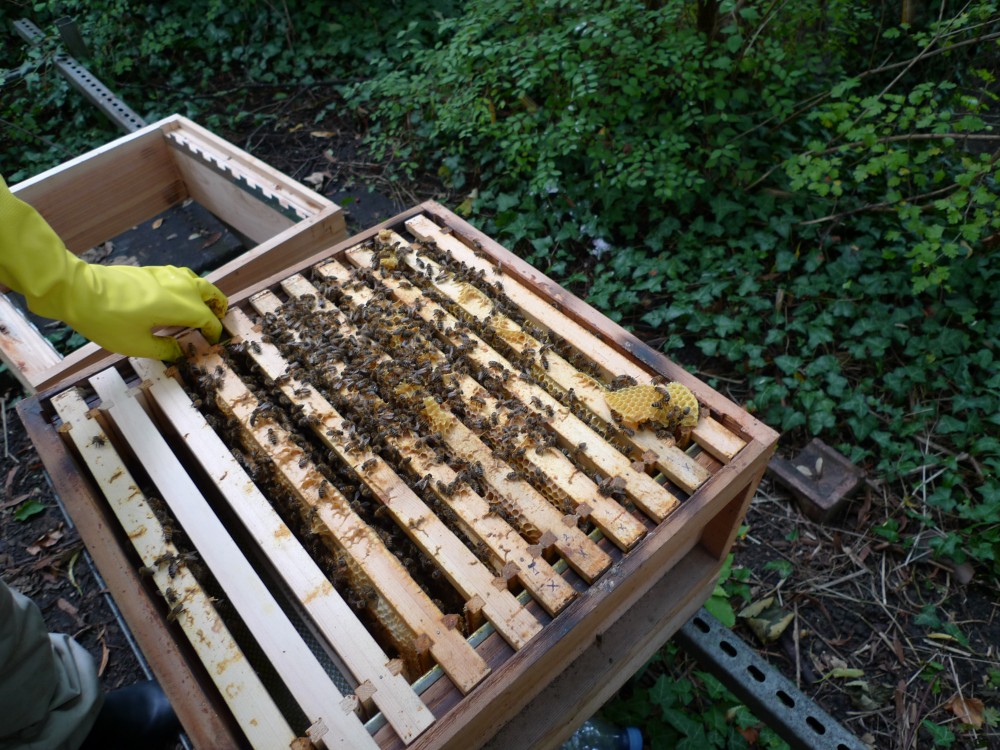
Lavender's hive

I think I accidentally crushed one of Lavender’s daughters, she was dragging this orange blob behind her squashed abdomen. Sorry little one 😦  I’m used to seeing the sting itself, which is visible here, but not the orange blob – presumably the bee’s venom sac, which would normally get pumped inside you?

EDIT: willowbatel has pointed out in his comment below that the blob is probably the stomach or other internal organ, as the poison sac attached to the stinger isn’t very big and usually is slightly clear.
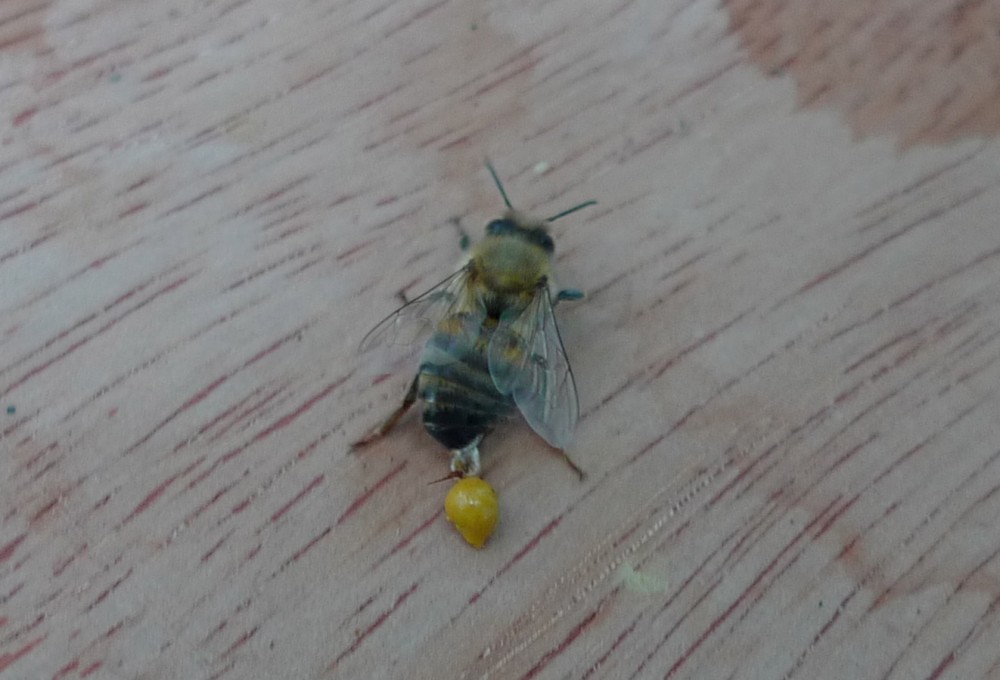
Squashed bee dragging sting

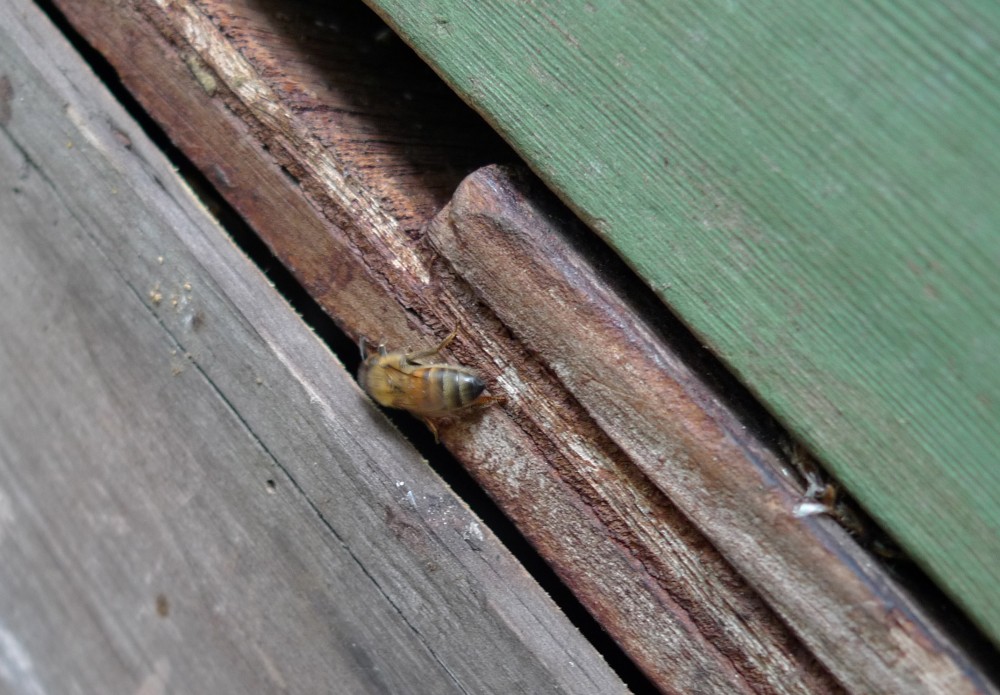
The bee below I photographed because I watched her for a while casing out a hive. Back and forth she went along this gap, shoving her head inside but not quite getting her body to follow through the narrow space. An innocent forager would have gone in through the front door, so she was clearly a devious robber bee looking out for a less well defended entrance. A reminder to keep beehives well sealed up.
This is not a bee. This is a Bob. He is getting ready for winter too. Zzzzzzz
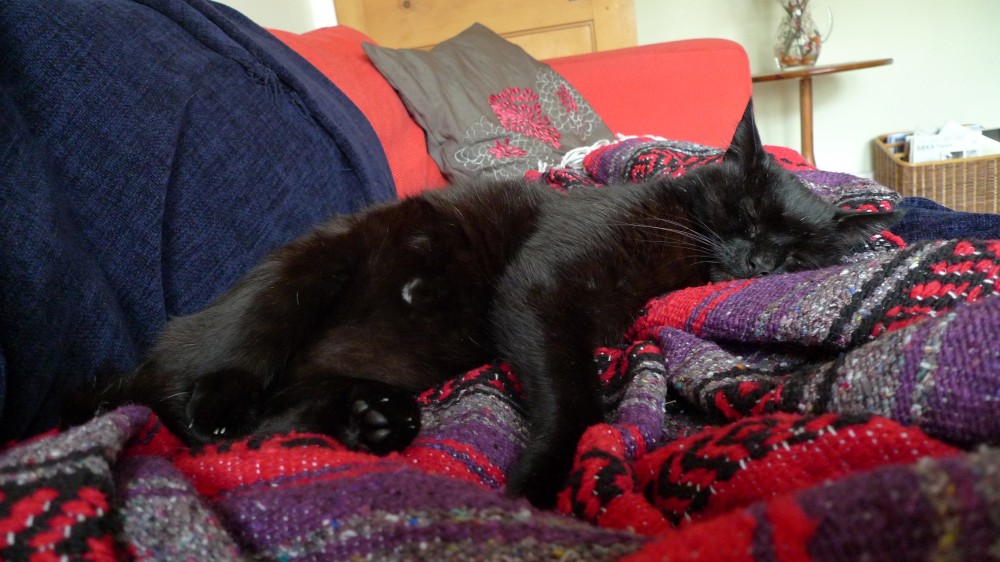
Bob being a cat

As cosy as a cat
Posted in Uncategorized | 14 Comments

Some good advice

Through the Facebook Beginner Beekeeper group I came across this link to recent advice by Andy Wattam, a UK National Bee Inspector.

www.bbka.org.uk/local/lincolnshire/articles/-emergency-bee-care.shtml

“Could I ask you please to put out a reminder to all of the District Secretaries about members looking at the food levels of their bee colonies, and also highlight Varroa Management at this Critical time.

I have been out inspecting quite a bit recently and almost exclusively have come across bees which are starving, some to the point where their demise was only hours away – I have even taken to carrying syrup in the car with me, as, in general terms beekeepers have nothing in stock for contingency feeding. In some cases I have had to pour syrup into empty Comb and onto the top-bars for the bees to feed to get them going again as they were at that ‘creeping’ point which signs almost imminent demise of the stock.

A very sad state of affairs I am sure you would agree? – These are not Isolated incidents, but on some days are reflected in every site we visit.

Also in many cases I am seeing increased levels of Varroa – this becomes more and more ‘visually’ evident in colonies whom are short of food as the brood nest diminishes and the mites move onto the bees themselves. Again in some of the cases the Beekeeper had neither thought about, nor prepared to carry out any sort of Varroa controls, or doing much in the way of monitoring. Can I emphasise again that where insert boards are used with Open Mesh Floors the boards must be made sticky before use, otherwise a consistently low mite count will be realized, as the mites will simply walk off! Often back into hive to continue their quest.

I am seeing in lots of cases of people using icing sugar as a ‘Varroa Treatment’. It should be borne in mind that Icing Sugar is to be seen as a complimentary Technique to other forms of Integrated Pest Management. As a standalone it rarely has sufficient knock-down to achieve the full controls on its own, unless it is done regularly, skillfully and with the correct Open Mesh Floor in place, IE: With sufficient drop beneath to ensure that the mites cannot return to the Hive, and sufficient cover onto the bees – the value of just sprinkling icing sugar onto top bars is very questionable, although in some cases it has helped to keep the bees alive! By giving them something to eat!

Again something else which rears its head regularly is where a beekeeper has taken delivery of a Nucleus – filled up the compliment of the Brood Chamber with Foundation and provided no supplementary feed – the bees are sitting there, just surviving on the drawn comb with no hope of expansion to survive the winter.

Please Please – Heft hives to check for Weight, Look inside and see what is happening, Feed now to ensure winter survival unless hives are so heavy you can hardly lift them.

Keep an eye on the wasp situation and reduce entrances / set traps where necessary.

We are now approximately three weeks into a dearth of nectar, unless you are within flying distance of a specific crop which is providing something of value, and from what I can see in most areas a minimum of 10 days before the Ivy comes properly into flower to be of use. The link below will take members to the Fact Sheets Section of Beebase where they will find information on many of the subjects outlined.

https://secure.fera.defra.gov.uk/beebase/index.cfm?pageid=167

Many Thanks and Kindest regards

Andy Wattam
National Bee Inspector.

Head of Bee Health Field Inspection Service for England & Wales.”

It’s sad to think of bees starving when the problem is so easily solved. Emma and I have been feeding our smaller hive this summer just in case. Our bigger hive has not needed it, but will receive a final feed of the year when we do Fumadil B treatment.

Must try to remember to bring vaseline to smear on the boards to trap the mites, I know I’m sometimes guilty of forgetting to do that. For varroa treatment we did the shook-swarm in March, are doing Apiguard at the moment and will do oxalic acid in December. Last year the varroa count on the monitoring board got really bad in November/December just before the oxalic acid treatment – over a hundred dropping a week – so that will be something to keep an eye on.

Posted in Colony management, Disease prevention | Tagged | 3 Comments

A few links

Some articles/blog posts you might enjoy…

I wouldn’t normally link to the Daily Mail, but local Ealing beekeepers John Chapple and Andy Pedley feature in a DM article celebrating their work as beekeepers to the Queen. I think John’s mischievous personality comes across well. The DM only make one obvious spelling mistake – “soupers” instead of “supers” – they must think the bees are cooking up minestrone in there.

This teacher’s life is one of my favourite blogs, by Stephen, a science teacher and beekeeper in Northern Ireland. This recent post features a slightly yucky method of detering foxes, fairy ring mushrooms and the origins of the phrase ‘getting pissed’: http://thisteacherslife.wordpress.com/2011/08/28/the-prowler.

BeGetting Carpenter Bees – bet you’ve never seen carpenter bees mating this closely before. An exhausted female is fought over by a trio of males – http://gardenwalkgardentalk.com/2011/08/29/beegetting-carpenter-bees

Inspired Beeing – I’ve begun reading this blog recently and it never disappoints. Cat quit her job in June 2011 to set off on an adventure to rural Turkey to support small-scale, eco-friendly female beekeepers over there. The photos she takes are full of vibrant colours. This particular post, about a young beekeeper she’s working with, has a very sad and troubling ending: http://inspiredbeeing.com/2011/08/28/sometimes-learning-really-stings-lessons-of-honey-and-development.

Posted in Uncategorized | Tagged , | 4 Comments

Bringing home the hunny

Picking up where my previous post left off. On Saturday we took our six frames of honey to Emma’s dad’s house, as he had kindly let us do the messy business of honey extraction in his nice clean house.

As Emma has been given a fancy electric centrifugal extractor by a colleague who has retired from beekeeping, I assumed extracting would be easy. So naive…

We had the difficulty that we had some frames with a mixture of capped and uncapped honey, because we had to remove the frames earlier than we would have liked to in order to do Apiguard treatment with the rest of the apiary. Uncapped honey means it’s still too watery – honey should be only 18% water – so the bees haven’t capped it over yet. It’s not good as it will ferment more easily after harvesting, because the sugar concentration will not be high enough to prevent yeast growing. Someone had suggested that we put these frames in without uncapping them, to get the uncapped honey out first and keep it separate. They looked like this:

Extracting time

Extracting time

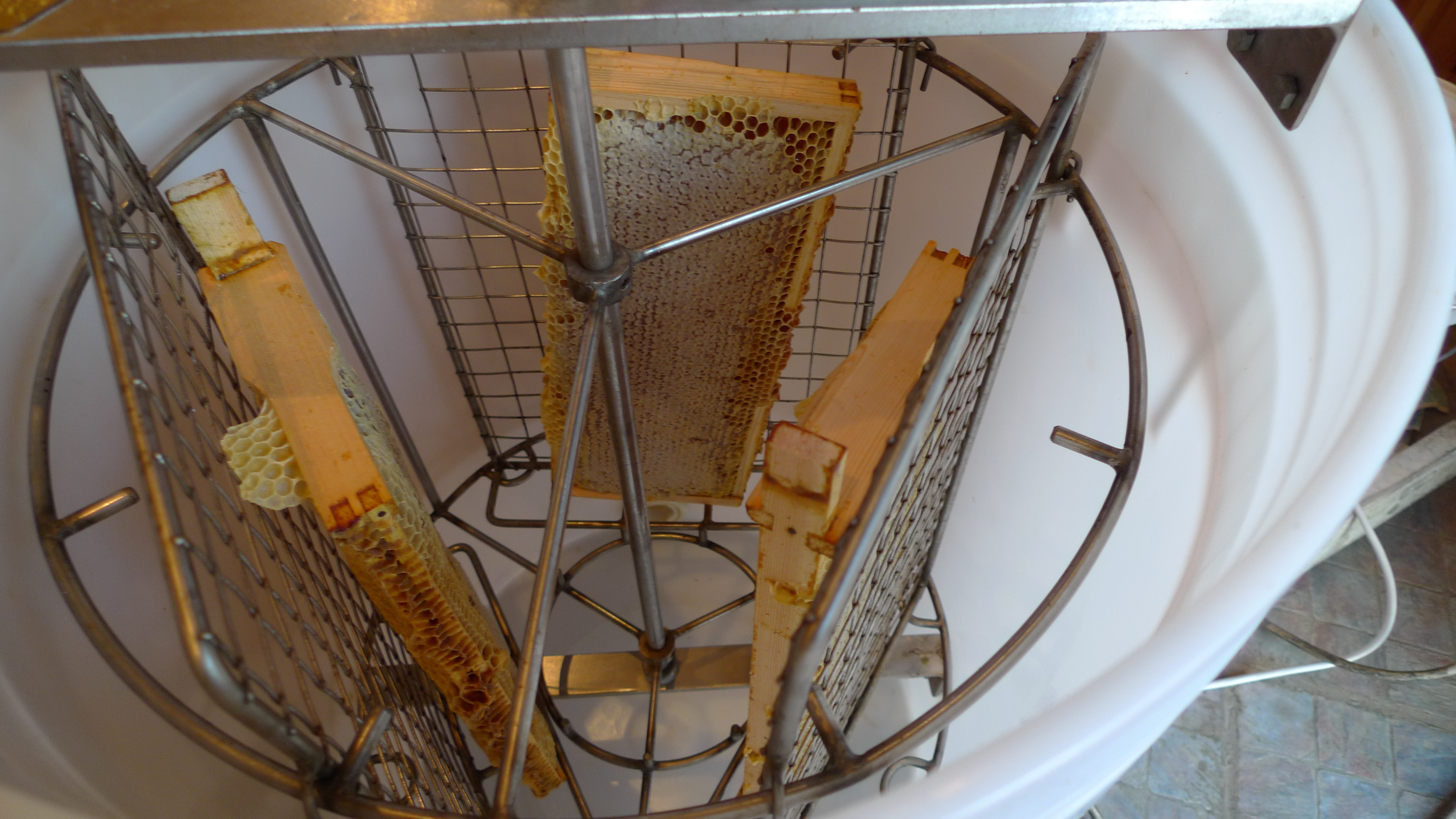
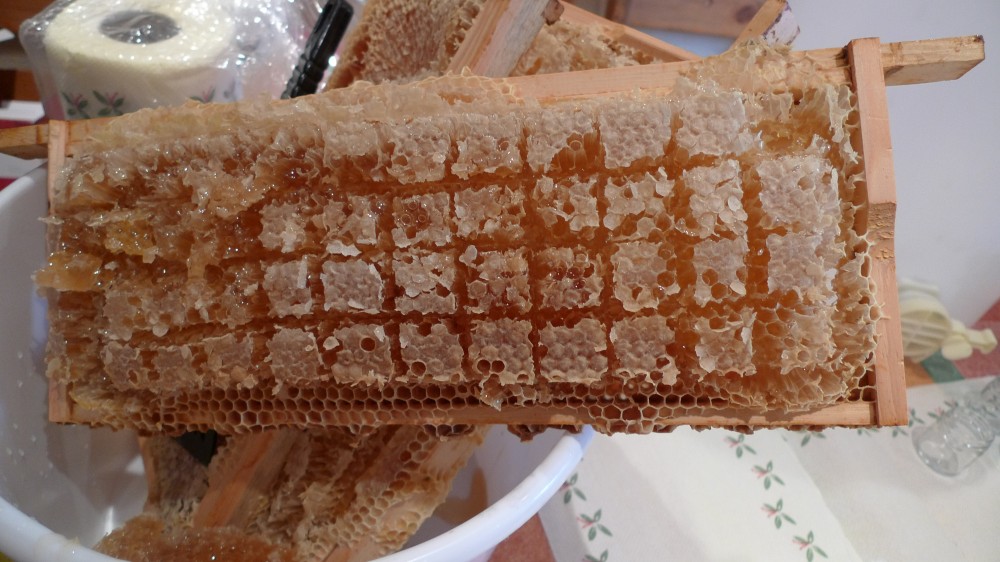
We switched the extractor on but things didn’t quite go to plan. The frames started collapsing and coming apart. And the uncapped honey was refusing to come out, it just stayed in the frames. So Emma had the idea of cutting the honey up into chunks to make comb honey instead, like this:


It was fun cutting the chunks out and putting into mini taster jars which we got from Thornes. There was much sticky finger licking going on along the way. It is a mild but intensely flowery honey which the bees have made us, the taste of summer.

Finally we tried to extract from the remaining three frames by first decapping them using an uncapping fork. You can see me having a go below, it’s quite a satisfying feeling.

We put the decapped frames in the extractor and turned it on, first slowly and then faster and faster until it was at a speed which nobody’s arm could possibly turn at. Barely any honey came out, it stubbornly stayed put!

Last year it only took Emma a few turns with a hand extractor to get all her honey out and it was dripping from the frames. With these frames the honey was like treacle, thick and gooey:

We had to give up trying to get the treacle honey out with the extractor in the end. Instead we dug it out from the frames with a spatula, throwing away the thin foundation strip in the middle. It’s a shame as we can’t use the frames again next year and the bees will have to build a super of wax cells up again from foundation.

What flowers can our bees have been on to make such thick honey? Heather produces notoriously thick, jelly-like honey which is a thixotropic stiff gel until stirred but I haven’t seen much in Ealing. ‘Keeping bees and making honey‘ by Alison Benjamin and Brian McCallum (2008) mentions that chestnut and hawthorn produce very thick, dark brown honey, but they’re supposed to have a strong, nutty, malty flavour which ours doesn’t. Has anyone else had such thick, stubborn honey before?

I’m very grateful to Emma’s dad for letting us do the extracting at his place. It would have been so hard in my tiny kitchen. Thank you Emma and Glenn!

Posted in Honey | Tagged | 30 Comments

Hunny time

Yesterday was all about the honey. After three years of trying, I finally have some!

On Friday Emma put a Porter bee escape on our super, which allows the bees to go down but not up so we can come along and nick their honey. Emma also sealed round the super with tape in case any wasps tried to get in while the super was undefended.

The bee escape…

And the super yesterday afternoon, still with a few bees left on. I brushed these off with a bee brush frame-by-frame and handed them to Emma, who had cleverly brought bin bags with her to put each frame in, keeping them protected from wasps and robber bees.

We only got six frames in the end, because the others hadn’t been capped yet. We wouldn’t have harvested so early except that it was decided everyone at the apiary had to start Apiguard treatment this weekend (Apiguard is a thymol-based anti-varroa treatment). If we had left the super on for the bees to finish capping with the Apiguard on there, we would have had thyme flavoured honey. Technically edible, but a wee bit strong.

Inside, Rosemary’s hive was doing very well. Bees spilled out from everywhere and it was tricky picking up the frames without squashing any. They have done very well at sticking the queen excluder down – you can see the pattern all over the frame tops. Next year we will have to get one of the proper wooden framed ones which they can’t stick down in the middle.

I was nervous about opening the other hive up, old Queen Rose’s hive, as we had left it alone for a couple of weeks while the new virgin queen in there was out on mating flights. Would we have a mated queen in there? Or a load of laying workers?

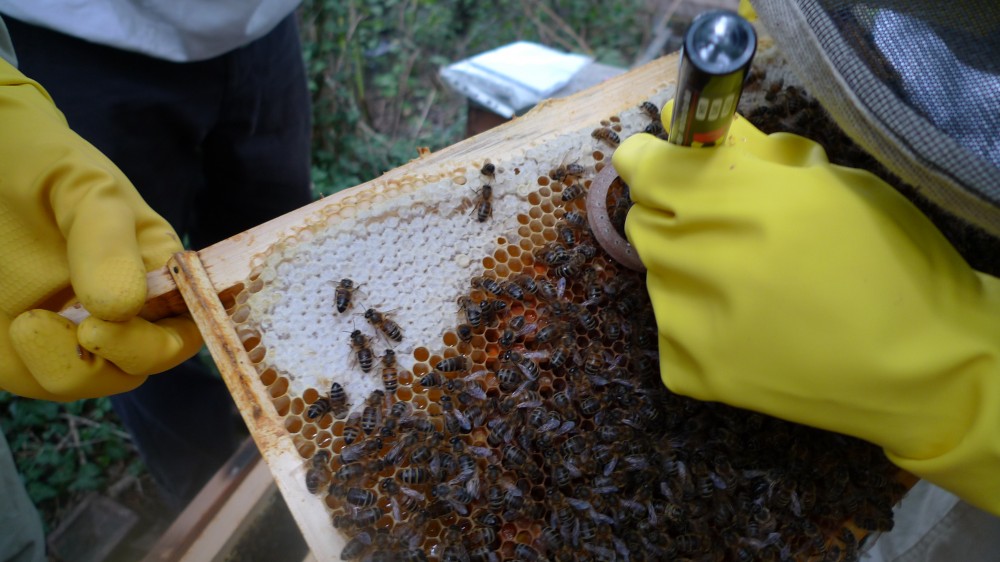
At first it didn’t look good. There weren’t many bees and no sign of brood. But then a little further in I saw rows of neatly laid eggs; and suddenly a sharp-eyed person spotted the new queen! There she is in the centre of the photo below, long and dark like her mum.


I had a queen marking kit with me; Emma did a good job of getting her in the queen marking cage very quickly and then I attempted to mark her. And tried again. And again. The pen was touching her thorax but nothing was happening. It wouldn’t make a mark on the back of my hand either. Bloody Thornes. Eventually Albert managed to get it working and Emma successfully dotted her white.

Marking Queen Lavender

Marking Queen Lavender

We wondered what to call the new queen. “Lavender?” Sarah suggested and we liked that. Lavender is appropriate as we were burning sweet-scented lavender in the smoker as we inspected. Long live Queen Lavender.

And finally on with the Apiguard. You can see this colony is much smaller than Queen Rosemary’s colony above, so we only put half the usual treatment portion on. We’ll put the other half on in two weeks time. Rosemary’s hive got a full portion. The treatment works because the worker bees dislike the thymol stink. They start removing the gel to clean the hive and remove the foreign smell, distributing it round the colony and killing off varroa mites in the process. It has a high efficiency rate, killing 90-95% of varroa mites in a hive if the treament is done properly. It has no harmful effects for the bees, just the inconvenience of a stinky hive.

Apiguard

This is getting to be a long post so I think I’ll do another on how the honey extraction went later in the week! To be continued…

Posted in Colony management, Disease prevention, Honey, Queens | Tagged , , | 16 Comments

What’s flowering now: early August

After a couple of weeks of heavy rain sunshine is back in Britain again. The flowers are changing outside, the days are shortening and honey bee queens are gradually laying less eggs as the hive emphasis changes from increasing numbers to storing honey for winter. During August honey bee population numbers will fall from a July peak of 50,000-60,000 adults and 40,000-50,000 eggs/brood larvae in a typical hive to around 45,000 adults and 30,000 eggs/brood larvae. The drop will be even more dramatic come September.

In the bumble bee world, towards the end of the summer the queen produces some sons, along with new queens. After mating, the males die off, as do the old queen and workers. Only the new, fertilised queens survive to hibernate through the winter, ready to start nests of their own the following spring.

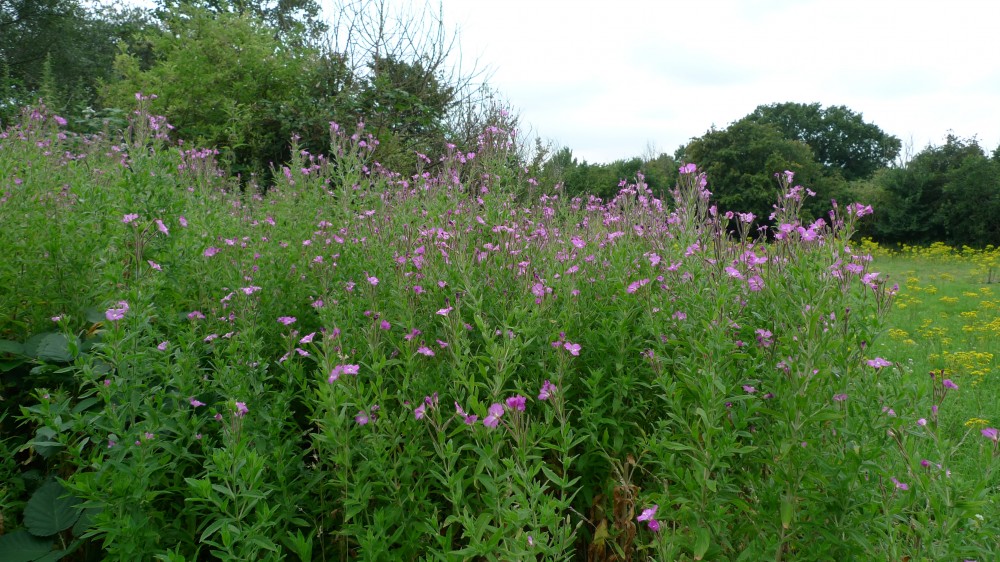
Walking through the park I found these pretty pink flowers with elaborately curled white anthers. Their name is unknown to me, can anyone help identify what they are?


EDIT: The pink flowers have been identified by Ashley below as possibly “willow herb family (fireweed) but it’s not the most common one (rosebay willow herb) as the flowers are too large and too round.”

This month’s BBKA News has a great article by Adrian Davis, Canterbury BKA, on bee-friendly plants which mentions Rosebay willow herb as a late summer flowering plant with “stunning rose-purple flowers”. It is a tall, perennial herb found on wasteland, railway embankments and woods, rapidly colonising open areas and much loved by bees. One of my favourite bloggers, Theresa Green, has produced a fascinating post on the biology and history of the plant: Rosebay willowherb.

The field also contained a sea of yellow flowers. I’m ashamed to say I didn’t know what they were either. EDIT: Liz Chapman and Nigel Clark have both identified it as ragwort. Nigel mentions that it is highly toxic to horses. Luckily I didn’t see any horses about, but then maybe the ragwort killed them all already… Ted Hooper’s classic ‘Guide to Bees and Honey’ says “Honey from ragwort is extremely offensive in smell, but once crystallised this is lost and it is as acceptable as any other honey.” It gives the bees both nectar and bright yellow pollen.

The bumble however looks like a Buff-tail, a very common species.

And this golden madam is a honey bee hanging out with a shiny beetle. She’s much paler than the black-striped honey bee above on the pink flower.

Everyone knows clover…

And what I’m assuming is a species of thistle, which Ted Hooper says can produce quite large quantities of nectar and pollen. Dave agrees with me below that it’s a thistle, Ashley thinks a type of knapweed and Nigel thinks burdock, a type of thistle used to make the traditional drink Dandelion and Burdock.

The rain followed by sunny weather is good news as nectar secretion in many flowers, such as clover and heather, is boosted on a sunny day. Below certain temperatures plants will not secrete nectar, e.g. below 8C in wild cherry. Hawthorn only secretes well when the temperature is unusually high for a British summer, at least 25C. A few species, such as brambles, are not influenced by temperature and will continue flowering until cold weather and frosts.

The Bumblebee Conservation Trust lists some of the flowers important for bumbles in July-September on their website at http://www.bumblebeeconservation.org/gardening_for_bumblebees.htm. They include brambles, mints, heathers, red clover, thistles and lavenders.

I’m off on holiday in San Diego for most of August. By the time I get back at the beginning of September there may be very few foraging bumbles left to photograph. I’ll miss you, pretty furry fuzzy bumbles.

Posted in Uncategorized | Tagged | 14 Comments

August varroa treatment

Have had a useful reminder e-mail from Andy Pedley at the Ealing Beekeepers Association, as me and Emma inspected early on Saturday and missed the usual 2pm meeting up…

“The date for starting the Apiguard treatment this year is Saturday 6th August.  It is mandatory on Association apiary sites at Stockdove Way, Perivale Wood and the Brentham Allotments. Apiguard is available at the hut at a favourable price to members.

We strongly recommended that all members follow the procedure for all of their colonies no matter where they are.  It is worth running a pre-treatment check to get an idea of existing mite levels before starting.

Further details on how to carry out the treatment can be found on the Vita-Europe web site.  Link

Remember that you should remove supers that you intend to extract before applying the Apiguard because the pungent aroma will taint the honey.

Mesh floors should be closed using the monitoring board to contain the vapour within the brood box.”

Emma is in charge of the Ealing Association website and has done a nice round up of news stories about bees this week: http://www.ealingbeekeepers.org.uk/page2.htm.

Posted in Disease prevention | Tagged | 2 Comments

Finally some sunshine

The past week’s weather has been causing me anxiety. Just as our new queen to replace the missing Rose was supposed to be out mating, vast quantities of rain and cloud fell on South-East England. Not just any rain, but the kind that soaks you in seconds. This weekend will have been the first chance our new queen has had to send some drones to a happy fall backwards.

We inspected yesterday but I’d forgotten to put the battery in my camera, so no pics. Left the hive which hopefully contains our new queen alone apart from giving them some feed. Checked on how Rosemary’s hive was doing at filling up their super. It’s very nearly full but not all the honey was capped yet. We hope to extract at least some on the first weekend of August, leave it in a settling tank for a few days then put into little tasting jars so we can give a taster to all the friends, family and workmates who are very eager to try some.

Some exciting things I’ve come across this week – Brookfield Farm’s blog post Grafting Honeybee Larvae to Make Queen Cells – great photos. And Richard Hammond’s Invisible Worlds film on the hidden world of the bees, both inside and outside the hive – http://www.youtube.com/watch?v=zZEoAMfRICM.

I’ve been having great conversations with @Loiscarter and @kernowspringer (real name Sharon Spurling) about why our bees had chewed holes in the frames on the edges of their brood nest. Sharon said to me “maybe it’s when they can’t be bothered to draw wax, just nick it from the bit of the room no one will notice :D”

Having thought about it, this makes a lot of sense – they made five queen cells up in a hurry, we think because Rose had gone missing – so maybe they were nicking all that queen cell wax from the edges of the nest where it wasn’t needed so badly! Clever little things that they are.

Then @Loiscarter sent me a pic of what her bees get up to when they feel it’s time to have a mouse guard for winter to stop any pesky mice getting in. Her bees don’t hang about waiting for her to put one on. Instead they build their own… out of propolis. Incredible, right? Lois originally posted this at http://twitpic.com/5t1byf

Propolis mouse guard

Propolis mouse guard. Photo taken by Lois Carter.


Posted in Uncategorized | Tagged | 2 Comments

What are they up to now?

To my despair yesterday was a classic British summers day: dramatic grey clouds and rain coming down harder than a power shower. The week before we’d left five queen cells in Rose’s little hive. Me and Emma wanted to see what was going on!

By late afternoon things had improved slightly so we took advantage of the momentary lapse in rain to do some beekeeping. I looked in the entrance of Rosemary’s big hive and saw this:

Bees snuggling in rainy weather

A blanket of bees! All snuggling up to each other as if to provide a layer of insulation against the cold rainy air getting in. It was the same in other hives round the apiary. I’ve heard of bees hanging outside the entrance in hot weather to cool themselves and the hive down; this clustering just inside the entrance presumably must be behaviour aimed at keeping the brood warm and cosy? They were not aggressive despite me poking my camera in.

We left the big hive alone and took a peek in Rose’s hive.

They’re on about seven brood frames now (with no super). They are being slow at drawing the remaining frames out. It won’t help that Rose appears to be MIA. No eggs or uncapped larvae this week. Of the five queen cells last week, we could only see two, both capped. The bees were clustering round the cells and looked like they were chewing at the ends. What has happened to the other queen cells? Were they destroyed by the workers or have some of those queens emerged already?

I read a very interesting article this week, ‘Piping queens that toot and quack‘. It mentions that workers sometimes stop a new virgin queen from destroying her rivals (perhaps as a safety net in case she goes missing during her mating flight?). Meanwhile they also can keep other mature queens trapped in their cells, pushing their cell caps back down and adding more wax. These trapped queens, or princesses-in-waiting, often produce a low frequency ‘quacking’ noise by vibrating their abdomens against the cell walls, as if to say ‘let me out, let me out!’

So we may have a virgin queen on the loose in our hive, or we may not. The bees keep their secrets close. The other mysterious thing they are up to is chewing holes in their comb. This seems to be happening on the outer combs, and sometimes the holes are big and jagged and other times perfectly round where they have chewed neatly through a cell. Anyone have any ideas why bees might start eating their wax?

One golden bee

One golden bee

Can you see the one golden bee above? We thought it might be a refugee from Albert’s New Zealand hive, perhaps allowed in because she had pollen or nectar to offload. None of Rose’s dark daughters are so amber.

While inspecting Emma noticed a bee with a white stripe on the top of its thorax, just under its head. I couldn’t get it to rub off, so I thought at first it was a genetic mutation rather than pollen. But then we noticed other bees around the apiary bearing similar badger stripes, and remembered hearing about Himalayan Balsam, which leaves a telltale white streak on bees which visit it. The pollen rubs off from stamens in the roof of the flower and the foragers are unable to groom it off themselves because it’s so high up on their thorax. Nice photos here: http://cabinetofcuriosities-greenfingers.blogspot.com/search/label/Himalayan%20balsam.

Posted in Queens | 11 Comments

A quintet of queen cells

Everything was going so well. Both of our hives seemed fine. Until today.

All was fine and dandy in Rosemary’s hive. It took a while to get in there – they had propolised down the entire queen excluder and it took ten minutes just to prise the super off – but inside all was business as usual. Lots of bees, lots of honey, lots of brood. A rare ray of sunshine pierced through the apiary’s leafy canopy and shone on the glistening nectar of this frame.

A frame full of lovely biscuit coloured brood, with drone brood along the bottom.

And Rosemary… can you see her blue dot there? Now imagine trying to pick her out without the dot.

Check out the huge pile of propolis and wax we spent ages prising off the queen excluder. We must get a proper wooden framed excluder instead of the flimsy plastic one we currently have, the gap the frame creates stops them propolising the thing down. One of Albert’s yellow New Zealand bees is investigating.


Onto Rose’s hive. This being the smaller hive made from a artificial swarm back in May, we have no super on it. So we were expecting an easy inspection, with no queen excluder to prise off. How wrong we were…

We found five queen cells, no Queen Rose and young larvae but no eggs that I could see – but then in the dark of the apiary it’s easy to miss eggs. The bees were not exactly aggressive, but more restless and flying up around the hive more than usual. One queen cell was uncapped and the other four capped.

So what are they up to? This is what I always find hard to work out! If they’re superseding Rose, why produce so many qcs? If they’re thinking of swarming, how would that make sense when it’s late in the swarm season, they’re a small colony and have plenty of space? The five queen cells were also spotted when one of the beekeepers did his Basic Assessment Exam on our hive on Tuesday.

Hopefully if we assume that they’re superseding Rose and leave them to get on with it a new queen will emerge victorious and kill any rivals. There was talk of obtaining a new queen from another beekeeper who had a mated queen spare, but that’s fallen through. The new virgin will have to mate, which will set the colony back a few weeks in brood production. That’s a shame but at least we get a nice new young queen in there and we have another hive doing well.

I was interested to read in the July issue of BBKA News that starting from 2012 the British Beekeepers Association are now running two exam dates a year for their Module exams – March and November. This is due to an increase in demand now that the BBKA has had a vast increase in members. I had been thinking of taking Module 3 on diseases in March 2012, but that will be run in November 2012, so instead I think I’ll take Module 2, ‘Honey bee products and forage‘ in March, or possibly Module 5, ‘Honey bee biology‘ if I’m feeling brave enough. In some ways Module 5 might be better as it overlaps a bit with Module 6 on Honeybee behaviour which I took in March, but I think remembering all the scientific names would be tricky for me.

Posted in Colony management, Queens | 10 Comments