Bee Health Day

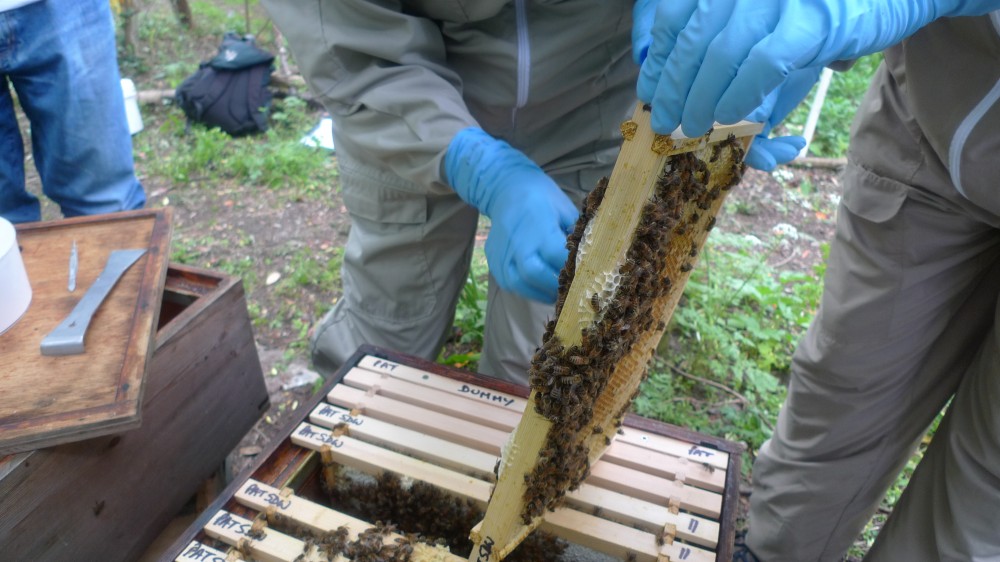
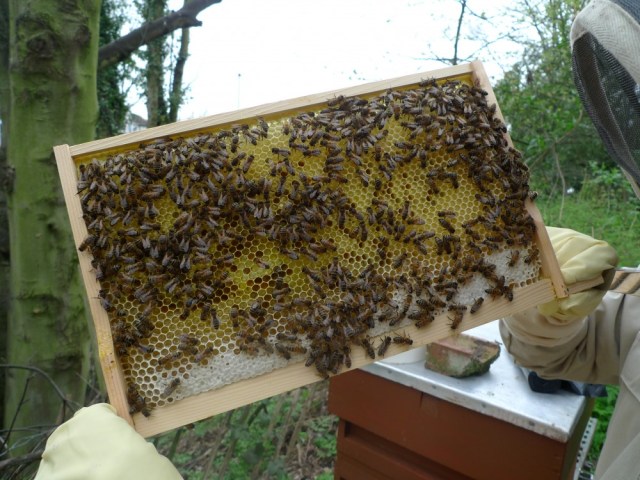
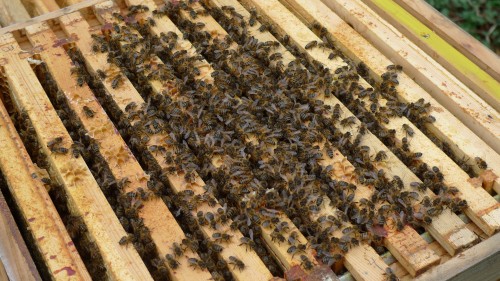
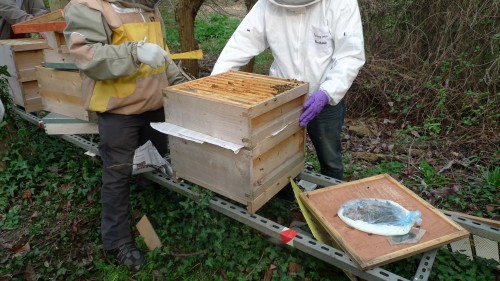
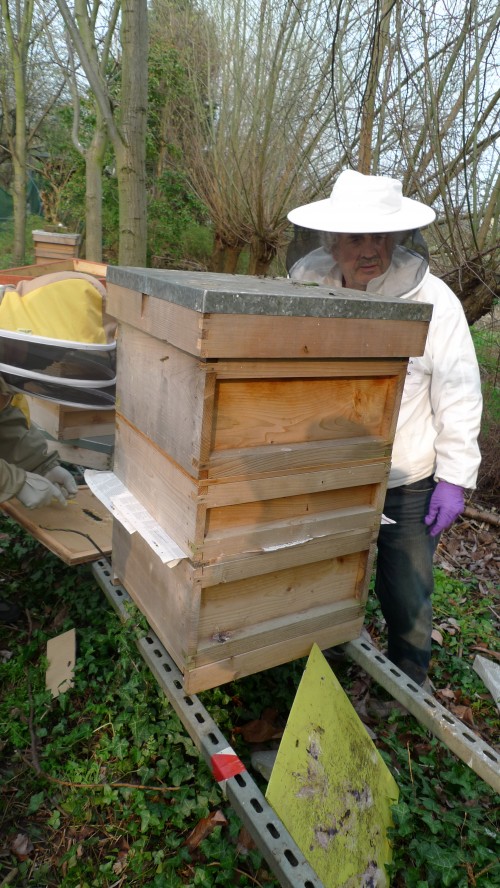
Went down to a Bee Health Day held at Roots & Shoots (a wildlife garden and base for the London Beekeepers’ Association) in Kennington, south London, today. It’s run each year by the London bee inspectors to give beekeepers information on looking after their bees well and included workshops on Varroa control, Swarm control, Apiary & hive hygiene and an apiary session on shook swarming, making up a nuc, open mesh floors and drone brood culling. Amazingly, it’s completely free so is well worth going down for.

I learnt so much that I’m pretty tired out now, my brain must be hurting from all the new information it’s squished in! Here are some very brief notes I took which in no way reflect everything the inspectors covered…

Alan Byham, the SE Regional Inspector, started the day off with a talk on ‘Simple beekeeping’. He asked how many of us were new beekeepers who had been keeping bees less than three years. Out of the many people who turned up (maybe 90ish?) most of us were new beekeepers, while some people had yet to get bees. Here are some of Alan’s tips for us:

  • Get a decent hive stand. Don’t have your brood frames so low down that you have to bend over to inspect them; they should be level with your hands. (Not much of a problem for someone like me at 5″2!)
  • Alan burns whatever he can get his hands on in his smoker, though he dislikes the smell of cardboard. He said the trick of keeping a smoker going is to really get it burning first – no quickly whipping the lid on once it’s alight – and once it’s really burning up put a lot of fuel on top. He uses a lot of rotten wood.
  • Water spray is an option rather than smoking; it’s effect is not as long lasting but is good on a colony without much in the way of stores, which will become irritable if smoked.
  • Use a dummy board in your brood boxes to avoid rolling the bees up and squashing them while inspecting
  • During swarm season only lightly smoke the bees, as if you smoke heavily and the bees are running everywhere you’ll struggle to find your queen. Have a queen cage in your pocket or an empty nucleus nearby. If you come across the queen, either put her in the queen cage or put the frame she’s on in the spare nucleus. This is in case you find queen cells and have to carry out swarm prevention measures like splitting the colony. When putting her in a cage pick her up by her wings or thorax, not her delicate abdomen.
  • A colony will go through ten pounds of stores in a week. If you have a week of bad weather and the colony can’t leave the hive, it will starve if it doesn’t have those ten pounds of stores. So you need to feed if you feel they don’t have sufficient stores to get them through the week.
We then went on to have a swarm control workshop (during which we learned we may have done things wrong on Saturday and the inspector thought we should check the old hive for queen cells!). After that Caroline Washington demonstrated how to make up a nucleus. Here’s a photo of Caroline in action:


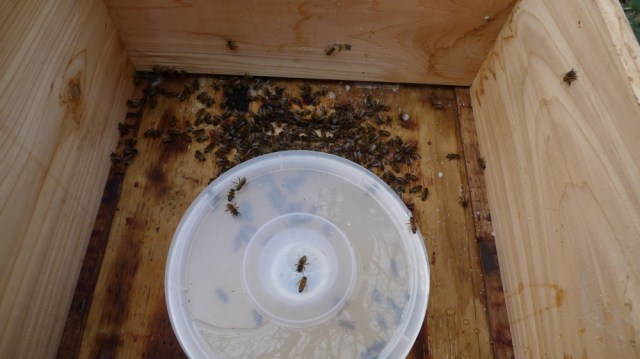
Unfortunately she found a number of bees suffering from deformed wing virus, which is associated with varroa. Believe it or not, one of the poor bees below was alive and rocking back and forwards pulling its proboscis between its legs, a sign of distress. All the bees on this saucer had tiny or non-existent shredded looking wings.

Another of the inspectors demonstrated the Beebase website to us, which is run by the National Bee Unit. It contains all sorts of free information on good beekeeping techniques and disease prevention methods. It’s great and they’re about to introduce a login area where beekeepers can record their bee inspections privately.

The Disease Incidence and Reports page is quite interesting, it gives live information about the location of confirmed cases of European Foul brood (EFB), American Foul brood (AFB) and Varroa in England and Wales. So far this year only one London colony in Croydon has been diagnosed with EFB, but in general London is quite a high EFB area, with about 3-4% of the colonies inspected having EFB. The Varroa Calculator is also useful for working out whether you need to take action about your mite count and what treatments you can do.

Think I’ll write up the rest of my notes later, time to have some tasty food now!

Posted in Colony management | Tagged , | 5 Comments

Inside the nuc

Today was beautiful, proper summer weather, and I had the day off, so I went down to see the bees before the rain predicted tomorrow arrives.

On Saturday we split our hive into two because we had sealed queen cells inside. The old queen, Queen Rose, was moved into a nucleus hive with some brood and stores, so I checked on her.

As you can see they’re doing well, only the frame at the top has yet to be completely drawn out. Looking through I spotted Queen Rose, freshly laid eggs pointing straight up into the air and tiny larvae. So she is still laying well, as you would expect a one year old queen to be. I spotted a few queen cups at the bottom of one frame, but thinking about it can’t remember if they were already there on the frame on Saturday. Should really squash them down next time.

They had nearly run out of the sugar syrup we gave them, so I topped that up. Here’s a couple hobnobbing on their nice clean new nuc porch:

Didn’t feel like doing anything very active afterwards, so just walked along the paths in the park by the canal, it’s only a five minute walk from my house. There’s some pretty wild bits of flowers and trees down there once you get beyond the mowed conventional swings and tennis courts bit of the park and get nearer the canal. I even stumbled into a bit of wood full of bottles – obviously used by teenagers/tramps for drinking in – and then spent ages trying to find a way out again through the undergrowth.

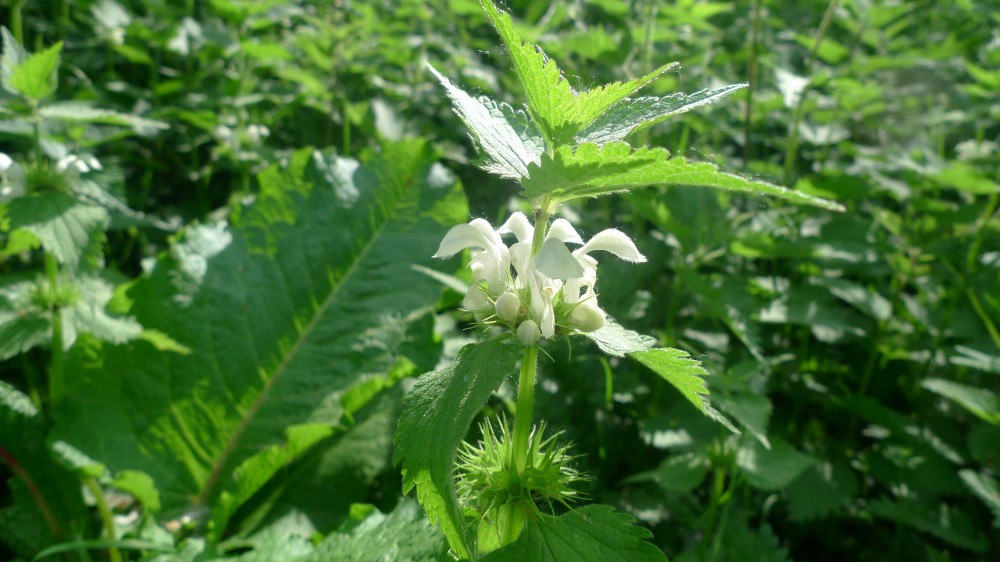
Recently I’ve been a bit more curious about where my bees get their nectar and pollen from than before. I can’t fly fast enough to follow them, but I can keep an eye out for what’s flowering. The nettles are out now:

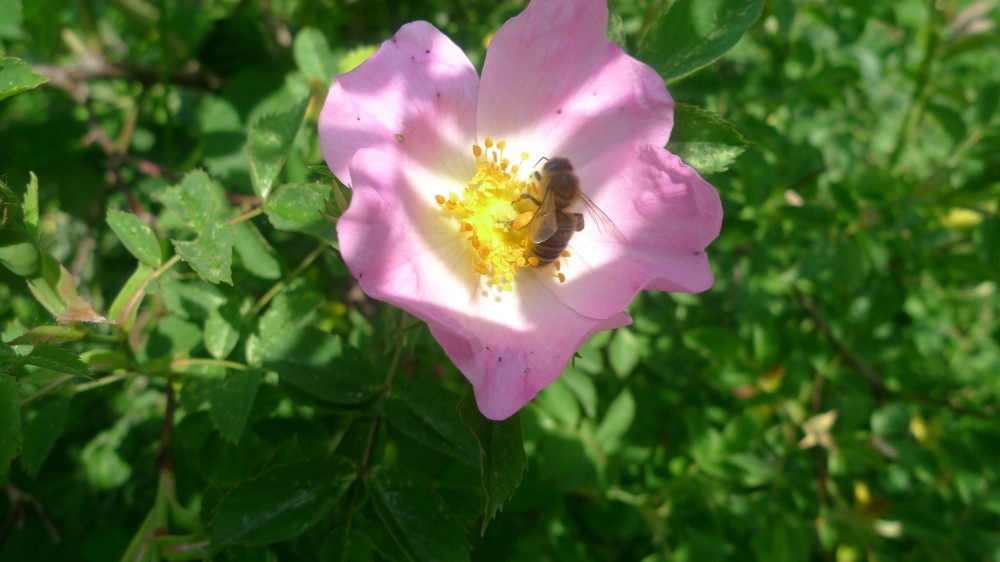
Some bumbles were on the nettles, but they flew too fast for the camera. I was more lucky with these dog roses:

Part of the reason honey bees are such good pollinators is that a foraging bee tends to stick to just one type of flower. She will know the time of day her chosen flower is producing maximum nectar and visit it then. And she lands….

Her pollen baskets are rose pollen colour only. There were plenty of these roses about. It’s nice to think that Queen Rose could be receiving some rose pollen right now. I found a bit about dog roses online, it seems the bees collect the pollen only from them:

Entomophilous flowers are usually brightly colored and scented. They normally contain a sweet liquid – nectar – as well as pollen, but some flowers (e.g., dog rose) are “pollen flowers” – they produce extra pollen as insect food but no nectar. The pollen of entomophilous flowers is sticky and adheres to the bodies of insects. Because of the more efficient pollination mechanism less pollen is produced than in the wind-pollinated flowers.

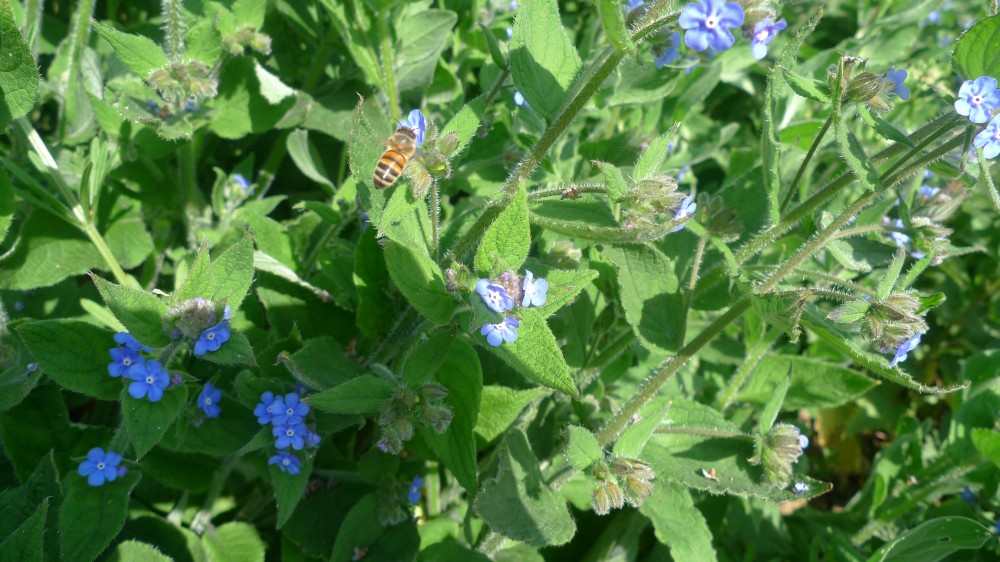
In contrast the bees were also on this little blue flower, but only sipping nectar, their pollen baskets were empty:

I don’t know what this little blue flower is called, but it’s a common wild flower around here. Anyone know?

As revision for my BBKA Honeybee Communication module exam earlier this year I did a revision post which has some more info on foraging behaviour.

Posted in Uncategorized | Tagged , , | 9 Comments

A royal break-up

On Tuesday Caroline Washington, our local bee inspector, had found a queen cell in our hive. Yesterday we decided what to do about it.

Caroline hadn’t been able to find Queen Rose on Tuesday. Possibly she was wisely hiding at the bottom of the box because it was so flipping cold. Yesterday was a lot sunnier and Emma found her on the fifth frame in. Here she is:

Queen Rose

Isn’t she a beauty? She looks as if she may be inspecting an empty cell, making sure it’s clean before measuring its size with her forelegs to tell whether to lay a worker or drone egg inside.

On another frame we noticed a bee stained with a lovely orangey/red pollen colour. Can you see her in the middle there? There is also a big beady eyed drone a bit to her right and little larvae are visible in the cells.

Here’s the queen cell. Everyone who has seen it has agreed that it is a perfect example of a queen cell, nice and big. As Emma said, it looks a bit like something from outer space. A bit further down, covered with bees, is another queen cell. At this point we asked for help from Andy Pedley, who knows what he’s doing. He recommended we do a split.

Luckily we had a nucleus ready to split the colony into – after the inspection on Tuesday Emma had contacted Thomas Bickerdike, a talented Ealing beekeeper and carpenter who runs a hive making company called the Beehive Workshop – www.thebeehiveworkshop.co.uk. He was able to make us up a cedar nucleus for £90 and have it ready for Saturday. The nucleus was beautifully made, very sturdy with a mesh floor and a little varroa monitoring board underneath which pulls out. Thomas also does a plywood version for £30 which is only designed for temporary summer building up of a colony. The cedar version will keep colonies warm overwinter and last us a lifetime. So much more convenient than ordering from a big supplier – as Thomas comes down on Saturdays anyway he could just bring it down with him rather than one of us having to stay in at home waiting for a delivery and then bring the nuc down in a taxi. Plus it’s nice to buy from someone you know.

Andy got us to put Queen Rose, a bit of brood and some stores into the nucleus, which fits five frames. Having a small space helps a small colony in keeping the brood at 35C. If the colony gets big enough we can eventually move them into a full size brood box before the winter. We moved the nuc a bit further away.

In the old brood box we left the queen cells, brood and stores with a super on top. Andy thought the larger queen cell would hatch first and the young queen would probably kill the other by stinging her cell. But we’ve left both queen cells just in case something goes wrong inside either of them. Now that we’ve split the colony they’re less likely to swarm.

The newly emerged princess will have to wait for good weather before navigating all the dangers of hungry birds to reach a drone congregation area up in the sky, where she will mate with multiple drones. Here is how Thomas D. Seeley describes the emergence of a queen in his book Honeybee Democracy (2010):

“the first virgin queen to emerge will announce her presence with queen piping signals, called “toots.” A queen pipes the same way as a worker, by pressing her thorax against a substrate and activating her flight muscles. A queen, however, presses herself against a comb instead of against a bee, probably to give her signal a broader audience….When the first virgin queen pipes, the workers instantly cease all movement for the duration of her signal, perhaps to minimize the background noise produced by their myriad footsteps, and the virgin queens confined in their cells will pipe in response, producing lower-pitched “quacks” that are somewhat longer than the first virgin queen’s “toots.” These quacks almost certainly inform the first virgin queen that she has lethal rivals.”

We must now leave the old hive with the queen cells alone for two-three weeks so as not to disturb the new young queen. It will be difficult to do so knowing all the drama that must be going on inside!

Posted in Colony management, Queens, Uncategorized | Tagged | 4 Comments

A bee inspector calls…

Today I have been down at the apiary watching Caroline Washington, our local FERA Bee Inspector, go through our hives. She was taking samples of bees as part of a nationwide analysis FERA are doing of the diseases present in UK hives. The results for each hive will eventually be available on the Beebase website via logging in.

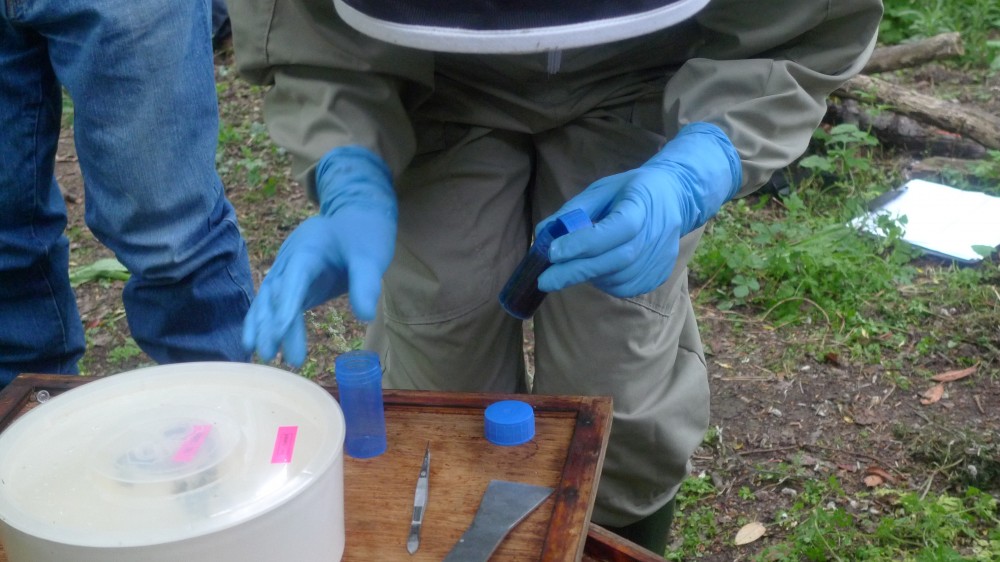
It was quite a learning experience watching Caroline. She took samples by getting someone to hold a frame up and then scooping up bees using a small plastic container, making sure beforehand that the queen was not on the frame!

Here you can see the containers. I think about 30 bees are needed for each sample. Caroline added a liquid to the containers which killed the bees.

Our hive was inspected third. Everything had looked fine when we inspected on Saturday. Was it fine when Caroline came? Of course not! All the frames were looking grand until the frame second from the front had a whopping beauty of a queen cell on the bottom of it. And Caroline spent quite some time looking but couldn’t find the queen, although eggs were present.

So…since they have only produced one queen cell it may be that the queen has died within the past three days (eggs hatch into larvae after three days) or that they want to supersede her, even though she’s less than a year old. Bees thinking of swarming would usually produce multiple queen cells. It’s a bit of a headache and Caroline advised me to wait till Saturday to see if they produce further queen cells and then take action.

After four hives we stopped for a cup of tea, as we were all freezing. It’s meant to be 15C in London today but it’s always a lot chillier under the apiary’s trees. Yesterday I was walking around in shorts and a t-shirt, today I was huddled up in jeans, a jumper, coat and bee suit. That’s British weather for you.

After warming ourselves up a bit Caroline went on inspecting. Her smoker lasted for ages, she put pine combs and twigs in it which produced a lovely smell too. In-between each hive she disinfected her hive tool and uncapping fork in a bucket of washing soda solution. The hive below Caroline unfortunately didn’t think was going to make it. There aren’t enough bees and the brood showed signs of disease. This brood here Caroline said had an unhealthy looking discolouration. She used her tweezers to pull out the larvae, several of which had rotted inside the cells.

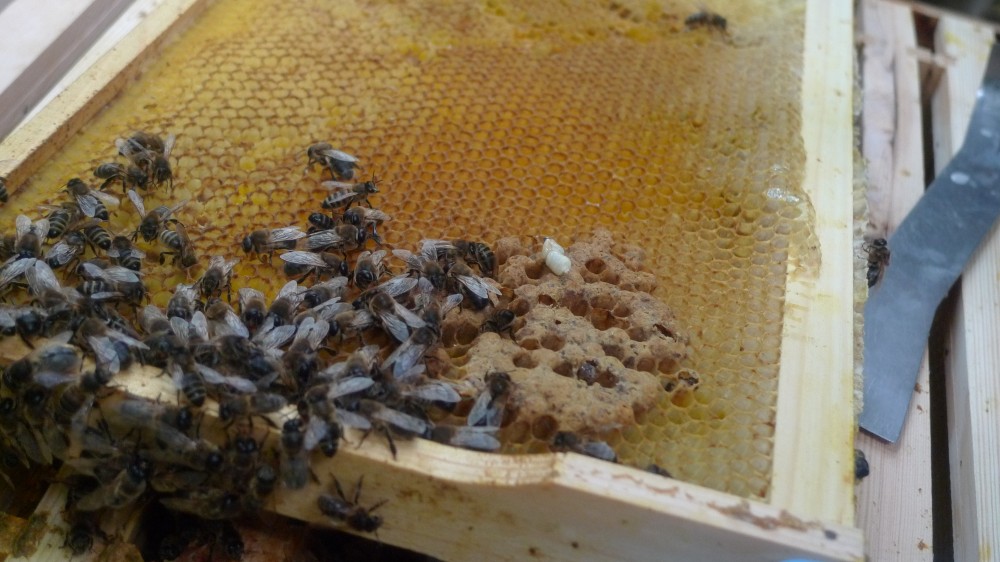
This frame Caroline told us newbies watching to take note of as an unhealthy brood pattern. It is far too patchy and several young bees toward the top of the frame have started emerging head first but never made it out.

The next hive we looked at, with a New Zealand queen, was doing better, with far more bees and healthy brood inside. However Caroline felt the queen should be laying more productively and advised requeening. She also found some unhealthy looking bees. It’s hard to see in the photo below, but this bee she found had died pulling on its proboscis, which she said is a sign of distress. Another one showed signs of deformed wing virus, which she said is the biggest problem for bees in London, as a result of varroa.

The hives at the apiary have not done very well over the winter – we started with fifteen and are now down to nine, several of which are not strong colonies. Caroline thought this might be to do with the heavy tree cover keeping the hives cold, so there will be efforts made to reduce this. Varroa is obviously also a major problem too. She said she despairs of beekeepers who refuse to treat for varroa, subsequently spreading the mites to neighbouring hives through bees drifting from one hive to another.

It is becoming fashionable to practice “natural beekeeping” in top bar or Warre hives (vertical top bar hives) where the bees produce their own comb rather than being given foundation sheets to build on. The Warre hives can be a nightmare for the bee inspectors to inspect as the combs can be huge, requiring the inspectors to work in pairs, unlike the National type boxes used in the Ealing apiary. Sometimes beekeepers using these type of hives are not carrying out any swarm control, causing neighbours to get tetchy when the hives swarm several times a season. Rightly or wrongly, frequent swarms can mean beekeepers become banned from allotment sites as the other allotment holders don’t want to put up with it. That isn’t really fair on beekeepers who do keep an eye on their bees.

I’m glad I was able to watch Caroline today, it was fascinating to hear all her advice. Fingers crossed our bees don’t swarm before Saturday!

EDIT: A Daily Telegraph article by beekeeper journalist Ian Douglas, who was also paid a visit by Caroline, has since been published: www.telegraph.co.uk/gardening/beekeeping/8567865/Beekeeping-Diary-an-inspector-calls.html

Posted in Colony management | Tagged , | 4 Comments

The double brood box is on…

So this week I was supposed to make up ten frames and take them down to the apiary. What actually happened was that I realised I had everything to make up ten frames except the nails and couldn’t find quite the right nails in the local hardware shops, who don’t appear to sell ‘beekeeper nails’.

So I took the unmade-up frames down to the apiary, where Emma and I had an epic frame making session. Making frames is something I really suck at, but luckily there were lots of skilled carpenters about to watch and shake their heads sorrowfully. John Chapple (the queen’s beekeeper!) gave me some good advice to shave a couple of millimeters off the foundation if it’s too long to fit in the frame. Here he is showing me how it’s done:

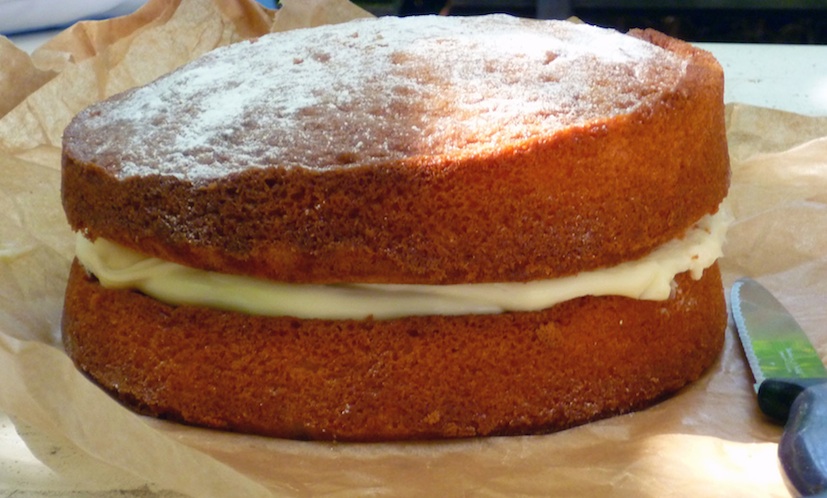
John got the foundation in perfectly, something I continued to fail to do with the next nine frames, especially in the 27C heat. You should really do it at home with foundation that’s been in the fridge, but in the hot weather our bees have taken up the whole box this week, so we thought we’d better give them some more space before they got royal weddings on their mind too. In-between making frames there was time to have some cake:

There is a running joke going that the Ealing Association isn’t so much a beekeepers club as a tea and cake drinking club with a spot of mild beekeeping on the side. Whatever the weather, a cup of tea and a bit of something to nibble on is always available.

John Chapple then got the idea to do this with our hive:

Shortly followed by this:

I’m on the left looking nervous, Emma is on the right in the pretty bird top. Don’t try this at home kids. Emma and I didn’t get stung but John did. This must be his idea of taking it easy before his quadruple bypass heart operation later in the week. Hope he’ll be ok.

Later on we went and inspected the bees properly with bee suits and smoker. They are doing fantastically with lots of brood and stores. We didn’t see Queen Rose, as Emma has named her, but she is obviously laying well and the bees seemed happy and mellow post the John stinging incident. On Tuesday our local government bee inspector, Caroline Washington, is visiting the apiary, so I’ll go down to see that.  Hopefully she will approve of the hive and our bees will be on their best behaviour.

Posted in Uncategorized | Tagged | 6 Comments

Not so super after all

Yesterday my hive partner, Emma, had put a super on our hive as we thought it wouldn’t do any harm to have one on there ready for all the loads of honey we’re going to get this year.

Today I told Alan, the beekeeper who kindly helped me shook-swarm, that we had put the super box on, but he advised us to take it off. So the super has been moved away for now! Alan told us we should wait till our colony has really built out all the frames and the box is heaving with bees before putting another brood box on, and then wait till that is also spilling over with bees before putting a super on. He keeps all his colonies on a double brood box and believes it really helps a colony survive the winter if it is bigger and has more stores for food and insulation. The bees are less likely to swarm on a double brood box system, and the queen will lay more eggs in the extra space, so you get more bees. There are a few disadvantages – some beekeepers at the apiary are against it as inspections are made more difficult and you may be more likely to miss queen cells with twice the number of brood frames. You get a bit less honey too, although Alan still gets loads in his locations.

This makes sense to me as I overwintered mine in a double brood box and they did better than most of the hives in the apiary. Most of the other hives have been quite slow to build up so far this year and only have bees on four-five frames compared to the nine frames our bees have now drawn out. Alan told us he thinks our bees will never really do well in the shady location they’re in down at the apiary! Emma’s been trying to hunt down alternative locations, perhaps in a kind person’s garden in exchange for some honey, but it’s hard to find places. Having a garden is a bit of a luxury in London. I have one but it’s tiny and shared with my sunbathing neighbour and her dog, so that’s not going to work.

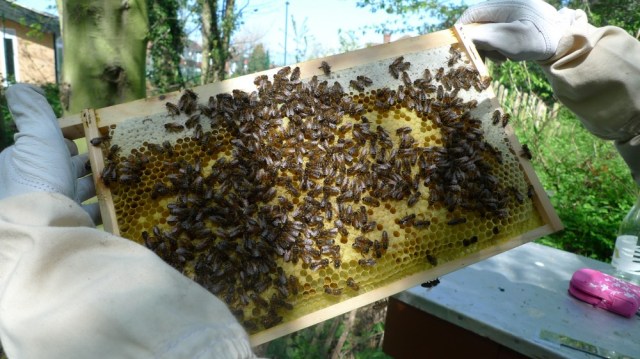
We had a look through and they all look fine, the queen was spotted plus more capped brood and even a bit of drone brood now, for the first time since shook-swarming. In the photo above you can see a bit of the many colours of pollen they’re storing. I like observing the colour variations in the bees too. Some of them have lighter caramel brown abdomens, others are quite black.

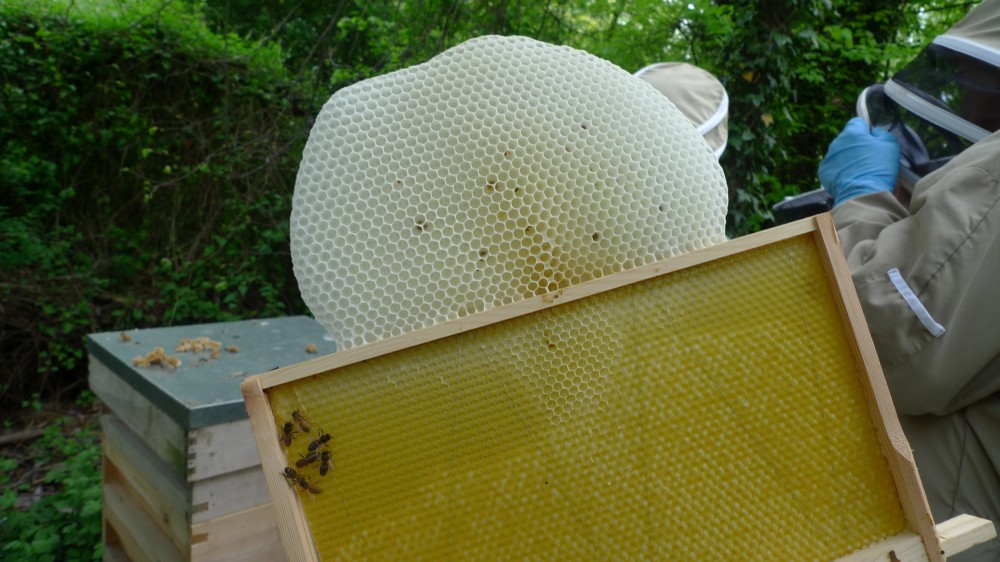
Above is what happens when you give naughty bees a bit of extra space to build in – beautiful natural comb, but not where the beekeeper wants it. This was in someone else’s hive.

Hopefully you can see here the structure of the comb. A bit of pollen has been stored inside but otherwise they haven’t done much with it yet, so you can see through to the cell walls on the other side. Each cell is a precise hexagon, offset from the cell on the reverse side. First thick layers of wax are placed at the base of what will become each comb, these are drawn out into cells by elongating and thinning the wax out to form the cell walls. Worker cells are about 5.2-5.4 mm in diameter, drone cells are wider at 6.2-6.4 mm.

Time for a bit of wine and relaxing now I think 🙂

Posted in Colony management | Tagged | 17 Comments

Three weeks after shook-swarming & swarm collecting tips

London has been basking in a heat wave this week. I can’t remember the last time I looked at the BBC weather forecast and saw three dazzling consecutive days of suns up there. It’s been 21C today and the bees were loving it, zooming back in with bulging pollen baskets.

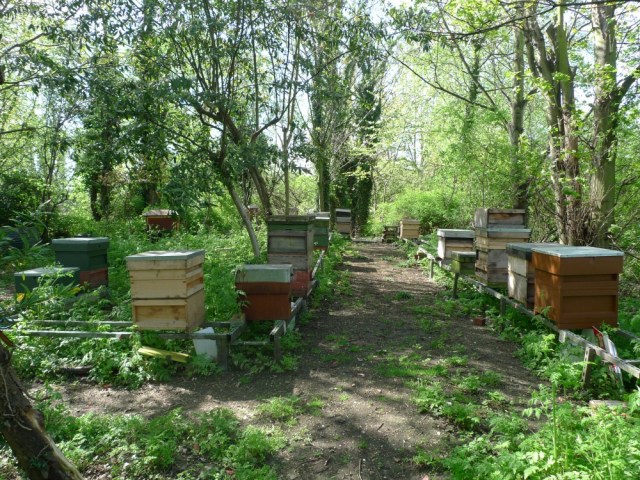
The apiary today. Mine is the second hive on the far right, next to the similarly sized chocolate brown hive.

Inside the hive they had drawn out eight combs, with only two out of their ten left untouched (the dummy board makes up eleven frames). My hive partner, Emma, has kindly offered to put a super on next week, and then the honey harvest can begin!

Here are some uncapped larvae with beautiful white honey towards the top of the frames. Emma commented that the bees on frames with larvae on always seem calmer, going about their business slowly and methodically with less of a frantic pace than bees on other hives. Perhaps because they are the younger nurse bees, or because the brood pheromones and those of the queen, who is likely to be nearby young brood, keep them calm?

And, best of all, our first sighting of capped brood since we put the bees on new foundation three weeks ago. Worker bees take 21 days to emerge from egg to larvae, so next week we should see plenty of fuzzy young bees ready to take over from their older sisters.

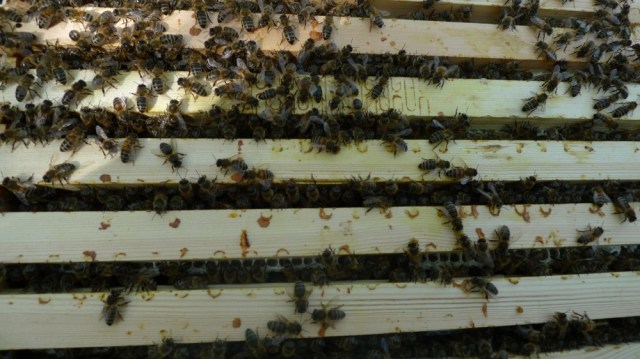
On the frame tops I saw some dots which I was worried at first might be dysentry, but looking closer they seem too reddy brown and the wrong texture for dysentry, so hopefully just propolis from their helpful attempts to stick down the queen excluder. Lots of hob-nobbing going on in this photo.

See also:

Some swarm collecting advice 

After having a little picnic we headed over to the local scout hut for a talk by Andy Pedley on swarm control and swarm collection. Andy is very experienced in collecting swarms and had some funny stories to tell us. Just yesterday he had two phone calls about swarms, neither of which turned out to be worth following up. One turned out to be about a colony living in a roof – not exactly an easy place to collect from – and the other was about “big fluffy things” – bumbles, not honey bees then. Andy said the first thing to ask a caller is “What exactly do you see?”, because the general public may mistake a lot of stripy flying things for bees. A football size ball of bees is what he wants to hear.

The second question to ask is “How high up is it?”, again something the general public is bad at estimating (me included). Twenty five feet up is not going to be doable. If the bees are on a branch which can be cut off and put on a sheet on the ground, then great. Put a basket or box over the top with a wedge underneath to lift it up slightly. The bees under the box will appreciate the dark cavity and start fanning Nasonov pheromone to attract in any stragglers such as flying scout bees. Leave the box an hour or so or until dusk, by which time all the bees are hopefully inside. Turn the box the other way up with the sheet over the top.

Take the swarm to their new home. Either place a board in front of the hive and shake the bees in front of the entrance so that they walk up the board and in, or take the less romantic option of shaking them in through the roof. If shaking in through the roof you can place a queen excluder above the entrance to stop the colony absconding. Putting a frame of brood from another hive will also encourage them to stay. It helps the colony if you feed them a weak sugar solution, but wait 48 hours until wax-building and foraging are under way before feeding. This ensures that any disease contaminated honey brought in the bees’ honey stomachs is used as energy for wax secretion and not stored in the frames.

Posted in Swarms | Tagged , | Leave a comment

Two weeks after shook-swarming

It’s now two weeks since I shook-swarmed my bees. Doing either an annual shook-swarm or the Bailey comb exchange is compulsory for all hives kept at the Ealing Association apiary, to help prevent disease.

I think some new beekeepers are nervous of doing shook-swarms, and I was too until it went really well this year. The bees took me destroying all their brood and shaking them into a completely new home very well considering and have got on with building up the colony again brilliantly. Two weeks on, they have drawn out nearly seven frames.

Here is one of the frames, with lots of pollen and nectar stores and some capped honey towards the top. They nibbled clean a whole slab of pollen substitute this week, plus I could see bees bringing all sorts of colour pollen back in their baskets, from pale butter yellow to green to golden orange.

A frame of pollen and nectar

We saw the queen making her way round the hive, marked with last year’s colour, a smart navy blue. She is laying well, we have some capped worker larvae now and in a little over a week’s time a new generation will emerge to help the older bees out. If they continue expanding at this rate the brood box will be full up within a couple of weeks!

Pat, one of the very nice members of the Ealing association, showed some of us one of his colonies. Pat is very jolly and has a way of explaining things and answering questions clearly without making you feel stupid, which is very nice when you’re a beginner and still learning. His colony are also doing well after being shook-swarmed.

Pat told us that although the Bailey comb exchange method (see the National Bee Unit’s Replacing Comb (pdf) factsheet for an explanation of this) of gradually swopping old frames for new without destroying any brood may be gentler, in his opinion it is not nearly as effective at preventing disease, especially varroa, as mites are able to travel up and find more brood to feed on. So I’m glad I did the shook-swarm.

See also:

Posted in Uncategorized | Tagged | 2 Comments

A week after shook-swarming

Had a quick peek in the hive today, a week after shook-swarming them. I had been a bit worried before I lifted the crown board up because lots of them had managed to drown themselves in the sugar syrup yet hardly any of the syrup had been drunk.

There was no need to be concerned though, as during the lovely weather this week they had managed to draw out nearly four frames, in which nectar and many shades of pollen were already stored – so they have quickly built up plenty of stores to feed new brood with. The queen has already laid neat rows of eggs, so next weekend I probably will see capped larvae, depending on when exactly the eggs were laid – eggs take three days to develop into larvae and worker larvae are capped six days after hatching out (9 days after being laid).

I feel very grateful that mine are doing ok so far, as there seem to have been heavy losses locally this year. About seven hives in the apiary have died out or look likely to. So I’ve been very lucky with mine. Today the other beekeepers combined two hives which weren’t doing so well – one was strong in terms of numbers of bees, but had lost its queen, the other was weak with only a couple of frames of bees. Some pics below…

The strong colony, with only drone brood and no queen to be found

Shaking all the bees off the crownboard into the weaker colony…

Putting newspaper between the two colonies gives them time to get used to each others scents, so no attacking happens. They will chew up the newspaper in the next day or so and the two colonies will be united.

Putting the stronger colony on top…

And two become one.

Hopefully this colony can now go on to be a strong one.

Posted in Colony management | Tagged | Leave a comment

A successful shook swarming

Yesterday I shook-swarmed my hive at the apiary, with the help of Alan Gibbs, one of the very experienced beekeepers down there. It’s a spring clean for the bees, removing all their old comb with larvae cocoons/faeces, varroa and possibly diseases and giving them fresh new foundation to build on.

I was very glad to have Alan helping me as I’ve only done a shook-swarm once before two years ago. First, you put a ‘new’ hive and foundation frames in the location of your old one, with a queen excluder on top of the floor (between the floor and the brood box). Once the new hive is where your old one used to be, any returning foragers should arrive there.  You then remove four frames from the centre of the new hive and place them to one side.

Removing the frames creates a gap to shake your bees into. I must admit my shaking technique is rubbish, it took me at least three or four shakes to get all the bees off each frame whereas Alan could remove them all in one shake. I was also brushing stragglers off with a bee brush. My queen was unmarked as I hadn’t been able to find her last summer, again Alan’s help came in handy as he marked her for me with a smart blue dot, last year’s colour.

Before the queen was found we had been going through the frames quite slowly, trying to find her. Afterwards we speeded up with the shaking as we didn’t have to worry about damaging her. Alan encouraged me to get every last bee in, saying “during a shook-swarm, every bee is precious”. We waited as a fuzzy new young bee emerged, biting her way out and emerging into what must have been an unusual welcome – no workers on the frame, only human smiling faces. We shook her in too.

My colony was bigger and healthier than I expected, spread over the two brood boxes and having several frames of stores and a few of brood. The queen had even been laying drone brood as well as worker, which is not usually the colony’s priority at this time of year. It was sad to burn up the frames of brood afterwards, I had to keep reminding myself that it’s for their own good in the long run. Even before the shook-swarm no varroa were on the monitoring board this week; hopefully the vast majority of the mites will have been feeding on the relatively small amount of spring brood and will have been burnt up in the old frames.

See the FERA Beebase website for a free downloadable shook-swarm factsheet which is worth following step-by-step if you’re shook-swarming for the first time.

I have been kicking myself today as I popped back to top up their sugar syrup and found this:

The bees you can see inside the feeder are dead, I forgot to put anything covering over the other crown board hole and they’ve all got up into the hive roof. Then some must have climbed into the feeder through the lid, before falling in and drowning. I stupidly didn’t bring a smoker or beesuit today as it’s a hassle to drag all my equipment on the two buses I take down to the apiary. So I think I’ll have to go back sometime this week and try and smoke them all down so I can cover over the hole and stop them getting in the feeder. For now I’ve put a brick on top of the feeder to weigh down its lid and try to get the gap too small for them to get in.

See also:

Going for a walk along part of the Grand Union Canal in Hanwell today lots of blossom was out and I spotted this worker diving into the white flowers:

An enormous bumble was also foraging on the blossom, she was so heavy the flowers were breaking under her weight. Good to see that some food is out there for them and spring is on the way at last. It was even warm enough for a drink outside in The Fox pub afterwards 🙂

Posted in Colony management | Tagged | 7 Comments