Springing into action

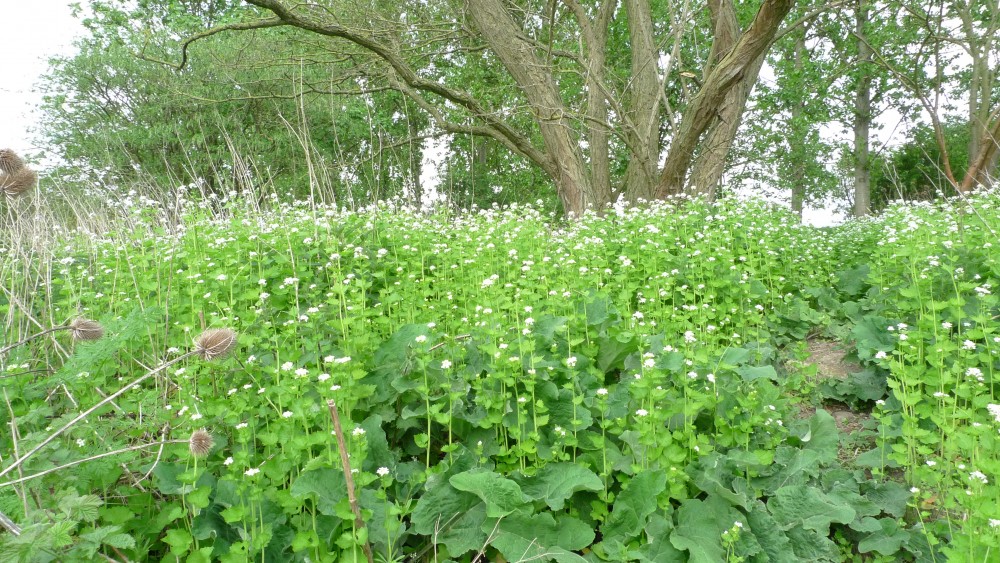
The arrival of some slightly warmer weather and occasional sunshine is the cue for the wild flowers of Ealing apiary to shoot upwards. Here you can see a swarm catcher dangling amidst a sea of white and green.

Weeds in the apiary

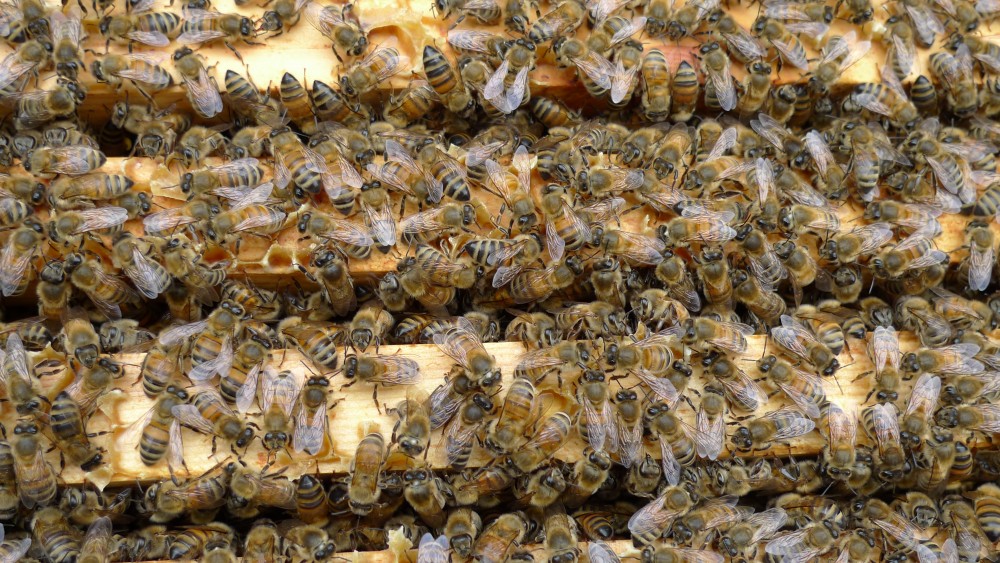
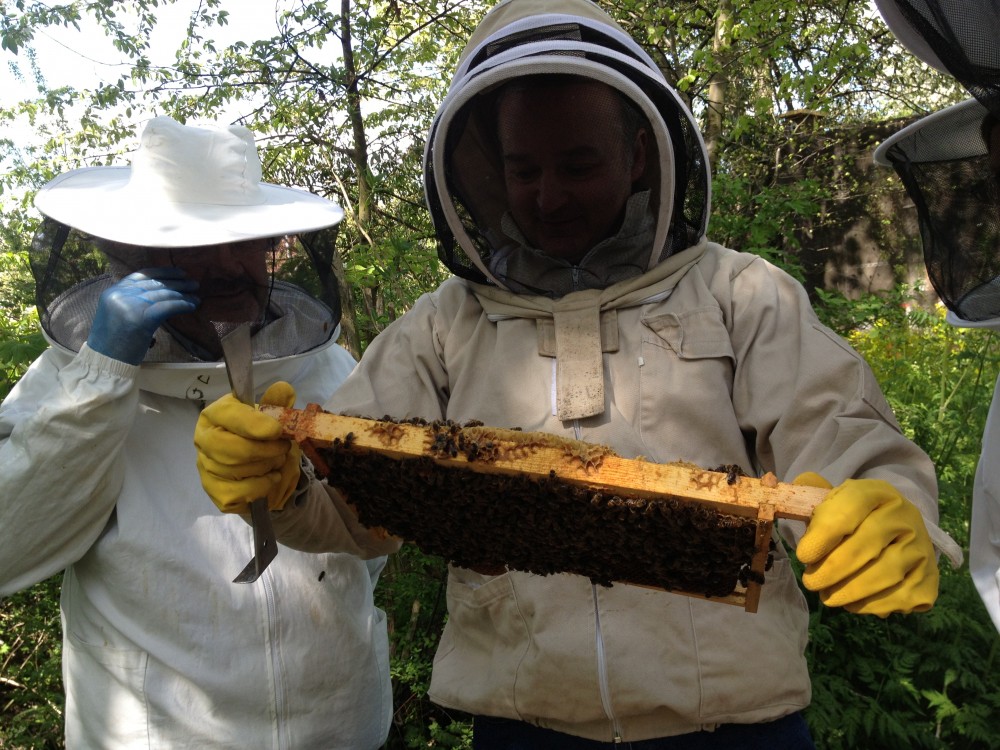
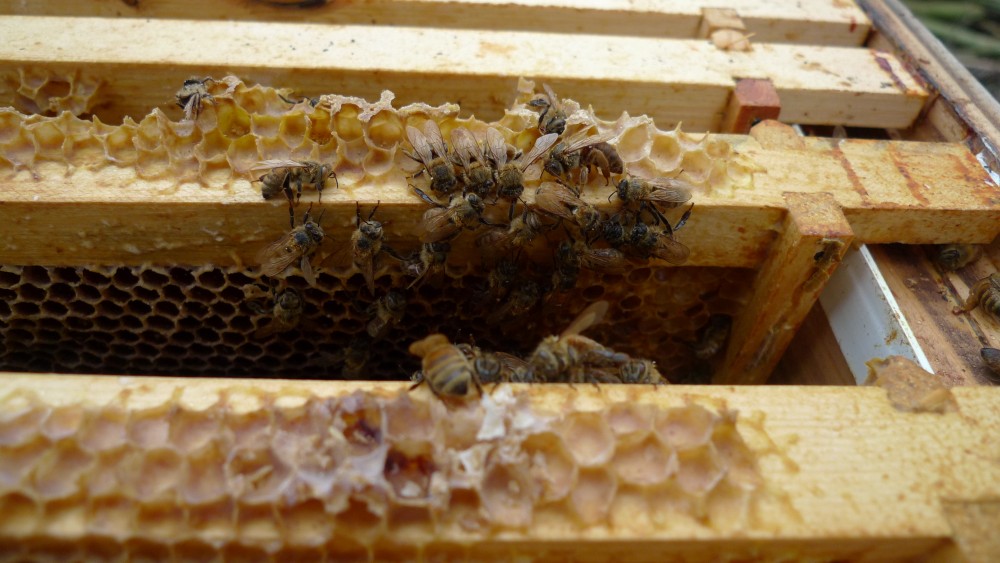
The bees are expanding fast too. Today I went to see our new hive in Hanwell – the bees have kindly been donated to us by Ian, a nice Ealing beekeeper. This was the scene when I lifted the crownboard…

Lots of bees

Packed frames

Full hive

Each frame is fully drawn out, right down to the dummy board. My smoker went out quickly but apart from a couple of puffs at the entrance I managed to inspect the hive without smoking them. Occasionally a couple of bees buzzed round my head, but despite only wearing thin latex gloves I received no stings. Since I started I’ve gradually learnt that swamping the bees in smoke isn’t necessary. I saw the queen and no queen cells, which was a relief.

Emma and her dad had left a super by the hive earlier this week, which was a big help. I put a queen excluder and the super over the top, so that the ladies can start storing honey up there and free up space for the queen to lay.

Song for a new super, set to the tune of Missy Elliott’s Get Ur Freak On

Bees be putting it down, fill your stomachs big and round
New combs around, y’all can’t stop eating
Now
Listen to me now, y’know you can do twenty pounds
And if you want that sweet nectar then come on get it now
(YES)
Is you with me now (YES) then buzz buzz buzz it now
(SWEET!!) Bees fly around (YES)
Now honey gathers round, now beeks jump around

Go, get your super on
Go, getcha getcha getcha getcha getcha super on

Dead drone

Dead drone

Last picture – a dead, disintegrating drone I found on the ground. The tiny hooks that hold the wings together in flight have become disengaged and you can clearly see his four wings. For all his big eyes and muscles he never reached a queen.

Posted in Uncategorized | 30 Comments

What’s flowering now: early May

Each summer I like to go round the park near my house in Hanwell, West London (Elthorne park) and try to get photos of the flowers that are out, to see what the bees have to feed on. Elthorne park has a smart  (e.g. boring) bit with a children’s playground, but behind that are some wilder fields, leading down to woodland and the canal. Bunnies bounce about and occasionally you can walk for as long as five minutes without spotting another human being.  Here’s what I found yesterday.

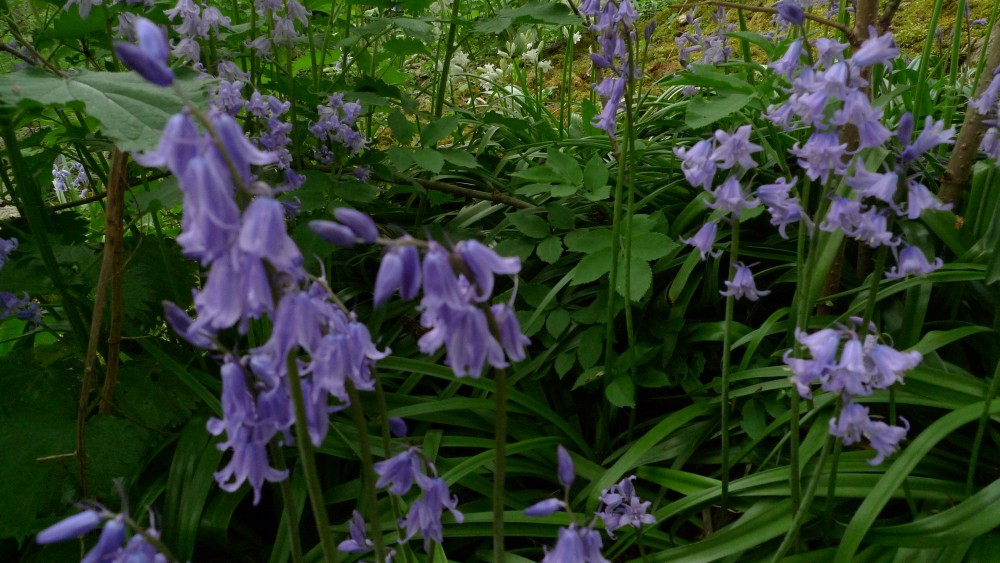
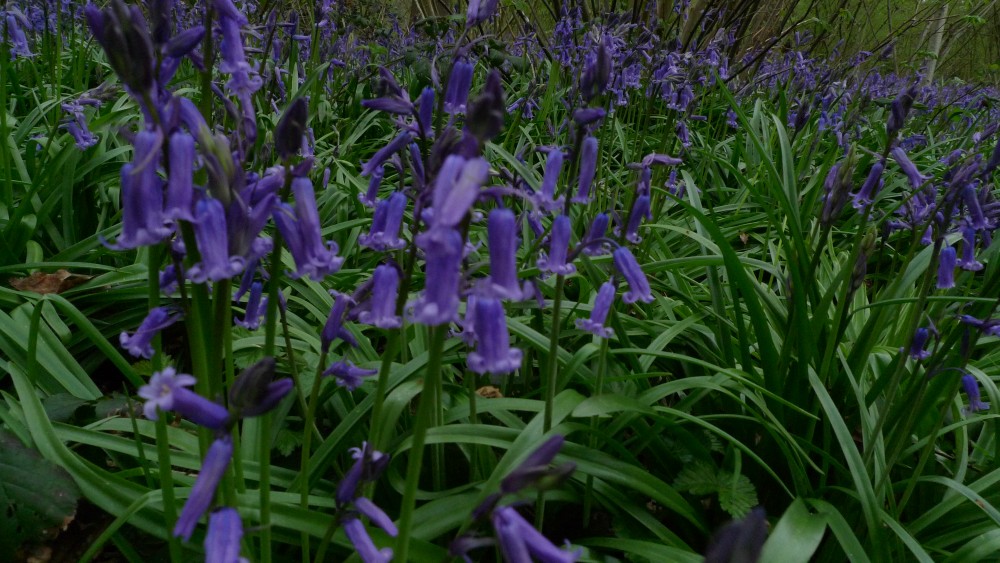
Bluebells

Bluebells

Bluebells…

EDIT: Comments from London Beekeepers Association Forage officer Mark Patterson, via Facebook:

“the blue bells are probably Spanish blue bells Hycinthoides hispanica or hybrids of them. English blue bell H. nonscripta are smaller, scented and have a unique tone of blueness.  I would say they are deffo not English blue bell H. non-scripta, because in non-scripta they all hang downwards on one side of the stem whereas H.hispanica and its hybrids have bells hanging at all angles from all around the flower stem as it would appear in your photo. There is a growing concern over H.hispanica and its hybrids taking over the UK and replacing our native bluebell. I have dug all mine up and bough in english bulbs from specialist nursery to replace them.”

There’s a good explanation of the differences between the English and Spanish bluebells in this post by a biologist: Bluebell time!

White bluebells

Whitebells…

Pink bluebells

And pinkbells! I assume these are just unusual variations of the usual blue colour? Ted Hooper describes bluebells in his Guide to Bees and Honey (2010): “The honeybee works this flower with varying eagerness but in some years with great vigour. It provides a yellow pollen.” I haven’t spotted a single bee on a bluebell this year, has anyone else?

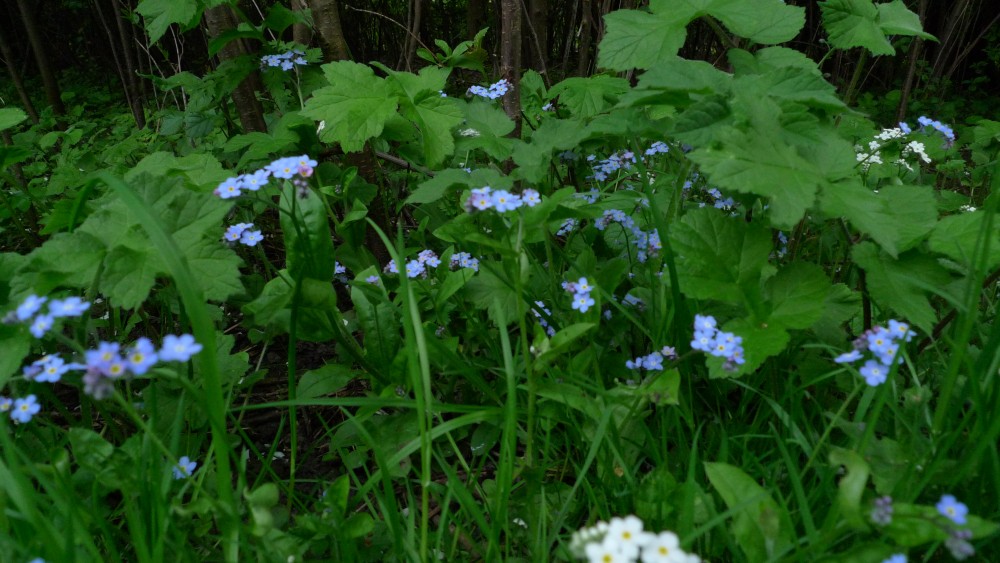
Forget-me-nots

Forget me not, Forget-me-nots

I think these pretty baby blue flowers with yellow centres are forget-me-nots. (EDIT: yep, confirmed by theprospectofbees in coments below.

White dead nettle

White dead nettle

This is white dead-head nettle. I like the contrast of the white flowers arrayed amongst the vibrant green leaves.

Purple flowers

Um, very tiny purple flowers?
(EDIT: theprospectofbees has suggested ground ivy in the comments below, and it certainly looks similar).

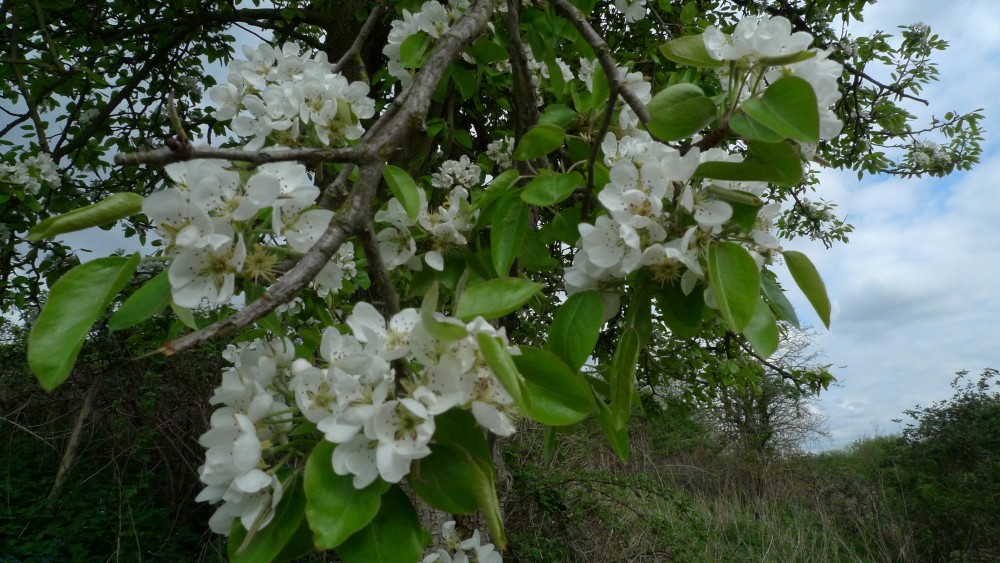
Blossom

Blossom of some kind – anyone know which? I hear apple blossom is out. Ted Hooper says “All the tree fruits – apple, pear, cherry and hawthorn or may…”None, except cherry, is a good honey plant, but they provide some nectar and plenty of pollen and are therefore useful to the beekeeper. The flowering periods cover the end of March, April and May….The honey is pale straw to medium amber and of delicate flavour. Pollen loads greenish yellow to pale yellow” (Guide to Bees and Honey, 2010, p.225). 

Dandelions

Dandelions and daisies in the sun

The under-appreciated dandelion, which looks like little yellow pom-poms to me. Recently I downloaded a helpful free online guide named ‘Twelve months of forage’ by Andy Willis from the Reading Beekeepers Association, included in their  March 2013 newsletter (scroll right to the end of the newsletter for the forage chart). Andy describes dandelion pollen as leaving a orange dusting on the underside of foragers. He also says dandelion can be a possible honey crop when it’s sunny – during dull or bad weather the flowers will close.

White flowers

Anyone have any ideas what this tall white flower is?
(EDIT: identified as garlic mustard by standingoutinmyfieldGarden Walk Garden Talk and theprospectofbees in comments below.)

White flowers

Here it is close-up.

pink blossom

Some pink blossom… I’m clueless on this too.
(EDIT: H-Appicultrice has suggested that it looks similar to Bramley apple blossom.)

carder bee

Common carder bee

And this was the only flower I actually saw bees on. It’s a common weed round here, but I don’t know what it’s called. When in a sunny spot I often see it covered with all types of bees – bumbles, honey bees and carders. This looks like a common carder bee to me.

EDIT: with help from Eddy Winko in the comments below, I’ve identified this blue flower as ‘green alkanet’ (also known as evergreen bugloss). The www.first-nature.com website tells me that “The name alkanet comes from the arabic name for henna, and the roots of Green Alkanet can be used to produce a red dye.” Indeed, this BBC article about partying in the times of Jane Austen reveals that “For rosy cheeks, alkanet and cochineal roots were used as the basis for rouge.” This blusher was used mostly by women, but also by some male officers during fancy occasions such as balls!

And a post by wellywoman gives the information that it originated in the southern Mediterranean but was imported for this red dye and was popular in medieval times with monks; it is probably from the gardens of the monks that it spread into the British countryside. It’s a member of the Borage family, which would explain why it’s so popular with the bees.

I haven’t done very well on my flower id-ing during this trip. I’m hoping some people will leave comments here to help me! Also, I didn’t see many bees, despite it being a warm, sunny day. I spotted five during a 40 minute walk and heard another two buzz past. Wonder if the rainy spring has meant a lot of bumble bee queens weren’t able to get going.

Posted in Uncategorized | Tagged | 27 Comments

First inspection of the year

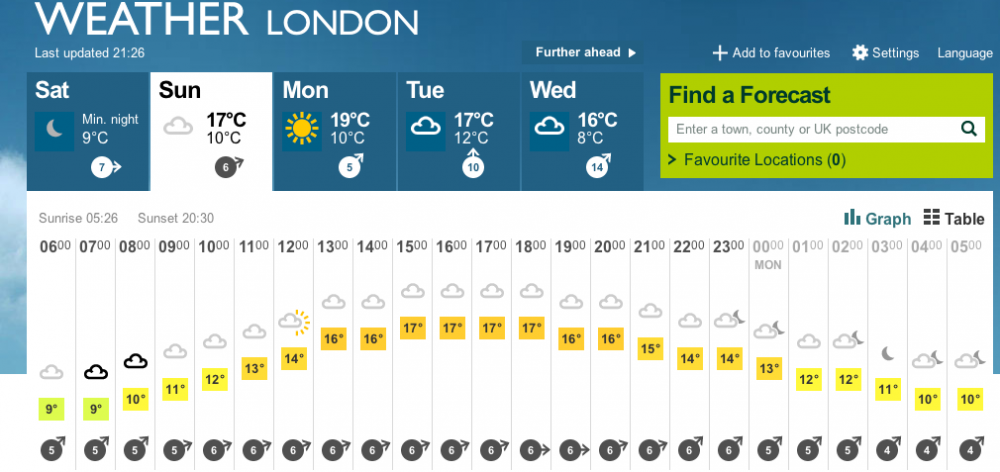
One of the unexpected consequences of taking up beekeeping – and only being able to visit the bees on a weekend – has been developing an obsession with the weather. During the summer months I jump on the BBC website as soon as Tuesday comes, to inspect the five day forecast. Sometimes on Tuesday sunshine will be predicted for Saturday, but that sunshine turns into clouds or rain as the week progresses. Other times rain will be expected, but as Saturday comes closer a sun will miraculously appear. It keeps me on tenterhooks I can tell you.

This is this week’s forecast: summer is here at last!

Screen Shot 2013-05-04 at 22.12.48

Yesterday was certainly full of surprises. I left the house to go and visit the local farmers market at about 12pm, only to find the kind of rain coming down that clears the streets, because people are afraid to leave their homes. I pushed my hair back under my waterproof and listened to the drops pounding down on my hood. By the time I reached the market the rain cleared, but all the plants and vegetables were dripping. I was convinced the day was a write off for beekeeping. Yet later on, by 2pm, the rain had cleared, sun came out and the day turned all lovely.

When I arrived at the apiary, everyone was standing watching a gentleman on a ladder constructing a bigger roof for us to meet under, as more people are visiting each week than ever. How many beekeepers does it take to put up a roof? One to do all the work, plus twenty to drink tea and watch.

Roof construction

After a cup of tea and a chocolate brownie, I watched David Pugh, an experienced Welsh beekeeper, go through his colony. As usual his dark, moody bees were doing well – I’ve never known those little buggers not get through a winter.  “Why is there still fondant on the hive?” someone asked. “Because I haven’t taken it off yet” David replied.

David Pugh inspecting

David Pugh inspecting

Things were not so positive in the hive next door inhabited by yellow Italians (imported from New Zealand), which appeared to have a spider problem. Lots of bees had died tangled up in cobwebs, and there was very little brood. Last week we’d seen wasps going in – weak colonies struggle to keep pests out. “Focus on building them up for the winter” David recommended. “You’ll never get any honey out of them this year – unless you’re exceptionally lucky.”

After that, I watched Thomas inspecting Ken’s hive. Ken had already tried earlier that morning, but without gloves on. The bees (headed by a queen raised from eggs from David’s fiesty bees) had beaten him back by stinging his hands repeatedly. So Tom was wise to have thick gloves on for the second attempt! Here you can see him showing the others the queen.

Thomas inspecting

Thomas inspecting

The bees were doing great. “Two for black bees, nil for New Zealanders”, Thomas observed.

An audience

Below is Albert inspecting. These bees came from a captured swarm last year. They seem to be doing okay and the queen was spotted, a large beauty.

Albert inspecting

Albert inspecting

After watching everyone else go through their hives, I was excited to be able to delve inside our two colonies for the first time this year. A small audience was there to watch and help, including a cartoonist from Private Eye, looking for inspiration for his regular comic in there. Our newest hive, which we bought recently from another Ealing beekeeper, was absolutely bursting. The bees had not gone up to start drawing out foundation in their second brood box for the Bailey comb exchange yet, but they had packed every spare centimetre of their hive with comb.

As I eased the sticky frames out, layers of drone comb were falling off the bottom. At one point I had to reach my hand into the bottom of the hive to fish out a particularly large dislodged piece, which would have been hard for the bees to remove on their own. Luckily I got no stings, despite wearing thin surgical gloves which had split at the wrists. Upon inspecting the purple eyed drones, no mites were spotted.

Our other, older hive with our lovely ultra gentle ladies was not so full of bees, but still had enough brood, pollen and honey stores. Our quite orange queen was spotted – she’s on the small side, but seems to be laying fine. I was a bit worried to see some smaller than usual workers – with developed wings but tiny abdomens – could this be due to the workers being weakened by varroa whilst developing?

The Private Eye cartoonist was interested in hearing our views on the two-year EU neonicotinoids ban. He had not heard of varroa mites and was surprised that they are such a problem for beekeepers here. There has been a lot of publicity about bees recently – they even featured in both Have I Got News For You and QI this week – but there are so many issues involved in bee health that I think it’s hard for the general public (or indeed beekeepers) to have a clear idea of all the factors involved.

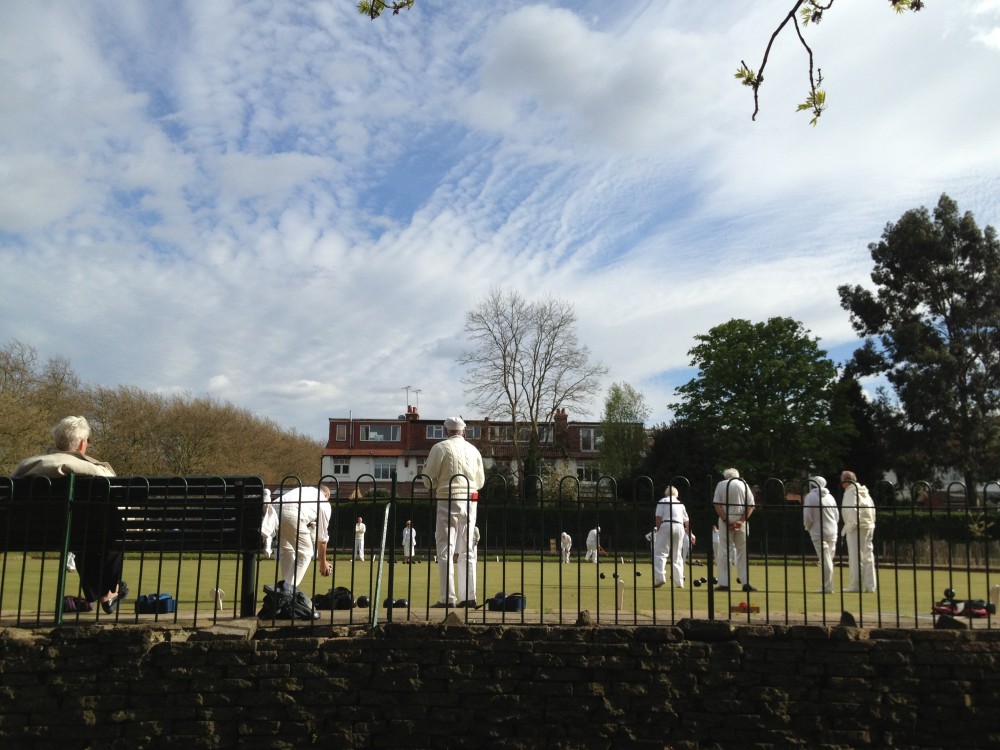
Drew cycled to the apiary to meet me and we walked part of the way home together. We stopped to watch a game of bowls – another very weather dependent sport. The bowlers were all dressed very smartly in white with cream jumpers, like cricketers. It’s a game of skill rather than physical exertion. The sky above is pretty and the bowlers must have been pleased to have a sunny day to play on.

Bowls

Bowls

Posted in Uncategorized | 29 Comments

Beekeeping in a hail storm

Yesterday I did a session for a few Ealing beginners at the apiary. Clare, the Ealing association Chairman, had asked me to demonstrate lighting smokers and inspecting. But it wasn’t inspecting weather, so we could only really do the smoker bit. I am by no means an expert at lighting a smoker – I can get it going but it always seems to go out quickly – but I tried my best to pass on a few tips. I mentioned getting as big a smoker as possible and some fuels to use – cheap things like newspaper, sawdust and egg boxes. Last year Emma and I tried out lavender, which makes a lovely smell.

My friend Yasmine holding a smoker last year, with Emma in the background

My friend Yasmine holding a smoker.

We then popped our heads in the top of a few hives. The first one we looked in had a couple of huge queen wasps sitting on the hive insulation, so we got rid of those. They then tried to get back in, so we found some gaffer tape in the apiary shed and sealed over the holes. They probably wouldn’t have done much harm unless they’d managed to get under the insulation, but no point encouraging wasps in the apiary.

After the session had ended I got talking to Ian, an Ealing beekeeper who has been very kind to me and Emma. He told me about a very simple method of starting a Bailey comb exchange, which is just to place a queen excluder on top of the current brood box and then an additional box full of new brood foundation on top, with some syrup to help them draw out fresh comb. In a week or two we can move the queen up into the top brood box and remove the bottom brood box frames once the brood inside has hatched out. This is a very easy technique for getting the bees to produce new comb, so that the old dirty brood combs can be discarded.

The rain seemed to have stopped and the sun came out, so Llyr, Emma and I went down to start the Bailey exchange on our hives (Llyr has just bought the hive next to our two). At first everything was going well and Llyr had managed to put the queen excluder and new brood box onto his hive without any bother.

Then Emma and I started doing our bees. We soon noticed that they’d managed to make some brace comb. Suddenly Emma cleverly spotted our queen on the underside of the crown board, darting amongst the brace comb. Luckily she had a queen cage clip with her, so we got the queen to walk in the clip and popped her in Llyr’s pocket to keep warm. At this point the skies darkened overhead and a hail shower came along! So we had an open hive, hail pelting down, a queen in a pocket and brace comb still to remove. Emma wisely decided to put the crownboard over the bees to keep them warm until the hail passed.

Eventually the shower cleared, so we could return the queen to the hive, pop the queen excluder on top and put the hive back together. Miraculously the bees stayed calm and didn’t get violently angry during all of this. English beekeeping has to be done in-between the rain drops!

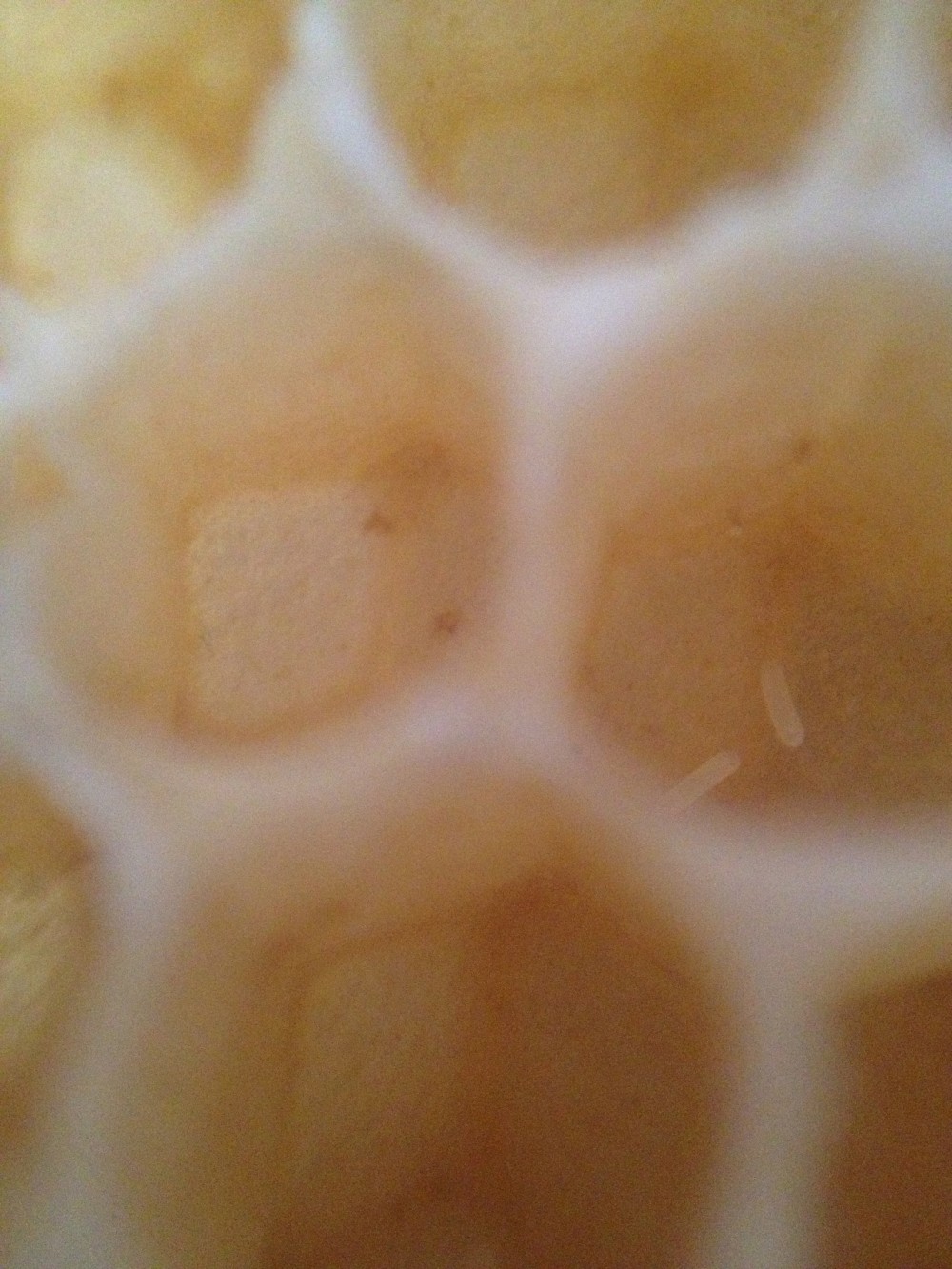
The reason for the queen being up in the brace comb soon became clear; she had been busy laying eggs in it. Can you see what look like small grains of rice in the photos below?

Honey bee eggs

In fact, occasionally she’d got so carried away that she’d laid two eggs in a cell! I’m hoping this was not a laying worker, as the eggs were right at the bottom of the cells and had been laid in a regular pattern.

Two honeybee eggs

A double yolker. Photos taken with my iPhone “macro” lens.

Today (Sunday) I went to the annual Perivale Wood open day. Perivale Wood is a very special ancient oak woodland; at this time of year it is absolutely carpeted with bluebells. It’s usually closed to the public, but if you join as a member for £4 a year you can get access. There is a very still, calm, atmosphere beneath the trees, even though cars and sirens can be heard in the distance. Here’s a few photos..

Perivale wood bluebells

Bluebell season

Perivale wood trees

By the way, there have been some political beekeeping events happening this week in London. I was stuck at work on Friday, but some beekeepers took to the streets in what is being called ‘The March of the Beekeepers’. The idea was to pressurise the Environment Minister, Owen Paterson, who will be taking part in an EU vote on Monday on whether to ban neonicotinoid insecticides. For those who are interested, Philip Strange has done a great blog post explaining these events: The March of the Beekeepers.

Posted in Uncategorized | 35 Comments

Dull roots with spring rain

An apiary on a soggy day is a place of frustration for a beekeeper. You can stand surrounded by hives and not see a single bee. The bees remain in retreat, and there is no beekeeping to be done.

We watch and wait still, continuing our weekly fondant check. Below you can see our three hives, in a row from the left. The tall, enormous hive is full of bees and honey stores …equipment.

Our hives

I touched the plastic wrapper of one of the fondant packets the bees are nibbling away inside and it was lovely and warm. They manage to keep it almost the temperature of a sauna inside there. I’d want to stay inside too.

The varroa monitoring boards have hardly any mites when I check. Perhaps this is the result of the winter oxalic acid treatment, or perhaps ants are eating them! Wax fragments and dropped pollen on the board confirm that comb building is going on, stores are being uncapped and pollen is being used to feed the brood. Things are going as well as can be hoped in this weather.

Other colonies have not been so lucky. This is one we found today. Only a tiny cluster remained.

Dead colony

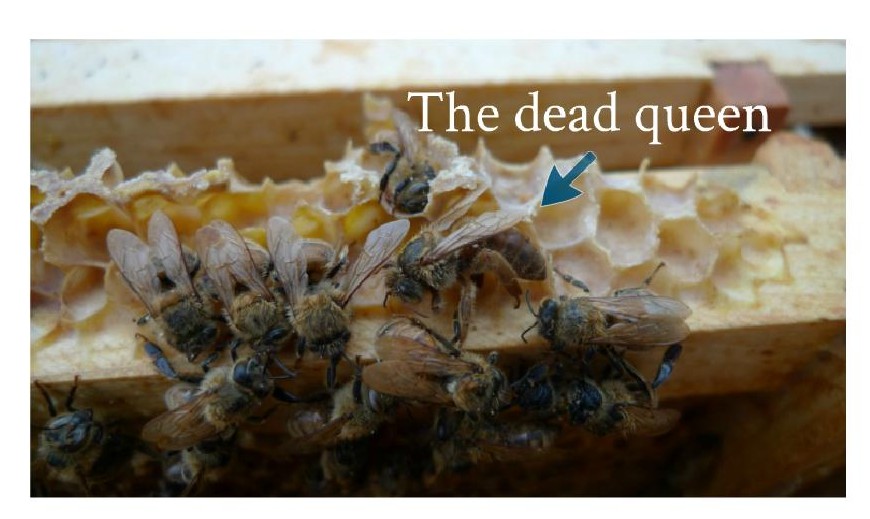
It was sad to see the queen on top of the frames, surrounded by a few attendants. They would have protected her until the end.

Dead honeybee queen

Thomas took a few away to test for nosema, which he suspects may have been implicated in the death of another colony in the apiary.

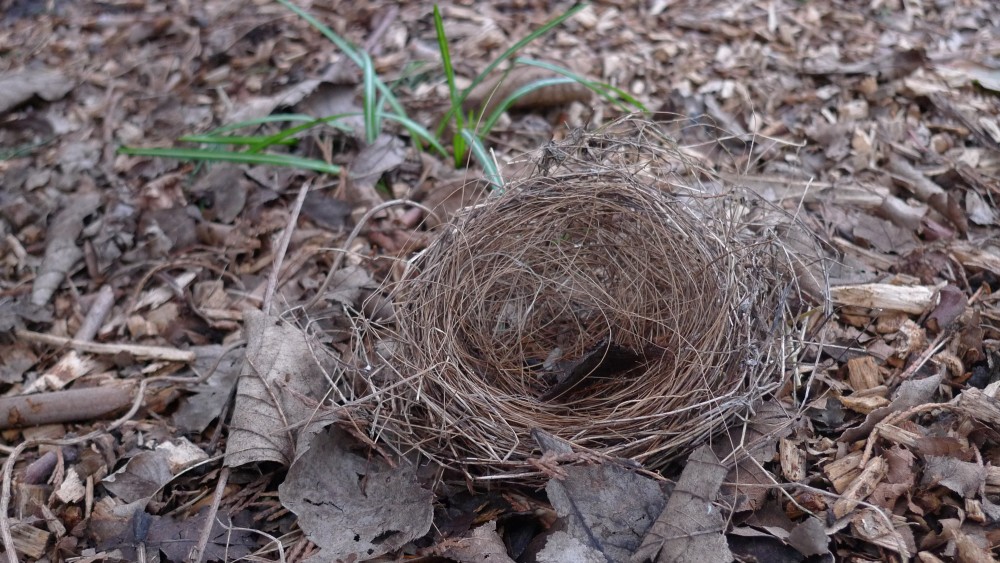
Under one of our apiary tables I discovered this little nest. Had it contained chicks? Or, as Emma has suggested, is it an old nest blown down from the trees, or perhaps a new nest just started? It contained no mossy lining. I hope it was empty. Perhaps the resourceful apiary robins will be able to make use of it.

Bird's nest

By the way I discovered these pretty embroidered bumble bee brooches today, made by a Scottish lady named Lisa Toppin.

Amazing attention to detail. Looks like a buff-tailed bumblebee? You can see a blog post on how she makes them here: More bumble bees and her Etsy shop, which she sells them from, is called Agnes and Cora.

Posted in Uncategorized | 34 Comments

Spring, is that you?

For weeks it has been painful to leave the house. I have spent many hours standing hunched at bus stops, the wind whipping mercilessly at my hair. My hands have even started cracking under the cold, with little cuts appearing at the joints. This week we had snow blizzards swirling round the city.

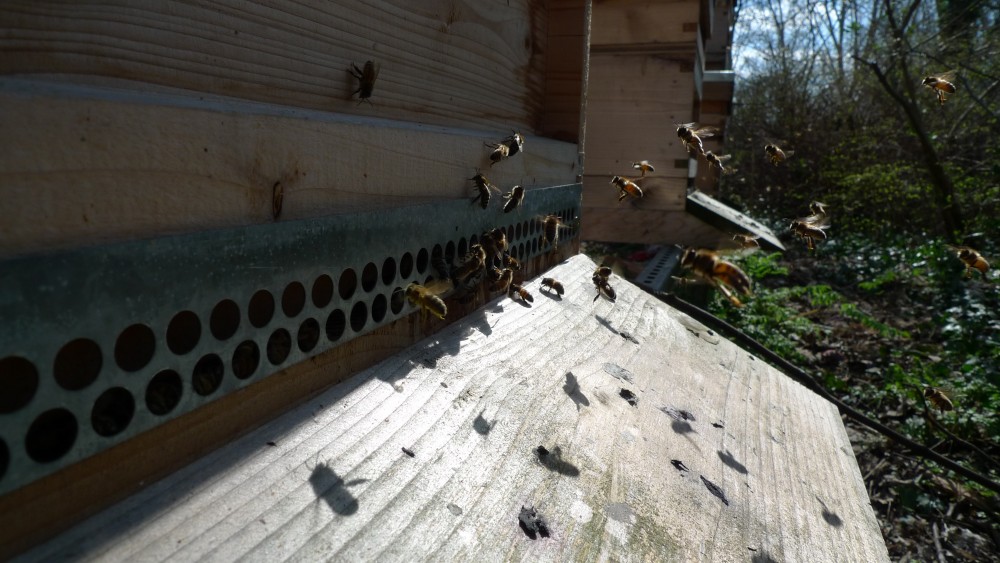
And then today. Today the sun came out. And so did the bees.

Flying bees, 6th April

This is the first time I’ve seen them flying since November. It was VERY exciting. They must have been desperate to feel the sun, to collect food, to poop. A buzz of excitement, of purpose, could be heard outside each hive. Lots to do!

Flying bees, 6th April

Terrible photos I know, but Emma and Drew were not there. Below you can see some yellow pollen on the legs of the lower bee. Several of the bees were bringing back similarly garish loads. Does anyone know what this yellow pollen is? Ian suggested daffodils. I had a look on the Bristol Beekeepers Association’s interactive pollen guide (access by clicking on ‘Pollen guide’ along their top navigation menu) and broccoli and blue crocus look a similar colour.

Honeybees, 6th April

Encouraged by the warmth, with the help of some excellent assistants I removed the chicken-wire around our hives, which was protecting them against woodpeckers. Now that the ground is softer and a few more insects about, hopefully woodpeckers will be going for easier targets.

I probably haven’t mentioned yet that recently Emma and I bought a hive from a beekeeper who has given up. So we now have two in place, lined up next to each other. I checked the fondant and the bees still had some left. It was still a little too cold for a proper inspection: we had coats on and inspecting should be done in t-shirt weather.

Beautiful flowers are out around Ealing apiary, including blue, white and pink hyacinths.

L1050251

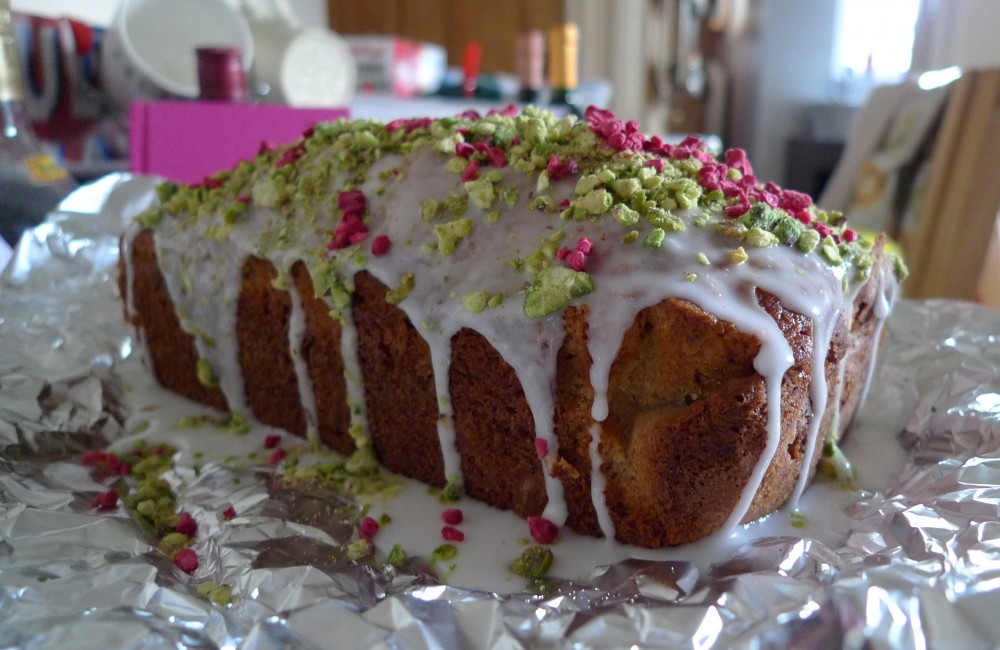
We also had some cake. This is a pistacho one, which we had today…

Pistachio cake

Pistachio cake

And this is a simnel cake, which is a fruit cake made with ground almonds, covered with marzipan and then lightly grilled – quite a bizarre experience for me, grilling a cake. The marzipan balls represent the eleven apostles, as it’s a cake traditionally eaten to celebrate Easter.

Simnel cake

Simnel cake

Perhaps spring is here at last and us beekeepers can start doing some actual beekeeping, rather than just talking about it. It has been a hard, long winter and many experienced beekeepers have lost several hives. I feel very grateful that our little bees have come through safely so far.

Posted in Uncategorized | 44 Comments

10th Honey bee pests, diseases and poisoning revision post: Braula coeca: the ‘bee louse’

The BBKA’s Module 3 syllabus says ‘The Candidate shall be able to give: …an outline account of the life cycle of Braula coeca, its effect on the colony and a description of the differences between adult Braula and Varroa”.

This funny little creature, Braula coeca (Pronounced Browler Seeker), is commonly – but mistakenly – known as the ‘bee louse’. In fact it is a type of fly, although one which can’t, being wingless.

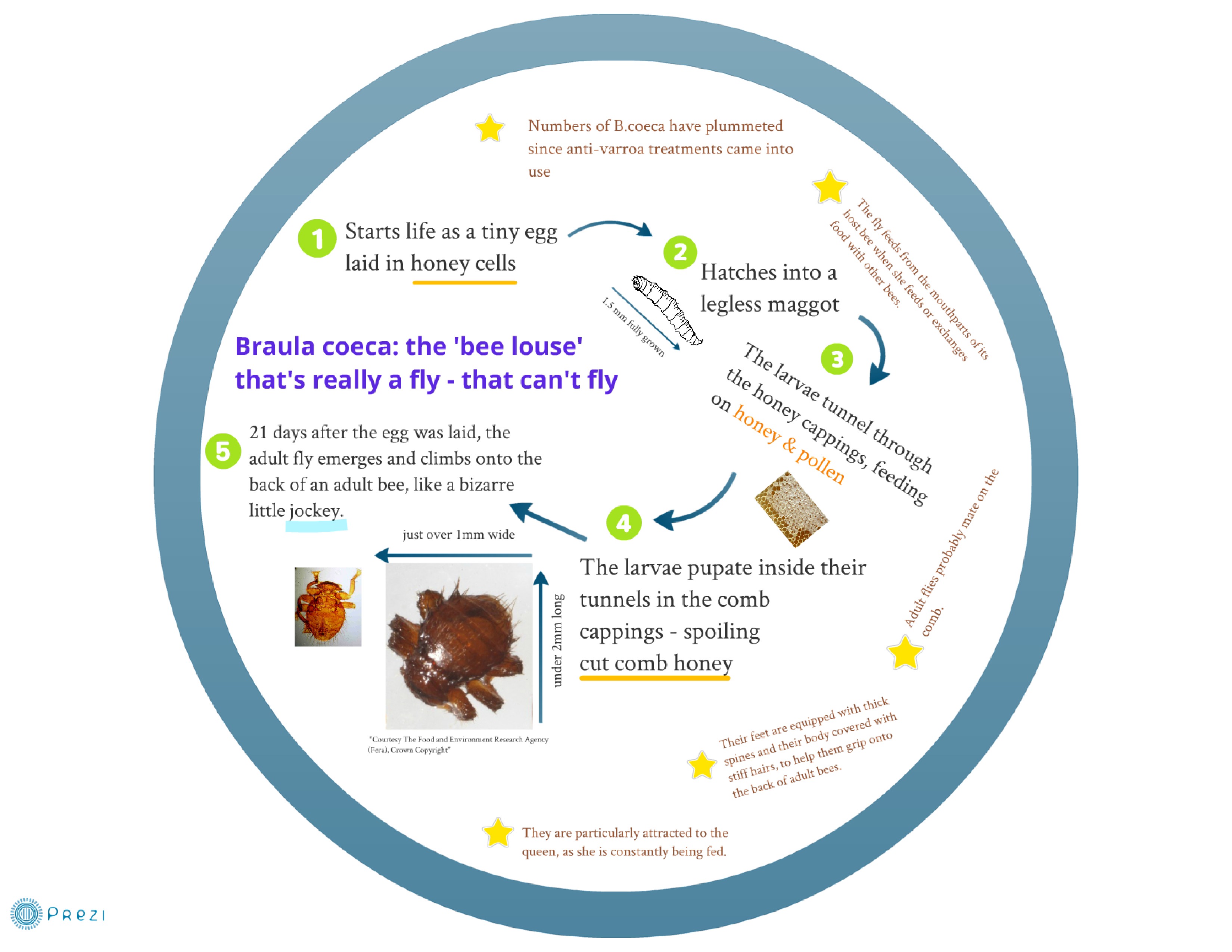
Below is an infographic on Braula coeca which I had a go at making using Prezi. Even though it’s not particularly complex, this took me ages! Respect to infographics creators.

Braula coeca: the 'bee louse'

If you have trouble reading the infographic, click on this Printer-friendly pdf version to see a larger version.

Braula is similar in size and colouring to a varroa mite. However, an adult Braula coeca has much more prominent legs than varroa (six legs compared to varroa’s eight) and more of a classic beetle shape with its head at its narrowest point, whereas a varroa mite is crab shaped, its legs protuding out slightly at its widest point.

Since beekeepers started treating against varroa with miticides, Braula coeca numbers have plummeted, but they used to be regularly observed riding the back of adult bees like little jockeys. When hungry, Braula will walk over the head of its host, lean forward and steal pollen and nectar from the bee’s mouth parts. It does this as the bee is feeding or exchanging food with another bee, or it can also deviously stroke the bee’s labrum (its “upper lip”), causing the bee to regurgitate a drop of fluid from its honey stomach, which the fly then eats.

Braula are particularly fond of queens, with dozens often found congregating on a queen’s back compared to typically only one or two Braula on an individual worker or drone bee. More than 180 adults have been found on a single queen (Source: University of Florida entomology department). This is likely to be because queens are fed regularly and consume greater quantities of food than worker bees.

Courtesy The Food and Environment Research Agency (Fera), Crown Copyright

Braulacoeca (top) compared to Varroa (right), Tropilaelaps (centre bottom) and Melittiphis (left). Courtesy The Food and Environment Research Agency (Fera), Crown Copyright

To reproduce, the female lays her eggs – 0.8mm in length – throughout the hive, though only those laid in the cappings of honey comb actually hatch, two to seven days later. The maggot-like larvae then burrow just under the surface of the capping, feeding on honey and pollen, creating little tunnels about 1mm wide. After a short series of moults, they emerge from the cappings as adult flies, ready to climb onto an unwitting bee. Like varroa mites, they overwinter by clinging to the back of an adult bee.

As they only steal a small amount of their food, rather than feeding on their haemolymph or developing larvae, Braula are not particularly harmful to honey bees. However, large numbers of them riding on a queens’ back must be a nuisance, and the developing larvae tunnelling through the wax cappings of honey cells is a pain for beekeepers wanting to produce cut comb.

Extracted honey with the cappings removed will be fine, but biting into cut comb will reveal the characteristic white tracks of the tiny Braula larvae within the cappings. If you live in an area where Braula still survive, the way to avoid this is freezing honey comb overnight as soon as you remove it from the hive, which destroys the eggs and larvae.

References:

The Module 3 exam is on Saturday, and I’m really not feeling confident about it. Between starting a new job and trying to find a wedding venue, I haven’t had as much time to revise as usual. I’d love to pass, but if I don’t I’ll go back to revising and retake in November.

Posted in Disease prevention, Exams | Tagged | 29 Comments

A few titbits

I forgot to post a photo I took from Karin Alton’s talk – of her wearing a human-sized varroa mite she had made, in proportion to the size the mite is on a bee. Imagine carrying one of these around sucking the life out of you all day.

Karin Alton wearing a human sized varroa mite

Karin Alton wearing a human sized varroa mite

Last week I gave a presentation to some beginner beekeepers on the Ealing & District Association annual beginner’s course. I was quite nervous but enjoyed myself. I had been asked to talk about progressing with beekeeping through the British Beekeepers’ Association (BBKA) Basic Assessment and Module exams.

If you’re thinking of taking any of the BBKA exams, the presentation might be of interest to you. I’ve made it available online as an interactive presentation at Progressing with Beekeeping and a pdf version is here.


Lastly, I enjoyed this month’s BBKA News, especially an article by Julian Grazebook, Dorset BKA (p15-16). Julian’s account of beginning beekeeping includes this ode to cake:

“Beekeeping is not a frenetic hobby, but I continue to be surprised by the large number of volunteers dedicated to sharing their Saturday afternoons instructing beginners. Perhaps it is their love of cakes which the students are encouraged to bring to each lesson as a sort of penance. I do not know if this is a unique Dorset trait or if it is shared by all beekeepers, but I have eaten more varieties of cake in the last year than during the rest of my life.”

Ealing beekeepers appreciate a bit of cake too Julian, you are not alone!

Pistachio & cardamom cake

Pistachio & cardamom cake

Posted in Exams | 18 Comments

Bee Keepers’ Day – Research on honeybee health and wellbeing

My second blog post on the Federation of Middlesex Beekeepers’ Associations annual ‘Bee Keepers’ Day‘, held last Saturday. Below are my notes from the second speaker, Dr Karin Alton. Karin is an entomologist from Sussex University, working with Professor Ratnieks at the Laboratory of Apiculture & Social Insects (LASI) on the hygienic bee project there. She explained to us that the hygienic behaviour shown by some honey bee workers includes:

1) Detecting dead or diseased larvae
2) Removing dead or diseased larvae

Through these types of behaviour, hygienic worker bees reduce the need for chemical anti-varroa treatments. There is a genetic basis for hygiene, with several recessive genes linked to increased hygienic behaviour. Around 10% of the general population of British honey bees have these genes. It is not something that bees can be taught or trained to do, either by other bees or humans – it’s all in their genetic coding.

Chalk brood infection

Chalk brood infection – hygienic workers should remove these larvae. Courtesy The Food and Environment Research Agency (Fera), Crown Copyright.

The Sussex team are trying to use dark, locally adapted bees for their hygienic research. They have been experimenting with killing off small areas of brood by pouring liquid nitrogen into circles of brood comb, using baked bean cans! Within 48 hours hygienic bees will clean out the circles of destroyed comb. So far the colonies studied have varied from between 20-90% of the dead brood having been removed after 48 hours, depending on how hygienic the bees were.

Breeding hygienic bees is obviously difficult because bees within colonies vary in hygienic behaviour, due to being half-sisters with a number of different fathers. Trying to breed for hygiene involves a continual process of testing and assessing bees. Artificially inseminating queens provides control over which drone sperm the queen receives, but, Karin commented, is “fiendishly difficult”! Inseminating a queen, even one knocked out with anaesthetic, requires a very steady hand. That we have no queen rearing industry in the UK adds to the difficulty, so the Sussex team is hoping to receive training from outside experts.

One of our 2012 queens, Queen Neroli. Copyright Emma Tennant.

One of our 2012 queens, Queen Neroli. Copyright Emma Tennant.

Practical difficulties of breeding hygienic bees

  • The genetics of honey bees is still poorly understood
  • Undesirable traits can pop up, such as aggressiveness
  • Proper evaluation of “selected” characteristics can be difficult
  • Need to avoid inbreeding
  • Progress is slow and time consuming, with constant monitoring required

More details about the project are available on the University of Sussex website: Breeding disease-resistant ‘hygienic’ honey bees.

Changes in our landscape

Karin next turned to a different topic; the dramatic change in the UK’s landscape over recent decades and how this has affected the amount of forage available to bees. A few sobering facts:

  •  50% of British hedgerows have been removed since WW2. The 1997 Hedgerows Regulations now aim to protect hedgerows – let’s hope they slow the pace of destruction. 
  • 97% of flower meadows have been lost since the 1940s – we now have less than 8,000 hectares left, mostly as small, isolated fields. Only half of these are protected as Sites of Special Scientific Interest (SSSI sites).
  • After the ice age, wild woodland would have covered most of the UK. We are now one of the least wooded countries in Europe – only 12% wooded.
  • Ancient woodland makes up only 2% of the UK’s land area.
  • We are the 16th most road covered country in the world, yet only the 76th biggest country in the world.
  • A 2012 RAC survey, Spaced Out: Perspectives on parking policy, suggested that around 1/3 of our front gardens have been paved over to be used as car parking spaces – a figure that will come as no surprise to most Londoners.

Given these figures, from my point of view it’s no surprise that many bee species are struggling. It’s more amazing that we have any bees left at all.

Foraging honey bee

FlowerSCAPES

As well as her research work at Sussex Uni, Karin is also involved in running her pollinator-friendly wildlife gardening consultancy company FlowerSCAPES, along with her husband Steve Alton. Together they carry out planting advisory services, talks and training, as well as selling wild flower seed mixes.

They have found that councils, and the British people in general, are very reluctant to change their gardening habits. In many cities, bedding plants (mostly grown in Holland and shipped over) are changed three times a year, at a cost of approximately £60-65 per square metre per year. In addition to this expense, councils often mow public lawns in places such as parks around 15 times a year. West Sussex County Council pays £1m annually to cut its grass.

What level of emissions do you think an industrial lawnmower produces? If you think less than a car, you’re likely to be wrong. Take a look at these figures, tweeted below by Steve & Karin:

Mowers, such as the Ransom Jackson Commander 3520 model,  churn out CO2 at alarming rates. Unlike with cars, there are no regulations requiring British lawnmower manufacturers to either reduce or advertise their emissions.

We are currently in a situation where councils are so financially stretched that they are merging hospitals and cutting community services such as libraries. Is cutting grass really what our councils should be spending money on? Sowing Karin’s pollinator mixes only costs £5 per square metre annually, and meadows only need three cuts a year.

Copyright Drew Scott.

Foraging honey bee. Copyright Drew Scott.

One council told Karin that they received a barrage of complaints from dog walkers about their dogs getting wet, after park grass was left to grow longer. My way of looking at that is that dogs are not about to go extinct, whereas several native bee species face that threat. What’s our priority as a society, protecting our native wildlife and spending our money on community services, or religiously trimming grass ultra-short so that we don’t have to towel-dry our dogs?

Karin finished her talk with a plea to us beekeepers to become ‘floral terrorists’, planting bee-friendly flowers wherever we go. Let’s ditch the dull roundabouts of imported bedding plants and go back to beautiful poppies waving in a summer breeze.

Albanian honeybee on a poppy

Honey bees on wild poppies.

Posted in Disease prevention | Tagged , , | 24 Comments

Bee Keepers’ Day – Apis through the looking glass

Yesterday I went to the Federation of Middlesex Beekeepers’ Associations annual ‘Bee Keepers’ Day‘. Each year the Middlesex associations (Ealing, Enfield, Harrow, North London, Pinner & Ruislip) take it in turn to host a day of beekeeping talks; this year the day was held in Muswell Hill, North London. Below are my notes from the first speaker.

Graham Royle, beekeeper from Cheshire. ‘Apis through the looking glass’ – a look at what we really see in the beehive. 

Graham has been beekeeping since 1988 and started to study for the BBKA examinations in 1995 when he decided he wanted to know more about the bees he was keeping. His studies resulted in achieving the BBKA Master Beekeeper certificate in 2002 and the National Diploma in Beekeeping in 2004 (the highest beekeeping qualification recognised in the UK). He was also awarded the Wax Chandler’s prize in 2002. Not bad, huh?

This talk was absolutely fascinating. I was left blown away by Graham’s drawing, dissecting and photography abilities. He is also a hugely inventive man in a very practical way, with a background in electronics.

Beekeepers tend not to look closely at individual bees whilst inspecting (with the exception of the queen, of course). We are too busy looking at the combs, checking for eggs, worrying about queen cells, marvelling at pretty pollen etc. Few of us take the time to really look at the workers properly and think about how their bodies function. Below are some of the insights that Graham shared with us.
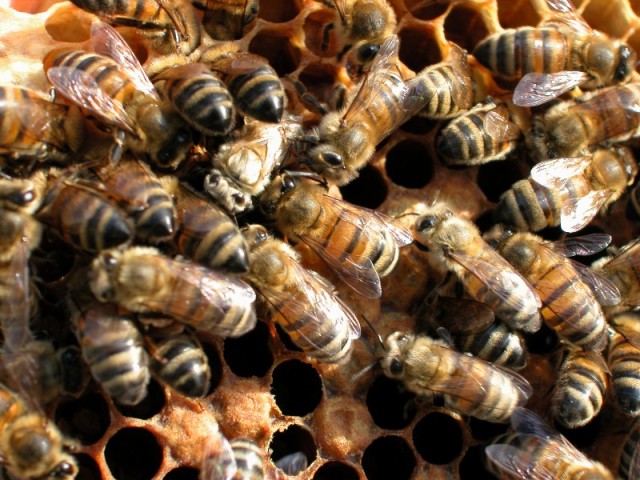
Courtesy The Food and Environment Research Agency (Fera), Crown Copyright

Honey bees. Courtesy The Food and Environment Research Agency (Fera), Crown Copyright

Senses

A bee’s senses are mostly located on their head. Their antennae are segmented and covered with sense cells. Through these, they can measure humidity and levels of carbon dioxide in the air, as well as detect pheromones and other smells.

Bee mandibles and antennae

The antennae up close, with the segments visible. This newly emerged bee has just used her mandibles to cut through the wax cap covering her cell. Image by Eric Tourneret, from thehoneygatherers.com.

They regularly clean their antennae with their front legs, using a built-in ‘antennae cleaner’ notch in each front leg. The small, pointy flap part of the notch is called the ‘fibula’ – this closes off the circle of the notch and little hairs in the formed circle brush dust and debris off the antenna as the bee pushes it through. Rusty at HoneyBeeSuite has a fabulous photo of this happening on her blog: Keeping antennae shiny and clean.

Honey bee front leg - drawing by me, based on diagram from 'The Honey Bee Inside Out', by Celia F. Davis.

Honey bee front leg – drawing by me, based on diagram from ‘The Honey Bee Inside Out’, by Celia F. Davis.

Eyes

As well as the obvious two eyes, bees have three small, simple ocelli eyes on the top of their head. No images can be seen through these eyes, but they can detect light levels. One theory for the positioning of the three eyes is that they help the bee work out if it is flying level horizontally or tilted to the left or right.

There are around 6,000 individual light sensors in each of the two compound eyes of a honey bee. As the eyes are rounded, each sensor is looking in a slightly different direction. Each sensor is covered with a lens …which has a spookily familiar shape…hexagonal, like a honeycomb. So the bees have 6,000 honeycomb shapes in each of their eyes. Hexagons are an efficient shape for packing a large number of elements into a small area, whether honey cells or eye lenses.

Image by Eric Tourneret, from thehoneygatherers.com. This is a Honey bee eye magnified 270 times. At the corners of the hexagons hairs sprout out – bees have very hairy eyes.

Bees are likely to see in lots of hexagonal coloured squares – their vision is much less acute and detailed than ours. It probably consists of lots of very coarse pixellated shapes, with flowers appearing as coloured patches. If you’ve ever been wearing bright clothing in a park and watched a bee fly around you inquisitively, it’s probably trying to work out if you are a flower.

However, with so many individual sensors their vision is much better than ours at detecting motion. A good reason to move slowly and calmly whilst around your bees.

Image by Eric Tourneret, from thehoneygatherers.com. As drones’ eyes are much larger (for spotting the queen during flight), the ocelli are pushed further forward on their head. Here you can just make out the outline of the three ocelli between the two massive eyes of the drone.
Developing honey bee larvae
Image by Eric Tourneret, from thehoneygatherers.com. I find it easier to understand the underlying form of a bee by looking at developing larvae. Note the rounded thorax, the segmented abdomen, the large area of the compound eyes and the dots of the three ocelli eyes on the top of the head.

Thorax

The thorax of a honey bee is roughly spherical and packed with muscles. It would be logical to assume that the wings are attached to muscles, but this is not the case. In fact one set of muscles run from the top to the bottom of the thorax and another set run horizontally across the thorax. The two sets take it in turn to contract during flight, indirectly causing the wings to move up and down. I suppose it would feel like us moving our arms by bobbing our torsos back and forwards? Hard to imagine.

Wings

Bees have four wings – if you are trying to work out whether an insect is a bee or a fly, look at the wings closely. During flight the front and back wings of a honey bee become hooked together; this is achieved by about 30 little hooks on the top edge of the hind wing gripping into a groove on the base of the front wing. The hind wing is then dragged up and down by the front wings (see Dave Cushman’s diagram ‘The Legs and Wings of Honey Bees‘).

Flying bees
Image by Eric Tourneret, from thehoneygatherers.com. The bee’s muscles allow it to flap its wings 400 to 500 times per second, to allow a speed of 25 to 30 kilometers per hour with its maximum payload.

Foraging

Bees comb as much pollen off their body as possible using their basitarus, a part of their legs which has rows of spiny hairs that act as in-built hair brushes. There is a spot on the middle of the back that bees can’t quite reach, with results in Graham getting calls from new beekeepers worrying that their bees are going mouldy, at the time when Himalayan Balsam is out!

The pollen baskets are fringed with hairs that help pollen stay in, and the bees also moisten the pollen with a bit of nectar to help it hold together. They don’t manage to get all the pollen from their body hairs, so some is left to pollinate the next flower they land on.

Courtesy The Food and Environment Research Agency (Fera), Crown Copyright

Courtesy The Food and Environment Research Agency (Fera), Crown Copyright

Feeding

The mouth cavity of a bee is elastic. From the mouth, food they ingest moves through the oesphagus into their abdomen. Initially food will be held in their crop (honey stomach), so that the bee can carry nectar home, rather than instantly digesting it all. The crop can stretch to carry a heavy load (the average when foraging is 40 mg, a bee weighs about 100 mg).

A proventriculus valve in the honey stomach can let food through to be digested or keep it within the crop. So honey is not bee vomit as some people like to say, because it has not been into a digestive stomach!

My drawing below shows what the small intestine and ventriculus look like when pulled out, which Graham can do when dissecting. The malpighian tubules do the job of our kidneys,  absorbing water and waste from the surrounding haemolymph (equivalent of our blood).
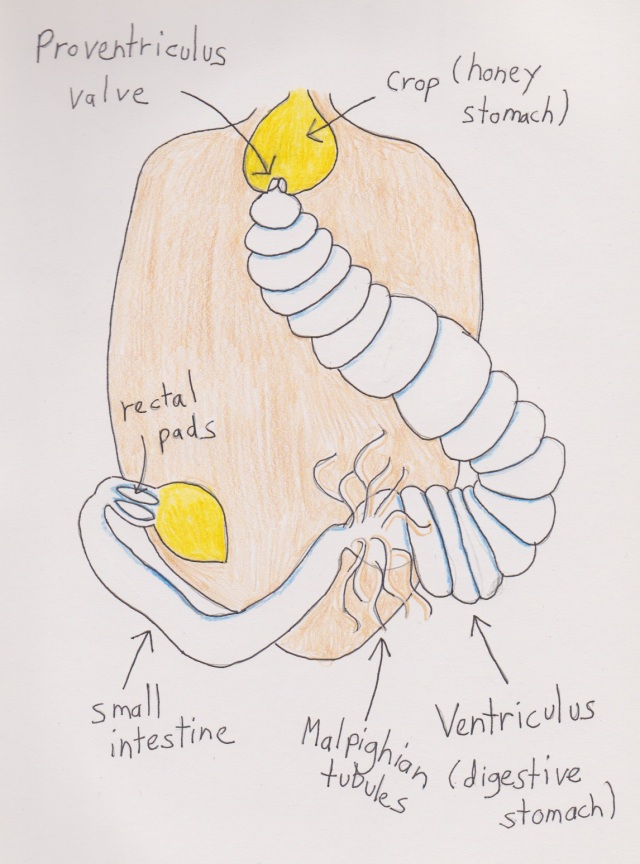
Bee digestive system - drawing by me, based on diagram from 'The Honey Bee Inside Out', by Celia F. Davis.

Bee digestive system – drawing by me, based on diagram from ‘The Honey Bee Inside Out’, by Celia F. Davis.

After pollen is digested, the outer husks of pollen grains pass through into the bee’s rectum and accumulate as yellow waste products. The husks are virtually indestructible, lasting thousands of years, which is why they are often used in forensic science and archaeology.

There are six of the rectal pads shown above in the rectum. These are thickened areas of the wall of the rectum, which show up as white elongated structures when dissecting. They are involved with moving water and other dissolved substances out from the rectum and into the bee’s haemolymph.

The rectum can expand significantly to fill almost the whole abdomen during winter, whilst the bees are clustering tightly and feeding on their honey stores; meanwhile the crop will shrink as the bees are digesting the honey immediately, not storing it for later regurgitation. In summer the reverse happens – the crop of the bee expands as the bee collects nectar, but the rectum shrinks because the bee has daily cleansing flights. So the abdominal space is used neatly, making the most of the available space depending on the season.

Reproduction

Queens contain specialised reproductive equipment within their long, tapering abdomens. Rows of eggs are in constant production, with queens typically having around 150-180 ovarioles (egg tubes) in their two huge ovaries. Glands by the side of the spermatheca nourish the sperm that a queen collects during her mating flights and keeps them alive for 3-4 years after mating. Amazing when you think about it.

A laying worker has tiny ovaries and can only produce 2-12 eggs at a time, compared to the 150-180 that a queen can. Of course she also has no spermatheca, so cannot fertilise her eggs and can only lay drones.

Dissection tips

Graham accompanied his talk with fantastic drawings and photos from his dissection work. Some of these he had animated, for example to demonstrate the action of the thorax muscles during flight, or the mechanism of the pollen baskets. To dissect he uses freshly killed bees anaesthetised with methyl acetate – rather than frozen ones, which he finds become mushy afterwards. He only takes one or two bees at a time.

It’s easiest to dissect bee internal organs under water (the bee should be under water, not you!), to support the organs once the external exoskeleton keeping the organs together has been removed. Graham showed us a short video of him cutting incredibly neatly around the abdomen with small scissors and a scalpel to reveal the organs inside, and then snipping off the spiracles and malpighian tubules attached to the organs. I imagine if I tried the poor bee would soon become pretty mangled.

Graham finished by telling us that his presentation was dedicated to the six workers, drone and queen that contributed to the making of the slides!
His book containing his illustrations and explanations of bee biology, ‘Apis through the Looking Glass‘ (2010) is available online from a few different places, such as Thornes, Northern Bee Books, Amazon etc. You can preview the first fifteen pages of it at blurb.co.uk/books/1274866-apis-through-the-looking-glass.

Posted in Bee biology, Honey | 31 Comments